


Report Overview
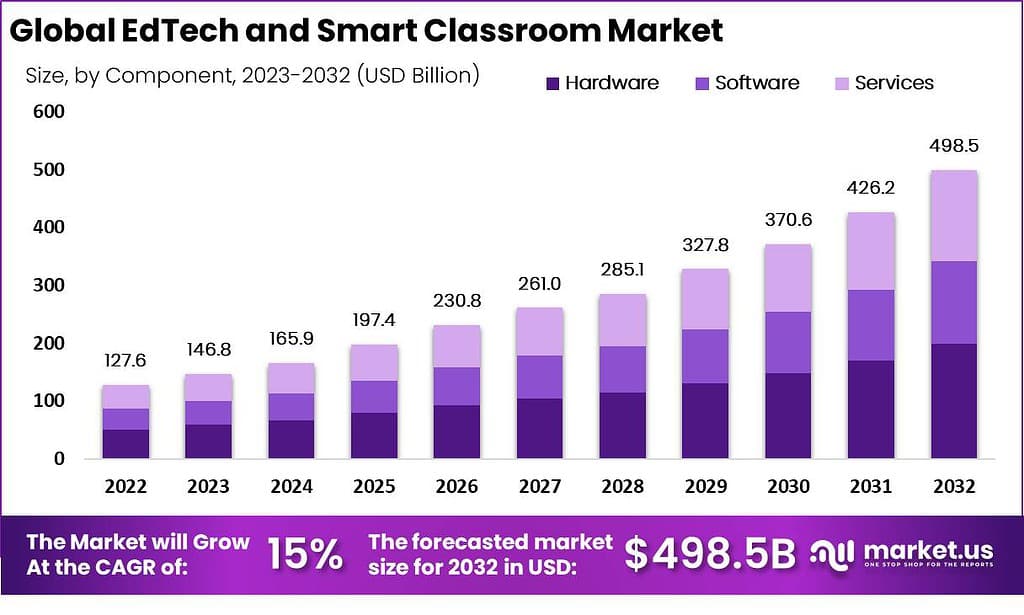
The global EdTech and Smart Classroom market is anticipated to be USD 498.5 billion by 2032. It is estimated to record a steady CAGR of 15% in the review period 2023 to 2032. It is likely to total USD 146.8 billion in 2023.
The EdTech and Smart Classroom Market comprises hardware (such as interactive displays and projectors), software solutions (including learning management systems and analytics tools), and services that facilitate connected, data-driven learning environments. Educational institutions are increasingly adopting these technologies to enhance instructional delivery, foster collaboration, and maintain continuity across onsite and remote settings.
Widespread internet accessibility, mobile device penetration, and cloud adoption have created a solid foundation for market expansion. The COVID-19 pandemic acted as a catalyst, accelerating digital integration in education systems globally and validating the effectiveness of digital learning. Concurrently, a shift toward lifelong learning and demand for personalized educational experiences have driven greater institutional and governmental investment.
The EdTech and smart classroom market is highly dynamic and competitive, with numerous companies offering a wide range of products and services. These include learning management systems, educational apps, virtual reality (VR) and augmented reality (AR) tools, online tutoring platforms, and content creation tools. Both established players and startups are innovating in this space, introducing new technologies and approaches to enhance teaching and learning outcomes.
According to Market.us, The Global Smart Classroom Market is projected to grow significantly, reaching a value of around USD 302.19 billion by 2034, rising from USD 83.69 billion in 2024, and expanding at a CAGR of 7.9% over the forecast period from 2025 to 2034. In 2024, North America emerged as the leading regional market, accounting for more than 34% of the global share and generating approximately USD 28.45 billion in revenue.
Key Takeaways
- Market Size and Growth: The global EdTech and Smart Classroom market is projected to reach USD 498.5 billion by 2032, with a steady CAGR of 15% from 2022 to 2032.
- 86% of teachers find using EdTech in the classroom important or essential.
- 96% of teachers believe EdTech boosts student engagement.
- 81% of college students say digital learning tech helped improve their grades.
- EdTech engagement belief is high, with 96% of teachers seeing increased student interest.
- Over 1.5 billion students worldwide were affected by COVID-19 school closures, leading to more EdTech use.
- Google Classroom boasts over 100 million users globally.
- The U.S. has spent more than $7 billion on devices and internet for remote learning.
- Smart classrooms with interactive tools are on the rise.
- In the UK, over 60% of teachers utilize EdTech apps and resources.
- Hardware Dominance: Hardware components, such as interactive displays, projectors, tablets, and audio systems, hold the largest market share in the EdTech and smart classroom market. These devices are crucial for creating technology-enabled learning spaces.
- Cloud-Based Deployment: Cloud-based deployment is the most popular choice in the market, offering easy access to educational resources, scalability, and flexibility for educational institutions.
- Higher Education Emphasis: The higher education sector is a significant driver of the EdTech market due to the increasing demand for advanced teaching tools and online education. Smart classrooms enhance traditional and online learning experiences.
- Digital Transformation: The digital transformation in education is a key driver, emphasizing technology integration for curriculum development, instructional delivery, and administrative processes.
- Privacy Concerns: Privacy and data security concerns are significant challenges in the EdTech market, particularly regarding the collection and handling of sensitive student and teacher data.
- Global Expansion Opportunity: The market presents an opportunity for global expansion, with the rise of remote learning and online education creating new market potential in different regions.
- Geopolitical and Recession Impact: Geopolitical factors, such as trade relations and regulations, can influence the market. Economic challenges may lead to increased demand for cost-effective online learning solutions.
- Regional Analysis: North America leads the market with a dominant share due to robust infrastructure, investment in educational technology, and a receptive culture for technological innovations in education.
- Key Market Players: Prominent companies in the market include Apple Inc., Google, Microsoft, Blackboard Inc., Coursera, Udemy, Adobe, and others.
By Component Analysis
In the EdTech and smart classroom market, the hardware segment holds the largest market share. The hardware component encompasses the physical devices and equipment used in smart classrooms, such as interactive displays, projectors, tablets, laptops, audio systems, cameras, and networking infrastructure.
There are several reasons for the dominance of the hardware segment in the market. Firstly, the adoption of smart classroom technologies requires the deployment of various hardware devices to create an interactive and engaging learning environment. Interactive displays and projectors enable teachers to deliver content in a visually appealing and interactive manner. Tablets and laptops provide students with access to digital resources, collaborative tools, and learning applications. Audio systems enhance the audio experience, ensuring clear communication and immersive multimedia content delivery. These hardware components form the foundation of smart classrooms and are essential for creating a technology-enabled learning space.
Secondly, the hardware segment typically involves higher upfront costs compared to software or services. Educational institutions and organizations investing in smart classrooms often allocate a significant portion of their budget to acquire the necessary hardware infrastructure. As a result, the hardware segment captures a substantial share of the market revenue.
Furthermore, the advancements in hardware technologies have contributed to the growth of the hardware segment. Manufacturers are continuously innovating to develop more advanced and feature-rich devices specifically designed for educational settings. These devices incorporate interactive touchscreens, wireless connectivity, high-resolution displays, and ergonomic designs to enhance the learning experience. The availability of a wide range of hardware options and the constant evolution of hardware technologies further drive the market growth of this segment.
By Deployment Mode Analysis
The cloud-based deployment segment holds the largest market share in the global EdTech and smart classroom market when considering deployment mode analysis. Cloud-based deployment has become increasingly popular due to its numerous advantages and benefits for educational institutions
Cloud-based solutions provide easy access to educational resources and tools from any location and at any time. Users can access learning materials, collaborate with peers, and engage in interactive activities through the cloud platform using their devices.
Cloud-based deployment offers scalability, allowing educational institutions to easily scale their infrastructure and resources as needed. This flexibility enables institutions to accommodate a growing number of users and students without significant infrastructure investments.
By End-User Analysis
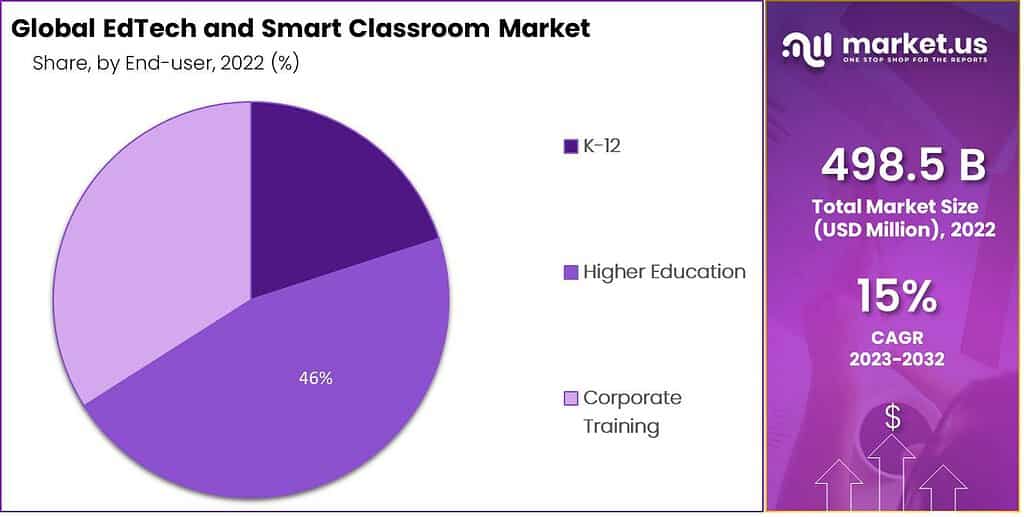
The higher education sector has been a significant driver in the growth of the educational technology (EdTech) and smart classrooms market. With the increasing demand for advanced teaching and learning tools, higher education institutions have embraced technology to enhance the classroom experience and improve educational outcomes.
One of the key factors contributing to the higher education sector’s dominant market share is the growing emphasis on digital learning and online education. Universities and colleges are increasingly offering online courses and degree programs to cater to the rising demand for flexible and accessible education. EdTech solutions and smart classrooms play a crucial role in facilitating online learning by providing interactive and engaging digital platforms for students and teachers.
Moreover, higher education institutions are recognizing the benefits of incorporating technology into traditional classroom settings. Smart classrooms equipped with interactive whiteboards, digital projectors, and audio-visual systems enable educators to deliver dynamic and multimedia-rich lessons. These technologies promote active learning, collaboration, and student engagement, thereby enhancing the overall learning experience.
Additionally, the higher education sector’s market dominance can be attributed to the need for efficient administrative systems and processes. EdTech solutions offer various tools and platforms for student management, course administration, grading systems, and other administrative tasks. These technologies streamline administrative workflows, reduce paperwork, and enhance operational efficiency in higher education institutions.
Key Market Segments
Component
- Hardware
- Interactive Displays
- Interactive Projectors
- Others
- Software
- Learning Management Systems (LMS)
- Student Information Systems (SIS)
- Classroom Management Systems (CMS)
- Others
- Services
Deployment Mode
- Cloud-based
- On-premise
End-User
- K-12
- Higher Education
- Corporate Training
Driving Factor
Digital Transformation in Education
One of the significant drivers in the EdTech and smart classrooms market is the ongoing digital transformation in education. The increasing recognition of the potential benefits of technology in enhancing teaching and learning experiences has led to a surge in the adoption of EdTech solutions. Digital transformation in education involves the integration of technology into various aspects of the education ecosystem, including curriculum development, instructional delivery, student assessment, and administrative processes.
This driver is fueled by the desire to improve educational outcomes, increase accessibility and flexibility, and prepare students for the digital age. The transformation is driven by factors such as the need for personalized and adaptive learning, the demand for remote and online education, and the growing availability of digital resources and tools. The digital transformation in education is reshaping traditional educational practices and creating new opportunities for both educators and learners.
Restraining Factor
Privacy and Data Security Concerns
Privacy and data security concerns present a significant restraint in the EdTech and smart classrooms market. As educational institutions increasingly rely on technology and data-driven solutions, there is a growing concern about the privacy and security of student and teacher data. EdTech solutions often collect and store sensitive personal information, including student records, assessment data, and learning analytics. The improper handling or unauthorized access to this data can lead to privacy breaches, identity theft, or misuse of personal information.
Additionally, the use of cloud-based platforms and online learning systems raises concerns about data security and the potential for data breaches. These concerns are particularly relevant in educational settings where children and young adults are involved. Ensuring robust data protection measures, complying with privacy regulations, and fostering a culture of data security are essential to address these concerns and build trust in the use of EdTech solutions.
Opportunity
Global Expansion and Market Penetration
The EdTech and smart classrooms market presents a significant opportunity for global expansion and market penetration. With advancements in technology and the increasing demand for digital learning solutions, there is a growing market potential across different regions and countries. EdTech companies and providers have the opportunity to expand their reach and tap into new markets by offering localized and culturally relevant educational solutions. This expansion can be facilitated by adapting the content, language, and instructional approaches to cater to specific regional needs.
Additionally, the rise of remote learning and online education has further opened up opportunities for global market penetration. EdTech companies can leverage digital platforms and online delivery models to reach a wider audience and overcome geographical barriers. The global expansion and market penetration opportunity provide a pathway for EdTech providers to scale their operations, increase their user base, and contribute to the democratization of education worldwide.
Challenge
Adapting to Changing Learning Environments
A significant challenge in the EdTech and smart classrooms market is the need to adapt to changing learning environments. The traditional classroom model is evolving rapidly, driven by factors such as the COVID-19 pandemic, remote learning, hybrid learning models, and the increasing emphasis on lifelong learning. EdTech solutions need to be flexible and adaptable to cater to these evolving learning environments. This challenge includes addressing issues such as the digital divide, ensuring equitable access to technology and internet connectivity, and developing inclusive solutions that accommodate diverse learning needs and preferences.
Additionally, as learning becomes more learner-centered and personalized, EdTech providers face the challenge of creating highly customizable and interactive platforms that can meet individual learner requirements. Adapting to changing learning environments requires continuous innovation, collaboration with educators and stakeholders, and a deep understanding of the evolving needs and expectations of learners in a rapidly changing educational landscape.
Geopolitical and Recession Impact Analysis
Geopolitical Impact:
- Trade Relations: Trade policies and agreements between countries can influence the export and import of edtech tools and services. For instance, tariffs or sanctions on edtech goods can make technology more expensive and less accessible to certain countries or regions.
- Regulatory Environment: Different countries have diverse regulations regarding data privacy, online content, and technology standards. These regulations can affect the deployment and adoption of certain edtech tools, especially those that collect or disseminate student information.
- Infrastructure and Investment: Geopolitical priorities can shape where and how infrastructure, like internet connectivity, is developed. Countries prioritizing digital infrastructure will likely see a faster adoption of smart classroom technologies.
Recession Impact:
- Budget Cuts: Educational institutions might face reduced funding, leading to decreased investments in new technologies, infrastructure, and professional development.
- Increased Demand for Affordable Solutions: While high-end solutions might see a decline in sales, there might be a surge in demand for cost-effective and scalable solutions, such as open-source software or budget-friendly hardware.
- Growth in Online Learning: Economic challenges can increase the number of individuals seeking online education, as it often offers a more affordable and flexible alternative to traditional learning. This could lead to an uptick in demand for Learning Management Systems and other online learning tools.
Regional Analysis
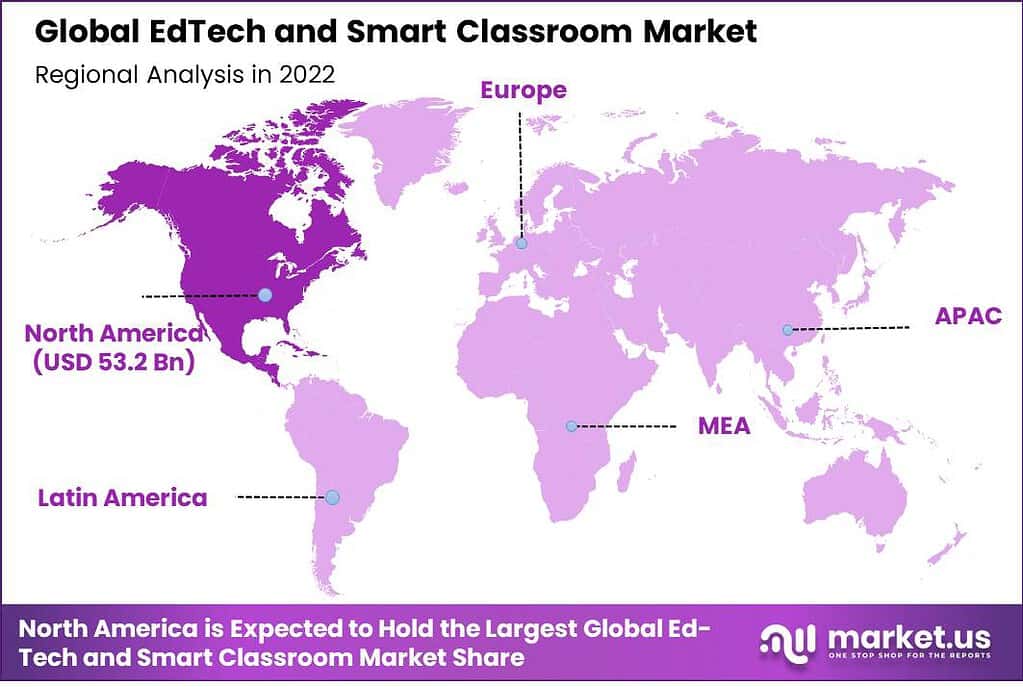
In 2022, North America is commanding, capturing the largest market share of 41.7%. This dominant role is largely attributable to several factors, including robust infrastructure, significant investment in educational technology, and a culture generally more receptive to adopting technological innovations in educational settings.
Moreover, many key players in the EdTech industry based in North America add to the region’s capacity to drive technological advancements in smart classrooms. High smartphone and internet penetration rates, as well as government initiatives aimed at digitalizing educational institutions, have further catalyzed the growth of the EdTech and Smart Classroom Market in North America. By leading in this market, North America not only sets trends but also influences the strategies of key stakeholders, including educational institutions, technology providers, and policymakers, on a global scale.
Key Regions and Countries Covered in this Report
- North America
- The US
- Canada
- Europe
- Germany
- France
- The UK
- Spain
- Italy
- Russia
- Netherland
- Rest of Europe
- APAC
- China
- Japan
- South Korea
- India
- Australia
- New Zealand
- Singapore
- Thailand
- Vietnam
- Rest of APAC
- Latin America
- Brazil
- Mexico
- Rest of Latin America
- Middle East & Africa
- South Africa
- Saudi Arabia
- UAE
- Rest of MEA
Key Player Analysis
The EdTech and Smart Classroom market is rapidly evolving, with several key players vying for dominance. The market share within this industry is constantly shifting as technology and educational needs change. A few prominent companies were leading the way. These included companies like Google with its G Suite for Education, Microsoft’s Office 365 for Education, and education-specific platforms like Canvas by Instructure and Blackboard.
Additionally, innovative startups such as Coursera, edX, and Khan Academy were making significant strides in online education. The COVID-19 pandemic has further accelerated the adoption of EdTech and smart classroom solutions, with more players entering the scene. The future of this market likely depends on factors like continued technological advancements, adaptability to changing educational models, and affordability, making it a dynamic and competitive space to watch.
Top Market Leaders
- Apple Inc.
- Microsoft
- Blackboard Inc.
- Coursera
- Udemy
- Adobe
- Instructure
- Moodle
- Pearson
- Promethean World
- SMART Technologies
- Kahoot!
- Top Hat
- BYJU’s
- Other Key Players
Recent Developments
1. Apple:
- March 2023: Launched iOS 16.3 update with Classroom App improvements, including live collaboration features, streamlined screen sharing, and enhanced student participation tools.
- August 2023: Unveiled “Reality Composer,” a new iPad app for creating augmented reality (AR) experiences, potentially enabling AR integration in future educational content.
2. Google:
- January 2023: Announced the beta launch of “Immersive Stream for Education,” enabling educators to create and share virtual field trips and immersive learning experiences.
- October 2023: Partnered with Samsung to bring “Chromebooks Enterprise” to more schools, offering enhanced device management and security features for classroom environments.
3. Microsoft:
- April 2023: Released “Minecraft: Education Edition” update with new features like “Creative Construction Sets” and “Chemistry Classroom Lab” for interactive learning experiences.
- September 2023: Acquired “Mentimeter,” a real-time polling and presentation platform, expanding its engagement tools for classrooms and educational settings.









