


Report Overview
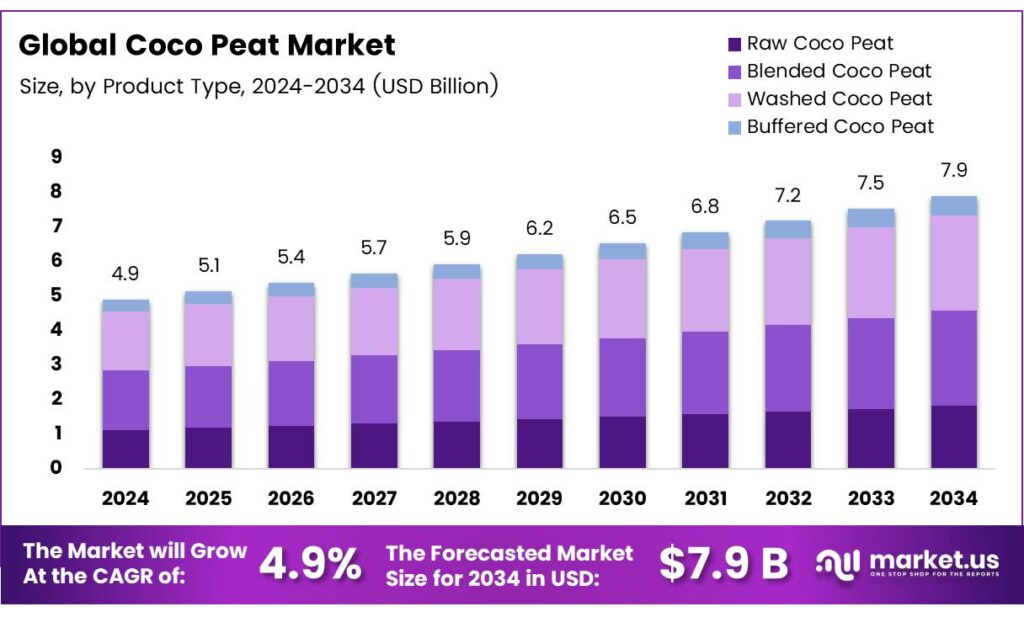
The Global Coco Peat Market size is expected to be worth around USD 7.9 billion by 2034, from USD 4.9 billion in 2024, growing at a CAGR of 4.9% during the forecast period from 2025 to 2034.
Coco Peat is the non-fibrous, spongy, lightweight, corky material that binds coir fiber within the coconut husk. Its demand has surged ever since. Known globally as Coco Peat, it is called Coco Coir in the US and Coir Pith in the Middle East. Once a mere by-product of coconut fiber extraction, Coco Peat is now a valued co-product. This 100% organic, natural, and biodegradable substance originates from coconut husks, making it a renewable alternative to peat moss.
Coco Peat boasts high moisture retention, holding up to 800% of its dry weight in water. Its cation exchange capacity ranges from 20 to 30 meq/100g, enhancing nutrient availability. It improves soil aeration, allowing roots to breathe freely. With a pH of 5.2 to 6.8, Coco Peat is neutral to slightly acidic, ideal for mixing with alkaline soils. It buffers pH variations effectively. Its spongy texture stores and releases nutrients on demand, supporting plant growth.
Coco peat excels in water retention, holding up to eight times its weight in moisture. This ensures plants receive consistent hydration, unlike traditional soil that dries quickly. Ideal for hot climates, it maintains a damp environment for reliable growth. Gardeners and farmers benefit from reduced watering needs and easier maintenance. A Journal of Plant Nutrition study shows 30% less watering compared to conventional soil.
As a renewable byproduct of coconut husks, coco peat offers a sustainable alternative to peat moss. It reduces waste, promotes circular agriculture, and avoids habitat loss from peat bogs. Environmentally, it supports eco-friendly practices with significant carbon savings. The International Journal of Environmental Science reports up to 40% lower emissions. Thus, coco peat combines high performance with responsible, conscious cultivation.
Key Takeaways
- The Global Coco Peat Market is projected to grow from USD 4.9 billion in 2024 to USD 7.9 billion by 2034 at a CAGR of 4.9%.
- Washed Coco Peat dominated the By Form segment in 2024 with 34.9% market share due to its low salt content and suitability for plant health.
- Coco Peat Blocks led the By Product Type segment in 2024 with 39.7% share, favored for easy storage, quick rehydration, and minimal waste.
- Horticulture and Floriculture held the largest By Application segment in 2024 with 38.4% share, driven by excellent drainage and pH balance.
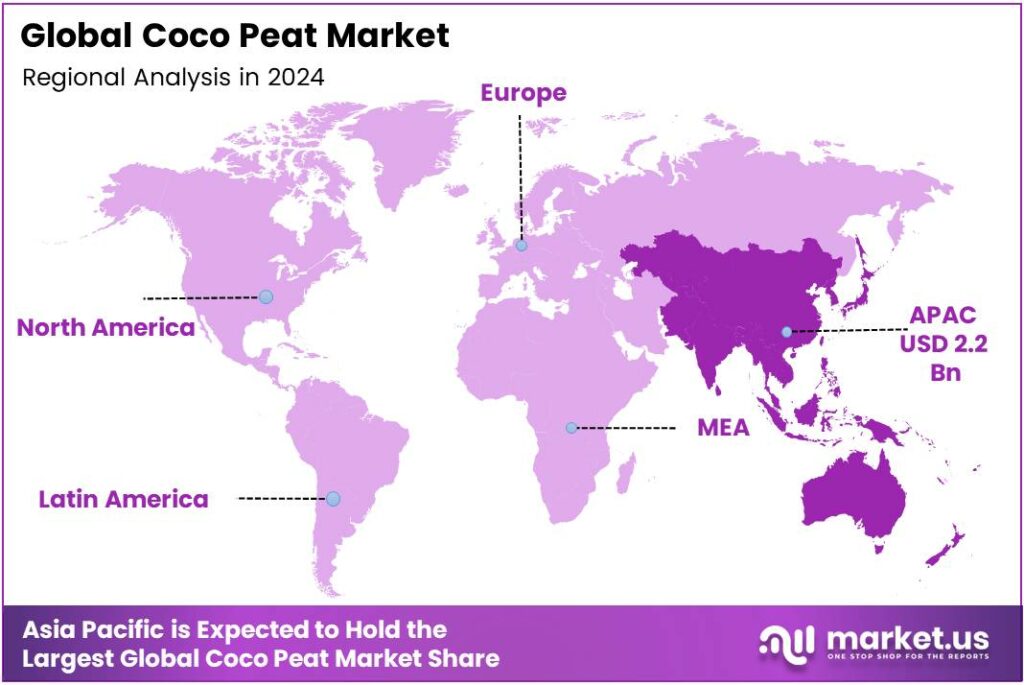
- Asia-Pacific commanded 44.9% of the global market in 2024, valued at USD 2.2 billion, led by major coconut-producing countries like India and Sri Lanka.
By Form Analysis
Washed Coco Peat dominates with 34.9% due to its superior purity and ease of use in various applications.
In 2024, Washed Coco Peat held a dominant market position in the By Form Analysis segment of the Coco Peat Market, with a 34.9% share. This sub-segment thrives because it undergoes thorough cleaning, removing excess salts and impurities. Consequently, growers prefer it for optimal plant health. Its versatility boosts adoption in professional setups, driving substantial revenue growth.
Raw Coco Peat emerges as a cost-effective option in the Coco Peat Market. It retains natural fibers, appealing to budget-conscious users. Although it requires more preparation, its abundance ensures steady demand. Thus, it supports large-scale farming efficiently, contributing to market expansion through affordability.
Blended Coco Peat gains traction by combining Coco Peat with other substrates. This innovation enhances water retention and nutrient delivery. As a result, it suits diverse soil needs, attracting innovative gardeners. Overall, it fosters sustainable practices, steadily increasing its presence in the evolving market.
By Product Type
Coco Peat Blocks dominate with 39.7% due to their compact design and convenient handling for global shipping.
In 2024, Coco Peat Blocks held a dominant market position in the By Product Type Analysis segment of the Coco Peat Market, with a 39.7% share. These blocks offer easy storage and quick rehydration, simplifying usage for commercial growers. Their durability ensures minimal waste, propelling widespread acceptance. Hence, they lead in efficiency and practicality.
Coco Peat Bricks provide a versatile alternative in the Coco Peat Market. Shaped for straightforward breakdown, they integrate seamlessly into potting mixes. This feature appeals to small-scale users, enhancing soil aeration. Consequently, bricks promote healthy root development, bolstering their role in everyday gardening tasks.
Coco Peat Powder stands out for its fine texture in the Coco Peat Market. It mixes effortlessly, ideal for seed starting and mulching. This sub-segment excels in precision applications, reducing clumping issues. Thus, it empowers hobbyists and pros alike, driving innovation in fine-tuned cultivation methods.
By Application
Horticulture and Floriculture dominate with 38.4% due to rising demand for high-quality growing media in commercial greenhouses.
In 2024, Horticulture and Floriculture held a dominant market position in the By Application Analysis segment of the Coco Peat Market, with a 38.4% share. This sector leverages coco peat’s excellent drainage and pH balance for vibrant blooms. Commercial operations scale up production effortlessly, fueling economic growth. As a result, it anchors the market’s core demand.
Agriculture utilizes coco peat extensively for field crops in the Coco Peat Market. It improves soil structure, combating erosion effectively. Farmers adopt it to boost yields sustainably, especially in arid regions. Therefore, this application drives long-term soil health, supporting global food security initiatives.
Home Gardening flourishes with Coco Peat’s accessibility in the Coco Peat Market. Enthusiasts create custom mixes for balconies and indoors, fostering urban greenery. Its eco-friendly nature encourages DIY projects, enhancing personal harvests. Thus, it democratizes gardening, sparking widespread hobbyist engagement.
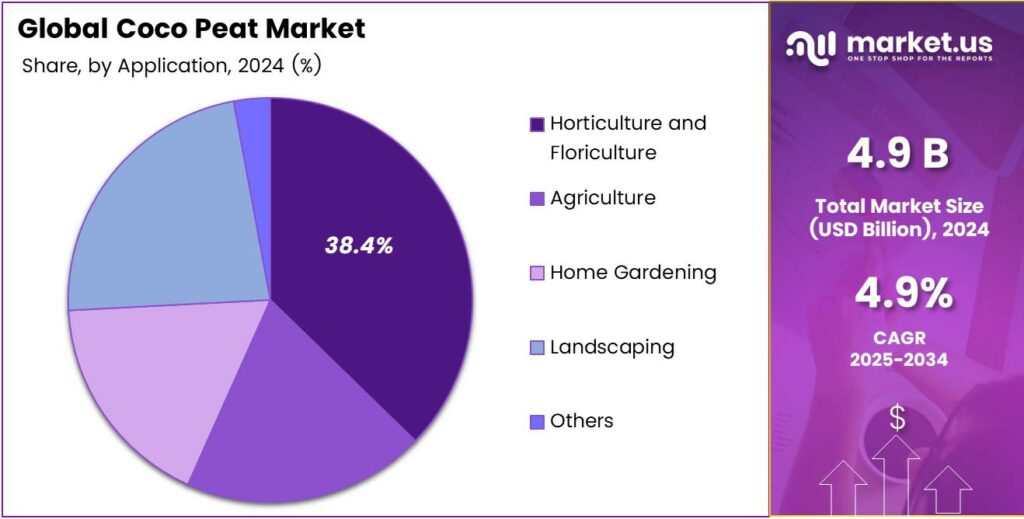
Key Market Segments
By Form
- Washed Coco Peat
- Raw Coco Peat
- Blended Coco Peat
- Buffered Coco Peat
By Product Type
- Coco Peat Blocks
- Coco Peat Bricks
- Coco Peat Powder
- Blended Coco Peat
By Application
- Horticulture and Floriculture
- Agriculture
- Home Gardening
- Landscaping
- Others
Emerging Trends
Shift to Peat-Free Growing Media
- The Food and Agriculture Organization of the United Nations (FAO) estimates global coconut production was approximately 62 million tonnes in 2019, generating around 20 million tonnes of husks and a theoretical potential of 6million tonnes of coir raw material (including coco pith) from those husks.
Government-backed agencies and research bodies are supporting this transition — for instance, India’s Coir Board has been promoting value-added uses of coir pith (which is coco peat) alongside fibre extraction. In simple terms, more people are choosing coco peat because it supports water-efficient and eco-friendly growing, and there is enough untapped husk raw material to scale up production. This creates a virtuous circle of resource use, environment, and agriculture.
Drivers
Urban Farming & Soilless Systems Drive Coco Peat Use
The rise of urban farming, vertical farming, and hydroponics is helping push the adoption of coco peat. Many soilless systems demand substrates that are lightweight, pathogen-free, and have reliable water- and air-holding capacity. Coco peat ticks those boxes. Coco peat can hold up to 8–9 times its weight in water.
- Beyond the technical properties, the supply chain supports scalability: globally, about 1.26 million tonnes of coir (the fibre and pith) were produced in 2019, with India alone contributing about 518,000 tonnes. Government and institutional initiatives are also aiding this driver.
The Indian government, through the Coir Board, has schemes like the Coir Udyami Yojana to support small units to process coir and coir by-products (including coco peat) into value-added items. From a human-perspective: imagine an urban gardener in Mumbai, strapped for space but eager to grow veggies on a terrace.
Restraints
Raw Material Utilisation Constraints Limit Coco Peat Growth
- Despite its promise, coco peat faces a restraint in that a large amount of the raw material (coconut husk) remains under-utilised, and quality standards are inconsistent. The FAO indicates that while coconut husks are widely available (35% of total coconut weight), only a fraction is processed into coir and by-products. For instance, coir production in 2017 was 995,000 tonnes and projected to reach 1,170,000 tonnes by 2027 — demonstrating growth but also showing a substantial gap versus the theoretical potential.
In India, for example, only about 40% of available husk feedstock is being used in the coir industry. This means the coco peat supply is constrained by how efficiently the husks are collected, processed, and converted. Quality is another issue. The performance of coco peat as a substrate depends on properties like electrical conductivity (salinity), pH, wash-out of salts, buffering, etc. Research shows variation across sources.
On the social side, much of the raw material collection and initial processing is rural, small-holder, and labour-intensive. If supply logistics, mechanisation, or modernisation lag, processing costs remain high, and some husk simply goes to waste (or is burned). Municipal waste reports indicate that the collection of coconut husk is often mixed with other waste and thus contaminated, reducing its suitability for high-quality substrate production.
Opportunity
Value-Added By-Products & Diversification
There’s an opportunity for coco peat not just as a growing medium, but as part of a broader value-added ecosystem centred on coconut husk and coir by-products. Given that only a portion of husk is currently used, scaling value-added uses can unlock new revenue streams for farmers, processors, and the broader industry. Research notes that the husk comprises 35% of the coconut weight, and of that, about 30% is coir fibre — meaning large volumes of pith are available for further processing.
- Indian policy supports this opportunity: the Coir Board and MSME ministry promote schemes such as the Coir Udyami Yojana (for credit-linked subsidy up to Rs 10 lakhs) for setting up units that produce coir and coir by-products. Moreover, the Tamil Nadu Coir Policy 2024 mentions plans to increase husk utilisation to 60% of production.
Given environmental trends (peat reduction, sustainable inputs) and government support, businesses that invest in processing and value addition of coco peat stand to benefit. In effect, it’s one more way to turn agricultural waste into clean-growth opportunities — good for rural livelihoods, good for sustainability, and good for growers seeking sustainable media.
Regional Analysis
Asia-Pacific leads with a 44.9% share and a USD 2.2 Billion market value.
In 2024, Asia-Pacific dominated the global coco peat market with a commanding 44.9% share, valued at USD 2.2 billion, supported by its large-scale coconut cultivation and well-established coir-processing industries. Countries such as India, Sri Lanka, Indonesia, the Philippines, and Vietnam play central roles, supplying the majority of global coco peat exports.
India remains the largest producer and exporter, contributing around 35% of global supply, driven by initiatives from the Coir Board of India and the Ministry of MSME to promote coir-based value addition and sustainable product diversification. The region’s extensive availability of coconut husks ensures a steady raw material base, while growing awareness about eco-friendly and renewable soil substitutes enhances market penetration.
Increasing adoption of hydroponics, floriculture, and greenhouse cultivation is fueling regional consumption, as coco peat’s high water-holding capacity and biodegradability align with sustainability goals. Countries like Thailand and Malaysia are witnessing strong adoption in controlled-environment agriculture. Furthermore, Asia-Pacific benefits from rising export demand from Europe and North America, where environmental regulations discourage peat moss extraction.
Asia-Pacific’s dominance is underpinned by abundant resources, policy support, and expanding sustainable farming practices. With ongoing investments in mechanized coir processing, quality standardization, and export capacity, the region is projected to sustain its leadership through 2034, consolidating its position as the global hub for coco peat production and export within the circular and green agriculture value chain.
Key Regions and Countries
- North America
- US
- Canada
- Europe
- Germany
- France
- The UK
- Spain
- Italy
- Rest of Europe
- Asia Pacific
- China
- Japan
- South Korea
- India
- Australia
- Rest of APAC
- Latin America
- Brazil
- Mexico
- Rest of Latin America
- Middle East & Africa
- GCC
- South Africa
- Rest of MEA
Key Players Analysis
Pelemix is a global leader specializing in high-performance, ready-to-use coco peat substrates and growing media. Their strength lies in rigorous scientific research, quality control, and tailored solutions for professional horticulture, including greenhouse and hydroponic systems. By offering consistent, buffered, and enhanced products, they cater to large-scale commercial growers seeking maximum yield and crop reliability, establishing a strong presence in demanding international markets.
Galuku International has established itself as a key supplier by controlling the supply chain from its source in Sri Lanka. They focus on producing premium, low-conductivity coco peat, coir pith, and chips, emphasizing sustainable and ethical manufacturing. Their direct control over raw material processing allows for high-quality, consistent products, making them a trusted partner for international distributors and agricultural businesses seeking reliable, bulk quantities of coir substrate.
Dutch Plantin boasts a formidable reputation for quality and scale. Based in the Netherlands and India, they produce a vast range of washed, buffered, and custom-blended coir products. Their expertise and large-volume capacity make them a primary supplier for European horticulture, garden centers, and soil manufacturers, serving both professional and retail markets with trusted, standardized substrates.
Top Key Players in the Market
- Pelemix
- Galuku International
- Dutch Plantin
- Samarasinghe Brothers
- CocoGreen
- Sai Cocopeat
- Kumaran Coirs
- Allwin Coir
- Dynamic International
- Benlion Coir Industries
Recent Developments
- In 2024, Pelemix participated in Fruit Attraction, showcasing its commitment to eco-friendly coco-peat solutions for strawberries and other crops, emphasizing the properties of coconut fiber for enhanced sustainability. Pelemix highlighted advancements in propagation technology, promoting coco fiber cubes as a superior, eco-friendly alternative to rockwool for plant propagation.
- In 2024, Galuku International, a Sri Lanka-based producer of coco peat and hydroponic substrates, emphasized its long-term expertise in value-added coconut products. The company continues to position itself as a global leader with over 25 years of experience in coir substrates, focusing on 100% organic hydroponic systems, such as grow bags and blocks, for erosion control and agricultural applications.









