


Report Overview
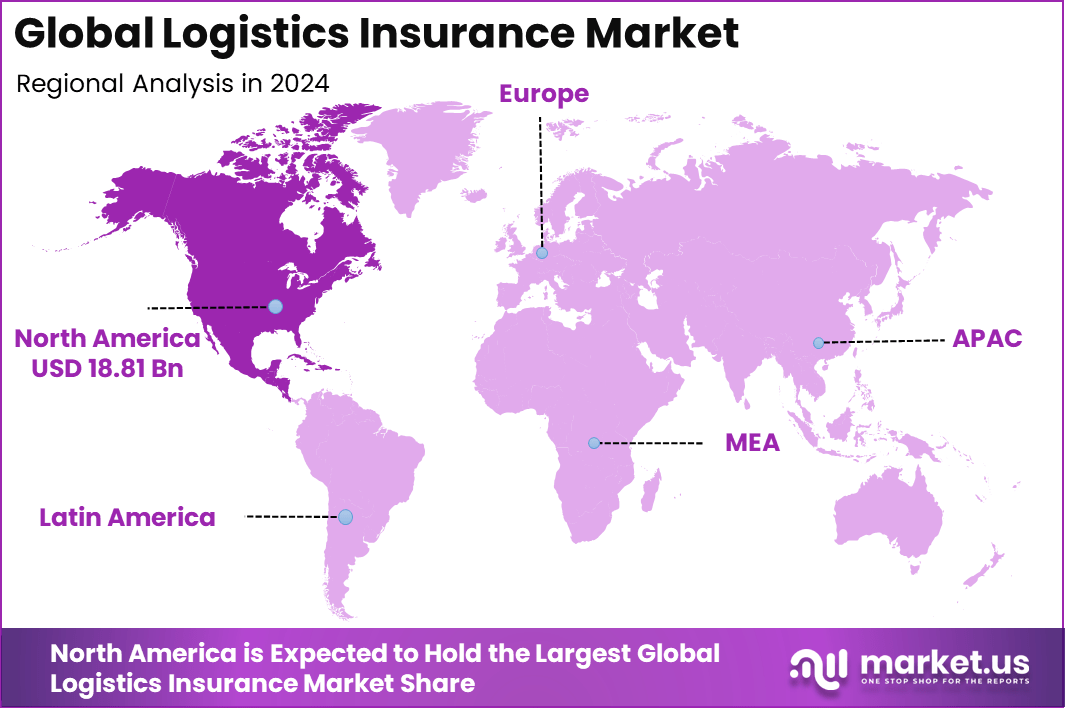
The Global Logistics Insurance Market size is expected to be worth around USD 92.18 billion by 2034, from USD 58.79 billion in 2024, growing at a CAGR of 4.6% during the forecast period from 2025 to 2034. In 2024, North America held a dominant market position, capturing more than a32% share, holding USD 18.81 billion in revenue.
The Logistics Insurance Market is increasingly recognized as essential for safeguarding goods in transit, warehousing, and distribution against a range of risks including damage, theft, delay and liability. This expertise-driven segment focuses on tailored insurance solutions and underpins the ability of businesses to maintain smooth supply chain operations. It is characterized by strong sector demand and a continued expansion in insurance product offerings that align with evolving logistics models.
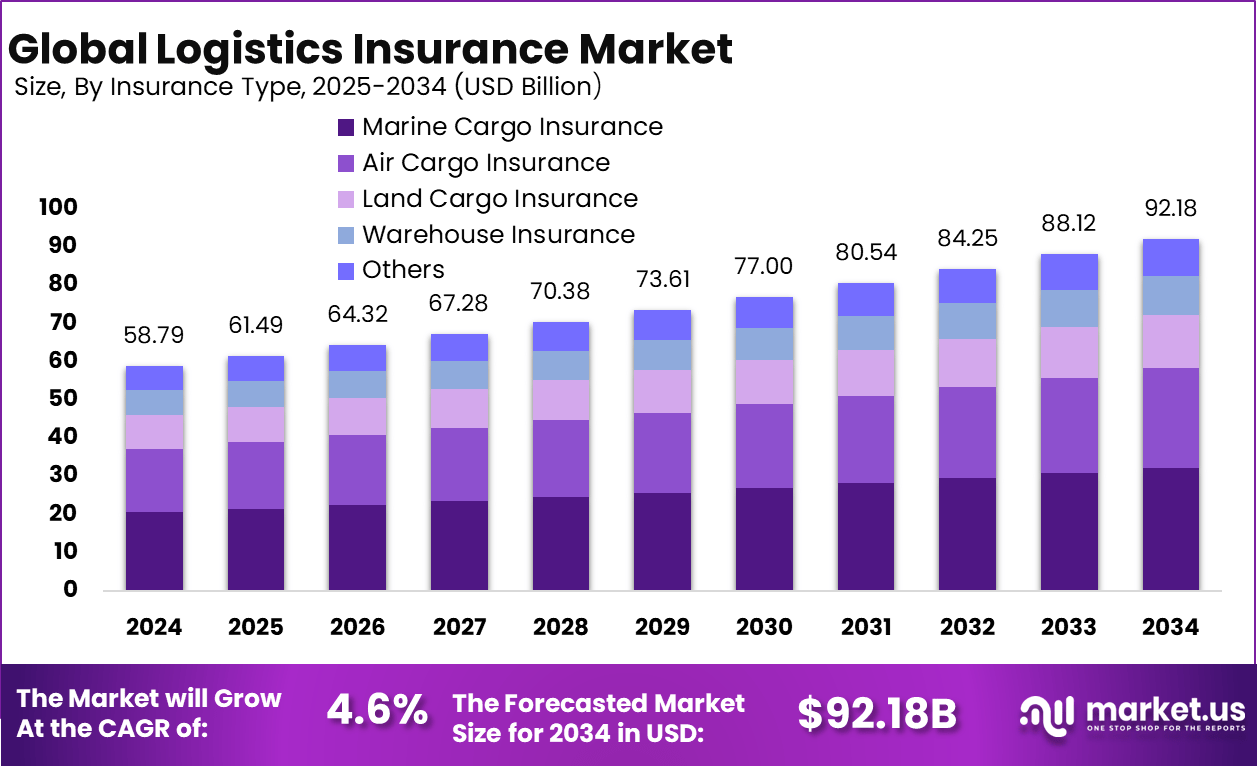
The Top Driving Factors behind market growth include expanding global trade, the e‑commerce boom, and increasingly complex, cross‑border supply chains. Economic growth fuels demand for logistics services, which in turn heightens exposure to risk and spurs the need for logistics insurance. Additionally, regulatory requirements in many regions mandate minimum coverage levels, further reinforcing uptake.
For instance, in June 2025, Cabrella announced a strategic partnership with Chit Chats to enhance shipping insurance solutions. This collaboration aims to provide better and more accessible insurance coverage for e-commerce businesses, helping them manage risks associated with shipping, particularly as the volume of cross-border transactions increases.
Demand analysis reveals a heightened awareness among transport operators and cargo owners regarding financial protection against disruptions. Annual policies have gained traction, while single‑trip and warehouse liability options cater to specific logistics needs. Sectors such as manufacturing, healthcare, and energy have increasingly integrated logistics insurance into their risk management strategies.
The Global AI in Insurance Market is projected to reach approximately USD 91 billion by 2033, rising from an estimated USD 5 billion in 2023, growing at a CAGR of 32.7% during the forecast period from 2024 to 2033. This strong growth is fueled by digital transformation, real-time risk analysis, and the use of AI in underwriting, fraud detection, and customer service.
The increasing adoption of technologies such as IoT, AI, blockchain, and telematics has been instrumental in transforming the industry. Real‑time tracking, sensor‑based monitoring, and predictive analytics enable more precise risk assessment and faster claims processing. Blockchain is also used to secure shipment records and automate indemnification through smart contracts.
Key Takeaway
- The market is projected to expand from USD 58.79 billion in 2024 to USD 92.18 billion by 2034, registering a steady CAGR of 4.6%, driven by rising global trade volumes and increased risk awareness in supply chain operations.
- North America led the market in 2024, securing over 32% share with revenue of approximately USD 18.81 billion. This dominance reflects the region’s robust logistics networks and high insurance penetration across transportation sectors.
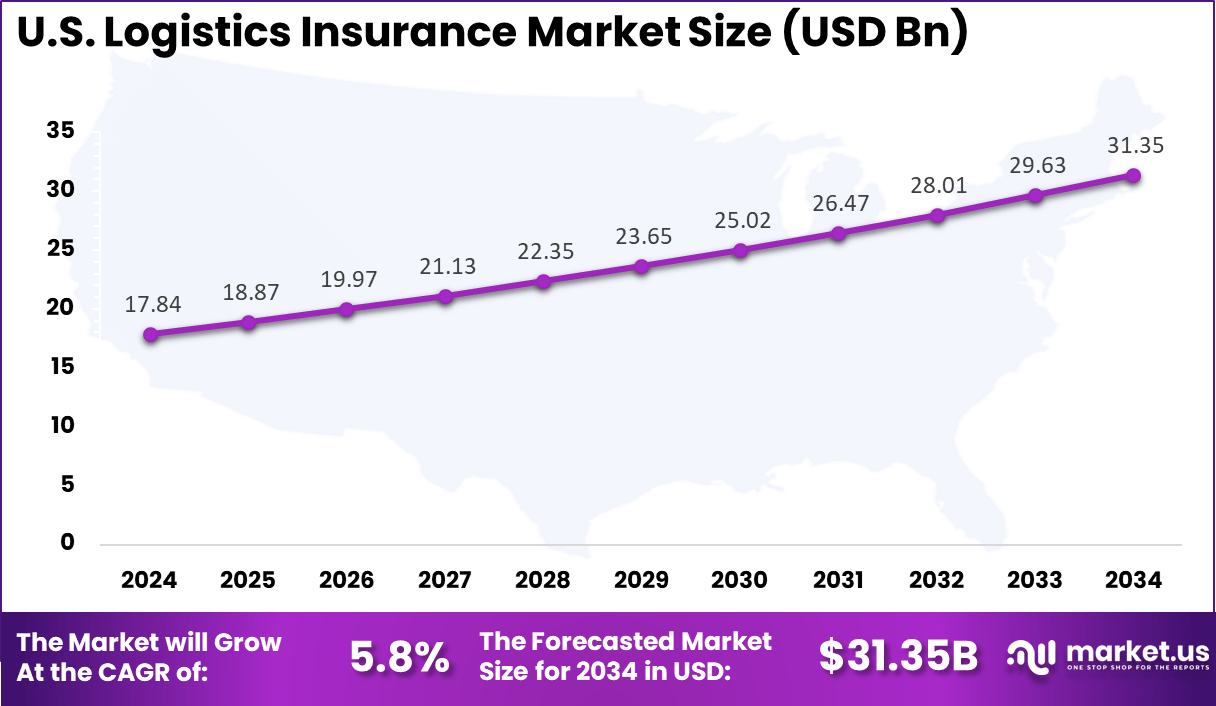
- The U.S. market alone contributed USD 17.84 billion in 2024 and is forecasted to grow at a CAGR of 5.8%, supported by expanding e-commerce, stricter freight liability regulations, and increased adoption of risk management practices.
- By insurance type, Marine Cargo Insurance held the top position with a 35% share, as ocean freight remains critical for international trade and requires comprehensive protection against damage, theft, and transit delays.
- In terms of coverage, All Risk Coverage was the preferred choice, capturing 38% of the market. Businesses increasingly opt for broader protection to guard against unpredictable losses in complex logistics chains.
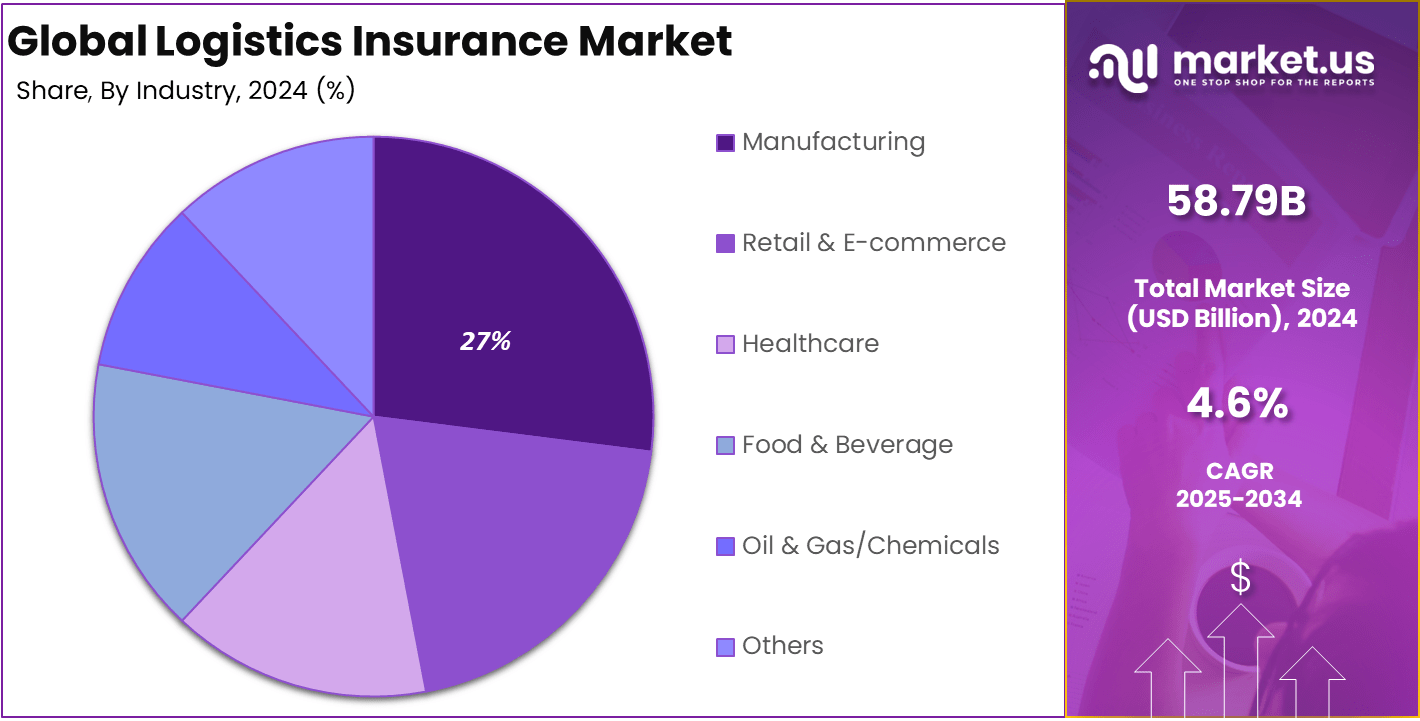
- The Manufacturing sector led all industries with a 27% share, reflecting its reliance on insured global supply networks for sourcing, distribution, and just-in-time delivery strategies.
U.S. Market Size
The market for Logistics Insurance within the U.S. is growing tremendously and is currently valued at USD 17.84 billion, the market has a projected CAGR of 5.8%. The U.S. logistics insurance market is growing rapidly due to the e-commerce boom, which has increased the volume of goods in transit and heightened risks of loss, theft, and damage.
This surge in demand for fast, reliable delivery drives the need for comprehensive coverage. Advancements in automation, real-time tracking, and digital transformation also play a key role in making logistics insurance more accessible and effective, enabling businesses to better manage risks and enhance operational resilience in an increasingly complex supply chain landscape.
For instance, in January 2025, Fortress Logistics Insurance Services LLC launched a new offering in the U.S., providing convenient and effective logistics insurance solutions. The company aims to simplify the process for businesses by offering expert-backed coverage tailored to the unique needs of logistics companies, helping them manage risks more effectively in an increasingly complex market.
In 2024, North America held a dominant market position in the Global Logistics Insurance Market, capturing more than a 32% share, holding USD 18.81 billion in revenue. This market is in a dominant position due to its strong logistics infrastructure, major industry players, and significant share in global trade and e-commerce.
The U.S. leads with its expansive transportation networks, advanced technologies like automation and AI, and a well-established insurance sector offering customized coverage. The rapid growth of online retail and the increasing demand for secure, efficient delivery solutions have further boosted the need for logistics insurance, solidifying North America’s market leadership.
For instance, in May 2024, Arta launched an embedded valuables insurance product in partnership with Chubb to expand its suite of consumer offerings in North America. This new product aims to provide tailored insurance solutions for high-value items, enhancing protection for consumers in logistics and transportation, and addressing the increasing demand for comprehensive coverage in the evolving marketplace.
Insurance Type Analysis
In 2024, Marine Cargo Insurance segment held a dominant market position, capturing a 35% share of the Global Logistics Insurance Market. This dominance is primarily due to the critical importance of international trade and the vast volumes of goods transported via sea routes, which expose shipments to a range of risks, including piracy, natural disasters, and accidents.
With the growing dependence of global supply networks on ocean transportation, companies are increasingly relying on marine cargo insurance to protect their products and economic interests, making this sector crucial for efficient global logistics.
For Instance, in January 2025, it was reported that importers will begin receiving digital marine cargo insurance starting in February 2025. This digital solution is expected to streamline the insurance process, making it more accessible and efficient for importers, while also addressing the growing demand for faster and more reliable logistics coverage in the evolving global market.
Coverage Type Analysis
In 2024, the All Risk Coverage segment held a dominant market position, capturing a 38% share of the Global Logistics Insurance Market. This sector has experienced growth primarily due to the increasing complexity of global supply chains and the need for comprehensive protection against various risks.
All risk coverage offers broader protection, covering almost all potential damages or losses during transit, making it highly attractive to businesses looking to safeguard their shipments against unexpected and diverse threats, such as accidents, theft, and natural disasters.
For instance, in June 2024, Dimerco addressed key questions surrounding All Risk Cargo Insurance, highlighting its importance in the logistics industry. All Risk Coverage is increasingly favored by businesses due to its comprehensive protection against a wide range of risks, including theft, damage, and unforeseen events during transit.
Industry Segment Analysis
In 2024, The Manufacturing segment held a dominant market position, capturing a 27% share of the Global Logistics Insurance Market. This dominance is due to the sector’s high demand for transportation of raw materials, parts, and final products through long and often complex supply chains.
Manufacturers require robust logistics insurance to protect against risks such as loss, damage, and delays, which can have substantial financial and operational impacts. Due to the growing interconnectivity of supply chains and the growth of global manufacturing operations, there is a need for comprehensive logistics insurance in this sector.
For instance, in October 2024, Policybazaar for Business launched Compass, a corporate insurance management platform aimed at simplifying and optimizing insurance coverage for businesses, including those in the manufacturing and logistics sectors. This platform is designed to help companies streamline their insurance management, ensuring more efficient risk coverage, particularly for industries with complex logistics and supply chain needs.
Key Market Segments
By Insurance Type
- Marine Cargo Insurance
- Air Cargo Insurance
- Land Cargo Insurance
- Warehouse Insurance
- Others
By Coverage Type
- All Risk Coverage
- Named Perils Coverage
- Total Loss Only
- Open Policy
- Others
By Industry
- Manufacturing
- Retail & E-commerce
- Healthcare
- Food & Beverage
- Oil & Gas/Chemicals
- Others
Key Regions and Countries
- North America
- US
- Canada
- Europe
- Germany
- France
- The UK
- Spain
- Italy
- Russia
- Netherlands
- Rest of Europe
- Asia Pacific
- China
- Japan
- South Korea
- India
- Australia
- Singapore
- Thailand
- Vietnam
- Rest of Latin America
- Latin America
- Brazil
- Mexico
- Rest of Latin America
- Middle East & Africa
- South Africa
- Saudi Arabia
- UAE
- Rest of MEA
Drivers
Growth in E-commerce and Online Shopping
Rapid growth in e-commerce and online shopping has led to a significant increase in the global shipping volume. As goods are increasingly transported over longer distances, the risk of loss, theft, or damage during transit has increased.
The surge in shipments has led to an increased demand for logistics insurance, as companies aim to protect their products and mitigate potential financial losses from these risks. Logistics insurance plays a crucial role in ensuring the smooth flow of goods, particularly in the e-commerce sector, where rapid delivery times are essential.
For instance, in March 2025, it was reported that Australia’s online shopping reached a record $69 billion in 2024. This surge in e-commerce activity has significantly increased the demand for efficient logistics solutions, including logistics insurance, as businesses strive to manage the growing volume of goods in transit. The rise in online retail is driving insurers to develop specialized products that cater to the evolving risks associated with fast, secure deliveries across the region.
Restraint
High Premium Costs
Several logistics providers face a significant financial burden due to insurance expenses, particularly in high-risk areas. Premiums in areas with high levels of political instability, widespread robbery, or vulnerability to natural disasters may be significantly higher.
Due to their inability to obtain extensive coverage, smaller logistics firms encounter challenges in dealing with this situation. Thus, such companies could struggle to secure adequate insurance, which exposes them to a variety of risks and hinders their ability to compete in the market.
For instance, in June 2025, it was reported that the ongoing Israel-Iran conflict is driving up marine insurance premiums, as insurers are increasingly invoking war coverage clauses. This geopolitical instability has heightened the risks associated with shipping in certain regions, leading to higher premiums for logistics companies operating in or near conflict zones.
Opportunities
Customized Insurance Products
Insurers are progressively utilizing data analytics, AI, and digital platforms to create customized and specialized insurance products that cater to the unique risk profiles of logistics companies. These tailored solutions allow for more accurate risk evaluation and pricing, providing clients with broader and more affordable coverage.
For instance, in May 2022, Allstate leveraged artificial intelligence (AI) to enhance its insurance services, focusing on improving customer experience and streamlining claims processing. The use of AI enabled Allstate to offer more personalized insurance policies, better risk assessment, and faster response times, making it more efficient in meeting the needs of customers.
Challenges
Supply Chain Disruptions
Supply chain disruptions caused by natural disasters, political instability, and unexpected events like pandemics have emerged as a major challenge for logistics insurers. These disruptions can elevate risk levels for logistics companies, making specific routes or regions harder to insure or resulting in higher premiums.
Insurers may be reluctant to provide coverage in such areas or may impose more stringent terms. This uncertainty complicates risk management for logistics providers and threatens the stability of global supply chains, which in turn impacts the broader logistics insurance market.
For instance, in April 2025, the trade tariffs implemented by the Trump administration significantly impacted supply chains and logistics insurance. These tariffs, particularly on imports from China, led to increased transportation costs and disruptions, creating greater uncertainty in global trade.
Latest Trends
The industry’s focus on sustainability and environmentally friendly logistics is being bolstered by increased awareness of the need for change. Enterprises are adopting measures like utilizing electric vehicles (EVs), transportation that is carbon-neutral, and packaging that minimizes environmental impact.
In addition, logistics companies are leveraging technology to improve efficiency and decrease emissions. This shift not only facilitates the alignment of businesses with global sustainability goals but also addresses the growing demand for environmentally friendly logistics options among consumers.
For instance, in March 2025, TERI and CONCOR signed an MOU to establish the CONCOR-TERI Centre of Excellence for Green and Sustainable Logistics. This initiative aims to promote environmentally friendly logistics practices and solutions, focusing on reducing carbon emissions and enhancing sustainability across the logistics sector.
Key Players Analysis
Prominent logistics insurance providers are making strategic investments to strengthen their market position and meet evolving customer demands. A significant focus has been placed on partnerships, mergers, acquisitions, and the launch of new, tailored insurance products. These moves are aimed at enhancing global reach, expanding service offerings, and integrating advanced technologies into operations.
Allianz SE, AXA XL, and Zurich Insurance Group are recognized as global leaders in logistics insurance. These firms maintain a strong foothold in marine, cargo, and freight liability coverage across developed markets. Their strengths lie in diversified product portfolios, strong reinsurance backing, and advanced risk assessment models
AIG, Chubb Ltd., and Tokio Marine Holdings hold significant market share due to their strategic regional expansions and industry-specific offerings. These companies are focusing on predictive analytics and automation to improve underwriting efficiency. They also provide integrated services such as loss prevention advisory and transit risk management.
The Travelers Companies, Munich Re, RSA Insurance Group, and Liberty Mutual Insurance, along with Atrium Underwriters at Lloyd’s, represent established insurers that cater to both large-scale freight providers and niche operators. Their underwriting expertise is supported by long-term relationships with logistics firms and brokers. They often specialize in high-risk or high-value shipments, offering tailored policies.
Top Key Players in the Market
- Allianz SE
- AXA XL (AXA Group)
- Zurich Insurance Group
- AIG (American International Group)
- Chubb Ltd.
- Tokio Marine Holdings
- The Travelers Companies, Inc.
- Munich Re
- RSA Insurance Group
- Liberty Mutual Insurance
- Atrium Underwriters (Lloyd’s)
- Others
Recent Developments
- In September 2024, Sompo International launched a new marine insurance proposition across the UK, aimed at enhancing the coverage options for maritime and logistics companies. This offering is designed to provide more tailored insurance solutions, addressing the complex risks associated with global trade and transportation.
- In November 2023, Insurlog and IXTS launched a new logistics insurance offering in Vietnam, aimed at addressing the growing demand for specialized coverage in the rapidly expanding logistics sector. This initiative is designed to provide tailored insurance solutions for logistics companies operating in the region, ensuring better risk management and operational resilience.









