


Report Overview
The Healthcare IT Consulting Market Size is forecasted to be valued at US$ 308.5 billion by 2034 from US$ 63.1 billion in 2024, growing at a CAGR of 17.2% during the forecast period 2025 to 2034.
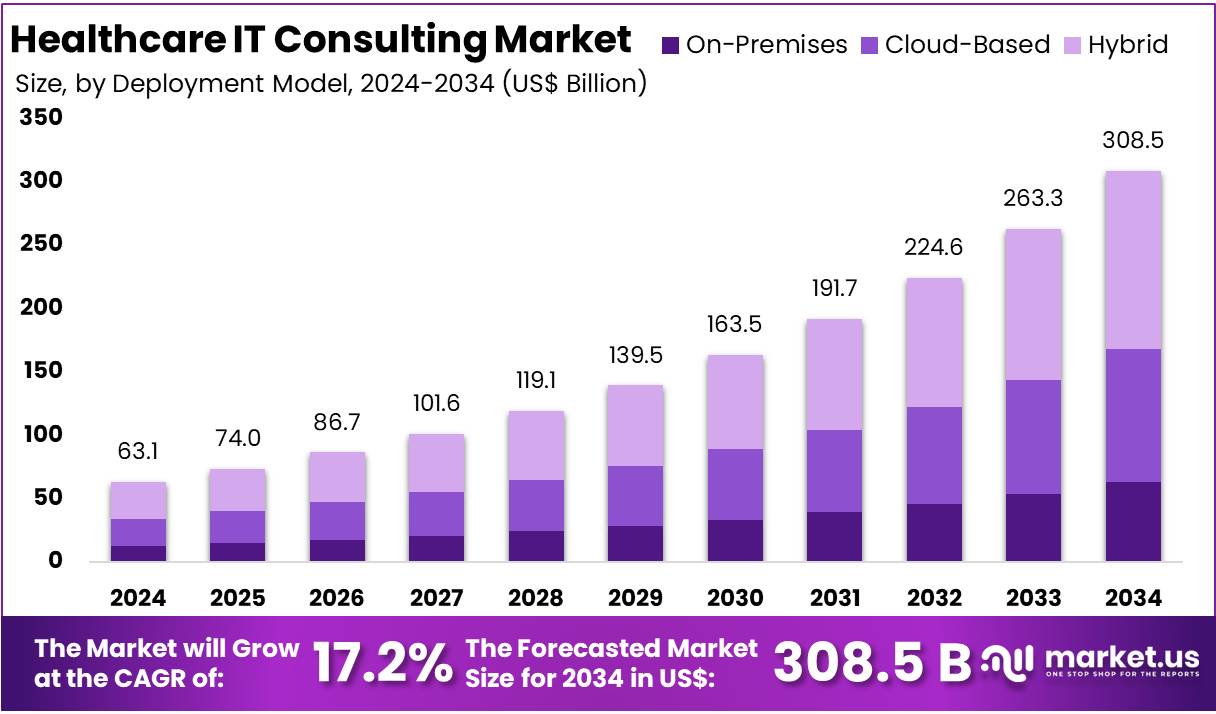
The healthcare IT consulting market has seen significant growth, driven by the widespread adoption of digital technologies within healthcare systems. This transformation is largely fueled by the need to improve efficiency, optimize patient care, and adhere to increasingly complex regulatory frameworks. With the healthcare sector becoming more digital, organizations are turning to specialized consulting firms for guidance on implementing technologies like Electronic Health Records (EHRs), cloud-based solutions, telemedicine platforms, and advanced data analytics.
As healthcare providers integrate these technologies into their operations, the role of IT consultants becomes critical in ensuring smooth transitions, compliance with regulations, and the effective use of new systems to enhance both administrative and clinical functions. One of the major drivers of this market is the increasing focus on patient-centered care, which relies heavily on the integration of information systems that allow for seamless data sharing and communication. For example, many healthcare providers are adopting AI-driven solutions to assist in diagnostic processes and improve decision-making in patient care. These technologies require expert implementation and ongoing optimization, which is where healthcare IT consulting services play a key role.
Additionally, the growing demand for telehealth services, spurred by the COVID-19 pandemic, has also amplified the need for IT consulting. As telemedicine becomes more integrated into routine care, healthcare providers are seeking specialized expertise to ensure they can deliver these services securely and efficiently. The rise in cyber threats targeting healthcare organizations is another key factor contributing to the demand for healthcare IT consulting.
With the increasing volume of patient data being digitized, the risk of data breaches and cyberattacks has escalated. This has led to heightened efforts around cybersecurity and risk management. Healthcare IT consultants are essential in helping organizations assess their vulnerabilities, implement robust security measures, and comply with data protection regulations, such as HIPAA in the U.S. The need for these services is expected to continue growing as healthcare organizations face ever-evolving security threats.
According to a report by the American Medical Association, practices that utilized IT consultants during the implementation of Electronic Health Records (EHR) experienced a significant 33% reduction in challenges compared to those that did not. This statistic highlights the crucial role that IT consultants play in ensuring a smooth transition to digital healthcare systems. One of the key advantages of EHR systems, as noted by the Institute of Medicine, is that they can reduce medication errors by as much as 55%, with IT consultants ensuring that systems are properly configured to flag drug interactions and other risks.
Despite the growth prospects, the healthcare IT consulting market faces several challenges. High implementation costs associated with adopting new technologies can be a significant barrier, particularly for smaller healthcare organizations with limited budgets. Additionally, the complexity of healthcare regulations across different regions can make it difficult for organizations to stay compliant while implementing new IT solutions. Resistance to change from healthcare professionals, who may be reluctant to adopt new technologies and workflows, is another challenge that consulting firms must navigate.
Key Takeaways
- In 2024, the market for healthcare IT consulting generated a revenue of US$ 63.1 billion, with a CAGR of 17.2%, and is expected to reach US$ 308.5 billion by the year 2034.
- By Type, Healthcare Business Process Management segment dominated the market with 26.3% share in 2024.
- Based on the deployment model segment, Hybrid held the largest revenue share of 45.4% in 2024.
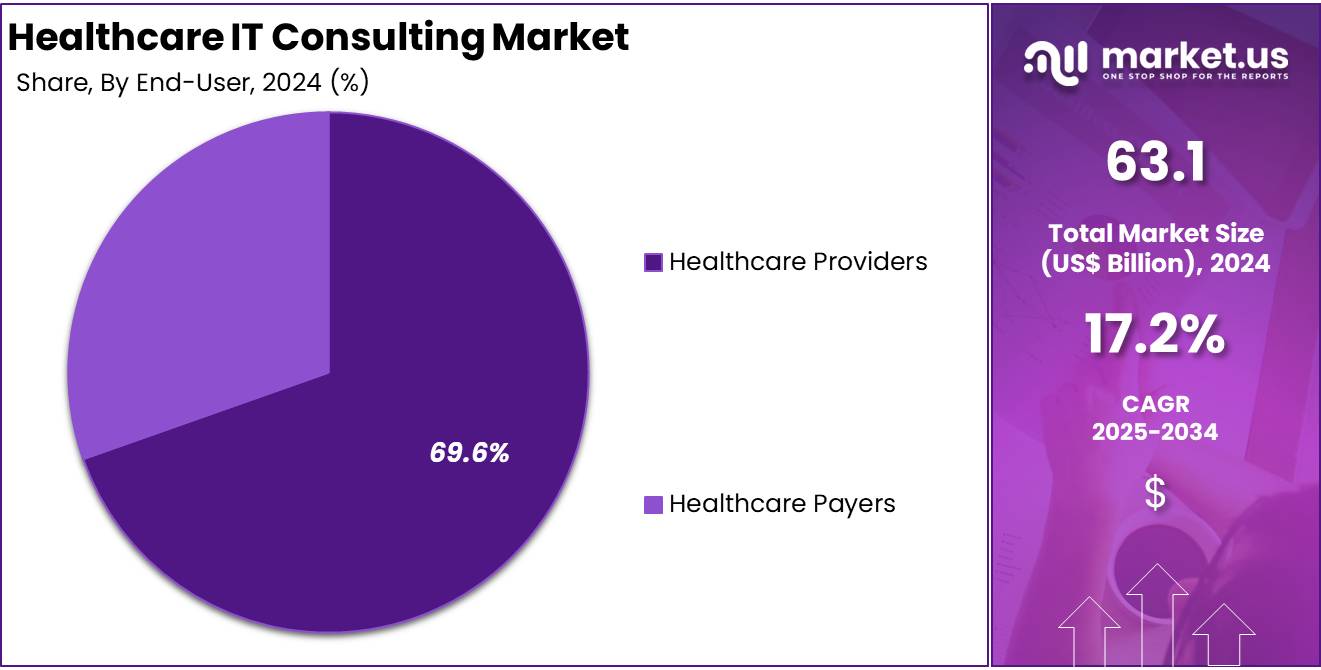
- By end-user, Healthcare Providers accounted for the largest market share of 69.6% in 2024.
- North America held the largest share of 39.8% in 2024 in the global market.
Type Analysis
Healthcare Business Process Management (BPM) was the largest segment within the healthcare IT consulting market with 26.3% share in 2024, reflecting a significant shift towards operational efficiency and cost optimization in healthcare organizations. The adoption of BPM solutions in healthcare is driven by the industry’s increasing need to streamline operations, reduce administrative burdens, and enhance patient care delivery.
For instance, healthcare organizations are integrating robotic process automation (RPA) and artificial intelligence (AI) tools to automate repetitive tasks such as billing, claims processing, and patient data management. This automation not only accelerates workflows but also minimizes human errors and operational costs. A report by Healthcare IT News found that effective EHR integration can reduce administrative costs by up to 30%. IT consultants are essential in managing these implementations, preventing costly errors and delays.
A prominent example of BPM’s impact is observed in revenue cycle management. Omega Healthcare Management Services, a firm supporting over 350 healthcare organizations, implemented AI-powered automation to process over 100 million transactions annually. This initiative resulted in a 30% return on investment, saved more than 15,000 employee hours per month, reduced documentation time by 40%, and improved processing accuracy to 99.5%.
Deployment Model Analysis
The hybrid deployment model has become the predominant choice in healthcare IT consulting, reflecting the sector’s need for a balanced approach that combines the benefits of both on-premises and cloud-based solutions. This segment accounted for 45.4% share in 2024. This model allows healthcare organizations to securely store sensitive data on-premises while leveraging the scalability and flexibility of the cloud for less critical operations. By integrating these two environments, healthcare providers can optimize their IT infrastructure to meet diverse needs, including regulatory compliance, data security, and operational efficiency.
One of the driving factors is the increasing complexity of healthcare IT environments. Organizations are managing a mix of legacy systems, EHRs, and emerging technologies such as AI and telemedicine platforms. The hybrid model facilitates the seamless integration of these diverse systems, enabling healthcare providers to modernize their infrastructure incrementally without disrupting existing operations. This approach aligns with the industry’s emphasis on interoperability and the need to maintain continuous access to critical patient data.
Furthermore, the hybrid model offers enhanced security and compliance capabilities. Healthcare organizations are subject to stringent regulations, such as the Health Insurance Portability and Accountability Act (HIPAA) in the United States, which mandate the protection of patient information. By retaining sensitive data on private clouds or on-premises systems, healthcare providers can implement robust security measures tailored to their specific requirements. Simultaneously, they can utilize public cloud services for non-sensitive applications, benefiting from the cloud’s cost-effectiveness and scalability.
End-User Analysis
The healthcare IT consulting market is experiencing significant growth, with healthcare providers—particularly hospitals—emerging as the largest end-user segment contributing with 69.6% share in 2024. Hospitals are increasingly adopting IT solutions to enhance patient care, streamline operations, and comply with stringent regulations. For example, EHRs facilitate the digitalization of patient information, enabling healthcare providers to access and share data efficiently, thereby improving the quality of care and reducing errors.
According to a study published in the Journal of Medical Internet Research, hospitals that utilized IT consulting services for EHR implementation experienced significant improvements in patient care efficiency. These hospitals saw a 15% increase in patient throughput, which is a key indicator of operational performance. Additionally, research conducted by the National Institutes of Health (NIH) found that EHR systems, when implemented with the support of IT consultants, led to a 20% boost in patient satisfaction scores. This improvement was attributed to more efficient operations, shorter wait times, and enhanced communication, as the benefits of the EHR systems were centralized and streamlined.
Diagnostic centers also represent a significant portion of the healthcare IT consulting market. These facilities are increasingly adopting IT solutions to manage patient data, improve diagnostic accuracy, and enhance operational efficiency. For instance, the adoption of Picture Archiving and Communication Systems (PACS) allows diagnostic centers to store and retrieve medical images digitally, facilitating remote consultations and reducing the need for physical storage space. IT consultants assist diagnostic centers in selecting and implementing appropriate technologies, ensuring seamless integration with existing systems, and providing training to staff.
Key Market Segments
By Type
- HC IT Strategy & Project/Program Management
- Healthcare Application Analysis, Design & Development
- HC IT Integration & Migration
- Change Management
- Healthcare/Medical System Security & Risk Assessment
- Healthcare Enterprise Reporting & Data Analytics
- Healthcare Business Process Management
- Regulatory Compliance
- Other Types
By Deployment Model
- On-Premises
- Cloud-Based
- Hybrid
By End-User
- Healthcare Providers
- Hospitals
- Diagnostic Centers
- Others
- Healthcare Payers
- Private Payers
- Public Payers
Drivers
Digital Transformation in Healthcare
Digital transformation in healthcare is reshaping the industry by integrating advanced technologies to enhance patient care, streamline operations, and improve overall healthcare delivery. This transformation encompasses various aspects, including the adoption of EHRs, telemedicine, AI, and data analytics. In June 2025, S&P Universal Consulting was launched to meet the growing demand for expertise in healthcare digital transformation. This highlights the expanding need for specialized IT consulting services in this sector, covering areas such as EMR implementation, cybersecurity, and clinical optimization.
The implementation of EHRs has significantly improved the accessibility and accuracy of patient information, leading to better-informed clinical decisions and reduced medical errors. For instance, the Royal Hobart Hospital in Tasmania replaced traditional paper-based charts with a digital system, resulting in increased patient safety and reduced administrative workload for healthcare professionals.
Telemedicine has emerged as a pivotal component of digital transformation, especially in the wake of the COVID-19 pandemic. The Seha Virtual Hospital in Saudi Arabia, recognized as the world’s largest virtual hospital, provides remote medical care through video consultations and monitoring devices. This model addresses challenges such as geographical access, specialized resources, and healthcare costs, demonstrating the effectiveness of digital solutions in expanding healthcare access.
AI is also playing a crucial role in revolutionizing healthcare. AI algorithms assist in diagnostics, treatment planning, and predictive analytics, leading to more personalized and efficient care. For instance, the deployment of the COMPOSER AI algorithm in emergency departments led to a 17% decrease in sepsis-related in-hospital mortality.
Similarly, the integration of AI tools in revenue cycle management has streamlined billing processes, with approximately 46% of hospitals utilizing AI for these operations. Data analytics enables healthcare providers to analyze vast amounts of patient data to identify trends, predict outcomes, and make evidence-based decisions. The integration of big data analytics has improved disease detection, patient monitoring, and resource allocation, contributing to better patient outcomes and optimized healthcare services. McKinsey estimates that big data analytics in healthcare could save the U.S. healthcare system approximately $300 billion annually, which accounts for 8% of the national healthcare expenditure.
The adoption of digital health initiatives is also evident in national programs. India’s Ayushman Bharat Digital Mission aims to create an integrated digital health infrastructure, linking healthcare providers and patients through digital platforms. This initiative facilitates real-time access to health records, promoting efficient and inclusive healthcare delivery across the country.
Restraints
Data Privacy Concerns
Data privacy concerns are a significant restraint in the healthcare IT consulting market, as the sector increasingly digitizes patient information and integrates advanced technologies. The healthcare industry is a prime target for cyberattacks due to the high value of protected health information (PHI) on the black market. In 2024, over 276 million individuals were affected by healthcare data breaches in the U.S., averaging more than 758,000 records exposed daily. These breaches often involve ransomware attacks, which encrypt data and demand payment for its release.
For instance, the cyberattack on Change Healthcare in February 2024 disrupted revenue cycle operations across the U.S., affecting approximately 100 million individuals. Similarly, a ransomware attack on DaVita, a dialysis provider, in April 2025 encrypted parts of its network, disrupting operations across the U.S. The financial impact of these breaches is substantial.
IBM’s 2024 Cost of a Data Breach report reveals that the average cost for companies to recover from a data breach is $4.88 million, a significant increase from the previous year’s $4.45 million. These costs encompass legal fees, regulatory fines, and the expense of implementing corrective measures. Moreover, the increasing use of third-party vendors and cloud services introduces additional risks. Healthcare organizations must ensure that their partners adhere to the same stringent data protection standards, as breaches can occur through vulnerabilities in third-party systems.









