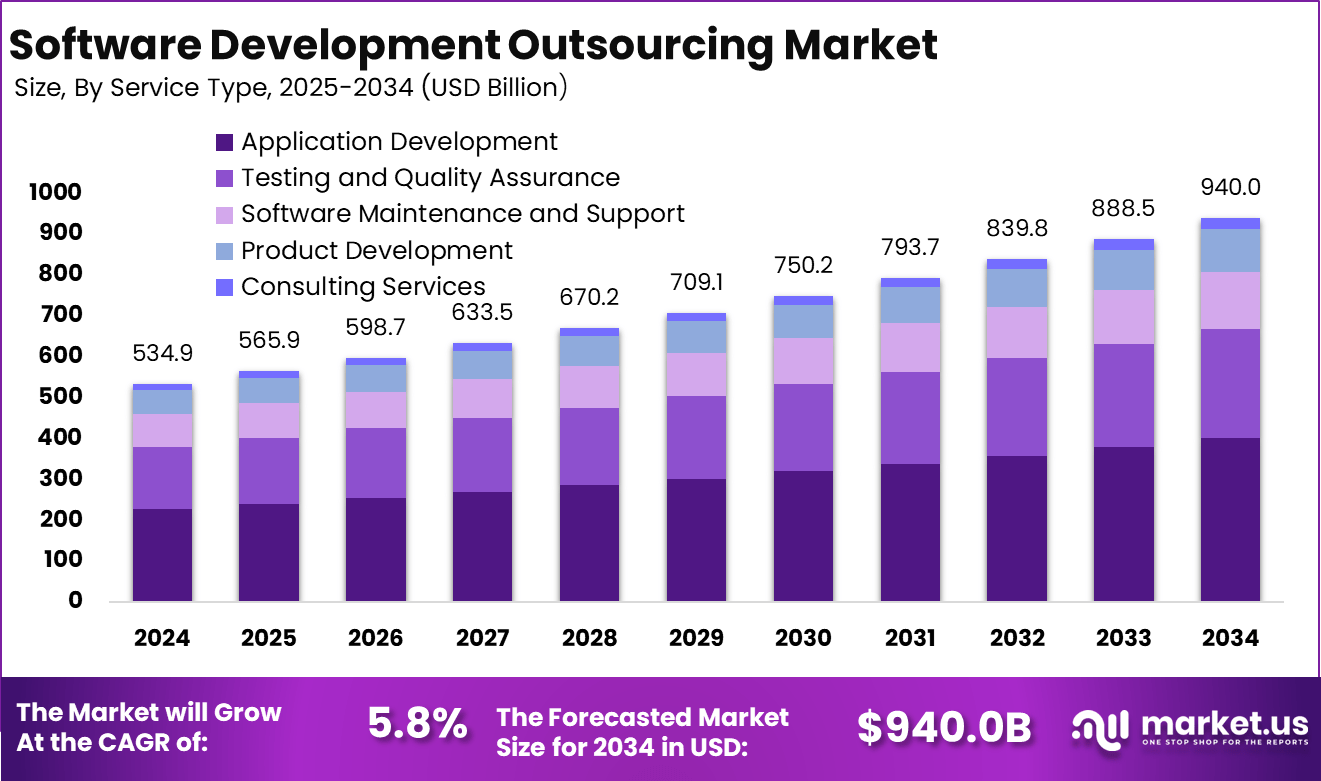
| In 2024, North America held a dominant market position in the Global Software Development Outsourcing Market, capturing more than a 34.7% share, holding USD 185.6 billion in revenue. This dominance is due to the region’s technological structure, and the presence of major software firms makes it a favorable location for outsourcing activities.
Furthermore, the increasing emphasis on digital transformation in North American firms has increased demand for custom software solutions, resulting in an increase in the number of outsourcing services. The combination of technological expertise and changing business necessities ensures that North America remains at the forefront of software development outsourcing.
For instance, In April 2023, Forbes noted Latin America’s fast rise as a key source of tech talent for North America, driven by proximity, time zone alignment, and cultural compatibility. Nations like Brazil, Mexico, Argentina, and Colombia are expanding their tech industries, supported by a young, skilled workforce and growing English proficiency, making the region a strong nearshoring choice amid the global shift to remote work.
Service Type Analysis
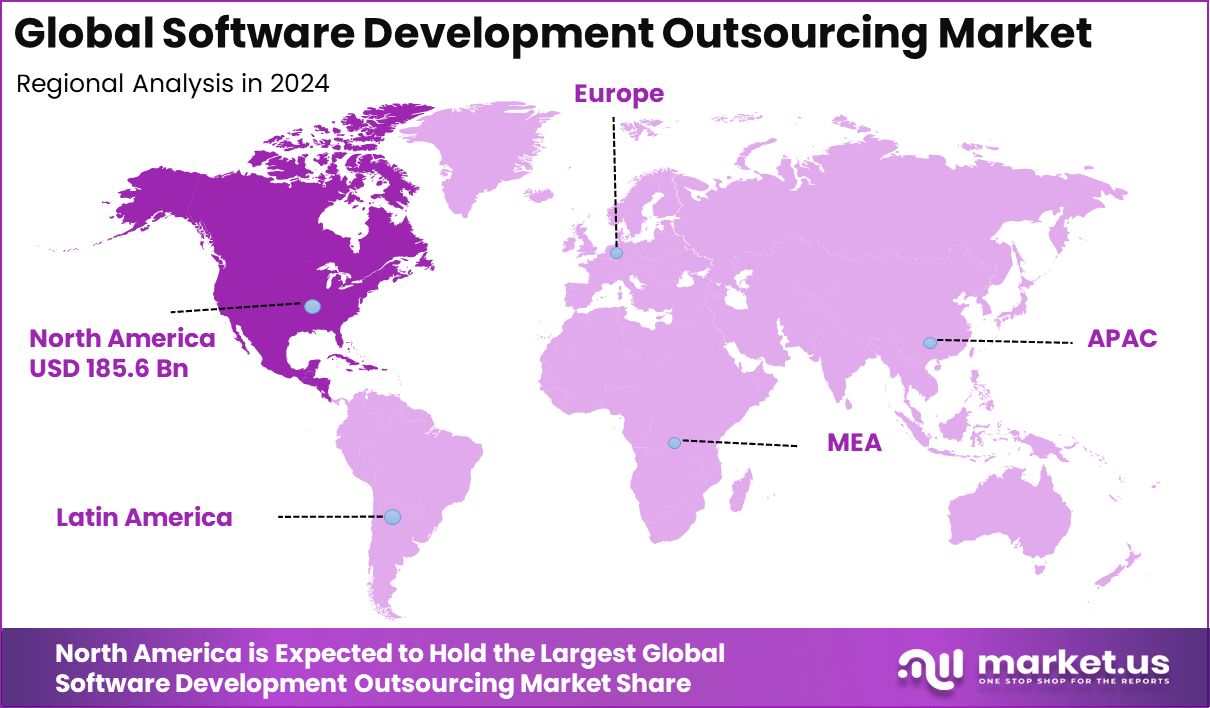
In 2024, Application Development segment held a dominant market position, capturing a 42.7% share of the Global Software Development Outsourcing Market. This dominance can be attributed to the increasing demand for customized, scalable, and innovative software solutions across various industries.
As businesses continue to focus on enhancing their digital presence and improving customer experiences, the need for application development outsourcing has surged. Furthermore, the rapid adoption of technologies like cloud computing, AI, and mobile applications has fueled the growth of this segment, driving its continued leadership in the market.
For instance, In March 2025, Perforce Software acquired Snowtrack, a Montreal-based developer of distributed version control tools for digital artists and designers. This acquisition enabled the launch of P4 One, a user-friendly version control client integrated into the Perforce P4 Platform, aimed at simplifying collaboration across creative and technical teams.
Deployment Model Analysis
In 2024, the On-premise segment held a dominant market position, capturing a 61.5% share of the Global Software Development Outsourcing Market. The primary reason for organizations to use on-premise solutions is to gain more control over their data and IT systems.
On-premise deployment models are becoming more popular among companies in heavily regulated industries like finance and healthcare, which emphasize security and compliance. Additionally, the ability to adapt and integrate on-premise solutions with existing systems makes it a desirable option for companies seeking complete control over their software and operations.
For instance, in June 2024, Wipro announced a collaboration with Hewlett-Packard Enterprise (HPE) to launch an on-premise Generative AI (GenAI) solution at Wipro’s Customer Experience Center in Kodathi, India. This solution integrates Wipro’s Smart Operations platform with HPE’s Machine Learning Development Environment, aiming to enhance operational efficiency and customer experience.
Organisation Type Analysis
In 2024, Large Enterprises segment held a dominant market position, capturing a 68.3% share of the Global Software Development Outsourcing Market. This dominance is due to the increasing need for complex, large-scale software solutions that can support the diverse and sophisticated operations of large organizations.
These enterprises often have the resources to invest in customized software development and the scale to benefit from the cost efficiencies of outsourcing. Additionally, the demand for advanced technologies like artificial intelligence, cloud computing, and data analytics has led large companies to outsource certain functions to meet changing business needs.
For instance, In April 2025, Orion Innovation was recognized by the International Association of Outsourcing Professionals® (IAOP®) as a global outsourcing leader, earning a place on the Global Outsourcing 100® list for the ninth consecutive year. This recognition reflects the company’s consistent performance in delivering high-impact digital transformation and product development services.
Industry Vertical Analysis
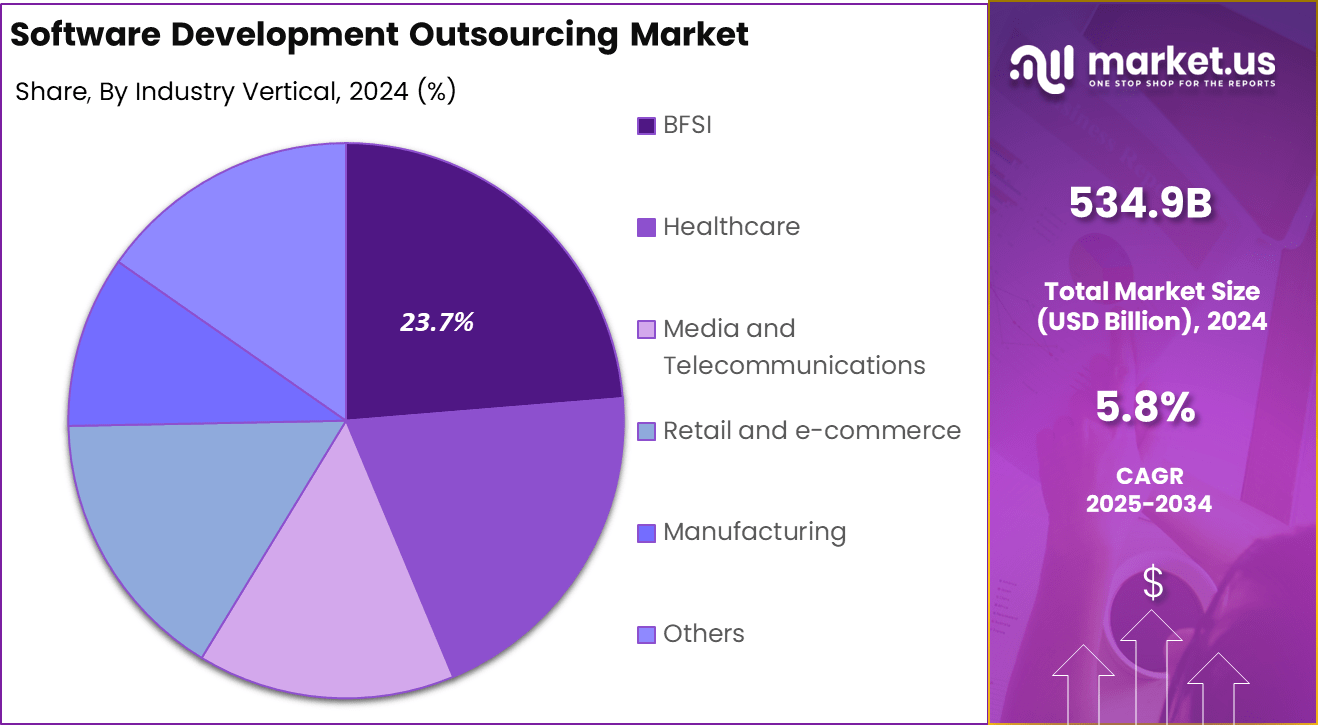
In 2024, BFSI segment held a dominant market position, capturing a 23.7% share of the Global Software Development Outsourcing Market. This dominance is driven by the sector’s urgent need for digital transformation, enhanced cybersecurity, and compliance with regulations.
BFSI organizations are increasingly outsourcing software development to quickly launch secure mobile banking apps, digital payment solutions, and data analytics platforms that improve customer experiences and operational efficiency. The complexity of financial transactions, changing regulations, and rising cyber threats have made outsourcing essential for BFSI firms seeking specialized expertise and innovative solutions.
For Instance, In April 2025, Candescent, a prominent independent digital banking technology provider, opened a new office in Bangalore, India, to strengthen its software development efforts in the Banking, Financial Services, and Insurance (BFSI) sector. This expansion reflects a strategic initiative to leverage India’s highly skilled tech workforce and deepen innovation capabilities.
Key Market Segments
By Service Type
- Application Development
- Testing and Quality Assurance
- Software Maintenance and Support
- Product Development
- Consulting Services
By Deployment Model
By Organisation Type
By Industry Vertical
- BFSI
- Healthcare
- Media and Telecommunications
- Retail and e-commerce
- Manufacturing
- Others
Key Regions and Countries
- North America
- Europe
- Germany
- France
- The UK
- Spain
- Italy
- Russia
- Netherlands
- Rest of Europe
- Asia Pacific
- China
- Japan
- South Korea
- India
- Australia
- Singapore
- Thailand
- Vietnam
- Rest of Latin America
- Latin America
- Brazil
- Mexico
- Rest of Latin America
- Middle East & Africa
- South Africa
- Saudi Arabia
- UAE
- Rest of MEA
Emerging Trend
AI Driven and Hybrid Outsourcing Models
A major emerging trend in software development outsourcing is the integration of AI powered development tools into outsourced engagements. Providers are now using advanced AI platforms to automate tasks such as code generation, testing, bug fixing and documentation.
Another important trend is the adoption of hybrid engagement models that blend staff augmentation, project based contracting and managed service teams. Organizations are increasingly choosing flexible structures that adapt to different project phases, using augmented staff during planning and managed teams during implementation.
Drivers
AI Driven and Hybrid Outsourcing Models
A major emerging trend in software development outsourcing is the integration of AI powered development tools into outsourced engagements. Providers are now using advanced AI platforms to automate tasks such as code generation, testing, bug fixing and documentation. This approach improves developer productivity and accelerates delivery timelines by automating repetitive processes while enabling developers to focus on complex problems.
Another important trend is the adoption of hybrid engagement models that blend staff augmentation, project based contracting and managed service teams. Organizations are increasingly choosing flexible structures that adapt to different project phases, using augmented staff during planning and managed teams during implementation. This modular model gives companies better control over scope and resources while improving scalability to meet changing needs.
Restraint
Access to Specialized Talent and Faster Delivery
The primary driver of software development outsourcing is the ability to access specialized skills that are difficult to build internally. As enterprises pursue advanced technologies like cloud computing, artificial intelligence and DevOps, outsourcing allows them to quickly tap into global expertise without lengthy hiring and training cycles. This access to qualified talent fills critical gaps in digital transformation efforts.
Another driver is the demand for faster time to market. Distributed outsourced teams operating in multiple time zones enable around the clock development, which reduces project timelines. This continuous development model is especially valuable in competitive markets where speed and responsiveness are critical to success.
Opportunities
Technological Advancements
New opportunities are emerging in the software development outsourcing industry with the rise of technologies such as AI, cloud computing, and blockchain. These developments allow outsourcing firms to focus on more niche services such as complex analytics, automation, and decentralized applications, which helps them remain competitive while providing value to clients seeking innovative solutions.
For instance, in December 2024, IBM’s study revealed that 51% of companies utilizing open-source AI tools reported positive ROI, compared to 41% of those not using open-source solutions. The research, based on a survey of over 2,400 IT decision-makers, also indicated that 62% of organizations plan to increase their AI investments in 2025, with 48% intending to leverage open-source ecosystems to optimize their AI implementations.
Challenges
Talent Scarcity and Rising Costs
As demand for specialist technical talent rises, outsourcing firms are finding it increasingly difficult to recruit and retain top performers. The shortage of skilled workers, coupled with rising wages for proficient developers, is reducing the cost advantages that outsourcing used to provide. As a result, companies may face extended hiring periods and higher costs, which can impact project schedules and budget control.
For instance, In June 2025, Bridge Hiring expanded its remote IT talent pool to support the growing digital needs of global businesses. The company now provides access to a wider network of professionals, including software engineers, virtual assistants, and web development specialists, enabling organizations to scale efficiently.
Key Players Analysis
Accenture, IBM, and Oracle dominate the software development outsourcing market with strong global networks and advanced service offerings. Their focus on cloud, AI, and agile practices has strengthened client trust. Continued investment in talent and innovation keeps them leading choices for complex and large-scale projects.
TCS, Infosys, and HCL drive innovation with extensive offshore centers and digital-first strategies. Their expertise in DevOps, automation, and scalable solutions attracts enterprises seeking efficiency and flexibility. These firms maintain strong client relationships through consistent delivery and transformation initiatives.
ACS Technologies, Inspur, ISS, and others serve niche and mid-market segments with cost-effective, tailored solutions. Their regional strengths and client-centric models help them compete effectively. Focus on quality at lower costs has made them preferred among small and medium enterprises looking for specialized outsourcing partners.
Top Key Players in the Market
- Accenture
- HCL Technologies
- HPE
- IBM Corporation
- Tata Consultancy Services
- Oracle Corporation
- Infosys Ltd.
- ACS Technologies
- Inspur
- ISS
- Others
Recent Developments
- In August 2024, Sonata Software was appointed as the Strategic IT outsourcing partner by a U.S. based Healthcare and Wellness firm. The collaboration focuses on two key objectives: achieving cost optimization through engineering efficiencies and driving technology modernization. This transformation leverages enterprise data, AI, and hyper-automation to enhance both patient-facing applications and internal systems, aiming to boost overall operational performance.
- In July 2024, Austin-based consultancy Connect33 launched LatAm Partners, a digital marketplace focused on IT outsourcing in Latin America. The platform offers a self-guided purchasing experience, connecting global buyers with vetted software development firms across the region. It also empowers Latin American tech providers by linking them to new business opportunities, streamlining access to global markets.
|---|