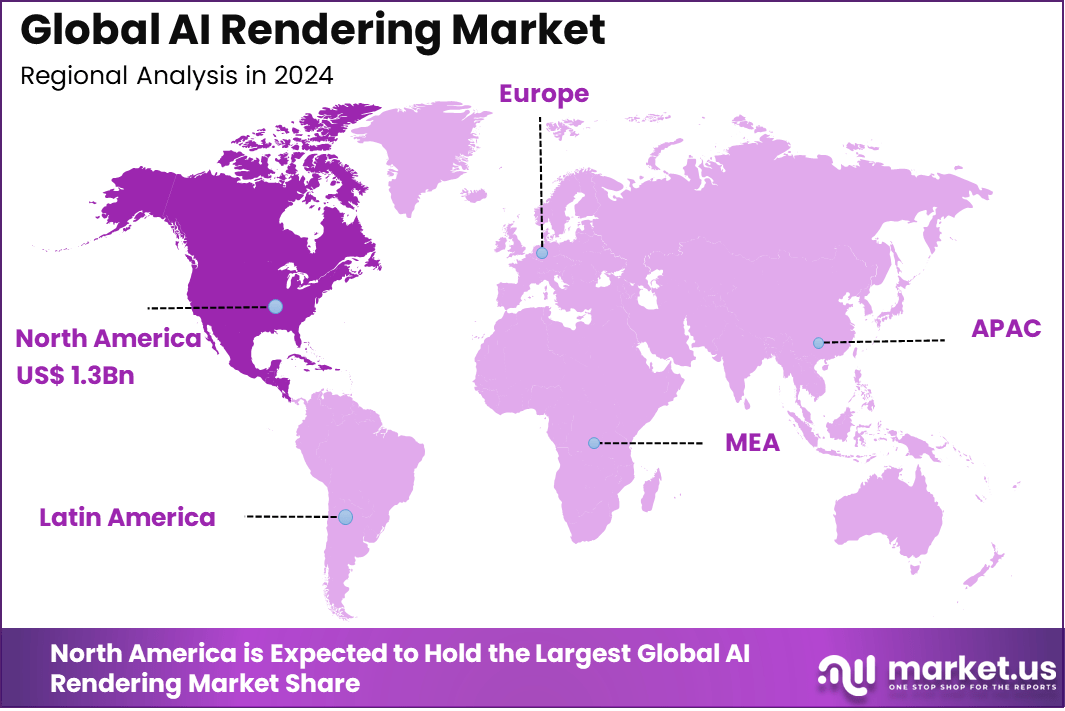
| In 2024, North America held a dominant market position, capturing more than a 39% share, holding USD 1.3 billion in revenue. This leadership is primarily attributed to the region’s strong presence of advanced digital media production studios, high adoption of AI technologies in rendering pipelines, and early access to scalable cloud infrastructure.
The U.S. market, in particular, has been a frontrunner in integrating deep learning algorithms into real-time rendering applications across gaming, virtual reality, and advertising industries. A mature ecosystem of AI research institutions and tech innovators has further accelerated the pace of adoption.
Another key factor behind North America’s dominance is the increasing demand for photorealistic and immersive content driven by the entertainment and e‑commerce sectors. Content creators and design firms across the region are using AI-powered tools to reduce production time and enhance visual quality, especially for high-end animations and product showcases.
The availability of skilled professionals, combined with heavy investment in generative media startups, has helped maintain a technological edge. As regulations around AI transparency and data ethics begin to take clearer shape in the U.S. and Canada, enterprises are also gaining more confidence to scale AI rendering workflows responsibly.
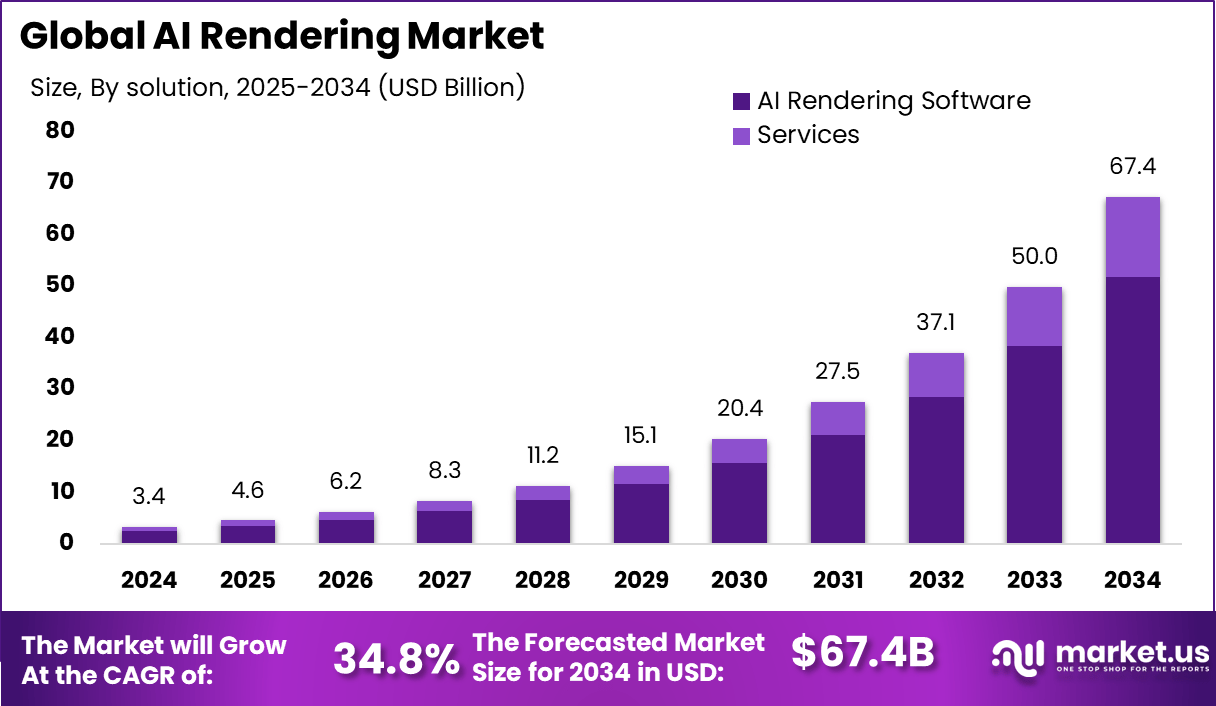
By Solution: AI Rendering Software – 76.8%
The dominance of AI rendering software, accounting for 76.8%, reflects the market’s shift toward intelligent, algorithm-driven visualization tools. These software platforms are being widely integrated into design, animation, and simulation workflows because of their ability to reduce rendering time, improve quality, and optimize lighting and texture generation with minimal manual effort. Their flexibility to operate on both local machines and cloud environments has expanded accessibility across creative and engineering sectors.
The preference for software over hardware-based solutions is rooted in adaptability and lower entry barriers. Software tools powered by neural networks, generative models, and real-time rendering engines are evolving rapidly, often with modular compatibility that fits into existing creative pipelines. Users are also valuing the automation features embedded in these platforms, which allow them to produce hyper-realistic content with fewer iterations and shorter feedback cycles.
By Enterprise Size: Large Enterprises – 70.5%
Large enterprises represent 70.5% of the adoption in the AI rendering ecosystem. These companies are better positioned to implement AI rendering due to their greater access to skilled talent, larger design departments, and established digital infrastructure. Their projects often demand high-quality visualization output, particularly in industries such as architecture, gaming, automotive, and entertainment, where visual storytelling and design accuracy are critical.
The adoption by large enterprises is also being driven by their ability to invest in innovation and manage complex workflows. Implementing AI-powered rendering involves coordination across departments including IT, creative, and data science. These organizations also tend to be early adopters of scalable rendering platforms that integrate AI into pre-visualization and post-production phases. This segment continues to lead as they prioritize efficiency, realism, and faster content delivery.
By Application: Visualization and Simulation – 38.6%
The application of AI rendering in visualization and simulation constitutes 38.6% of the total usage, with its impact seen prominently in fields requiring lifelike replication of real-world environments. From engineering prototypes to architectural walkthroughs, AI rendering streamlines the process of creating detailed and interactive virtual models. It supports decision-making by generating accurate and immersive simulations that were once difficult and time-consuming to produce.
This segment’s growth is closely linked to rising demand for real-time rendering and the need to reduce manual workload in previsualization. AI is increasingly being used to speed up iterations and ensure consistency across simulation projects. The ability of AI algorithms to enhance lighting, simulate environmental changes, and generate realistic reflections or shadows without human input has improved the quality and usability of digital simulations across various industries.
By End-use: Gaming – 30.8%
Within end-use categories, the gaming sector accounts for 30.8% of the AI rendering adoption. Game developers are utilizing AI to create visually rich environments, optimize rendering workflows, and dynamically adjust graphics in real-time. This adoption is enhancing not only the realism of virtual worlds but also improving game performance across devices by making rendering more efficient.
Gaming studios are integrating AI tools to automate repetitive visual tasks, such as texture enhancement and procedural environment generation. This reduces development cycles and enables teams to focus on gameplay mechanics and narrative design. The gaming industry has also become a testing ground for advanced rendering technologies, particularly where real-time user interaction and immersive graphics are prioritized.
Key Market Segments
By Solution
- AI Rendering Software
- Services
- Implementation & Integration Services
- Consulting & Training Services
- Support & Maintenance Services
By Enterprise Size
By Application
- Visualisation and Simulation
- Animation
- Product, Design and Modelling
- Others
By End-use
- Automotive
- Gaming
- Healthcare
- Media and Entertainment
- Manufacturing
- Others
Key Regions and Countries
- North America
- Europe
- Germany
- France
- The UK
- Spain
- Italy
- Russia
- Netherlands
- Rest of Europe
- Asia Pacific
- China
- Japan
- South Korea
- India
- Australia
- Singapore
- Thailand
- Vietnam
- Rest of Latin America
- Latin America
- Brazil
- Mexico
- Rest of Latin America
- Middle East & Africa
- South Africa
- Saudi Arabia
- UAE
- Rest of MEA
Emerging Trend Analysis
Proliferation of Neural Rendering Accelerators
Neural rendering is entering a transformative phase as purpose-built hardware accelerators are being introduced to handle the intensive computational demands of real-time 3D visualizations. These accelerators are capable of adapting dynamically to different neural rendering pipelines, allowing applications such as AR, VR, and digital twins to perform locally with greater speed and efficiency. This trend reflects a shift from centralized to edge-based processing.
As edge devices gain the ability to handle complex rendering workloads, latency is reduced and user interaction becomes more immersive. This development is expected to enable broader deployment of AI rendering in consumer electronics and enterprise environments, encouraging real-time applications that were previously impractical on standard hardware.
Driver Analysis
AI-Powered Automation in Rendering Workflows
AI has made it possible to automate several time-consuming elements within the rendering process, such as noise reduction, lighting enhancement, and procedural modeling. These features not only accelerate production timelines but also improve the scalability of rendering tasks across various industries, from entertainment to product design.
With improved efficiency and reduced manual workload, professionals can achieve consistent, high-quality results in less time. As AI rendering becomes more refined and user-friendly, the productivity gains will further incentivize organizations to adopt intelligent automation across their visual workflows.
Restraint Analysis
Complexity and Infrastructure Cost
The technological infrastructure needed to deploy high-quality AI rendering solutions is still cost-intensive. Many advanced rendering systems require powerful GPUs, specialized neural processors, or cloud-based rendering farms, which may not be financially viable for small and mid-sized companies.
Additionally, there remains a steep learning curve for deploying and managing AI-based rendering pipelines. This complexity often necessitates specialized training or the hiring of technical experts, limiting access for non-technical teams and slowing down widespread industry adoption.
Opportunity Analysis
Edge-Enabled Immersive Experiences
The rising compatibility of AI rendering with edge computing platforms presents a major opportunity. By processing visual content closer to the user, such as on mobile devices or local hardware, latency and bandwidth limitations are significantly minimized. This unlocks new use cases, especially in areas like remote assistance, virtual training, and live simulation.
Industries looking to enhance user engagement through real-time visualization can now consider edge rendering as a viable solution. This not only improves responsiveness but also ensures privacy and data sovereignty by limiting cloud dependency.
Challenge Analysis
Ethical Concerns and Content Authenticity
The ability of AI rendering to create photorealistic content introduces complex ethical concerns. Content generated through these systems can be mistaken for real images or videos, which increases the risk of manipulation or misinformation. The lack of visible indicators distinguishing AI-generated content from authentic media remains a growing concern.
In regulated sectors such as journalism or legal documentation, unverified use of AI-rendered visuals may result in legal ramifications or damage to public trust. The implementation of detection frameworks, digital watermarking, and content certification protocols will become critical to address these challenges in the near future.
Key Player Analysis
MyArchitectAI, ArchiVinci, and Vizcom Technologies, Inc. are leading innovation in AI rendering by offering automated visualization tools tailored for architects and designers. Their platforms help speed up design workflows and improve visual quality using generative AI and sketch-to-render capabilities.
Dimension 5, Integrated BIM, and GENENSE Global 3D Rendering Services are enhancing the integration of AI in BIM and cloud rendering. These players focus on efficiency in 3D modeling and global access to real-time rendering, supported by GPU acceleration from NVIDIA Corporation.
Carahsoft Technology Corp, paintit, Neolocus, and Architect Render, LLC are addressing niche demands in government, creative, and branding applications. Their services expand the scope of AI rendering across sectors, supporting high-quality output and intelligent design automation.
Top Key Players Covered
- MyArchitectAI
- ArchiVinci
- Vizcom Technologies, Inc.
- Dimension 5
- Integrated BIM
- GENENSE Global 3D Rendering Services
- NVIDIA Corporation
- Carahsoft Technology Corp
- paintit
- Neolocus
- Architect Render, LLC
- Others
Recent Developments
- Vizcom continued to gain traction throughout 2024, offering a platform that transforms sketches and 3D models into photorealistic renderings using advanced machine learning. Its collaborative features and rapid rendering speeds have made it essential for design teams aiming to iterate quickly and visualize concepts with remarkable accuracy.
- In March 2024, Carahsoft announced a partnership with Rendered.ai to bring synthetic data generation platforms to government agencies. As the Master Government Aggregator, Carahsoft is now distributing Rendered.ai’s solutions through a network of resellers, expanding access to AI-driven computer vision and rendering tools in the public sector
|---|