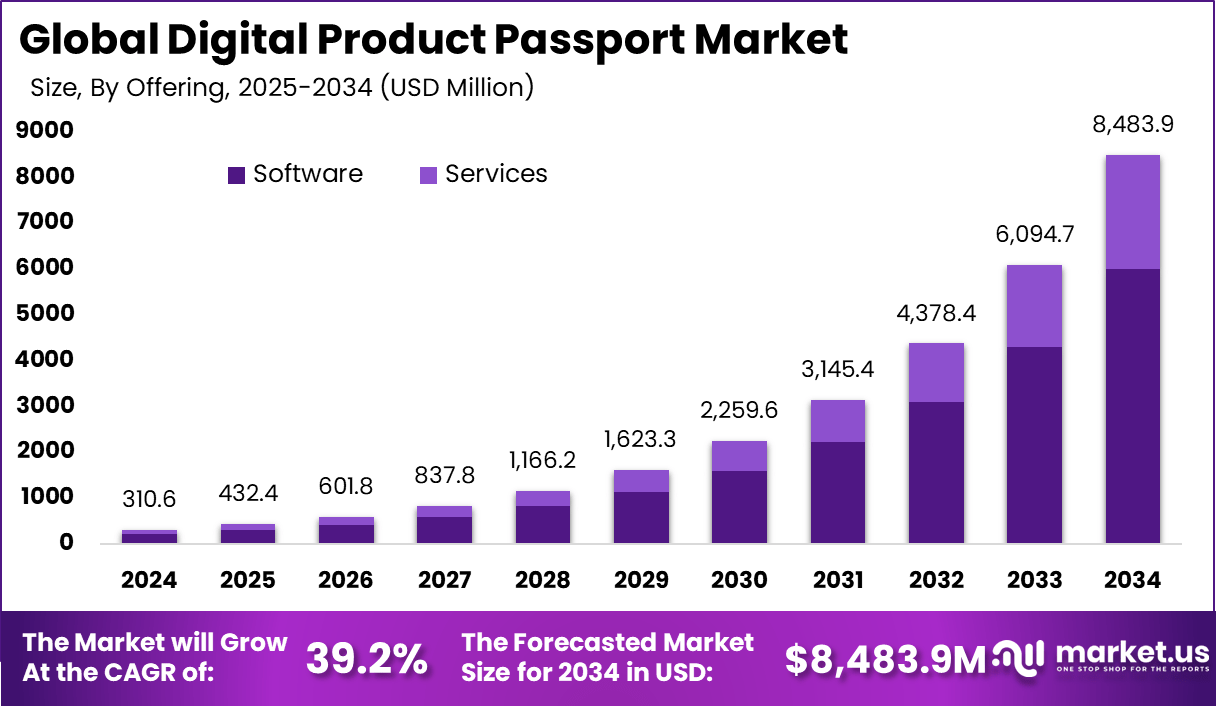
| In 2024, North America held a dominant market position in the Global Digital Product Passport Market, capturing more than a 38.6% share, holding USD 119.8 million in revenue. This market is growing significantly with investments in sustainability and transparency, alongside the rapid adoption of DPPs to meet regulatory requirements and corporate sustainability targets.
Key industries like automotive, electronics, and consumer goods are adopting DPPs to improve product traceability and supply chain visibility, responding to growing consumer demand for ethical practices. The integration of blockchain, IoT, and AI technologies further accelerates adoption, supporting the region’s transition to a circular economy and fostering continued growth and innovation.
For instance, in April 2025, the United Nations Economic Commission for Europe (UNECE) and ISO launched a joint initiative to advance the implementation of DPPs. This initiative, supported by North America, aims to foster standardized product data management, enhance transparency, and ensure regulatory compliance across industries.
By Offering Analysis
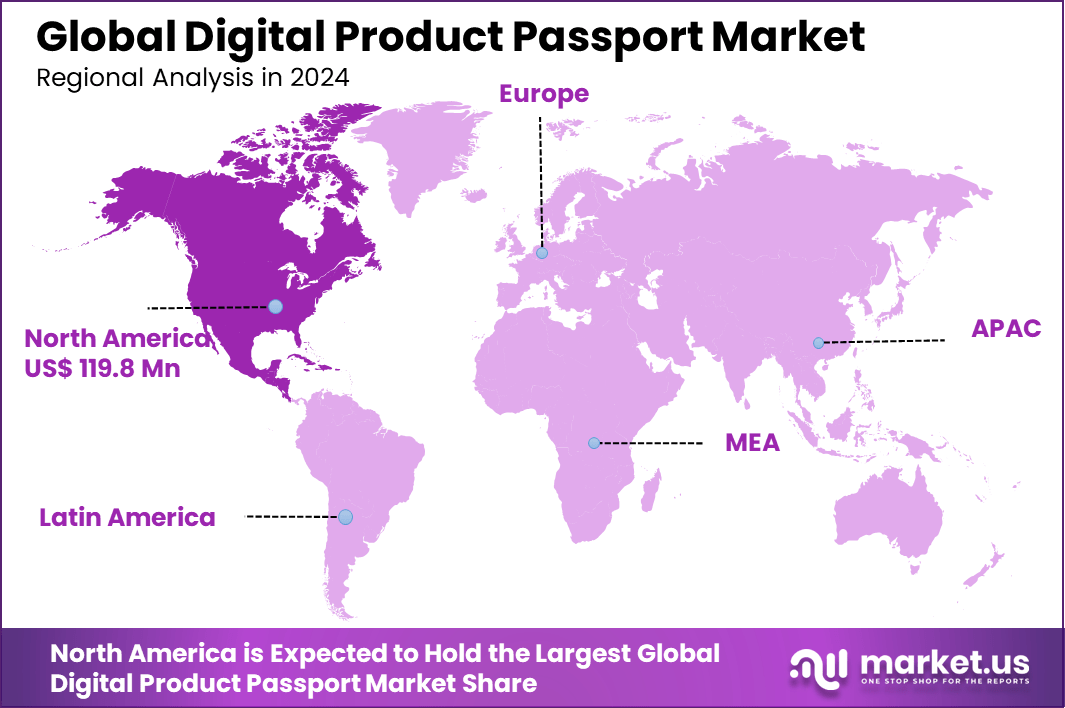
In 2024, the Software segment held a dominant position in the Digital Product Passport market, capturing more than a 70.7% share. This leadership reflects the increasing reliance on software platforms to manage product traceability, lifecycle data, and regulatory compliance in digital formats.
Software solutions are being actively adopted to facilitate seamless integration with enterprise systems, such as ERP and PLM, ensuring that all product information remains transparent, updated, and accessible across the value chain.
As sustainability reporting and circular economy initiatives gain momentum, software-driven passports are playing a critical role in enabling accurate data sharing and product authenticity verification. For instance, In November 2023, Avery Dennison introduced a Digital Product Passport solution that combines advanced software with traceability features to improve transparency in the textile industry.
This solution enables real-time tracking of product lifecycle data, including materials, origin, and sustainability performance. The launch supports the industry’s shift toward more responsible production and helps brands align with new regulatory standards focused on circularity and accountability.
By Deployment Analysis
In 2024, the Cloud-Based segment accounted for a dominant market share, exceeding 64.2%. This dominance is underpinned by the scalability, flexibility, and real-time access that cloud infrastructure offers. Cloud-based digital product passport solutions are particularly attractive to companies operating globally, as they enable remote access to product data and simplify updates across decentralized supply chains.
The ability to meet evolving compliance requirements without extensive on-premise infrastructure investment has positioned cloud deployment as the preferred approach for enterprises focused on agility and long-term digital growth.
For instance, in June 2025, Whatt.io introduced tiered SaaS subscriptions to accelerate the adoption of Cloud-Based Digital Product Passports. These subscriptions offer scalable solutions tailored to different business needs, empowering companies to efficiently manage product data, ensure regulatory compliance, and enhance supply chain transparency.
By Industry Analysis
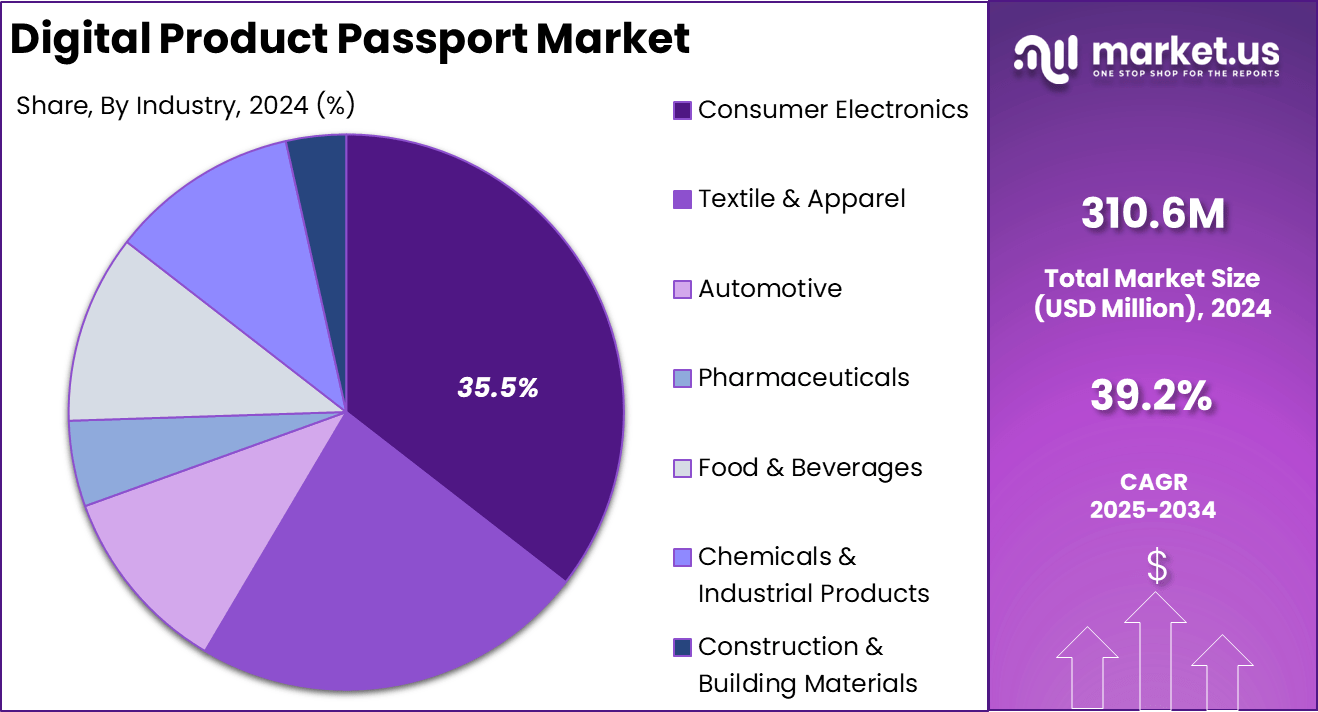
In 2024, the Consumer Electronics segment held a leading position in the Digital Product Passport market, securing more than a 35.5% share. The complex and fast-moving nature of this industry, combined with rising regulatory scrutiny around e-waste and product sustainability, has accelerated the adoption of digital passports.
These tools enable electronics manufacturers to provide detailed product composition, repairability scores, recycling instructions, and origin tracking. As consumers and governments demand greater transparency, the consumer electronics sector has emerged as a pioneer in integrating digital product passports to support environmental goals and improve post-sale service capabilities.
For instance, In August 2024, Eviden introduced a Digital Passport solution tailored for the consumer electronics sector. This technology allows manufacturers to trace product data across the full lifecycle, improving transparency and regulatory compliance. Through Digital Product Passports, the solution enhances supply chain visibility, curbs counterfeit risks, and supports rising consumer expectations for ethical and sustainable electronics.
Key Market Segments
By Offering
By Deployment
By Industry
- Consumer Electronics
- Textile & Apparel
- Automotive
- Pharmaceuticals
- Food & Beverages
- Chemicals & Industrial Products
- Construction & Building Materials
- Others
Key Regions and Countries
- North America
- Europe
- Germany
- France
- The UK
- Spain
- Italy
- Russia
- Netherlands
- Rest of Europe
- Asia Pacific
- China
- Japan
- South Korea
- India
- Australia
- Singapore
- Thailand
- Vietnam
- Rest of Latin America
- Latin America
- Brazil
- Mexico
- Rest of Latin America
- Middle East & Africa
- South Africa
- Saudi Arabia
- UAE
- Rest of MEA
Drivers
Regulatory Support and Legal Frameworks
Governments worldwide are introducing regulations that prioritize sustainable practices, urging industries to embrace tools that enhance transparency and resource efficiency. One such regulatory push comes from the European Union’s Green Deal, which supports Digital Product Passports (DPPs) as part of its circular economy strategy. These passports help businesses comply with environmental reporting, encourage recycling, and support product reuse initiatives.
For instance, In June 2025, a European initiative launched a DPP prototype for the photovoltaic industry. This model allows solar panel manufacturers to track lifecycle data from production to disposal. The aim is to improve recycling processes and support broader sustainability goals, aligning the PV sector with evolving EU directives and consumer expectations for traceability.
Restraint
High Implementation Costs
The development and deployment of DPP systems demand significant capital investment in digital infrastructure, workforce training, and software upgrades. These high upfront costs can be particularly burdensome for small and medium-sized enterprises, which may lack the financial flexibility to adopt such technology without external support.
For instance, In March 2025, Renoon emphasized that the costs associated with DPP implementation continue to be a primary concern. SMEs, especially those managing large product portfolios, often find it difficult to justify the initial expense despite the long-term benefits. As a result, adoption may remain limited until scalable, cost-effective solutions become more accessible or regulations mandate adoption.
Opportunities
Integration with Emerging Technologies
Combining Digital Product Passports with technologies such as blockchain, AI, and IoT offers a powerful path toward smart, transparent, and automated supply chains. These technologies facilitate the real-time capture and verification of product data, driving precision and reducing reliance on manual data entry. Industries with complex lifecycle requirements, such as automotive and fashion, stand to gain significant value from these integrations.
For instance, In July 2024, Piconext integrated generative AI into its DPP platform, enhancing its ability to manage and generate product data automatically. This advancement allows for more dynamic tracking, supports regulatory compliance, and improves visibility across the product lifecycle. Businesses adopting such solutions benefit from more actionable insights and streamlined reporting.
Challenges
Technology Integration Complexities
While emerging technologies offer significant advantages, integrating them into existing systems can be highly challenging. Legacy infrastructure, data silos, and lack of standardization often create barriers that hinder seamless implementation. These integration issues are particularly pronounced in industries with multi-tiered supply chains and diverse technology stacks.
For instance, In February 2024, luxury brands faced interoperability challenges while merging blockchain and AI within their DPP frameworks. Issues such as aligning decentralized blockchain structures with centralized AI analytics, ensuring real-time responsiveness, and maintaining data consistency remain major hurdles. Addressing these structural limitations is essential to achieving scalable and efficient DPP adoption.
Key Player Analysis
In the Digital Product Passport landscape, companies such as 3E, Avery Dennison, and Billon Group are advancing the use of secure and traceable systems for product lifecycle transparency. Their platforms focus on digital identity, sustainability tracking, and compliance reporting across industrial and consumer markets. These firms are prioritizing blockchain integration and real-time data management to align with evolving EU environmental policies.
Firms including Circularise, CIRPASS, and Det Norske Veritas Group (DNV) are contributing significantly to the foundation of decentralized data exchange networks for product passports. These players are helping industries improve traceability, especially in chemicals, textiles, and electronics. By supporting open protocols and secure data layers, they ensure regulatory adherence while protecting proprietary business information.
Companies such as iPoint-systems GmbH, Kezzler, LyondellBasell, OPTEL GROUP, and Sigma Technology are also shaping the future of DPP adoption. Their solutions emphasize serialized product tracking, smart labeling, and life cycle analytics. By combining cloud-based architecture with secure identifiers, these firms are addressing key industry demands for trust, verification, and accountability.
Top Key Players Covered
- 3E
- Avery Dennison
- Billon Group
- Circularise
- CIRPASS
- Det Norske Veritas Group (DNV)
- iPoint-systems GmbH
- Kezzler
- LyondellBasell Industries Holdings B.V.
- OPTEL GROUP
- Sigma Technology
- Others
Recent Developments
- In April 2025, Circularise partnered with Teijin to drive material traceability and circularity through the implementation of Digital Product Passports. This collaboration focuses on enhancing the transparency of materials used in products, allowing stakeholders to track their origin, composition, and recycling potential.
- In February 2025, Victoria’s Secret & Co. introduced Digital Product Passports across selected collections, including the Signature Cotton T-shirt Bra and VSX Featherweight Max Sports Bra. Each product features a QR code label that enables customers to access verified data on fabric composition, sourcing transparency, manufacturing partners, and environmental impact indicators.
- In January 2025, Madaster launched a dedicated Digital Product Passport platform for construction and manufacturing sectors. The solution captures comprehensive data on material composition, embodied carbon, reusability, and end-of-life pathways. It is designed to help companies comply with upcoming EU circular economy rules while enhancing resource efficiency and reducing material waste.
- In February 2025, Dutch brand Garcia committed to embedding Digital Product Passports across its entire Spring/Summer 2025 range. Each item will include a QR code care label that links consumers to detailed data about sustainability practices, material origins, and recycled content percentages used in the garments.
- In January 2025, Viking Outdoor Footwear began piloting Digital Product Passports with QR codes in GS1 Digital Link format. In collaboration with Kezzler and Trimco Group, Viking is proactively implementing traceability solutions in footwear ahead of anticipated EU mandates for transparency in textile production.
- In January 2025, Immu.ai and the Holochain Foundation announced a collaboration to advance the development of Digital Product Passports. The partnership aims to integrate blockchain and Holochain technologies to enhance product traceability, improve data security, and support sustainable practices.
|---|