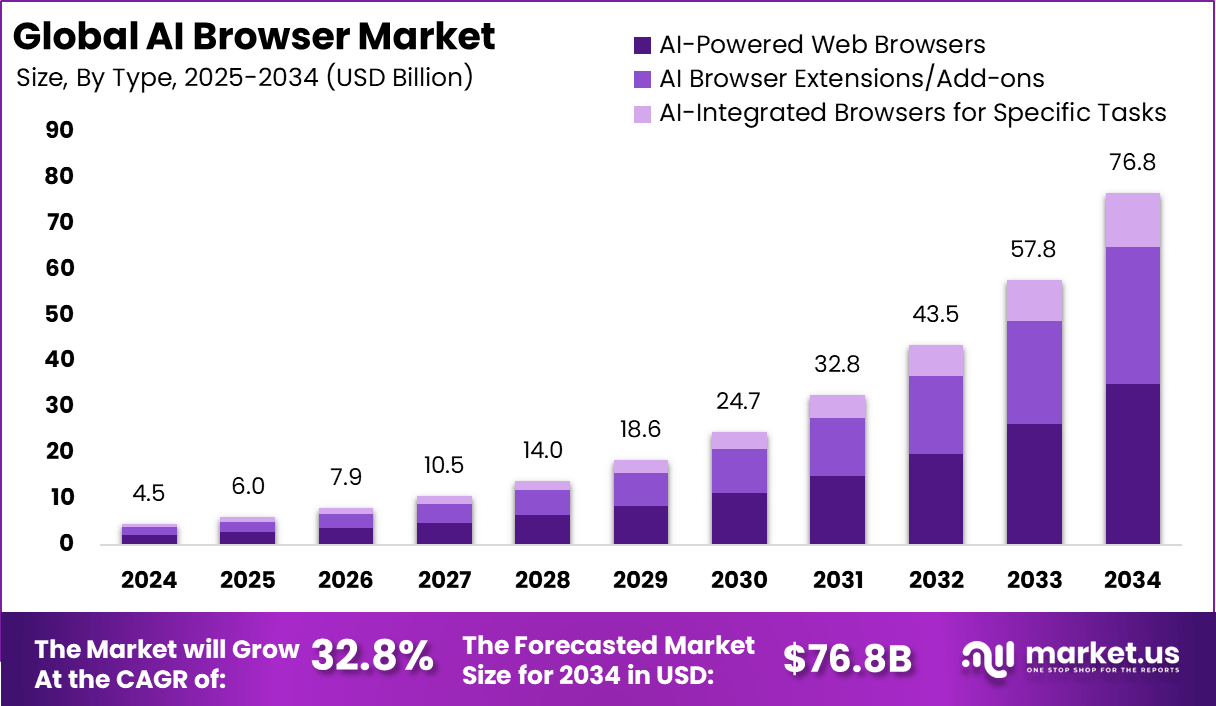
| In 2024, North America held a dominant market position, capturing more than a 36.6% share, holding USD 1.6 billion revenue. This leadership is primarily driven by early adoption of advanced AI technologies and the presence of major tech innovators based in the United States. The region has seen a rapid shift from traditional browsing methods to agent-based interfaces, particularly in enterprise settings where productivity tools are quickly integrated into workflows.
High internet penetration, widespread access to edge computing infrastructure, and robust investments in AI startups have further fueled this transformation. North America’s leadership can also be attributed to its mature digital ecosystem and strong consumer willingness to explore new interfaces. Companies in this region are increasingly focusing on privacy-respecting AI solutions, with users preferring local data processing capabilities built into AI browsers.

By Type Analysis
In 2024, AI-powered web browsers are capturing the attention of nearly half the market, with a notable 45.7% share. These browsers are designed to do much more than display web pages – they anticipate user needs, automate repetitive tasks, and provide real-time assistance.
Users are drawn to features like intelligent search, content summarization, and proactive security alerts that make browsing smoother and more productive. The appeal lies in the ability to get things done faster, whether it’s researching, shopping, or managing daily tasks online.
The growing popularity of AI-powered browsers is also fueled by the desire for personalization. People want browsers that learn their habits and preferences, offering tailored recommendations and shortcuts that save time.
As more users experience the benefits of these intelligent tools, word-of-mouth and positive online reviews are accelerating adoption. This momentum is pushing developers to release new updates and innovations at a rapid pace, ensuring that AI browsers remain at the forefront of digital convenience.
By Deployment Mode Analysis
In 2024, cloud-based AI browsers dominate the deployment landscape, accounting for 65.2% of the market. The shift to the cloud is making advanced AI features accessible to a wider audience, regardless of the device they use.
With cloud-based solutions, users enjoy seamless updates, cross-device synchronization, and the ability to tap into powerful AI models without taxing their local hardware. This flexibility is especially important as people increasingly switch between smartphones, tablets, and desktops throughout the day.
Cloud deployment also brings significant advantages for businesses and IT teams. It allows for centralized management, improved security, and easier integration with other cloud-based services. The scalability of cloud infrastructure means that even as user demand spikes, performance remains consistent.
By Technology Analysis
In 2024, natural language processing (NLP) is at the heart of 32.7% of AI browser technologies. NLP allows browsers to understand and respond to human language, making interactions more intuitive and conversational.
This technology powers features like voice search, chat-based assistance, and instant translation, enabling users to communicate with their browsers as naturally as they would with another person. The adoption of NLP is growing as users seek more human-like interactions and as businesses look to automate customer support and content discovery.
NLP’s ability to process vast amounts of data and extract meaningful insights is helping users find relevant information faster, while also making the web more accessible to people with different language backgrounds or disabilities. The ongoing improvements in NLP accuracy and speed are setting new standards for what people expect from their browsing experience.

By End-User Analysis
In 2024, enterprise users represent a commanding 76.8% of the AI browser market. Organizations are turning to AI browsers to streamline workflows, enhance productivity, and strengthen security. For enterprises, the appeal goes beyond convenience – AI browsers enable automated data collection, competitor monitoring, and real-time insights that drive better decision-making.
These tools are becoming essential for teams that need to manage large volumes of information efficiently. The high adoption rate among businesses is also driven by the need for robust security and compliance features. AI browsers can detect threats, enforce company policies, and ensure that sensitive data is handled properly.
As remote and hybrid work models become the norm, enterprises are investing in AI-powered browsers to support distributed teams and maintain a competitive edge. The result is a market where business needs are shaping the direction of innovation and setting new benchmarks for browser technology
Key Market Segments
By Type
- AI-Powered Web Browsers
- AI Browser Extensions/Add-ons
- AI-Integrated Browsers for Specific Tasks
By Deployment Mode
- Cloud-Based AI Browsers
- On-Premise AI Browsers
By Technology
- Natural Language Processing (NLP)
- Machine Learning (ML) Algorithms
- Data Mining and Analytics
- Voice Recognition and Assistance
- Others
By End-User
- Individual Consumers
- Enterprise Use
- Healthcare
- E-commerce & Retail
- IT & Telecom
- Automotive
- Food & Beverages
- Others
Key Regions and Countries
- North America
- Europe
- Germany
- France
- The UK
- Spain
- Italy
- Russia
- Netherlands
- Rest of Europe
- Asia Pacific
- China
- Japan
- South Korea
- India
- Australia
- Singapore
- Thailand
- Vietnam
- Rest of Latin America
- Latin America
- Brazil
- Mexico
- Rest of Latin America
- Middle East & Africa
- South Africa
- Saudi Arabia
- UAE
- Rest of MEA
Emerging Trend
Rise of Agentic Browsers
One of the most exciting trends in the AI browser space is the shift from simple AI features to fully agentic browsers. These new browsers do more than just respond to commands. They can independently plan and perform complex, multi-step tasks, like booking travel or gathering research, all within the browser itself.
This evolution makes browsing feel more like working alongside a smart digital assistant that understands context and adapts to your needs. The growing autonomy of these browsers is changing user expectations and setting a new standard for what people want in their online experiences.
Key Driver
Demand for Personalized and Efficient Browsing
People today expect their browsers to do more than just display web pages. The main driver behind the surge in AI browser adoption is the desire for a more personalized, efficient, and helpful online experience. Modern users want tools that can summarize content, automate repetitive tasks, and provide instant answers without the hassle of switching between tabs or apps.
This demand is especially strong among professionals and businesses looking to save time and boost productivity. The ability to tailor the browsing experience to individual needs is pushing innovation forward at a rapid pace.
Major Restraint
Privacy and Data Security Concerns
Despite all the innovation, privacy and data security remain major concerns holding back broader adoption of AI browsers. As these browsers gain more access to user data and perform actions on behalf of users, people worry about how their information is stored, processed, and shared.
The need for robust privacy controls and transparent data handling is more important than ever. Many users and organizations hesitate to fully embrace AI browsers until they are confident that their sensitive information will be protected against misuse or breaches.
Opportunity
Deep Integration with Everyday Digital Tasks
A huge opportunity for AI browsers lies in their ability to deeply integrate with daily digital activities. By connecting directly with other online services, these browsers can automate everything from filling out forms to making purchases and scheduling appointments.
This seamless integration promises to save users significant time and effort, making online tasks almost effortless. Businesses that can harness this capability will be able to offer smoother, more valuable experiences to their customers, creating new ways to stand out in a crowded digital landscape.
Challenge
Adapting to Rapidly Changing Technology and User Needs
The biggest challenge for AI browser developers is keeping up with the fast pace of technological change and shifting user expectations. As new AI capabilities emerge, browsers must constantly adapt to deliver value without overwhelming users or compromising performance.
Balancing innovation with reliability, security, and ease of use is a delicate task. Developers also face pressure to comply with evolving regulations and to ensure their products remain accessible and trustworthy for all types of users.
Key Player Analysis
The AI browser market is led by major players like Google LLC, Microsoft, and Apple Inc., who are integrating advanced AI to improve user experience. Chrome, Edge, and Safari use AI for real-time language tools, smart browsing, and personalized content. These companies benefit from large ecosystems that allow seamless AI integration into browsers, making their offerings more intelligent and user-friendly.
Firms like Mozilla, Brave Software, Inc., and Opera Norway are focusing on privacy-first AI features. Firefox is testing AI search and summaries, Brave uses machine learning to block ads and track behavior, while Opera is adding AI chat tools. These browsers are appealing to users who value security, transparency, and innovation in browsing.
Smaller players such as Vivaldi, SAMSUNG, Yandex, Pale Moon, Maxthon, and UC Browser are targeting niche needs with AI-based tools. Vivaldi uses AI for tab grouping, Samsung’s browser supports reading aids, and Yandex focuses on local language AI. These brands are adding more variety and competition in the evolving AI browser market
Top Key Players Covered
- Google LLC
- Microsoft
- Mozilla
- Apple Inc.
- Brave Software, Inc.
- Opera Norway
- Vivaldi Technologies AS
- SAMSUNG
- Yandex
- Pale Moon
- Maxthon
- UC Browser
- Others
Recent Developments
- In July 2025, a major leap in the AI browser space as Perplexity AI launched its much-anticipated browser, Comet. This new platform is designed to do more than just surf the web – it acts as a digital assistant, connecting with enterprise tools like Slack and letting users ask complex questions using voice or text.
- In June 2025, Google made headlines by rolling out its new AI Mode in Google Search for users in India, removing the need for any Labs sign-up. This AI Mode offers a smarter, more interactive search experience, letting users type, speak, or use images to get rich, AI-powered answers.
|---|