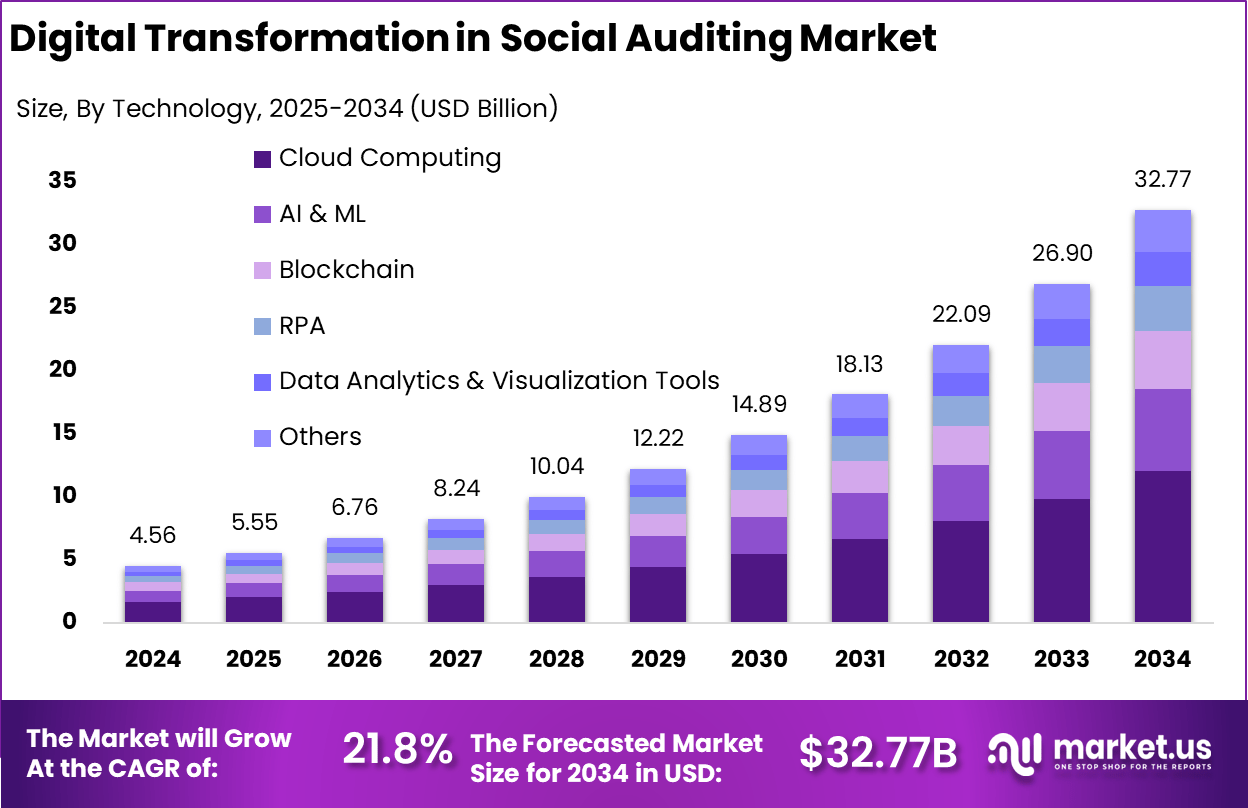
| In 2024, North America held a dominant market position in the Global Digital Transformation in Social Auditing Market, capturing more than a 38.4% share, holding USD 1.75 billion in revenue. The market holds a dominant position due to significant corporate investments in CSR initiatives, a rising demand for quality management services, and a strong emphasis on integrating social and environmental responsibilities into business strategies.
For instance, in November 2024, Trullion, a leader in AI-powered accounting and audit technology, proudly announced its recognition as one of North America’s top 15 fastest-growing companies in Deloitte’s 2024 Technology Fast 500™. This recognition highlights Trullion’s role in driving digital transformation in social auditing.
Technology Analysis
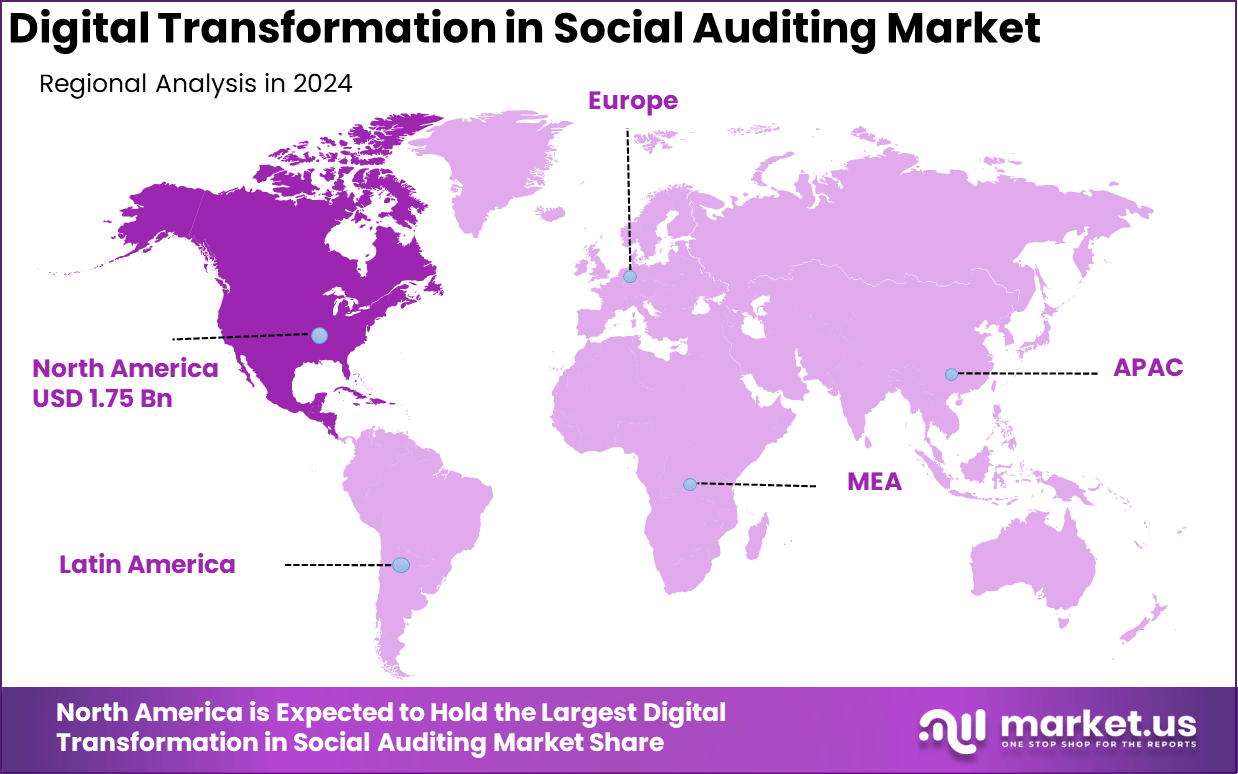
In 2024, The Cloud Computing segment held a dominant market position, capturing a 36.7% share of the Global Digital Transformation in Social Auditing Market. This dominance is due to the scalability, flexibility, and cost-efficiency that cloud solutions offer, enabling real-time data access, secure storage, and seamless collaboration across geographies.
The integration of advanced technologies like AI and data analytics into cloud computing enhances the accuracy and efficiency of social audits. Its ability to streamline audit processes while ensuring compliance and transparency has solidified its leading role in the market.
For Instance, In June 2025, Caseware introduced a next-generation cloud audit solution tailored for audit professionals in Singapore. This platform integrates real-time collaboration, automated reporting, and data analytics, allowing teams to work more efficiently and deliver insights with greater precision. By reducing manual tasks and improving accuracy, the solution helps ensure compliance and transparency.
Audit Type Analysis
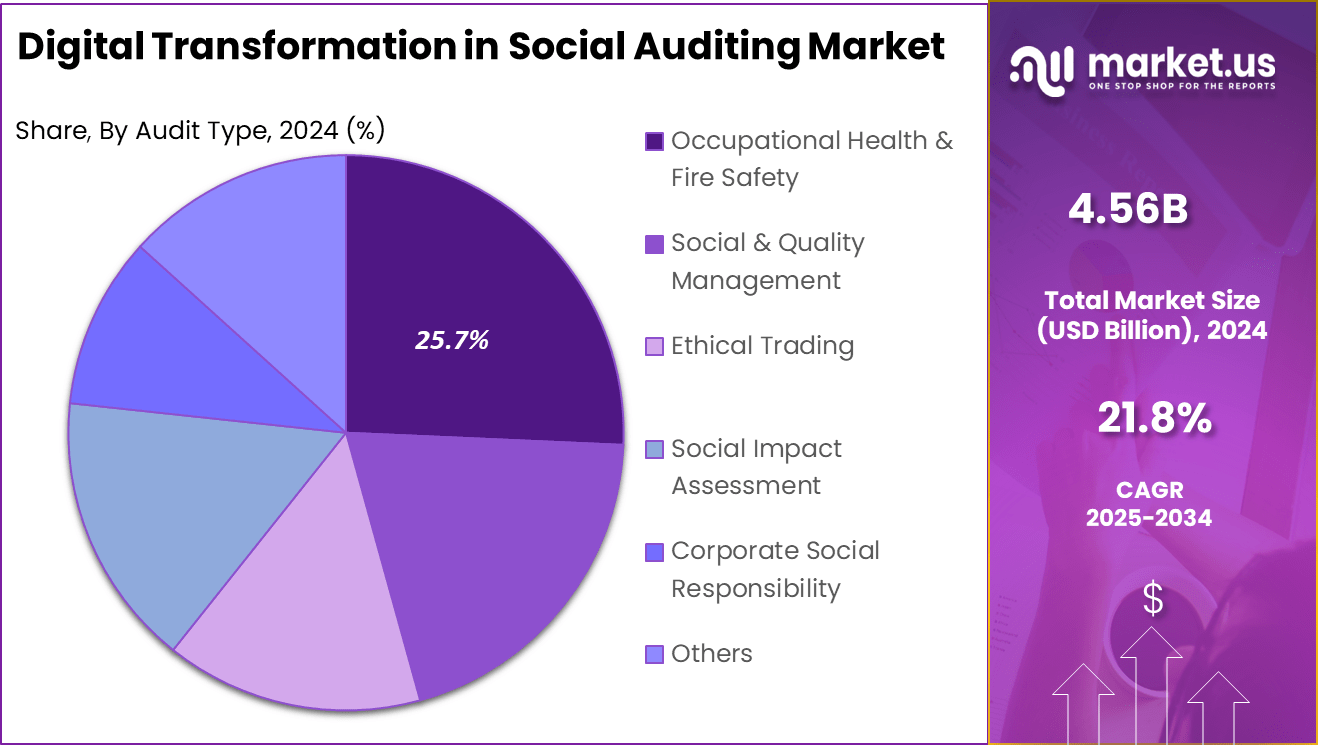
In 2024, the Occupational Health & Fire Safety segment held a dominant market position, capturing a 25.7% share of the Global Digital Transformation in Social Auditing Market. The demand in this sector has been driven mainly by the increasing focus on workplace safety standards, stricter regulatory requirements, and rising awareness of employee well-being.
Companies are leveraging digital solutions to monitor, report, and improve safety compliance in real time, ensuring both legal adherence and the protection of their workforce, which has significantly contributed to the growth of this segment.
For instance, in June 2024, Alba signed a Memorandum of Understanding (MOU) with the National Fire Protection Association (NFPA) to strengthen fire safety and occupational health measures. This collaboration is a significant step in enhancing safety standards within the workplace, ensuring that fire safety protocols and health measures are effectively integrated into operational processes.
Industry Vertical Segment Analysis
In 2024, Food & Beverage segment held a dominant market position, capturing a 21.8% share of the Global Digital Transformation in Social Auditing Market. This dominance is due to the increasing pressure on food companies to meet stringent regulatory requirements to ensure supply chain transparency and address consumer demand for sustainability and ethical sourcing.
The use of digital technologies enables immediate monitoring, tracking, and compliance with social and environmental laws, improves audit efficiency, enhances company confidence among consumers and stakeholders, and drives growth in this sector.
For Instance, in April 2025, Hummingbird Facilities earned top ratings in the BRCGS Food Safety Standard audits, demonstrating their commitment to maintaining the highest levels of food safety and compliance. This achievement highlights the critical role of rigorous auditing standards in ensuring quality and safety across the food industry.
Organization Size Analysis
In 2024, The Large Enterprises segment held a dominant market position, capturing a 68.4% share of the Global Digital Transformation in Social Auditing Market. This dominance is due to the ability of large organizations to invest in resources and their need to comply with stringent social and environmental regulations.
These enterprises place a high priority on transparency, risk management, and maintaining brand reputation, which fuels the widespread adoption of advanced digital auditing technologies. Furthermore, their focus on sustainability and meeting stakeholder expectations makes them key innovators and investors in social auditing solutions, ensuring efficiency and compliance across their complex operations.
For Instance, in April 2025, EY announced the large-scale integration of leading-edge AI technology into its global assurance technology platform. This development marks a significant step in the digital transformation of the social auditing landscape, particularly in integrating advanced technologies to drive operational improvements and transparency across industries.
Key Market Segments
By Technology
- Artificial Intelligence (AI) & Machine Learning (ML)
- Blockchain
- Cloud Computing
- Robotic Process Automation (RPA)
- Data Analytics & Visualization Tools
- Others
By Audit Type
- Occupational Health & Fire Safety
- Social & Quality Management
- Ethical Trading
- Social Impact Assessment
- Corporate Social Responsibility
- Others
By Industry Vertical
- Food & Beverage
- Oil & Gas
- Apparel & Footwear Industry
- Industrial Machinery
- Banking, Financial Services & Insurance
- Retail
- Telecom
- Others
By Organization Size
- Large Enterprises
- Small and Medium Enterprises (SMEs)
Key Regions and Countries
- North America
- Europe
- Germany
- France
- The UK
- Spain
- Italy
- Russia
- Netherlands
- Rest of Europe
- Asia Pacific
- China
- Japan
- South Korea
- India
- Australia
- Singapore
- Thailand
- Vietnam
- Rest of Latin America
- Latin America
- Brazil
- Mexico
- Rest of Latin America
- Middle East & Africa
- South Africa
- Saudi Arabia
- UAE
- Rest of MEA
Emerging Trend
AI-Driven Auditing
A major trend shaping digital transformation in social auditing is the integration of artificial intelligence and machine learning into audit processes. These advanced technologies are now being used to analyze vast volumes of data, spot unusual patterns, and identify risks more efficiently than traditional methods.
AI tools help auditors move beyond simple compliance checks, enabling them to deliver deeper insights and focus on areas that matter most for organizations. This shift is making audits more proactive and insightful, while also improving fraud detection and risk assessment in real time
Drivers
Demand for Greater Transparency
The push for more transparency and accountability in organizations is a strong driver behind the digital shift in social auditing. Stakeholders, including the public and regulatory bodies, expect clear, timely, and accurate reporting on social and ethical practices.
Digital tools make it easier for auditors to collect, verify, and report data, which in turn builds trust and strengthens the credibility of audit results. The ability to access and analyze information quickly supports better decision-making and enhances the value of audits for all parties involved
Restraint
Data Quality and Integrity Concerns
One of the main restraints slowing down digital transformation in social auditing is the challenge of ensuring high-quality and reliable data. The effectiveness of digital tools, especially those powered by AI, depends heavily on the accuracy and completeness of the data they process.
Poor data quality can lead to incorrect findings, which undermines the trust in audit outcomes. Organizations must invest in robust data management practices and continuous monitoring to address these concerns and fully benefit from digital advancements
For instance, in December 2024, a report on the OCR HIPAA audits and OIG recommendations highlighted the growing concerns surrounding data privacy and security in digital auditing. The audit findings underscore the need for healthcare organizations to enhance their compliance with privacy regulations, particularly in the handling of sensitive patient data.
Opportunities
Real-Time and Continuous Auditing
Digital transformation opens up the opportunity for real-time and continuous auditing. With cloud-based platforms and advanced analytics, auditors can now monitor activities as they happen, rather than relying only on periodic checks.
This allows for quicker identification of issues, more timely interventions, and ongoing assurance for stakeholders. Continuous auditing not only increases efficiency but also helps organizations stay agile and responsive in a rapidly changing environment
For instance, in March 2025, OLACEFS (the Latin American and Caribbean Organization of Supreme Audit Institutions) launched a digital transformation process aimed at enhancing the capabilities of audit institutions across the region. This initiative seeks to modernize audit practices by integrating advanced technologies such as AI, cloud computing, and data analytics.
Challenges
Upskilling the Audit Workforce
A significant challenge in this digital journey is equipping auditors with the right skills to use new technologies effectively. As digital tools become more complex, auditors need to develop both technical and analytical capabilities to interpret results and provide meaningful recommendations.
The need for ongoing training and adaptation can be difficult, especially for smaller firms or those with limited resources. Without the right skills in place, the benefits of digital transformation may not be fully realized, and the risk of errors or misinterpretations increases.
Key Players Analysis
SAP SE, Microsoft Corporation, and Oracle Corporation are leading players in digital transformation within social auditing. These firms offer enterprise-grade platforms that integrate auditing workflows with analytics, compliance monitoring, and ESG reporting. Their cloud-based solutions help organizations collect, manage, and visualize supplier data across global operations.
IBM Corporation, Qlik Technologies, Sisense Inc., and Tableau Software have established strong capabilities in data visualization and AI-driven insights. These companies empower businesses to assess labor conditions, ethics compliance, and supplier risk through real-time dashboards and predictive models. Their platforms support seamless integration with third-party audit data and sustainability indices, enabling continuous monitoring of social impact.
Domo Inc., Infor Inc., Zoho Corporation, ThoughtSpot, TIBCO Software, and MicroStrategy are contributing to accessible and cost-efficient digital auditing. These companies focus on self-service analytics, mobile-first interfaces, and low-code platforms that support rapid deployment. Their tools allow auditors and compliance officers to track key social metrics, generate customizable reports, and respond swiftly to violations.
Top Key Players in the Market
- SAP SE
- Microsoft Corporation
- Oracle Corporation
- IBM Corporation
- Qlik Technologies
- Sisense Inc.
- Tableau Software
- Domo Inc.
- Infor Inc.
- Zoho Corporation
- ThoughtSpot, Inc.
- TIBCO Software Inc.
- MicroStrategy Incorporated
- Others
Recent Developments
- In October 2024, CA ANZ and ACCA released a comprehensive guide aimed at enhancing the adoption of digital auditing standards across the accounting and auditing sectors. The guide focuses on integrating advanced technologies, such as AI and cloud computing, to improve audit processes, ensure transparency, and streamline compliance with evolving regulatory frameworks.
- In August 2024, Xero announced a new partnership with Caseware, a leading audit and accounting platform, to enhance its audit capabilities. This collaboration will integrate Caseware’s advanced tools with Xero’s accounting software, enabling businesses to streamline their audit processes.
|---|