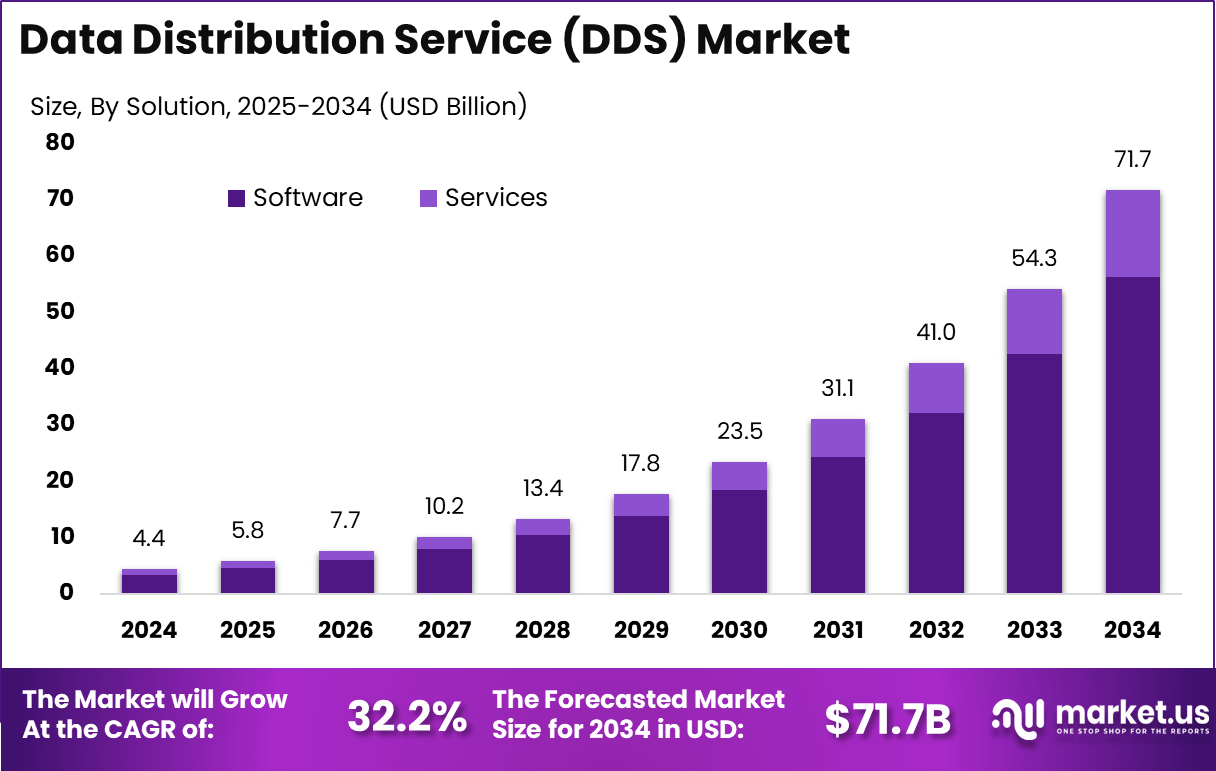
| In 2024, North America held a dominant market position in the Data Distribution Service (DDS) Market, capturing more than a 40.5% share, holding USD 1.78 billion in revenue. This dominance is due to its advanced digital infrastructure, widespread adoption of cloud and data center technologies, and the presence of leading tech providers.
The region’s focus on digital transformation, real-time and IoT solutions, and ongoing investments in automation and modernization have significantly boosted the demand for DDS platforms. Additionally, North America benefits from a mature high-speed data distribution ecosystem, strong regulatory support, and substantial R&D activity, positioning it as a global leader in DDS innovation and implementation.
For instance, in February 2025, Pivotree and DDS distributor Data Solutions announced a partnership to deliver advanced DDS solutions across North America. This collaboration highlights the region’s dominance in the DDS market, driven by the demand for scalable, real-time communication solutions in industries like retail, healthcare, and logistics.
Solution Analysis
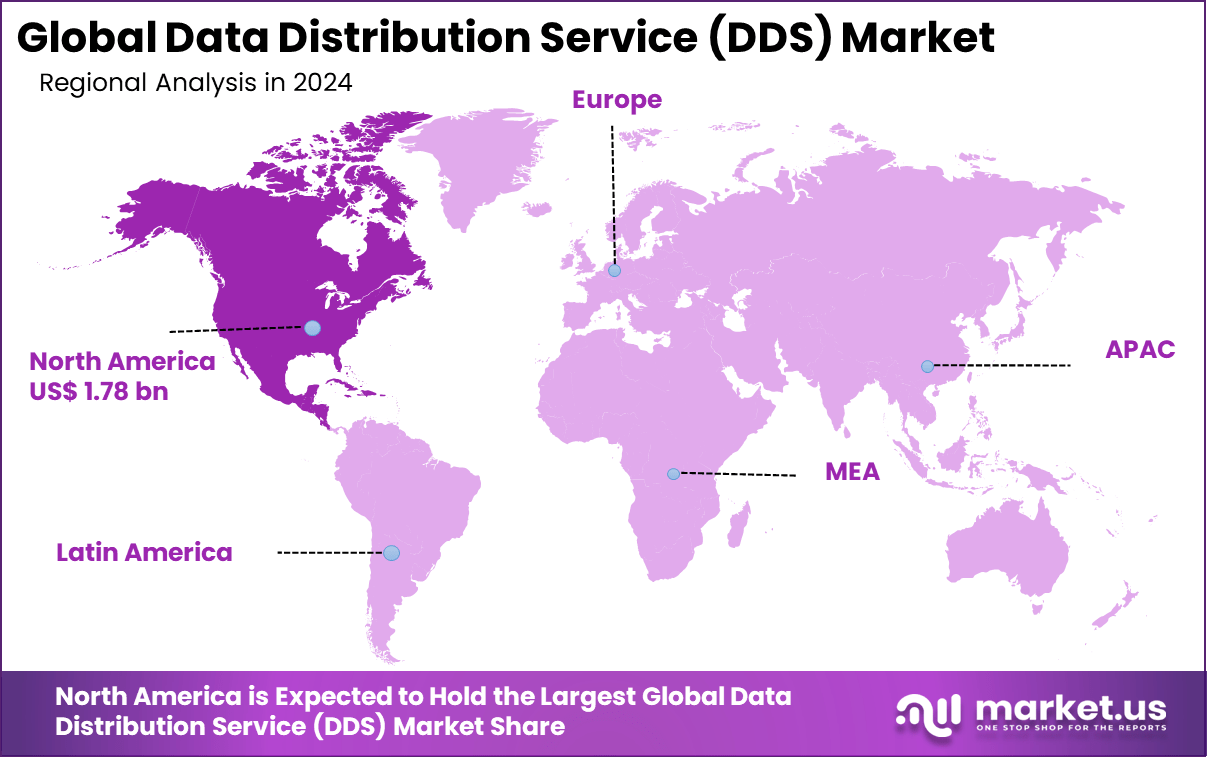
In 2024, The Software segment held a dominant market position, capturing a 78.5% share of the Global Data Distribution Service (DDS) Market. This dominance is due to the increasing need for scalable, flexible, and real-time data communication platforms that can be seamlessly integrated into various applications.
DDS software solutions are preferred across industries for their ability to handle complex data distribution with low latency, customizable Quality of Service (QoS), and cross-platform compatibility. Moreover, the growing adoption of cloud-native and edge computing architectures has further accelerated the use of DDS software, enabling smooth interoperability in distributed, real-time systems.
For Instance, in November 2024, RTI became the first DDS provider to meet all major automotive software safety standards. This achievement underscores RTI’s commitment to delivering high-performance, reliable DDS solutions that comply with stringent safety requirements, making them ideal for automotive applications where safety, real-time communication, and scalability are critical.
Enterprise Size Analysis
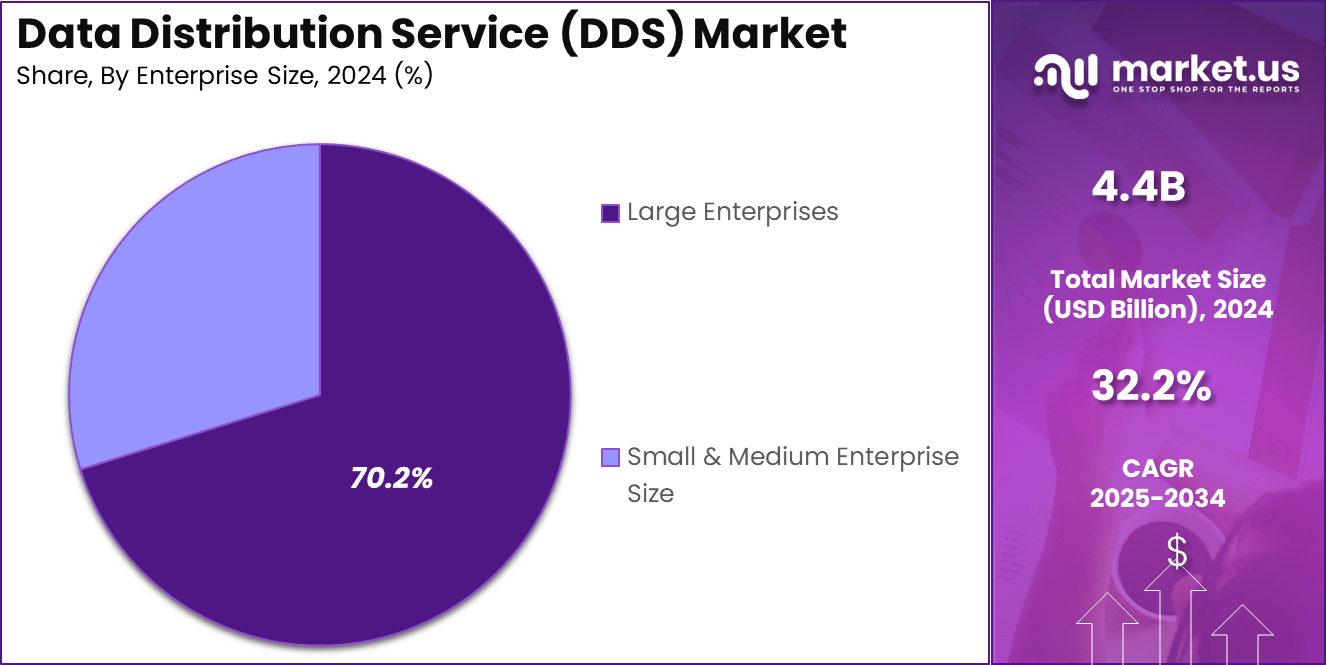
In 2024, the Large Enterprises segment held a dominant market position, capturing a 70.2% share of the DDS Market. The demand is surging due to the growing volume of data and increased investments in digital transformation and cloud-based solutions. These organizations require robust, scalable, and secure DDS platforms to manage complex IT infrastructures, facilitate real-time data exchange, and support automation for improved operational efficiency.
Large enterprises across industries such as aerospace, defense, automotive, and healthcare increasingly require DDS to ensure reliable, low-latency data exchange across their distributed systems, enabling enhanced decision-making, automation, and operational efficiency at scale.
For instance, In November 2024, XPENG Motors adopted RTI Connext Drive® for its future E/E architecture to enhance real-time data communication in advanced vehicle systems. This move supports XPENG’s focus on greater automation, scalability, and performance in its next-generation electric vehicles, showcasing the growing use of DDS in the automotive sector.
Sector Analysis
In 2024, The Telecommunications and Networks segment held a dominant market position, capturing a 34.5% share of the Global Data Distribution Service (DDS) Market. This dominance is due to the increasing demand for real-time, high-performance communication solutions within the telecommunications industry.
DDS is essential for managing the vast amounts of data exchanged across complex, distributed network systems, enabling low-latency, reliable communication. The sector’s rapid growth, driven by the expansion of 5G networks, IoT devices, and the need for efficient, scalable data distribution, has further fueled the adoption of DDS solutions.
For Instance, in July 2020, Real-Time Innovations (RTI) announced a partnership with SoC-e to integrate RTI’s Data Distribution Service (DDS) with SoC-e’s Time-Sensitive Networking (TSN) technology. This collaboration aims to enhance communication performance in distributed systems by combining DDS’s real-time data distribution with TSN’s deterministic networking features.
Key Market Segments
By Solution
- Software
- Services
- Implementation & Integration Services
- Consulting & Training Services
- Support & Maintenance Services
By Enterprise Size
- Small & Medium Enterprise Size
- Large Enterprises
By Sector
- Telecommunications and Networks
- Defense
- Virtualisation & Cloud
- Energy
- Mining
- Industrial Internet of Things (IIoT) and Robotics
- Public and Private Transportation
- Others
Emerging Trend
Integration with Edge Computing
One of the most noticeable trends in Data Distribution Service is its growing synergy with edge computing. As industries deploy an increasing number of connected devices, DDS is pivotal in enabling real-time data flow closer to the source of data generation.
This shift toward edge architectures means data processing is handled right where it is created – dramatically reducing latency and improving the responsiveness of smart factories, autonomous vehicles, and urban infrastructure. By operating efficiently at the edge, DDS empowers organizations to make instant decisions based on live data, unlocking new capabilities for automation and digital transformation.
Key Market Driver
Demand for Real-Time Data Exchange
A major reason behind the rise of DDS is the urgent industry demand for real-time, reliable data exchange across distributed systems. Whether it’s smart manufacturing, transportation, or healthcare, organizations now rely on instant information to enhance safety, efficiency, and innovation. DDS stands out because it guarantees high-speed data transmission and consistent communication, meeting the needs of mission-critical environments that cannot tolerate delays or interruptions.
Major Restraint
Complexity and Cost of Implementation
The initial cost and complexity of bringing DDS into an organization can be daunting, especially for smaller enterprises. Many businesses hesitate due to the specialized knowledge required to integrate DDS seamlessly with their existing systems.
Adapting infrastructure, training teams, and managing ongoing maintenance all contribute to this barrier. Companies often need to balance the promise of robust real-time capabilities with practical budgetary constraints and the challenge of overcoming a steep learning curve.
Opportunity
The Rise of Next-Generation Networks
The widespread adoption of 5G and advancements in network technologies have opened up a golden opportunity for DDS. With the ultra-low latency and immense bandwidth promised by next-generation networks, DDS can reach its full potential in supporting applications requiring high-speed, high-volume data movement.
For businesses focused on smart mobility, connected health, or real-time industrial control, coupling DDS with advanced network infrastructure offers a pathway to unlock new service models and business strategies.
Persistent Challenge
Security Vulnerabilities
Despite its technical strengths, ensuring the security of DDS remains a top concern. Public-facing DDS deployments have been found exposing sensitive information due to misconfigurations or outdated components.
As mission-critical systems depend more on DDS, the risks associated with unauthorized access, data leakage, or unpatched vulnerabilities become significant. This challenge calls for continuous vigilance, robust security practices, and collaboration across industry players to keep data distribution both safe and resilient.
Key Players Analysis
Real-Time Innovations and ADLINK Technology lead the DDS market with reliable, low-latency platforms for industrial, autonomous, and defense applications. Milsoft Utility Solutions and Apex Logic focus on scalable, interoperable solutions tailored for utilities and mission-critical systems. Their strong R&D and partnerships support their competitive positions.
eProsima and EUROCONTROL serve niche markets like aerospace and simulation with lightweight, standards-compliant DDS. Trend Micro adds value by integrating cybersecurity into DDS, meeting secure data needs in smart infrastructure. These players effectively target emerging real-time communication demands.
KONGSBERG and S2E Software Systems specialize in robust DDS for defense, maritime, and industrial sectors. Other emerging players offer cost-efficient, domain-specific solutions, driving innovation and expanding market reach. Together, these companies sustain growth as real-time systems adoption rises.
Top Key Players in the Market
- Real-Time Innovations
- ADLINK Technology Inc.
- Milsoft Utility Solutions
- Apex Logic, Inc.
- eProsima
- EUROCONTROL
- Trend Micro Incorporated
- KONGSBERG
- S2E Software Systems
- Others
Recent Developments
- In September 2024, eProsima launched Fast DDS 3.0, a significant update to its DDS implementation. This release enhances performance and scalability, reinforcing eProsima’s commitment to providing high-performance networking middleware for distributed systems, fully compliant with the DDS standard.
- In June 2024, at COMPUTEX 2024, ADLINK showcased advancements in edge AI solutions, emphasizing their application in smart manufacturing, healthcare, and transportation. By leveraging NVIDIA’s platforms, ADLINK demonstrated low-latency features essential for real-time data processing, aligning with DDS’s capabilities in distributed systems.
|---|