


Report Overview
Global Food Starch Market is expected to be worth around USD 37.4 billion by 2034, up from USD 22.3 billion in 2024, and grow at a CAGR of 5.3% from 2025 to 2034. Asia-Pacific’s dominance is driven by strong demand across its USD 10.5 billion market.
Food starch is a natural carbohydrate derived from sources such as corn, potato, wheat, rice, and tapioca. It is widely used in the food and beverage industry for its thickening, stabilizing, and gelling properties. When heated with water, starches swell and form a paste, making them ideal for improving the texture and consistency of sauces, soups, gravies, baked goods, and dairy products.
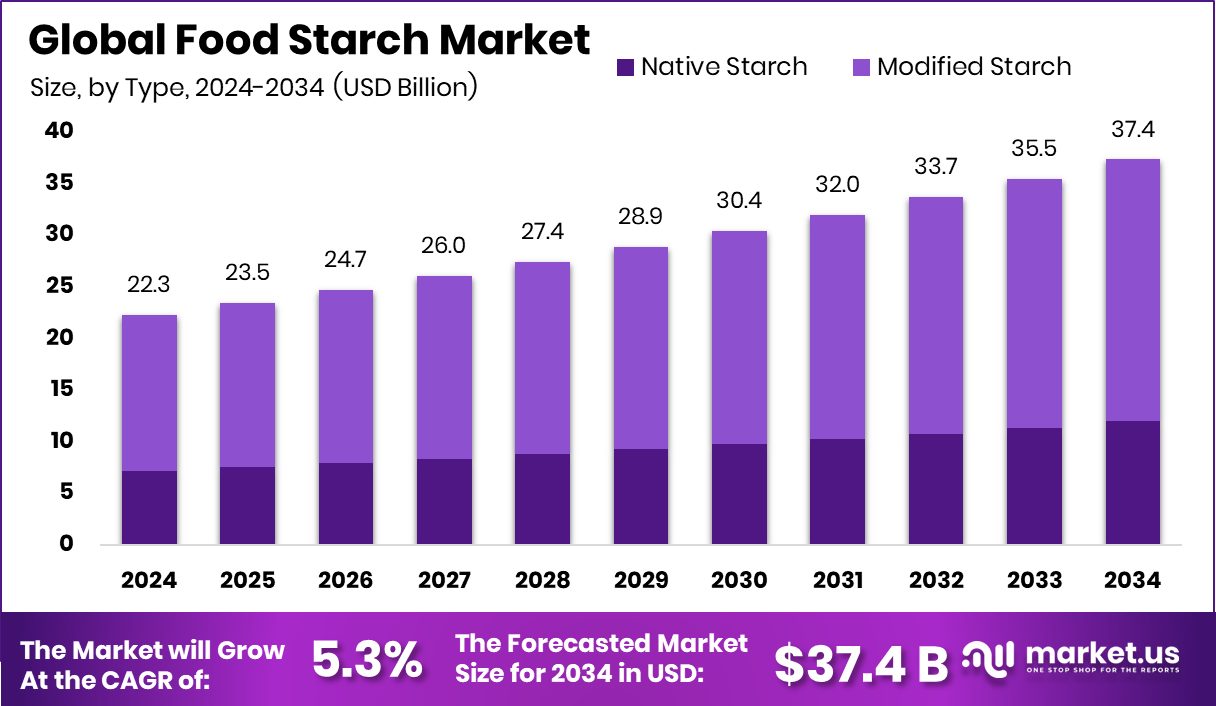
The food starch market refers to the global trade and consumption of starch-based ingredients across a wide range of food products. This market includes both native and modified starches, used in processed foods, convenience meals, snacks, and beverages. It caters to the growing demand for clean-label, plant-based, and gluten-free ingredients. The market is driven by changing consumer preferences, industrial food processing needs, and the demand for improved texture, taste, and stability in packaged foods.
The market is primarily growing due to increased consumption of processed and ready-to-eat food products. Urbanization, busy lifestyles, and rising disposable incomes have shifted dietary habits toward convenience foods that often rely on starch for texture and stability. The shift toward clean-label ingredients has also encouraged producers to reformulate products using plant-based starches. According to an industry report, A&B secures US$180,000 grant to advance NextGen sweet potato initiative.
Rising demand for gluten-free products has significantly boosted the use of alternative starch sources like rice and tapioca. Consumers with dietary restrictions or preferences are actively seeking products that maintain desirable texture and taste without gluten, which positions starch as a key substitute. The bakery, dairy, and meat processing sectors remain strong demand contributors.
Key Takeaways
- Global Food Starch Market is expected to be worth around USD 37.4 billion by 2034, up from USD 22.3 billion in 2024, and grow at a CAGR of 5.3% from 2025 to 2034.
- Modified starch dominates the food starch market, accounting for 67.9% due to its functional versatility.
- Maize is the leading source in the food starch market, contributing a 59.3% market share globally.
- Powder form holds 86.2% share, making it the most preferred format in food starch applications.
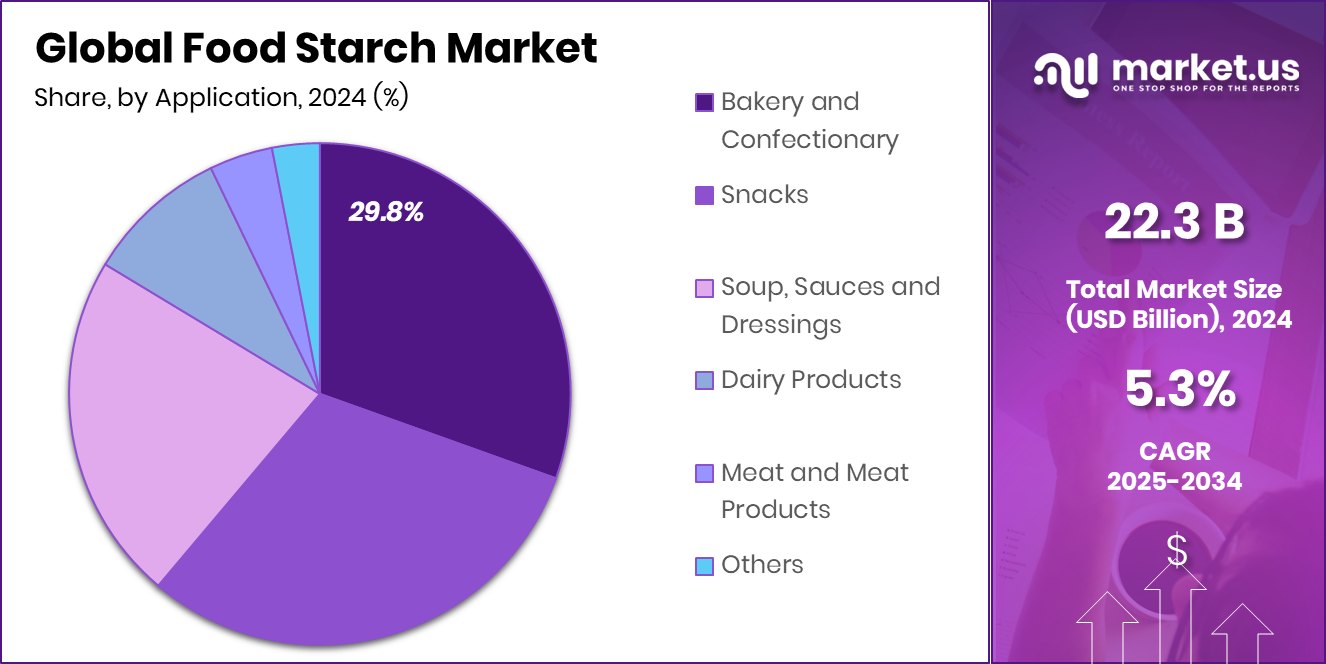
- Bakery and confectionery lead with 29.8% application share, driven by demand for texture and stability.
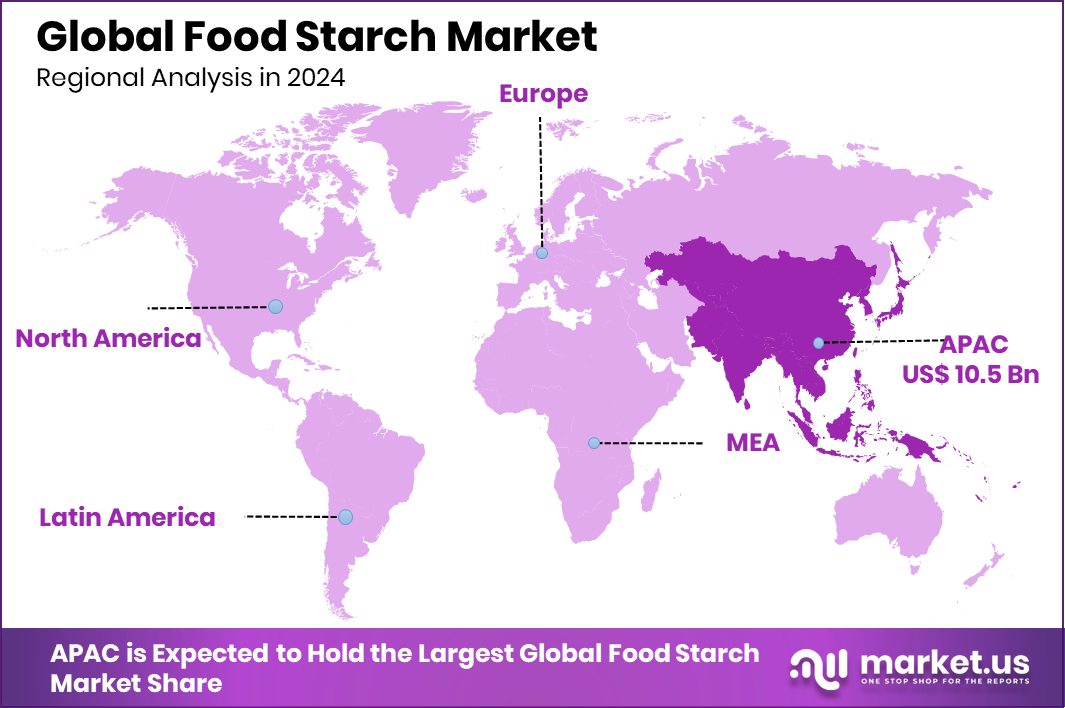
- The Asia-Pacific food starch market reached a value of USD 10.5 billion.
By Type Analysis
Modified starch holds a 67.9% share in the food starch market.
In 2024, Modified Starch held a dominant market position in the By Type segment of the Food Starch Market, with a 67.9% share. This leading position can be attributed to the versatile functional properties that modified starch offers across various food applications.
Unlike native starch, modified starch is processed to enhance characteristics such as stability, solubility, and resistance to heat, acid, or shear, making it highly suitable for modern food manufacturing requirements. Its wide adoption is evident in processed foods, including sauces, dressings, frozen meals, dairy products, and instant mixes, where consistent texture and extended shelf life are critical.
The significant share held by modified starch also reflects the growing demand for tailored food ingredients that meet industrial processing standards without compromising product quality. Food manufacturers increasingly rely on modified starches to optimize viscosity, improve freeze-thaw performance, and stabilize emulsions under variable storage and transport conditions.
Additionally, as consumer demand for convenience food rises, modified starch continues to play a key role in delivering appealing texture and mouthfeel in finished products. The ability of modified starch to adapt to evolving formulation needs has reinforced its leadership in this segment, solidifying its role as a foundational ingredient in global food processing trends.
By Source Analysis
Maize is the leading source, accounting for 59.3% share.
In 2024, Maize held a dominant market position in the By Source segment of the Food Starch Market, with a 59.3% share. This strong market presence is primarily due to the high availability, cost-effectiveness, and versatile processing characteristics of maize as a starch source.
Maize-derived starch is widely favored for its neutral taste, easy digestibility, and adaptability in both native and modified forms, making it suitable for a wide range of food applications such as bakery products, dairy formulations, sauces, snacks, and processed meats.
The dominance of maize in the source segment reflects its long-standing role as a staple raw material in starch production. It supports both functional and nutritional roles in food, serving as a thickener, stabilizer, and texture enhancer. Its compatibility with various industrial processes—such as extrusion, fermentation, and enzymatic modification—adds further value to its commercial utilization.
The scalability of maize starch production also enables manufacturers to meet large-scale demand across global food sectors. As food processors increasingly prioritize consistency and efficiency, the preference for maize as a starch source continues to rise.
By Form Analysis
Powder form dominates with 86.2% in food starch use.
In 2024, Powder held a dominant market position in the By Form segment of the Food Starch Market, with an 86.2% share. This overwhelming dominance is largely attributed to the widespread application of powdered starch across multiple food processing industries due to its ease of handling, extended shelf life, and efficient integration into dry and wet formulations.
Powdered starch is favored for its stability during storage and transportation, making it an ideal choice for large-scale commercial use in products such as instant soups, bakery mixes, sauces, and confectionery.
The powdered form enables precise measurement and consistent quality control during production, which is essential in maintaining uniformity in the texture and viscosity of final food products. Its adaptability in both native and modified variants further enhances its appeal to food manufacturers seeking tailored functional properties.
Additionally, powder starch dissolves efficiently and reacts quickly when heated, improving operational efficiency on industrial production lines. The high share held by the powder form also reflects its compatibility with modern food trends focused on convenience, ready-to-cook products, and ingredient stability.
By Application Analysis
Bakery and confectionery lead application with 29.8% market share
In 2024, Bakery and Confectionery held a dominant market position in the By Application segment of the Food Starch Market, with a 29.8% share. This leading share highlights the essential role of starch in improving the structure, texture, and shelf life of baked goods and confectionery items.
In bakery applications, starch functions as a moisture-retaining agent, enhancing softness and extending freshness in products such as bread, cakes, and pastries. Its ability to control dough viscosity and stabilize batter during processing contributes significantly to product consistency and quality.
In confectionery, starch plays a key role in shaping and forming sweets, particularly in gummy and jelly-based products, where it serves as both a gelling and thickening agent. It also aids in achieving desired chewiness, clarity, and mouthfeel, which are critical to consumer satisfaction.
The dominance of this segment reflects the consistent demand for processed sweets and baked snacks across both developed and emerging markets. As production volumes grow in response to evolving consumer preferences, the need for reliable and functional starch ingredients remains high.
Key Market Segments
By Type
- Native Starch
- Modified Starch
By Source
- Maize
- Wheat
- Potato
- Others
By Form
- Powder
- Liquid
By Application
- Bakery and Confectionery
- Snacks
- Soup, Sauces and Dressings
- Dairy Products
- Meat and Meat Products
- Others
Driving Factors
Rising Demand for Processed and Convenience Foods
One of the major driving factors for the food starch market is the growing consumption of processed and convenience foods. As urban populations expand and lifestyles become more hectic, people are looking for quick meal solutions that save time without compromising on taste or texture.
Starch is widely used in ready-to-eat meals, soups, sauces, bakery mixes, and snacks to improve consistency, thickness, and shelf stability. It also helps maintain the desired look and feel of the final product during storage and reheating.
This demand is especially strong in developing regions where changing work patterns and growing middle-class incomes are leading to increased reliance on packaged foods.
Restraining Factors
Health Concerns Over Excess Carbohydrate Intake
A key restraining factor for the food starch market is the growing concern among consumers about excessive carbohydrate consumption. As awareness increases about health issues like obesity, diabetes, and metabolic disorders, many people are starting to avoid starchy foods or reduce their intake.
This shift in dietary habits is pushing some consumers toward low-carb or keto-friendly diets, which limits the demand for starch-based ingredients. In response, food companies are being cautious in how they formulate or label products. This rising health consciousness can act as a barrier to growth, especially in health-aware urban and developed markets.
Growth Opportunity
Expanding Organic and Non‑GMO Starch Ingredient Options
A key growth opportunity in the food starch market is the rising demand for organic and non‑GMO starch ingredients. Consumers are increasingly seeking food made from naturally sourced and minimally processed ingredients. This trend opens new doors for producers and manufacturers to introduce starches labeled as “organic,” “non‑GMO,” or “USDA certified.”
These premium starch options carry a higher value and cater to health-conscious shoppers who care about transparency and sustainability. By investing in the cultivation and processing of organic corn, potato, or tapioca starch, companies can differentiate their brands and tap into a growing niche.
The potential expansion of this segment is significant, particularly in developed markets where clean‑label and traceable food ingredients are becoming consumer priorities.
Latest Trends
Clean-Label Starches Gaining More Consumer Attention
One of the latest trends in the food starch market is the growing shift toward clean-label starches. Consumers today are reading ingredient labels more carefully and prefer products with fewer, recognizable components. As a result, food companies are moving away from chemically modified starches and adopting natural, minimally processed starches derived from sources like corn, potato, rice, and tapioca.
These clean-label starches are used in soups, sauces, baby food, and snacks where natural claims are important. The trend is also supported by regulatory changes and increasing consumer awareness about food additives. This shift is pushing manufacturers to innovate with starches that offer the same functionality—like thickening and stabilizing—while meeting clean-label standards.
Regional Analysis
In 2024, Asia-Pacific led the food starch market with a 47.4% share.
In 2024, the Asia-Pacific region dominated the food starch market, accounting for the largest share of 47.4%, with a total market value of USD 10.5 billion. This leading position is supported by the region’s strong food processing industry, large population base, and increasing demand for convenience and packaged foods in countries such as China, India, and Southeast Asian nations.
The market growth is further driven by rising consumer preferences for texture-enhancing and shelf-life-extending ingredients in daily food consumption. North America also maintains a significant presence in the global food starch market, supported by steady demand for modified starches in bakery, dairy, and processed meat products.
In Europe, the market reflects consistent growth, particularly in countries emphasizing clean-label and plant-based food alternatives, where starch plays a critical role in replacing artificial additives. The Middle East & Africa region is experiencing gradual adoption of food starch, especially in urban centers where processed food consumption is increasing.
Latin America, while smaller in share, is showing emerging potential due to expanding food manufacturing activities and dietary shifts toward convenient food solutions.
Key Regions and Countries
- North America
- US
- Canada
- Europe
- Germany
- France
- The UK
- Spain
- Italy
- Rest of Europe
- Asia Pacific
- China
- Japan
- South Korea
- India
- Australia
- Rest of APAC
- Latin America
- Brazil
- Mexico
- Rest of Latin America
- Middle East & Africa
- GCC
- South Africa
- Rest of MEA
Key Players Analysis
ADM continues to reinforce its leadership through vertically integrated operations, leveraging its large agricultural footprint to secure raw materials at lower costs. It’s fully integrated value chain—from farming to ingredient production—enables consistent product quality and reliable supply. In 2024, ADM has emphasized innovation in modified starches, developing heat- and acid-resistant options suited for high-demand processed foods.
Cargill remains a formidable competitor, focusing on functional starch solutions for emerging segments such as gluten-free and clean-label foods. The company’s strategy in 2024 centers on customizing starch blends that deliver fat reduction, shelf-life extension, and texture enhancement. Its global R&D network enables rapid response to regional formulation needs. By forging strategic partnerships with food manufacturers, Cargill ensures its starch products remain integral in next-generation processed foods.
Ingredion has strengthened its market presence through specialized starch platforms such as tapioca- and potato-based systems designed for gluten-free and natural food sectors. In 2024, the company emphasized promoting clean-label native starches to meet consumer preferences. Its agility in launching organic and non-GMO starch options has resonated strongly in health-conscious markets.
Tate & Lyle has sharpened its focus on tailored functional starches with capabilities such as freeze-thaw stability and low-sugar formulations. Its expertise in texturants and emulsifiers has supported broader adoption across bakery, confectionery, and snack applications. In 2024, Tate & Lyle emphasized sustainability initiatives and responsible sourcing, enhancing its appeal among environmentally conscious clients.
Top Key Players in the Market
- Archer Daniels Midland Company
- Cargill Inc.
- Ingredion Inc.
- Tate & Lyle Plc
- Roquette Frères
- Royal Avebe
- BENEO
- Grain Processing Corporation
- Tereos SA
- Gulshan Polyols
- Cosun Beet Company
- Emsland Group
- Zhucheng Xingmao
- Global Bio-Chem
- Shandong Fuyang
- Sunar Group
- Siam Modified Starch
- Südzucker AG
- Vedan International
Recent Developments
- In August 2024, Roquette expanded its texturizing solutions by introducing four new CLEARAM® TR hydroxypropylated tapioca starches, enhancing texture, viscosity, and clarity in sauces, dairy desserts, and bakery fillings .
- In June 2024, Tate & Lyle announced plans to acquire CP Kelco, a key producer of pectin and specialty gums, for USD 1.8 billion to strengthen its range of clean‑label mouthfeel and starch-based texturants.









