| For instance, in February 2024, Starship Technologies, an Estonian autonomous delivery company, secured $90 million in a funding round co-led by Plural and Iconical. To expand into new markets and enhance its technology stack, the company has received $230 million in additional funding. Over 80 locations worldwide, including the U.S., UK, Germany, Denmark, Estonia, and Finland, have received over six million autonomous robot deliveries from the spacecraft fleet.
With a single charge, each robot can operate for up to 18 hours, using the same energy as an electric kettle to heat ten cups of tea. It has also pioneered wireless charging so robots can charge themselves between deliveries. Starship aims to enhance its AI and wireless charging infrastructure while also expanding its global delivery as a service (DaaS) offering with the new funding.
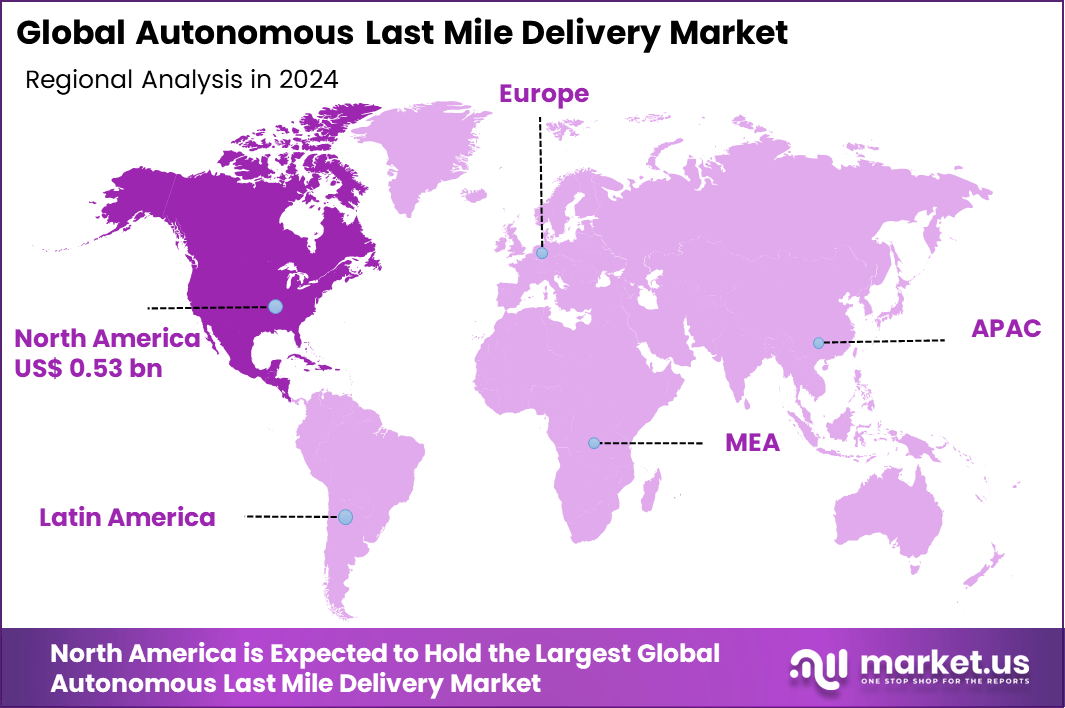
In 2024, North America held a dominant market position in the global Autonomous Last Mile Delivery Market, capturing more than a 40% share, holding USD 0.53 Billion in revenue. North America holds a dominant position in the autonomous last-mile delivery market due to a confluence of factors. It has a strong e-commerce presence, and high online shopping rates have led to vast demand for efficient delivery services.
For instance, In November 2023, Amazon launched its first 100% electric last-mile fleet program in India. Over 300 Delivery Service Partners now use custom three-wheeler EVs with built-in safety features. The program includes support for maintenance, charging, and parking, promoting cleaner deliveries and safer working conditions.
Platform Analysis
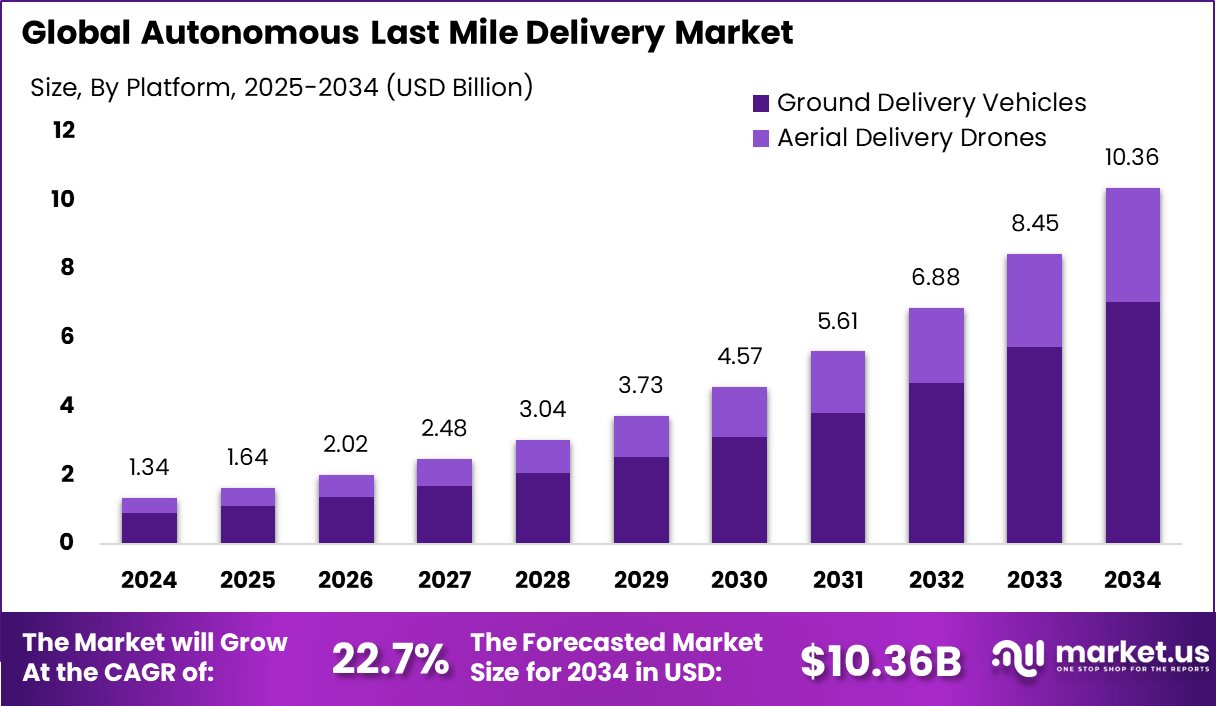
In 2024, Ground Delivery Vehicles segment held a dominant market position, capturing a 68% share of the Global Autonomous Last Mile Delivery Market. This dominance is mainly due to the cost-effectiveness, scalability, and operational efficiency of ground-based autonomous systems such as delivery robots and self-driving vans or trucks.
These vehicles are ideal for urban and suburban settings, providing a practical solution to the increasing demand for last-mile transportation services. In addition, the development of AI, robotics, and sensors has increased the capabilities of ground-delivery vehicles to operate autonomously with improved accuracy and dependability.
For instance, In November 2024, Rakuten expanded its autonomous delivery service in Tokyo’s Harumi area using advanced robots from U.S. based Avride. These robots, equipped with LiDAR and ultrasonic sensors, safely navigate sidewalks at speeds of up to 6 km/h. Residents can choose from 5,000 items, delivered in 15-minute intervals to over 90 pickup spots.
Solution Analysis
In 2024, the Hardware segment held a dominant market position, capturing a 42% share of the Global Autonomous Last Mile Delivery Market. The significance of hardware components in autonomous delivery systems is the driving force behind this dominance. Hardware that is primarily used in space exploration includes LiDAR sensors, cameras, and GPS modules, as well as processors, batteries, and special delivery containers.
These technological advancements in autonomous delivery vehicles make them more reliable, effective, and efficient in the delivery of goods in urban transportation. The considerable amount of capital needed for the design/testing and deployment of these hardware systems also contributes to making the segment the dominant player in the market.
For instance, in October 2024, Serve Robotics unveiled its third-generation autonomous delivery robots, announcing that these advanced units equipped with state-of-the-art hardware such as LiDAR, ultrasonic sensors, multiple cameras, and AI-powered computing modules entered manufacturing at that time. The company plans to deploy 2,000 of these robots across U.S. markets on the Uber Eats platform in 2025.
Range Analysis
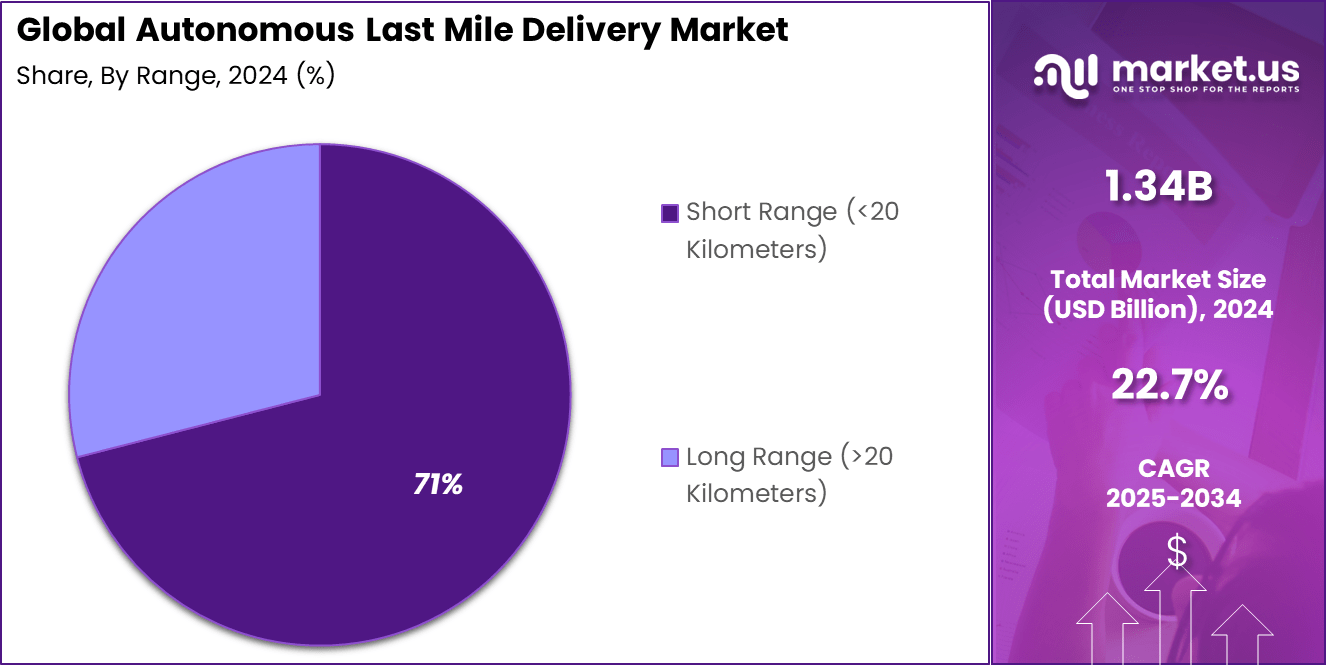
In 2024, the Short Range (<20 Kilometers) segment held a dominant market position, capturing a 71% share of the Global Autonomous Last Mile Delivery Market. This segment held a dominant position due to its suitability for urban and suburban last-mile deliveries. Autonomous delivery solutions are optimized for short distances, making them ideal for local deliveries in dense city environments.
These systems offer faster delivery times, lower operational costs, and improved efficiency, particularly for food, groceries, and small packages. Short-range autonomous delivery services are becoming increasingly popular due to the increasing need for cost-effective and efficient delivery solutions, as well as advancements in vehicle technology. This range also decreases the complexity of navigation and regulatory issues.
For instance, In March 2025, Uber Eats introduced autonomous delivery robots in Miami through a partnership with Serve Robotics. These electric robots now operate in areas like Miami Beach and Brickell for short-distance deliveries. Capable of traveling up to 11 mph and carrying 15 gallons of food, the robots serve customers from select partners such as Mister 01 and Shake Shack.
End User Analysis
In 2024, the Retail & Food segment held a dominant market position, capturing a 38% share of the Global Autonomous Last Mile Delivery Market. The Retail & Food segment held a dominant market position due to the increasing demand for faster and more efficient delivery services.
Consumers are increasingly relying on online food delivery platforms and the convenience of online shopping, which has led to the adoption of autonomous last-mile delivery systems. The integration of these technologies into logistics is becoming more prevalent in the food service sector, as retailers and other organizations seek to reduce operational expenses, improve customer satisfaction, and increase delivery speed.
For instance, In April 2025, DoorDash expanded its collaboration with Coco Robotics by deploying autonomous sidewalk delivery robots in Los Angeles and Chicago. These cooler-sized robots are built for short-distance deliveries within one mile, supporting over 600 merchant partners. The initiative aims to reduce carbon emissions and improve delivery efficiency.
Key Market Segments
By Platform
- Ground Delivery Vehicles
- Delivery Bots
- Self-driving Vans & Trucks
- Aerial Delivery Drones
- Fixed-Wing
- Rotary-Wing
- Hybrid
By Solution
By Range
- Short Range (<20 Kilometers)
- Long Range (>20 Kilometers)
By End-use
- Logistics & Transportation
- Healthcare & Pharmacies
- Retail & Food
- Others
Key Regions and Countries
- North America
- Europe
- Germany
- France
- The UK
- Spain
- Italy
- Russia
- Netherlands
- Rest of Europe
- Asia Pacific
- China
- Japan
- South Korea
- India
- Australia
- Singapore
- Thailand
- Vietnam
- Rest of Latin America
- Latin America
- Brazil
- Mexico
- Rest of Latin America
- Middle East & Africa
- South Africa
- Saudi Arabia
- UAE
- Rest of MEA
Emerging Trends Analysis
Rise of AI and Smart Routing
One of the most influential trends shaping autonomous last mile delivery is the adoption of advanced artificial intelligence and machine learning to optimize delivery routes in real time. These systems can interpret data from weather, traffic, and customer behavior to calculate the most efficient routes for drones, vehicles, and robots, increasing speed and enhancing resource use.
This not only makes deliveries quicker but also helps reduce overall operational costs and environmental impact. The trend stretches beyond just technology, influencing how companies can predict and respond to consumer demand more accurately, which leads to greater satisfaction for customers and smoother delivery operations.
Driver Analysis
Changing E-Commerce and Consumer Expectations
A key driver energizing this industry is the dramatic rise in e-commerce, which has changed what people expect from delivery services. Shoppers are now demanding quicker, more reliable deliveries with high visibility and less human interaction, especially for items arriving at their doorstep. This shift in habit urges businesses to embrace technologies that promise fast, contactless drop-offs.
Autonomous delivery systems respond to this call, providing goods efficiently any time of day, and offer greater convenience for end consumers. Such changing habits are making logistics companies prioritize investments and innovations in automated delivery technologies that deliver on these promises.
Restraint Analysis
Regulatory and Infrastructure Barriers
While the technology holds promise, regulatory and infrastructure limitations present a real challenge. For fully autonomous delivery systems to work safely, they need roads, curb space, air corridors, and operational zones adapted to new vehicles and drones.
Many cities still lack reliable infrastructure or clear regulations to support these technologies, which leads to uncertainty, delays, and potentially higher costs as organizations wait for clearer rules or invest in new infrastructure. The slow pace of regulatory change and lack of harmonized rules are becoming significant speed bumps for wider adoption.
Opportunity Analysis
Expanding Services in Underserved Areas
There is a remarkable opportunity for autonomous last mile delivery to shine in places where traditional delivery faces either high costs or logistical hurdles, such as rural, remote, or hard-to-reach locations. Drones and self-driving robots can navigate areas where regular vehicles struggle or where there is limited road access.
By deploying these technologies, companies can bring essential goods to communities faster and more frequently, and even help during emergencies or when human delivery is limited, making these innovations not just profitable but genuinely impactful for society at large.
Challenge Analysis
Safety and Consumer Acceptance
Even with all the innovation, the industry faces an ongoing challenge to assure the safety of these vehicles and win over the trust of the public. People are understandably cautious about sharing sidewalks and streets with robots or drones.
Ensuring that these machines can reliably detect obstacles, interact safely with pedestrians, and respond correctly to unexpected situations is critical. Building confidence with communities through transparent operations, regular safety updates, and positive customer experiences is vital so that technology and society can progress together.
Key Players Analysis
Alibaba, Amazon.com, and FedEx are leading the Autonomous Last Mile Delivery market with strong logistics infrastructure and heavy investment in robotics. Alibaba has expanded its fleet of delivery bots across urban regions. Amazon continues testing drones and sidewalk robots for faster, contactless delivery. FedEx has introduced autonomous ground bots to enhance same-day services.
UPS, Kiwibot, Yandex, and Zipline are making notable progress. UPS has partnered with robotics firms to automate short-range routes. Kiwibot operates widely on campuses. Yandex focuses on AI-driven navigation, while Zipline specializes in drone deliveries, especially for healthcare.
DHL, DPDgroup, and Drone Delivery Canada are expanding their autonomous delivery pilots. Flytrex, Matternet, and Starship Technologies are pushing innovations in both aerial and ground-based systems. Firms like Robby Technologies, Relay Robotics, SkyDrop, and Udelv are refining route automation and safety. Together, these players are accelerating the transition toward efficient and sustainable last mile delivery.
Top Key Players in the Market
- Alibaba
- FedEx
- com
- Kiwibot
- UPS
- Yandex
- Zipline
- com Inc.
- Continental AG
- DHL (Deutsche Post AG)
- DPDgroup (La Poste)
- Drone Delivery Canada
- Flytrex Inc.
- Matternet
- Relay Robotics Inc.
- Robby Technologies Inc.
- SkyDrop
- ST Engineering Aethon Inc.
- Starship Technologies
- Udelv Inc.
- Others
Recent Developments
- In May 2025, Amazon unveiled seven new robots at its Dortmund delivery station to boost safety and speed in package handling. These innovations represent the company’s broader push toward automation in logistics.
- In January 2025, RoboSense and Coco Robotics formed a strategic alliance to improve last-mile delivery. RoboSense’s advanced perception systems now power Coco’s delivery fleet, enhancing obstacle detection and navigation. That same month, NEOLIX secured a key license for unmanned vehicle operations in Chengdu, expanding its presence across major Chinese cities.
- In February 2025, Avride launched sidewalk delivery bots for Uber Eats in Jersey City. This move followed earlier deployments in Austin and Dallas, part of a broader partnership integrating Avride’s robotic technologies into the Uber platform to streamline urban deliveries.
- In October 2024, Wing Aviation and Serve Robotics partnered to pilot a hybrid delivery system, combining AI-powered sidewalk robots with drones to scale autonomous food delivery.
|---|