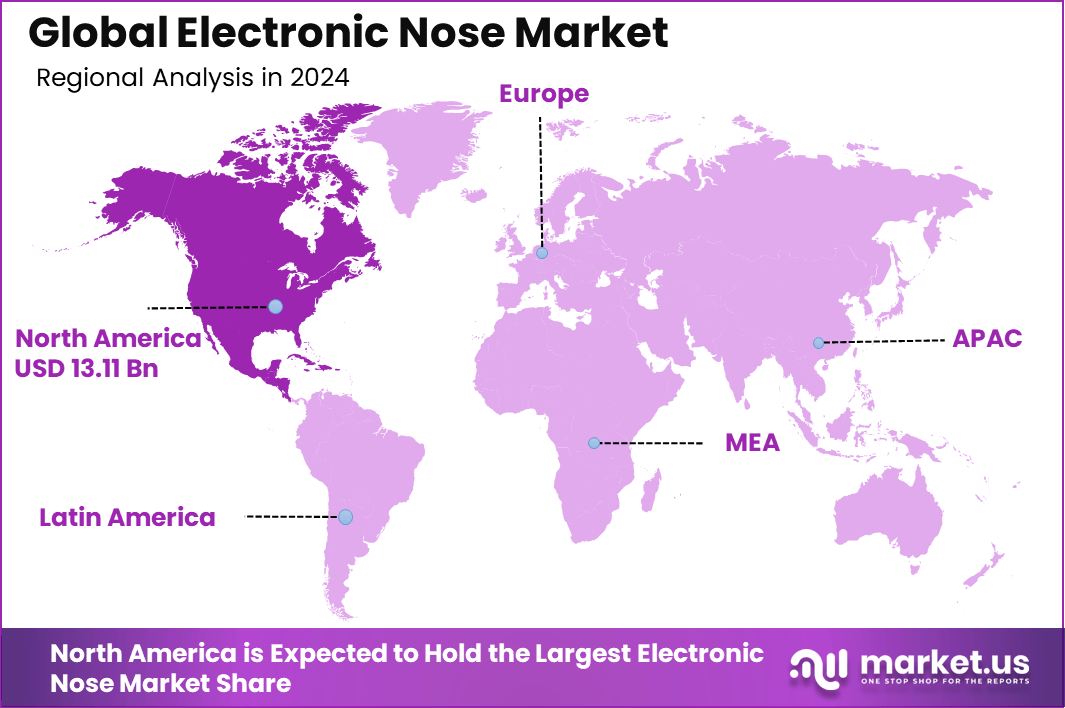
| In 2024, North America held a dominant market position in the Electronic Nose market, capturing more than a 32.7% share, generating USD 13.11 billion in revenue. This leadership can be attributed to the region’s strong adoption of advanced technologies, high investments in research and development, and a well-established manufacturing base.
The growing demand for electronic noses in industries such as food and beverage, healthcare, and environmental monitoring has been a key driver of this growth. Additionally, the presence of major players in the region, along with significant government and private sector investments, has further solidified North America’s market dominance.
By Product Type
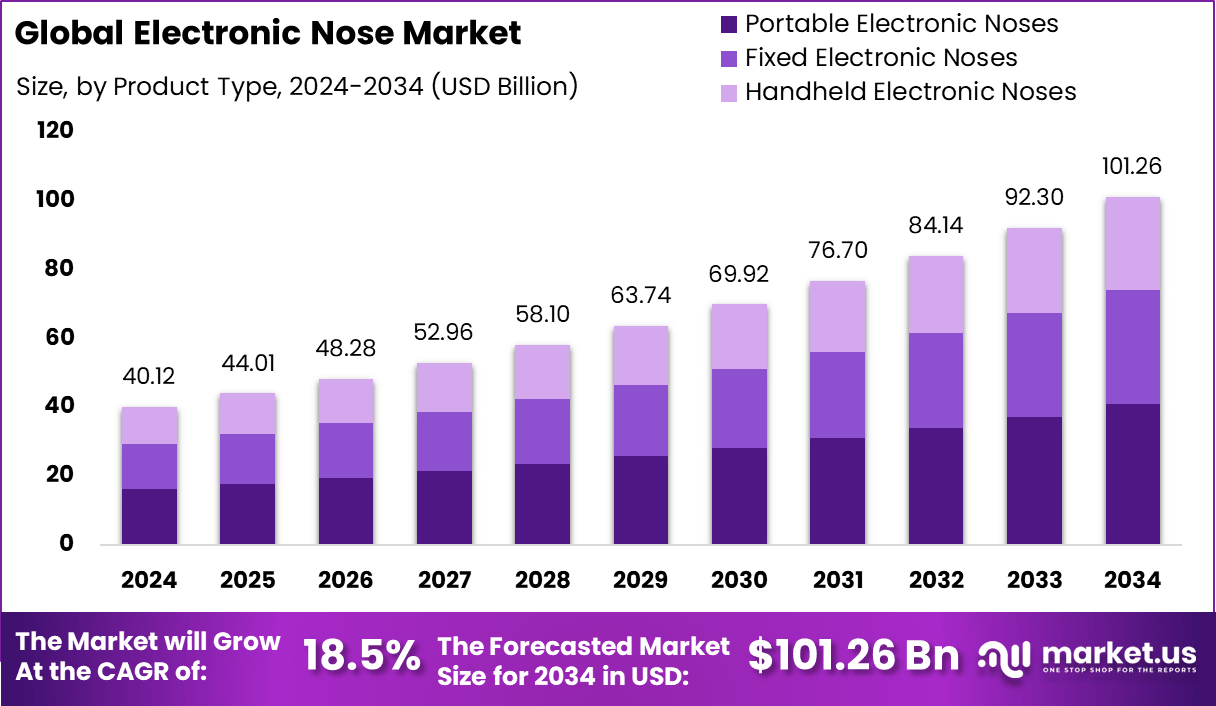
Portable Electronic Noses (40.4%)
Portable electronic noses have emerged as a game-changer in the electronic nose market, comprising the leading segment by product type with a market share of 40.4%. The main reason behind their popularity stems from their convenience and flexibility. Unlike bulky stationary systems, portable e-noses are lightweight, easy to transport, and suitable for on-site evaluations – perfect for industries where immediate or field testing is crucial.
This portability is particularly important for sectors like food safety, environmental monitoring, and emergency response, where quick decision-making directly impacts outcomes. These devices are not only convenient but also empower professionals to conduct complex odor analyses without specialized laboratory settings.
The ability to carry out diagnostics or quality checks directly at the source saves both time and resources, making portable e-noses an attractive investment. Ultimately, their growing adoption signals a broader trend towards mobility and adaptability in scientific instruments, reflecting the shifting needs of today’s fast-paced industries.
By Application
Food & Beverage Industry (32.6%)
The food and beverage industry stands out as the primary application area for electronic noses, securing a 32.6% market share. This is largely because companies in this sector are under constant pressure to guarantee product quality, maintain freshness, and detect contamination before products reach consumers.
Electronic noses serve as vital tools for these tasks, whether it’s checking the ripeness of fruit, ensuring the consistency of flavors, or detecting spoilage earlier than traditional methods can. Moreover, as consumer expectations for quality rise and regulatory standards become stricter, the reliance on objective, rapid-testing solutions like e-noses increases.
These devices help manufacturers maintain high standards, reduce product recalls, and foster a reputation for reliability. Their role is only expected to expand as the food industry increasingly turns to automation and technology-based quality control for a competitive edge.
By Sensor Technology
Metal Oxide Semiconductor (MOS) Sensors (25.7%)
Metal Oxide Semiconductor (MOS) sensors represent the leading sensor technology in the electronic nose market, holding a 25.7% share. The reason for their dominance is twofold: MOS sensors are both highly sensitive to a wide range of volatile compounds and cost-effective to produce. This makes them suitable for a diverse array of applications – from detecting gases in industrial processes to identifying spoilage in food products.
Furthermore, MOS sensors are appreciated for their robustness and relatively simple design, which translates to reliable performance even in challenging environments. Their widespread adoption is a testament to their adaptability and effectiveness, qualities that manufacturers prioritize as they strive for higher accuracy and reliability in odor detection technology.
By Form Factor
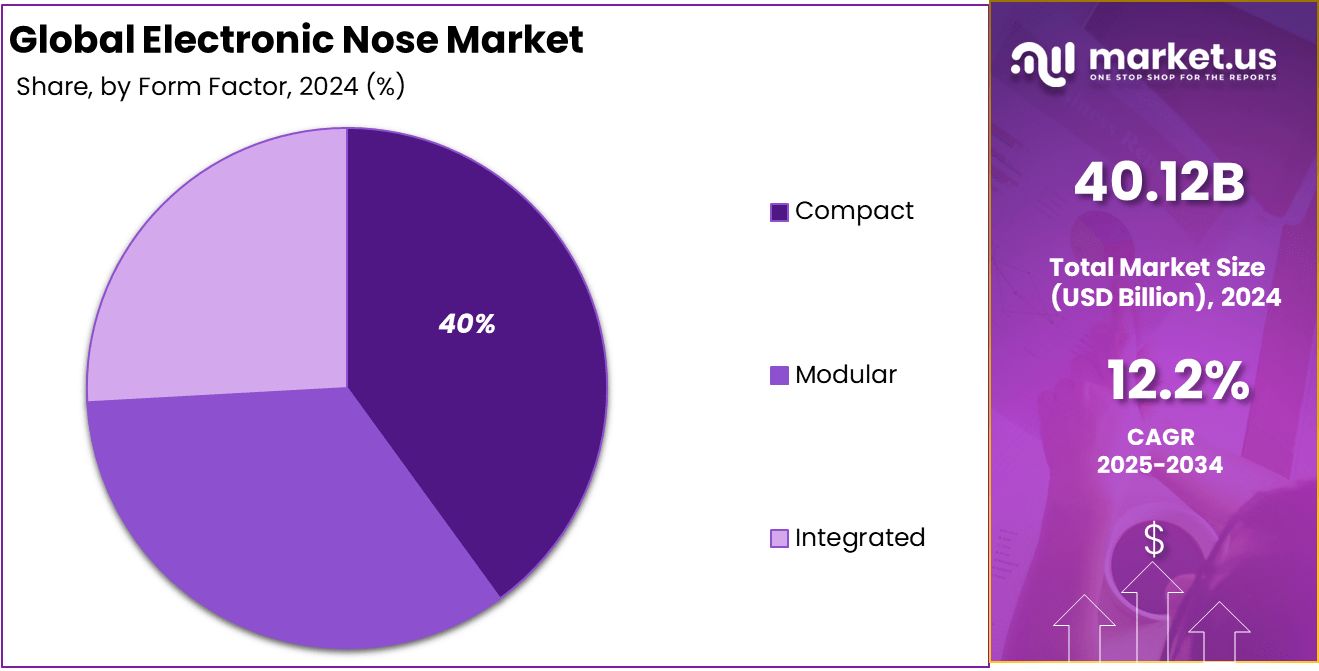
Compact (40.2%)
The preference for compact electronic noses is evident with this form factor leading at 40.2% market share. The appeal lies in their ability to provide advanced functionality while occupying minimal space – a factor that benefits laboratories, processing facilities, and portable field operations. Compact e-noses integrate seamlessly into existing workflows without requiring substantial modifications or new infrastructure.
Additionally, this trend towards compactness aligns with the broader miniaturization observed in today’s tech landscape. As scientific instruments become smaller yet more powerful, the demand for space-saving solutions grows. Compact e-noses enable businesses to deploy sophisticated sensing technology in areas previously constrained by space or budget, thus widening access and driving market expansion.
Key Market Segments
By Product Type
- Portable Electronic Noses
- Fixed Electronic Noses
- Handheld Electronic Noses
By Application
- Food & Beverage Industry
- Medical & Healthcare Industry
- Environmental Monitoring
- Defense and Security
- Industrial Manufacturing
By Sensor Technology
- Metal Oxide Semiconductor (MOS) Sensors
- Polymer Sensors
- Conductive Polymer Sensors
- Surface Acoustic Wave (SAW) Sensors
- Piezoelectric Sensors
By Form Factor
Key Regions and Countries
North America
Europe
- Germany
- France
- The UK
- Spain
- Italy
- Russia
- Netherlands
- Rest of Europe
Asia Pacific
- China
- Japan
- South Korea
- India
- Australia
- Singapore
- Thailand
- Vietnam
- Rest of APAC
Latin America
- Brazil
- Mexico
- Rest of Latin America
Middle East & Africa
- South Africa
- Saudi Arabia
- UAE
- Rest of MEA
Drivers
Rising Adoption of Electric Vehicles (EVs)
Growing consumer demand for food quality control is one of the major drivers behind the rapid adoption of electronic nose technology in the food and beverage industry. With increasing consumer expectations about safety, freshness and quality of food products, businesses are moving towards electronic nose for precise and non-invasive quality control.
For instance, Alpha MOS, a leader in electronic nose technology, has developed innovative sensor solutions that help food manufacturers to continuously monitor and maintain product quality. Their system is used extensively in the food industry for taste and aroma profiles, as well as to detect unwanted chemicals or deteriorating agents, thus ensures the product integrity.
Restraint
Limited Sensor Accuracy and Sensitivity
The limited sensor accuracy and sensitivity to the electronic nose presents a significant challenge for their widespread adoption and application in various industries. These devices, while revolutionary, often struggle to achieve high levels of accuracy required for some complex functions, such as medical diagnosis and food quality control.
For instance, in healthcare applications, electronic nose is being detected to detect the disease through respiratory analysis. However, breathing samples can be challenging to receive frequent accuracy in identifying biomarkers, especially when various compounds overlap or are present in low concentrations.
In the food and beverage industry, a highly sensitive sensor is required to detect a subtle gap in aroma and taste. Unfortunately, many electronic nose currently encounter issues with time flow, which reduces sensitivity, which compromises their credibility.
Opportunities
Integration with IoT and Smart Devices
Electronic nose integration with IOT and smart devices is one of the most exciting opportunities for the global electronic nose market. This synergy enables real -time data collection, analysis and monitoring in various applications, including environmental detection to healthcare diagnostics.
For instance, in smart homes, electronic nose can be used to detect harmful gases such as carbon monoxide or even to analyze air quality, which warns residents about potential hazards. As IOT systems are rapidly connected, these devices can send immediate alert to users’ smartphones or other smart devices, making homes safe and more efficient.
In agriculture, IOT-integrated electronic can monitor the condition of nose crops, detect early signs of the disease or deteriorate through smell analysis. By connecting these systems with smart sensors, farmers can take action in real time, reduce waste and improve crop yields.
Growth Factors
- Technological Advancements: The continuous evolution of sensor technology, in association with Artificial Intelligence (AI) and machine learning, is improving the accuracy and reliability of electronic nose. As the sensors become more sensitive and AI algorithms are more sophisticated, this equipment are able to detect and analyze more accurately, providing their adoption in various industries including healthcare, food security and environmental monitoring.
- Growing Demand in Healthcare: The healthcare industry presents an important development opportunity for the electronic nose market. Electronic nose can detect the disease biomarker in the human breath, which can enable non-invasive and initial stage diagnosis for diseases such as cancer, diabetes and respiratory disorders. As the healthcare provider wants innovative ways to improve the care of the patient, the demand for these clinical equipment is expected to increase.
- Rising Focus on Food Safety and Quality Control: Electronic nose is rapidly used for quality control in the food and beverage industry, with consumers being more health-conscious and high standards of food security. These devices help deteriorate, detection of contamination and ensure stability in taste and aroma, which are essential for brand reputation and consumer trust.
- Increasing Environmental Concerns: Growing global focus on environmental stability has promoted the demand for electronic nose under air quality supervision. These devices can detect pollutants, dangerous gases and chemicals in the air, supporting environmental protection efforts. As governments and organizations increase the rules to reduce pollution, the use of electronic nose for environmental monitoring is expected to expand.
Key Players Analysis
WAGEM Monitoring Systems, Tiger Nose Associates, and Cyranose are key players in the Electronic Nose market. WAGEM focuses on odor monitoring for industrial air quality, while Tiger Nose develops sensor arrays for detecting volatile compounds. Cyranose stands out for its portable e-nose devices used in real-time chemical detection, offering reliable field diagnostics across multiple sectors.
SPEC Sensors, Odotech, and Owlstone Medical contribute to medical and environmental advancements. SPEC Sensors creates compact gas sensors, Odotech delivers odor monitoring for waste management, and Owlstone leads in breath-based diagnostics. Bedfont further supports non-invasive medical testing through its breath analysis instruments.
Aryballe Technologies, Alpha MOS, and Ionicon Analytik are advancing digital scent detection. Aryballe uses biosensors and AI for food and fragrance testing. Alpha MOS offers e-nose systems for quality control, and Ionicon provides high-precision gas analyzers. Players like Cambridge Sensotecs, Smiths Detection, and Airsense Analytics also play critical roles in expanding e-nose applications across safety, food, and healthcare domains.
Top Key Players in the Market
- WAGEM Monitoring Systems
- Tiger Nose Associates
- Cyranose
- SPEC Sensors
- Odotech
- Owlstone Medical
- Bedfont
- eNose Company
- Aryballe Technologies
- Cambridge Sensotecs
- Delphian Corporation
- Aethon
- Airsense Analytics
- Alpha MOS
- Smiths Detection
- Ionicon Analytik
- Others
Recent Developments
- In November 2024, a study in Science Advances revealed an electronic nose capable of detecting odors at speeds similar to a mouse’s olfactory system. It distinguishes scents by analyzing the unique patterns they form on the sensor over time. This development marks a major step in mimicking biological scent recognition through artificial means.
- In February 2024, Ariese introduced the PEN, a portable electronic nose designed to identify gases and gas mixtures. It uses a wide range of sensors and is applicable in environmental monitoring, industrial safety, and healthcare diagnostics.
- By April 2024, engineers at Princess Sumaya University for Technology (PSUT) built a prototype e-nose to detect bacteria and microbes in food. This device aims to improve food safety in public venues such as malls, schools, and airports, particularly protecting vulnerable groups like children and travelers.
- In January 2024, researchers in Taiwan developed an AI-based e-nose that identifies different types of coffee with 98% accuracy. Created at the National Kaohsiung University of Science and Technology, the device leverages machine learning algorithms to recognize complex aroma profiles.
- In August 2023, Odotech launched an enhanced version of its odor monitoring technology, which expands the potential for real-time tracking of odor emissions in waste management. This innovation aims to help municipalities manage odor emissions more efficiently.
|---|