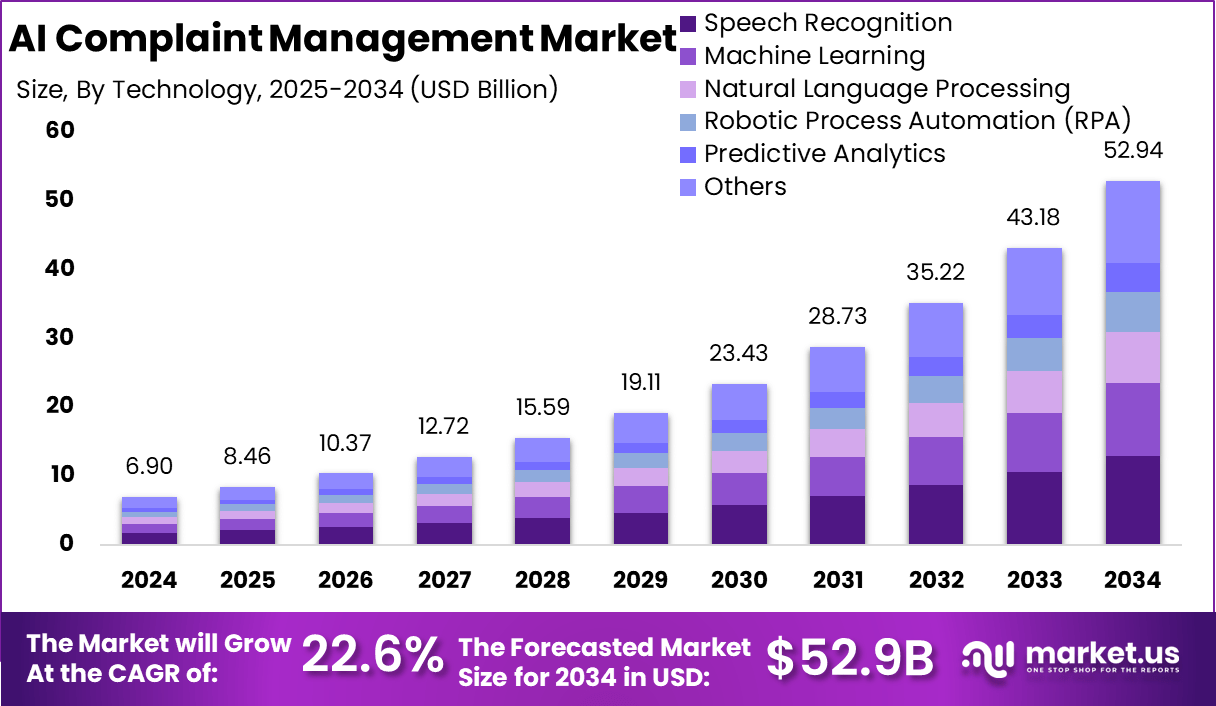
| By Technology
Speech recognition technology has emerged as a transformative tool in the AI complaint management market, accounting for 22.5% of the segment’s revenue share. The adoption of speech recognition is primarily fueled by its ability to convert customer voice complaints into structured data in real time.
This capability accelerates complaint categorization, ticket generation, and case routing, drastically reducing response times and enhancing the overall customer experience. Integrating speech recognition with customer relationship management (CRM) platforms allows organizations to personalize responses, tap into historical customer data, and deliver proactive solutions efficiently.
Additionally, speech recognition enables round-the-clock support, handling multiple complaints simultaneously without increasing headcount. For instance, national helplines and multinational enterprises are leveraging AI-driven voice solutions to support customers in various languages and regions, reflecting the segment’s pivotal role in making complaint management more accessible and efficient.
By Deployment
The cloud deployment segment has emerged as the clear leader in the AI complaint management market for 2024, securing the largest share of global revenue. Cloud-based solutions are increasingly favored by organizations of all sizes as they provide unmatched accessibility, allowing stakeholders to access, manage, and resolve complaints from virtually anywhere and at any time.
This accessibility enhances response times, making complaint resolution more efficient and improving customer satisfaction. Cloud platforms are also celebrated for reducing the operational burden of maintaining on-premises infrastructure. They eliminate the need for significant upfront investment and ongoing hardware management, offering flexible pricing models that scale as organizational needs grow.
These solutions integrate seamlessly with existing business and management systems, streamlining workflows and ensuring that data from multiple channels – such as email, chat, social media, and voice – can be unified for comprehensive analysis and faster resolution. Another compelling factor behind the dominance of cloud deployment is the support for automation and workflow optimization.
By Application
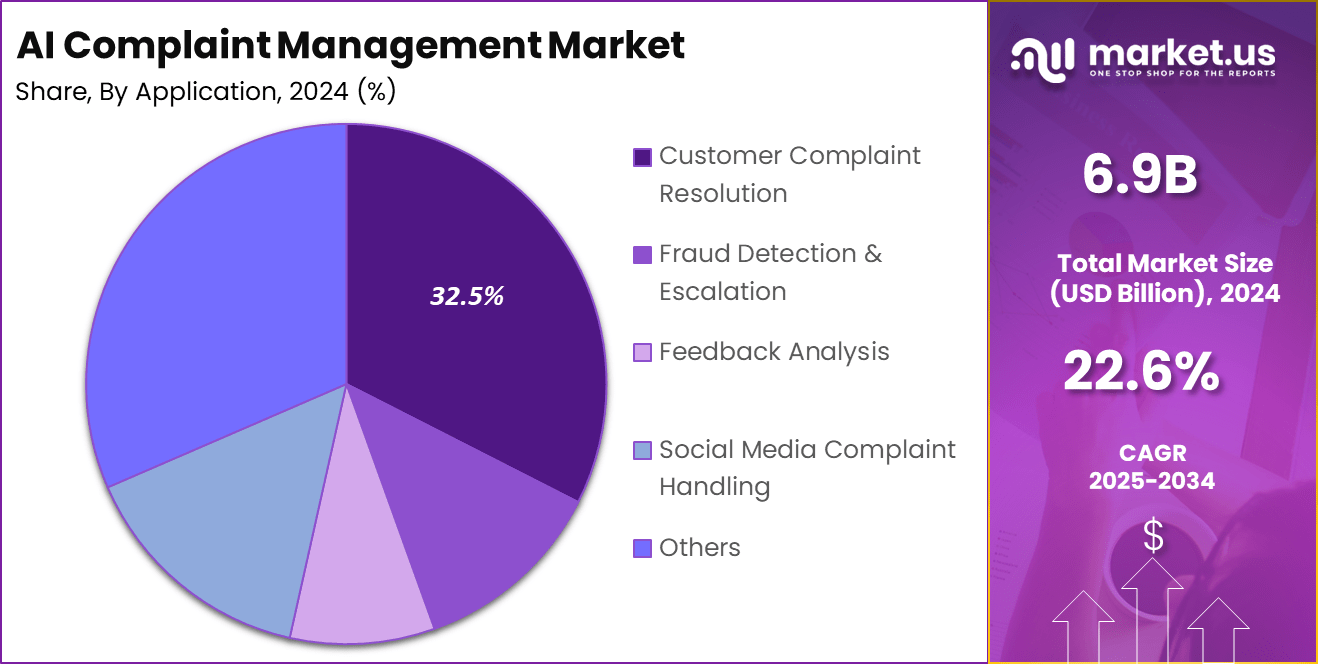
The customer complaint resolution segment holds the largest share in the application category, accounting for 32.5% of AI complaint management deployments. Businesses are rapidly adopting AI-powered tools to automate ticket sorting, prioritize based on urgency, and provide real-time escalation paths.
These advancements result in faster, more consistent resolution of issues, minimizing operational bottlenecks and improving customer satisfaction rates. AI-driven systems can recognize sentiment, urgency, and context from every complaint, optimizing how businesses assign and resolve cases.
Furthermore, AI application in customer complaint resolution transforms reactive support into a proactive function. By analyzing historical data and complaint patterns, AI systems help identify recurring problems and propose preventative measures, enabling organizations to refine their services and products. This shift not only resolves complaints more efficiently but also strengthens customer relationships and brand loyalty in the long run.
By Vertical
Telecommunications stands out as a leading vertical, contributing 25.8% to the overall market share for AI complaint management solutions. Telecom companies manage vast volumes of service requests and technical grievances daily, necessitating robust AI-driven tools to maintain service quality and customer retention.
These organizations deploy AI to automate categorization, prioritize and route complaints, and integrate virtual assistants to provide instant support for common issues. Given the sector’s reliance on customer satisfaction amidst fierce competition, AI-based solutions help telecom operators promptly resolve technical faults, billing disputes, and network outages.
This not only alleviates pressure on call centers but also improves customer trust by ensuring transparent and timely service. As telecommunications companies continue to digitize operations and scale, AI-powered complaint management will remain an essential driver of efficiency and customer-centric service delivery.
Key Market Segments
By Technology
- Natural Language Processing
- Machine Learning
- Robotic Process Automation (RPA)
- Speech Recognition
- Predictive Analytics
- Others
By Application
- Customer Complaint Resolution
- Fraud Detection & Escalation
- Feedback Analysis
- Social Media Complaint Handling
- Others
By Deployment
By Vertical
- IT & ITES
- Hospitality & Travel
- Healthcare and Life Sciences
- Retail & E-commerce
- BFSI
- Government and Public Sector
- Telecommunications
- Others
Key Regions and Countries
- North America
- Europe
- Germany
- France
- The UK
- Spain
- Italy
- Russia
- Netherlands
- Rest of Europe
- Asia Pacific
- China
- Japan
- South Korea
- India
- Australia
- Singapore
- Thailand
- Vietnam
- Rest of Latin America
- Latin America
- Brazil
- Mexico
- Rest of Latin America
- Middle East & Africa
- South Africa
- Saudi Arabia
- UAE
- Rest of MEA
Emerging Trend
Proactive and Omnichannel AI Integration
A prominent trend in AI complaint management is the rise of proactive solutions that leverage multiple communication channels. Modern systems are evolving to not just react to issues as they arise but to actually anticipate dissatisfaction by monitoring real-time data from both traditional interactions and connected devices.
This omnichannel approach means customer complaints can be detected earlier, often by analyzing signals from emails, social media, chat, and even IoT devices. Such integration offers quicker responses and helps to resolve issues before they escalate, setting a new standard in the customer experience landscape.
As tech-savvy consumers expect seamless communication, centralized dashboards are allowing businesses to piece together a more holistic view of customer journeys. This results in tailored resolutions and a stronger ability to spot pattern-based issues. Companies adapting to this trend are finding themselves better equipped to meet rising customer expectations while driving operational efficiency and continuous feedback-driven improvement.
Key Driver
Enhancing Customer Satisfaction Through Personalization
A core driver fueling the adoption of AI in complaint management is the need for improved customer satisfaction. Businesses have realized that personalized, rapid complaint resolution is essential for building trust and loyalty. With AI’s capabilities in sentiment analysis and anomaly detection, organizations can now identify urgent complaints and respond with empathy and tailored solutions.
Systems are able to parse customer input accurately, categorize grievances, and even recommend appropriate actions to human agents, ensuring that no one-size-fits-all response leaves a customer dissatisfied. The result is a noticeable shift in company aspirations: moving from simply closing complaints to forging meaningful relationships with customers.
By promptly addressing specific concerns, businesses not only minimize frustration but also turn each complaint into an opportunity for deeper engagement. This positive experience often translates into greater loyalty and word-of-mouth recommendations, both of which are vital for sustaining a competitive edge.
Notable Restraint
Limitations in Understanding Human Emotion
Despite significant progress, AI systems still grapple with the challenges of recognizing the full spectrum of human emotion. While automated tools deftly analyze keywords and resolve routine issues, they often fall short in grasping sentiment in complex or sensitive scenarios. AI might miss cultural subtleties, idiomatic expressions, or the emotional depth present in a customer’s complaint, leading to responses that feel robotic or impersonal.
Customers routinely express frustration with purely automated interactions during emotionally charged situations. Many still prefer reaching a human agent who can offer understanding and flexible support. Organizations using AI in complaint management must therefore ensure the right human-AI balance, keeping staff engaged for intricate or high-emotion cases to complement, rather than replace, the strengths of technology.
Major Opportunity
Harnessing Data for Predictive and Continuous Improvement
A compelling opportunity for organizations is the use of AI-driven analytics to predict problems and create a culture of continual enhancement. With access to large volumes of structured and unstructured customer feedback, AI can identify emerging issues, recurring complaints, and hidden pain points.
This enables organizations to address root causes proactively, often before complaints even occur, and to adjust products or processes in real time for better outcomes. Furthermore, these analytics foster data-driven decision-making across departments, guiding training needs, product redesign, or communication strategies.
By shifting from reactive problem-solving to predictive improvement, businesses reduce complaint volumes and boost satisfaction, making their complaint management system a strategic growth asset rather than just a support tool.
Persistent Challenge
Balancing Automation, Ethics, and Privacy
A persistent challenge in AI complaint management is the need to strike a careful balance between automation, ethical considerations, and data privacy. As organizations collect and analyze more personal information, questions arise about transparency, data handling practices, and the potential for improper use.
Customers want to know how their data is processed, why AI-driven decisions are made, and how fairness is ensured. Any lack of clarity risks eroding trust and incurring regulatory penalties for mishandling data or failing to explain outcomes clearly. Organizations also face the challenge of maintaining meaningful human oversight alongside automated systems.
As AI applications grow in complexity, they must be rigorously audited for bias, accuracy, and compliance with evolving regulations. Only by prioritizing ethical use and robust privacy controls can companies safely harness the full potential of AI in complaint management, creating systems that are not just efficient but also trusted by those they serve.
Key Player Analysis
In the AI complaint management market, Microsoft, Oracle, and SAP SE have established a strong foothold by offering AI-powered enterprise solutions integrated into broader CRM and ERP ecosystems. These companies leverage advanced NLP, machine learning, and data analytics to automate complaint resolution, enhance agent productivity, and deliver real-time insights. Their platforms are widely adopted across sectors such as finance, telecom, and retail.
Zendesk, Inc., Freshworks Inc., and Salesforce Inc. have gained significant traction by focusing on user-friendly interfaces and quick deployment capabilities. Their AI-based tools assist in sentiment detection, auto-ticket routing, and omnichannel support. These platforms are especially popular among mid-sized businesses seeking efficient complaint handling without heavy IT investment.
Zoho Corporation, NICE Ltd, Kustomer, Inc., and Verint Systems Inc. are positioning themselves through specialized AI offerings tailored to customer engagement and operational efficiency. Their focus includes real-time behavior tracking, conversation analytics, and proactive issue identification. These firms cater to businesses seeking customizable, privacy-compliant, and cost-effective solutions.
Top Key Players Covered
- Microsoft
- Oracle
- SAP SE
- Zendesk, Inc.
- Freshworks Inc.
- Salesforce Inc.
- Zoho Corporation Pvt. Ltd.
- NICE Ltd
- Kustomer, Inc.
- Verint Systems Inc.
Recent Developments
- In March 2025, Zendesk launched its Agentic AI-powered Resolution Platform to enhance customer service by blending AI and human expertise. The platform features adaptive AI agents, a robust knowledge graph, seamless integrations, and no-code customization tools. Its outcome-based pricing ensures customers pay only for resolved cases, emphasizing service effectiveness.
- Also in March 2025, Oracle upgraded its Financial NLP Investigation Hub with advanced Agentic AI capabilities. These enhancements automate investigative tasks, generate detailed narratives, and recommend actions. This reduces manual work and improves both the speed and accuracy of financial crime investigations.
|---|