


Report Overview
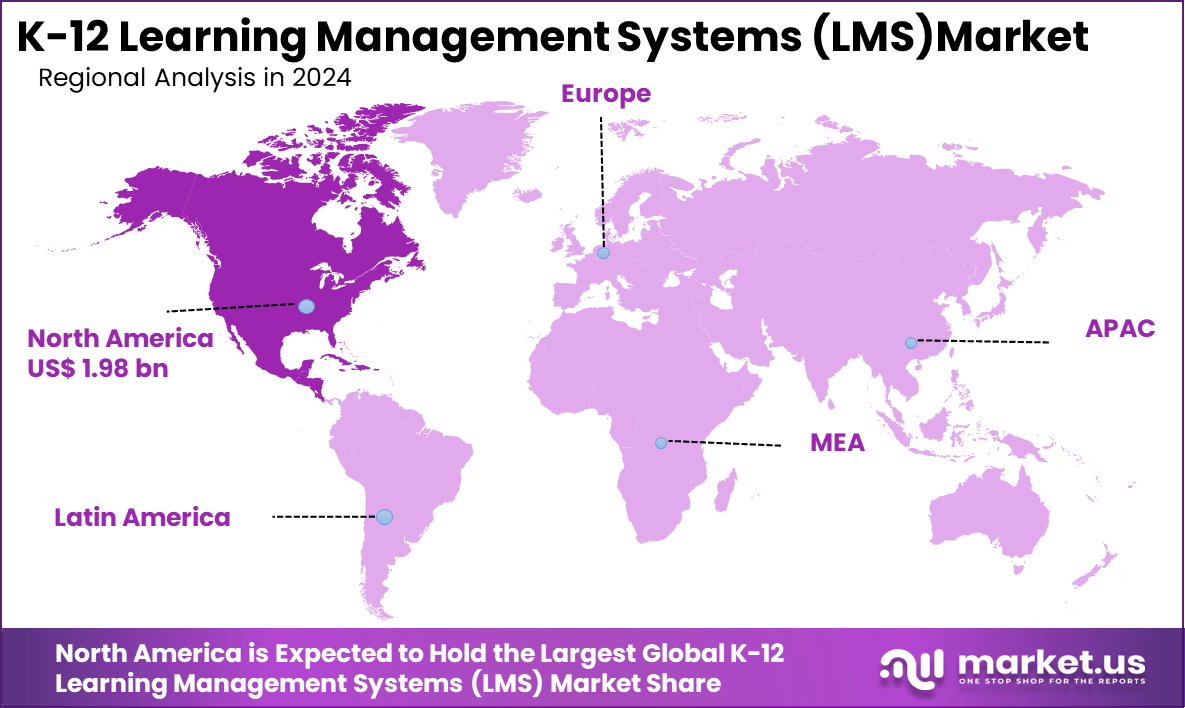
The Global K-12 Learning Management Systems (LMS) Market size is expected to be worth around USD 33.5 billion by 2034, from USD 5.5 billion in 2024, growing at a CAGR of 19.8% during the forecast period from 2025 to 2034. In 2024, North America held a dominant market position, capturing more than a36% share, holding USD 1.98 billion in revenue.
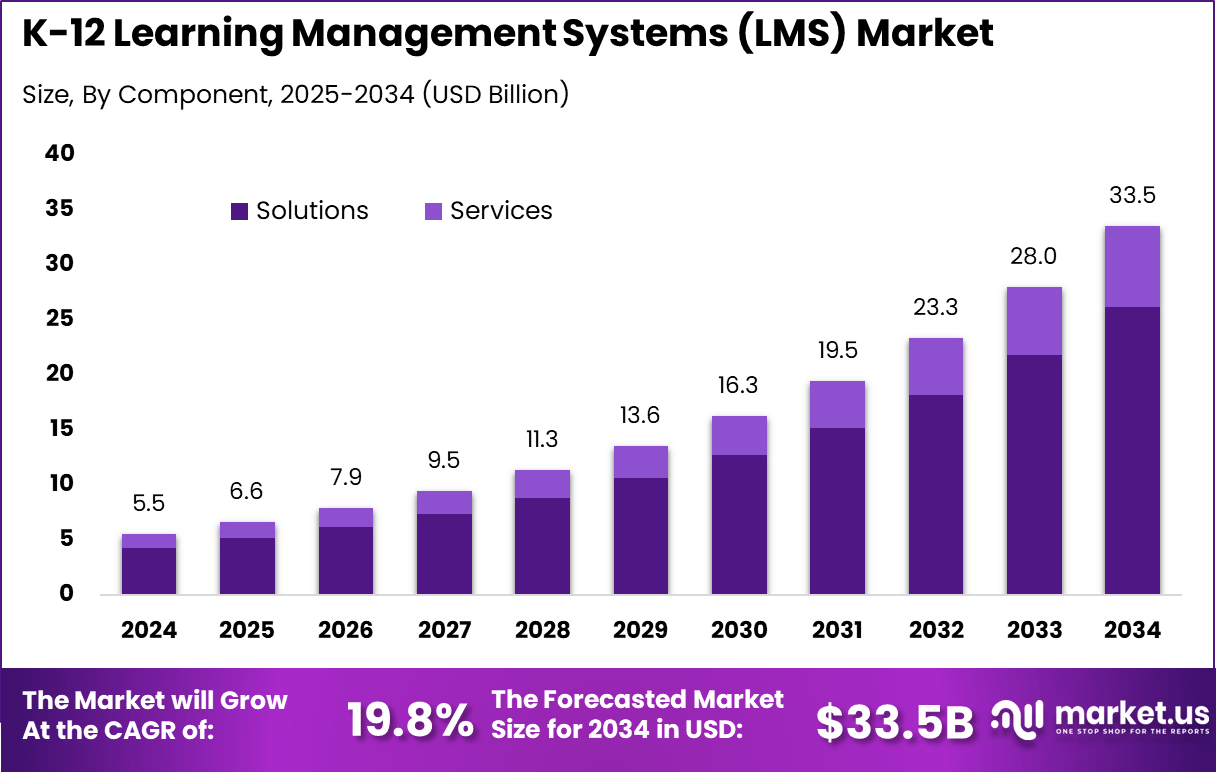
The K-12 Learning Management Systems (LMS) market centers on digital platforms specially designed to manage, organize, and deliver educational content for students from kindergarten through twelfth grade. These platforms have reshaped the educational landscape by providing streamlined access to learning materials, tools to track student progress, and avenues for communication and collaboration between teachers, students, and parents.
One of the top driving factors behind this market’s rapid growth is the surge in digital integration within classrooms. Schools are embracing technology to create more engaging and interactive learning experiences, simplify resource management, and address the growing need for flexible and remote education. After the COVID-19 pandemic, the role of LMS became even more crucial, as institutions urgently shifted to online and hybrid learning models to maintain academic continuity.
For instance, in July 2025, Instructure announced a global partnership with OpenAI to embed advanced AI capabilities directly into its Canvas LMS platform. This collaboration aims to enhance teaching and learning through intelligent tutoring, automated feedback, and real-time content generation while maintaining strict data privacy controls. The integration is designed to support educators with personalized insights and reduce administrative workload.
Scope and Forecast
| Feature/Trend | Details |
|---|---|
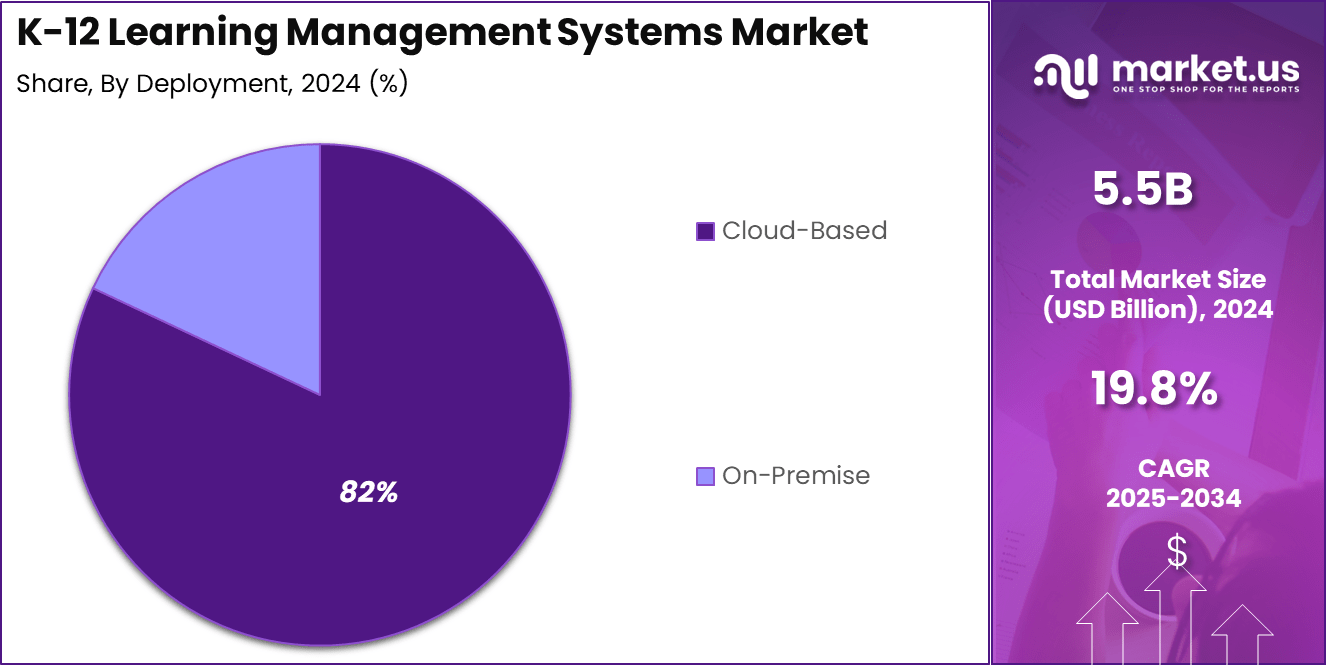
| Cloud-based Deployment | Scalability, accessibility, and cost-effectiveness make cloud-based LMS dominant. |
| Mobile & Multi-device Access | Growing demand for learning on smartphones and tablets. |
| AI & Personalization | Adaptive learning paths, AI-driven recommendations, and automated assessments. |
| Gamification & Engagement | Use of interactive modules, badges, and rewards to boost student motivation. |
| Data Analytics & Reporting | Advanced dashboards for real-time student performance and progress tracking. |
| Integration & Interoperability | Seamless plug-ins with curriculum standards, school systems, and third-party tools. |
| Mixed Reality & Immersive Learning | Integration of AR/VR for enhanced interactivity and experiential learning. |
| Focus on Microlearning | Trend toward concise, modular, bite-sized content tailored for K–12 learners. |
| Enhanced Parental Engagement | Tools for progress monitoring, messaging, and at-home support. |
Key Market Segments
By Component
- Solutions
- Curriculum Management
- Content Authoring Tools
- Student Performance Tracking
- Assessment & Testing Solutions
- Communication & Collaboration Tools
- Services
- Implementation & Integration
- Training & Support
- Consulting
By Deployment
- Cloud-Based
- On-Premise
Key Regions and Countries
- North America
- US
- Canada
- Europe
- Germany
- France
- The UK
- Spain
- Italy
- Russia
- Netherlands
- Rest of Europe
- Asia Pacific
- China
- Japan
- South Korea
- India
- Australia
- Singapore
- Thailand
- Vietnam
- Rest of Latin America
- Latin America
- Brazil
- Mexico
- Rest of Latin America
- Middle East & Africa
- South Africa
- Saudi Arabia
- UAE
- Rest of MEA
Drivers
Increasing Digital Adoption in Learning
The landscape of K–12 education has been fundamentally changed by the swift adoption of digital and blended learning methods. A growing demand for flexible, scalable platforms in schools enables them to manage virtual classrooms, monitor students’ progress, and provide engaging content.
The use of Learning Management Systems (LMS) has become an essential component, enabling teachers to tailor instruction and improve learning outcomes. This structural necessity arises due to changing educational expectations and the ongoing policy emphasis on digital transformation in global educational systems.
For instance, in October 2024, Seesaw and D2L Brightspace announced a strategic partnership to deliver a unified learning experience spanning early elementary through high school. This integration aims to support educators with consistent tools, streamline workflows, and enhance student progression across grade levels. The partnership reflects a growing trend toward comprehensive, age-spanning digital learning ecosystems in K–12 education.
Restraint
Infrastructure & Digital Divide
Persistent digital infrastructure gaps hinder widespread LMS adoption, especially in rural or underserved regions. Insufficient broadband connectivity, insufficient hardware availability, and unstable connectivity hinder the efficiency of platforms and user participation.
These inequities lead to a fragmented market where technologically advanced institutions move quickly, while others face difficulties with fundamental implementation. To ensure equal access and the systemic integration of technology into K–12 education across all segments of society, it is imperative to close this digital divide.
for instance, In November 2024, India’s Ministry of Education revealed a 29% internet access gap between rural and urban schools, exposing critical digital infrastructure challenges. This divide limits the effective rollout of K–12 LMS platforms in underserved areas. Poor connectivity, lack of devices, and unreliable power supply remain key barriers to equitable digital education.
Opportunities
Integration with Advanced Technologies
The strategic integration of LMS platforms with advanced technologies such as artificial intelligence, learning analytics, and student information systems presents a significant market for growth and differentiation.
These improvements enable personalized learning, instant performance evaluation, and seamless curriculum integration. As schools prioritize data-driven teaching and enhancing their operational effectiveness, the K-12 educational sector is poised to benefit from platforms that offer modular, AI-integrated, and standards-compliant integration features.
For instance, in April 2025, Kira Learning unveiled a suite of AI agents designed to revolutionize digital instruction across K–12 education. These agents function as intelligent teaching assistants, supporting tasks such as grading, lesson planning, and personalized tutoring across subjects. Built with explainable AI, the platform aims to enhance educator efficiency and student engagement while maintaining transparency and trust.
Challenges
Competitive Landscape & Market Fragmentation
The K–12 LMS industry is fragmented and heavily reliant on established players such as Blackboard, Moodle, Instructure, PowerSchool, Edsby, and D2L. Every rival aims to outperform in terms of functionality, user-friendliness, scalability, and integration features.
The congested setting presents obstacles for recent graduates and ongoing differentiation, particularly as educational institutions strive to find solutions that accommodate changing educational and technological landscapes. Strategic alliances and consolidation within the ecosystem are necessary for long-term market dominance and expansion.
For instance, in July 2025, Anthology unveiled advanced AI and immersive learning innovations within its Blackboard platform, reinforcing its position as the fastest-evolving LMS for the fourth consecutive year. Key enhancements include the Anthology Virtual Assistant (AVA), designed to streamline workflows, improve student engagement, and reduce faculty administrative burden.
Key Players Analysis
One of the leading players in the market, in June 2024, PowerSchool announced its acquisition by Bain Capital in a landmark $5.6 billion take-private deal. The transaction aims to accelerate PowerSchool’s global expansion and innovation in areas such as AI-powered tools and personalized learning platforms. As a leading K–12 LMS provider, PowerSchool’s transition to private ownership is expected to provide greater strategic flexibility, enabling the company to deepen product development, scale digital infrastructure, and strengthen its role in shaping the future of educational technology.
Top Key Players in the Market
- PowerSchool
- Blackboard Inc. (Anthology)
- Google Classroom
- Instructure
- Moodle
- D2L Brightspace
- Edmodo
- Seesaw
- Knewton Alta/Pearson
- Others
Recent Developments
- In June 2025, Instructure released a LearnPlatform report revealing that K–12 districts are becoming more selective in adopting EdTech tools amid ongoing budget constraints. The report highlights a shift toward evidence-based decision-making, with schools prioritizing platforms that demonstrate clear instructional impact and cost-effectiveness.
- In October 2024, Anthology partnered with UK-based Obrizum to enhance AI-powered learning capabilities for Blackboard users worldwide. This collaboration aims to deliver hyper-personalized, adaptive learning experiences by leveraging Obrizum’s AI engine within the Blackboard LMS ecosystem.
- In July 2024, private equity giant KKR purchased Instructure, maker of the popular Canvas LMS, for a whopping $4.8 billion. This bold move is expected to accelerate innovation in cloud-based and personalized learning tools for schools globally.

- 蓝茶市场(2026—2031)
0评论2026-09-15

- 泡沫材料市场(2026—2031)
0评论2026-09-15

- 重铬酸钠市场(2026—2031)
0评论2026-09-15

- 家族性淀粉样多发性神经病(FAP)市场(2026—2031)
0评论2026-09-15

- 次氯酸钙市场(2026—2031)
0评论2026-09-15

- 海上储能市场(2026—2031)
0评论2026-09-12

- 混凝土市场(2026—2031)
0评论2026-09-12

- 矫形器械市场(2026—2031)
0评论2026-09-12

- 木质素基树脂市场(2026—2031)
0评论2026-09-12

- 聚碳酸酯二元醇市场(2026—2031)
0评论2026-09-12