


Report Overview
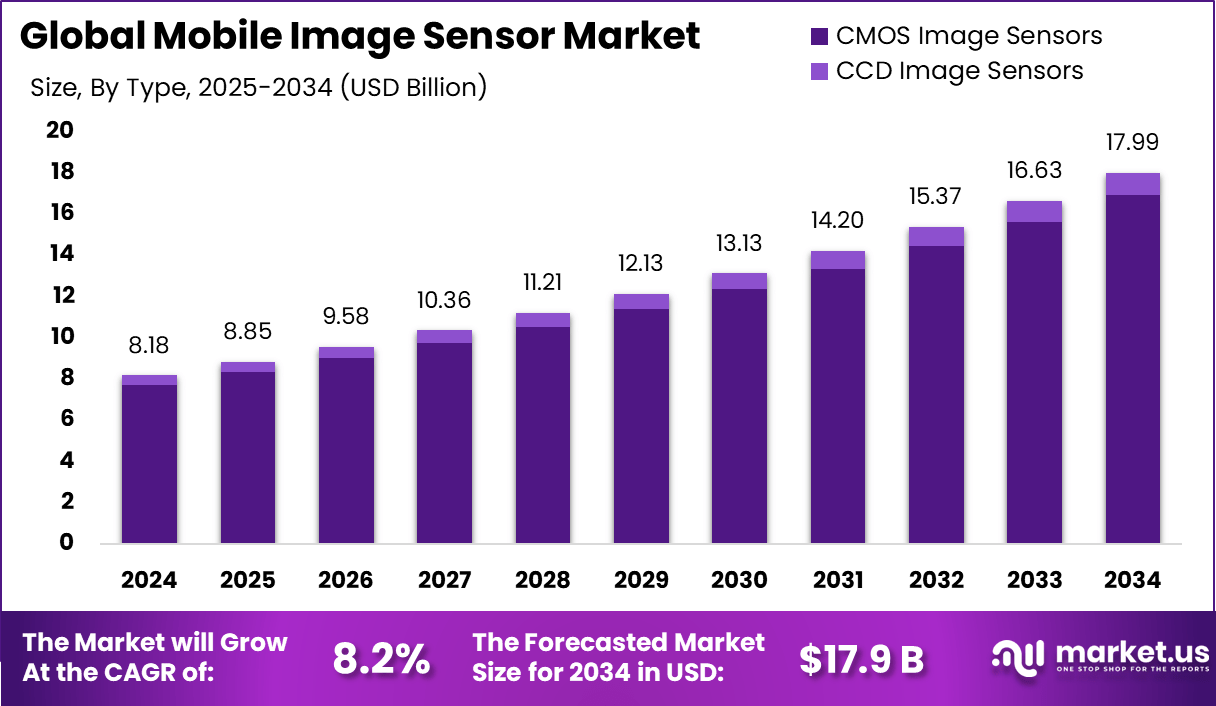
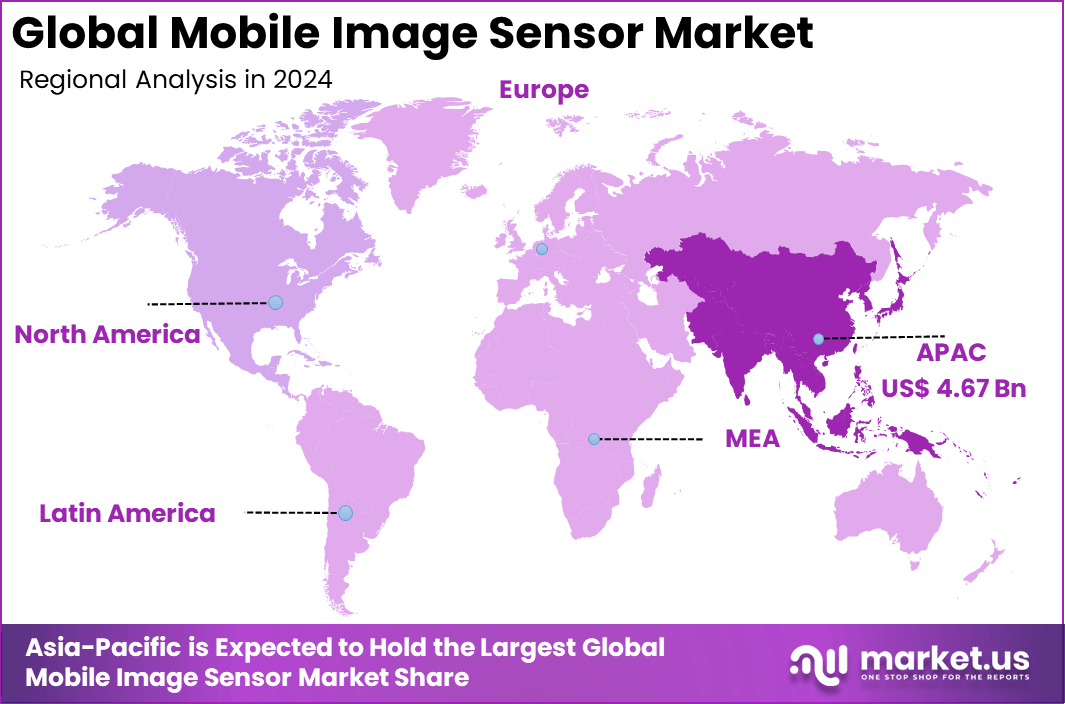
The Global Mobile Image Sensor Market size is expected to be worth around USD 17.9 billion by 2034, from USD 8.18 billion in 2024, growing at a CAGR of 8.2% during the forecast period from 2025 to 2034. In 2024, Asia-Pacific held a dominant market position, capturing more than a 57.1% share, holding USD 4.67 billion in revenue.
A mobile image sensor is a semiconductor device that captures light and converts it into digital signals, enabling cameras in smartphones to produce images and videos. These sensors are primarily of two types: CMOS (Complementary Metal-Oxide Semiconductor) and CCD (Charge-Coupled Device), with CMOS dominating the mobile sector due to its lower power consumption and faster processing speeds.
The market growth is fueled by factors such as increasing smartphone penetration, rising demand for high-resolution photography, and advancements in 3D sensing and AI-powered imaging. For instance, Apple’s iPhone and Samsung’s Galaxy series leverage advanced CMOS sensors with over 48 MP resolution, supporting features like night mode and real-time image processing.
Investment opportunities in this market are robust, appealing not just to established players but also to new innovators. There’s a significant push toward R&D in areas such as quantum-dot technology, embedded AI, 3D sensing, and environmentally conscious manufacturing. As the demand for advanced sensors grows both in consumer markets and in sectors like automotive and healthcare, those willing to innovate efficiently and sustainably stand to capture substantial value.
The business benefits of investing in mobile image sensors are tangible and wide-reaching. Businesses can differentiate products in a crowded marketplace, increase brand loyalty through enhanced user experiences, and open doors to new verticals such as immersive AR/VR applications or AI-powered diagnostic tools. Speed to market, rapid innovation cycles, and the ability to meet rapidly shifting consumer expectations are all increasingly tied to advanced image sensor integration.
Scope and Forecast
| Feature/Trend | Details |
|---|---|
| Shift to CMOS Technology | CMOS image sensors have become the dominant standard for energy efficiency and imaging quality. |
| Higher Resolutions | Demand for sensors above 50MP, especially in flagship smartphones. |
| Advanced Camera Functions | Features like optical zoom, HDR, low-light/night modes, and better autofocus. |
| Multi-Camera & Miniaturization | Compact, multi-lens configurations in thin devices. |
| Integration of AI Capabilities | Real-time scene recognition, smart editing, and AR/3D sensing. |
| Enhanced Power Efficiency | Sensor designs that prolong battery life and lower device heat. |
| Biometric & Security Applications | Fingerprint, facial authentication, and payment security. |
| AR/VR and 3D Sensing | Growth in sensors used for AR apps, facial mapping, and depth perception. |
Driving Factor
Advancements in 3D sensing and facial recognition technologies
One of the major driving factors in the global mobile image sensor market is the advancement of 3D sensing and facial recognition technologies, which are revolutionizing how smartphones perceive and interact with their environment. 3D image sensors capture depth information along with standard RGB data, enabling precise facial mapping, gesture recognition, and spatial awareness.
This technology is a cornerstone for facial recognition systems like Apple’s Face ID, which uses a TrueDepth camera incorporating structured light to project over 30,000 infrared dots on the user’s face for secure authentication. Apple’s use of 3D sensing has set industry benchmarks, prompting other manufacturers like Huawei (e.g., Mate series) and Xiaomi to adopt similar solutions.
These capabilities are also expanding into augmented reality (AR) and virtual try-on experiences in apps, significantly improving user interaction. 3D sensing in mobile devices is driven by growing consumer demand for biometric security and immersive content. In addition, Android smartphone brands such as Oppo and Vivo are integrating time-of-flight (ToF) and structured light sensors to enhance portrait photography and secure facial unlock features.
Restraining Factor
Pricing pressure from low-cost smartphone manufacturers is limiting sensor margin potential.
As brands like Xiaomi, Realme, Transsion (Itel, Tecno), and Infinix compete aggressively in price-sensitive markets such as India, Africa, and Southeast Asia, they prioritize cost efficiency in smartphone components, including image sensors. These brands often target budget-conscious consumers with smartphones priced under USD 150, making it challenging to integrate premium, high-cost sensors.
As a result, sensor suppliers are forced to offer lower-priced, mid-tier CMOS sensors, which restricts revenue growth and technological differentiation. For example, in India, one of the largest smartphone markets, over 75% of smartphone shipments in 2023 were in the sub-$250 category, dominated by budget and mid-range offerings.
In such scenarios, manufacturers typically opt for 5 MP to 12 MP image sensors with limited 3D or AI capabilities to keep costs low, putting pressure on image sensor vendors like Sony, Samsung, and Omnivision to compete on price rather than innovation. This dynamic slows adoption of higher-end technologies like stacked CMOS, periscope zoom lenses, and advanced 3D sensing, especially in the low-cost segment, thereby restraining overall market profitability despite high unit volumes.
Growth Opportunity
Automotive and wearable device integration
The integration of mobile image sensors into automotive and wearable devices presents a significant growth opportunity for the market beyond traditional smartphones. In the automotive sector, image sensors are increasingly used in Advanced Driver Assistance Systems (ADAS), including applications like driver monitoring, lane departure warning, collision avoidance, and parking assistance.
For instance, Sony’s CMOS sensors are being integrated into various automotive camera modules to support real-time image capture under varying lighting conditions. In the wearables market, devices such as smartwatches, AR glasses, fitness trackers, and health-monitoring gadgets are increasingly incorporating image sensors for functions like gesture recognition, eye tracking, and biometric monitoring.
The popularity of smart glasses like Meta Ray-Ban and Snap Spectacles, which use miniature CMOS sensors for image and video capture, underscores this trend. Additionally, wearable health devices are using optical sensors for continuous monitoring of heart rate, oxygen levels, and facial detection. These emerging applications offer sensor manufacturers a chance to diversify their product portfolio and tap into high-growth verticals.
Key Market Segments
Type
- CCD Image Sensors
- CMOS Image Sensors
Image Processing Technology
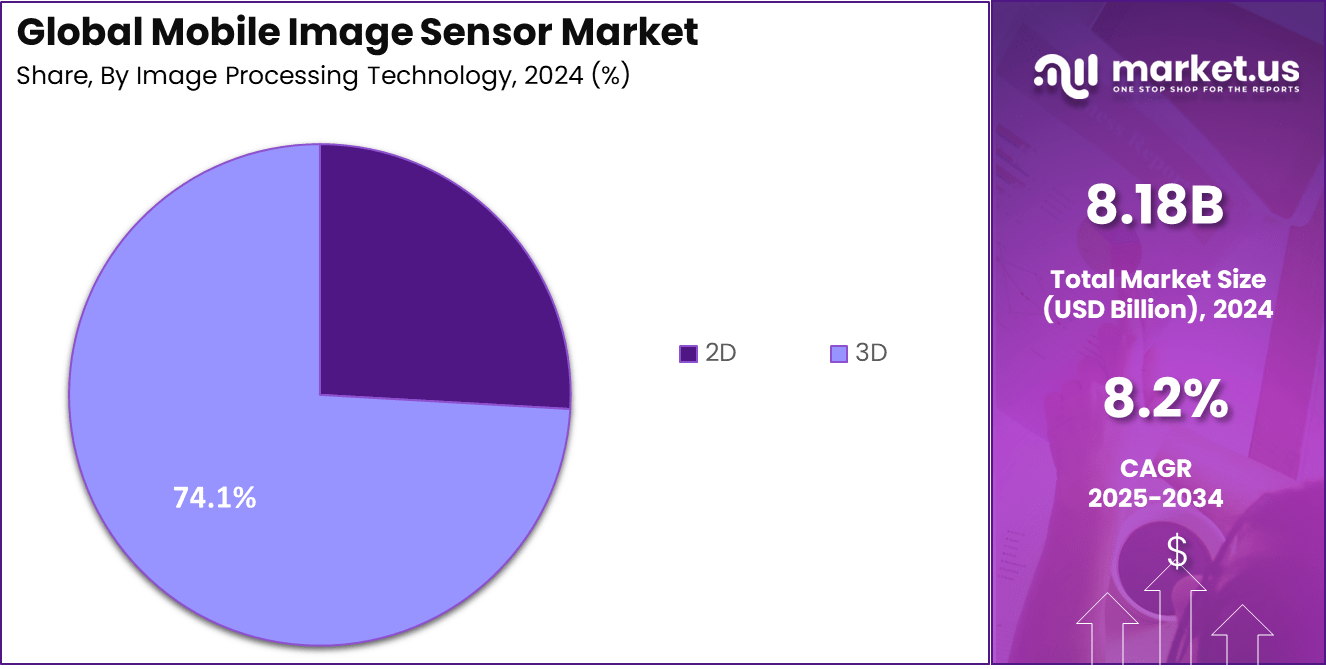
- 2D
- 3D
Resolution
- Up to 5 MP
- 5 MP to 12 MP
- 12 MP to 16 MP
- Above 16 MP
Key Regions and Countries
- North America
- US
- Canada
- Europe
- Germany
- France
- The UK
- Spain
- Italy
- Russia
- Netherlands
- Rest of Europe
- Asia Pacific
- China
- Japan
- South Korea
- India
- Australia
- Singapore
- Thailand
- Vietnam
- Rest of Latin America
- Latin America
- Brazil
- Mexico
- Rest of Latin America
- Middle East & Africa
- South Africa
- Saudi Arabia
- UAE
- Rest of MEA
Key Player Analysis
The global mobile image sensor market is highly competitive, dominated by a few major players who account for the majority of the market share. As of 2024, Sony leads the market with an estimated 40–45% share, due to its strong portfolio of high-performance CMOS sensors widely adopted in premium smartphones like Apple’s iPhones and Samsung’s Galaxy S series.
Sony’s sensors, such as the IMX989 and IMX890, are known for their exceptional low-light performance and support for high-resolution photography, including 4K and 8K video capabilities. Samsung Electronics holds a significant share with its ISOCELL sensor lineup, including the 200 MP ISOCELL HP2, featured in the Galaxy S24 Ultra.
Samsung not only uses its sensors internally but also supplies them to other OEMs. OmniVision Technologies, now part of Will Semiconductor (China), is a growing competitor, especially in the mid-range segment and automotive applications, providing versatile CMOS sensors with 3D sensing and HDR support.
Other notable players include Canon, STMicroelectronics, LG Innotek, Sharpvision, and Sunny Optical, each offering niche capabilities in imaging modules. Increasing demand for AI-based processing, 3D imaging, and compact sensor design continues to drive R&D investment and strategic partnerships among these companies, keeping the market dynamic and innovation-focused.
Top Key Players
- Samsung Electronics
- Sony
- Canon
- Fujitsu Microelectronics Inc
- LG Innotek
- Sharpvision
- SiliconFile
- Sunny Optical Technology
- STMicroelectronics
- Toshiba
- IBM Microelectronics
- Elpida
- Other Key Players
Recent Developments
- June 2025: Sony introduced the LYT-828, a new 50 MP stacked CMOS sensor featuring Hybrid Frame-HDR (HF-HDR) technology and over 100 dB dynamic range. Designed for smartphone main/sub cameras, it enhances high-contrast imaging, significantly reducing noise and blowout.
- November 2024: Sony announced the IMX925-a 24.55 MP industrial-grade, back-illuminated stacked CMOS sensor with global shutter tech (“Pregius S”), delivering 394 fps and twice the energy efficiency compared to predecessors.
- June 2024: Samsung launched three new ISOCELL sensors- HP9 (200 MP telephoto), GNJ, and JN5, featuring ultra-fine pixel designs, Tetra²pixel binning, and consistent imaging across modules. These are being featured across premium series such as Xiaomi 15 Ultra, Vivo X100, and X200 Ultra.
- April 2025: OmniVision launched the OV50X, a flagship 1‑inch 50 MP smartphone sensor with Dual Analog Gain HDR and Quad‑Phase Detection autofocus, offering 8K HDR video at 180 fps and 110 dB dynamic range. Evaluations are ongoing for deployment by year-end.

- 蓝茶市场(2026—2031)
0评论2026-09-15

- 泡沫材料市场(2026—2031)
0评论2026-09-15

- 重铬酸钠市场(2026—2031)
0评论2026-09-15

- 家族性淀粉样多发性神经病(FAP)市场(2026—2031)
0评论2026-09-15

- 次氯酸钙市场(2026—2031)
0评论2026-09-15

- 海上储能市场(2026—2031)
0评论2026-09-12

- 混凝土市场(2026—2031)
0评论2026-09-12

- 矫形器械市场(2026—2031)
0评论2026-09-12

- 木质素基树脂市场(2026—2031)
0评论2026-09-12

- 聚碳酸酯二元醇市场(2026—2031)
0评论2026-09-12