


Report Overview
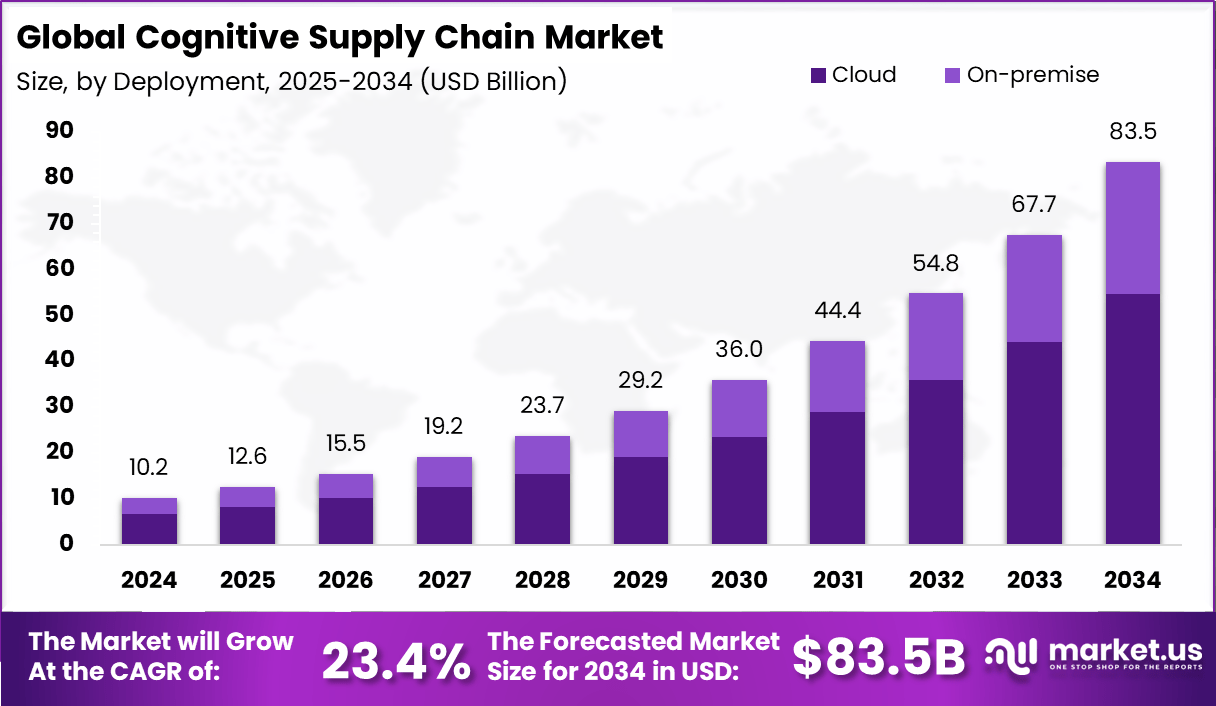
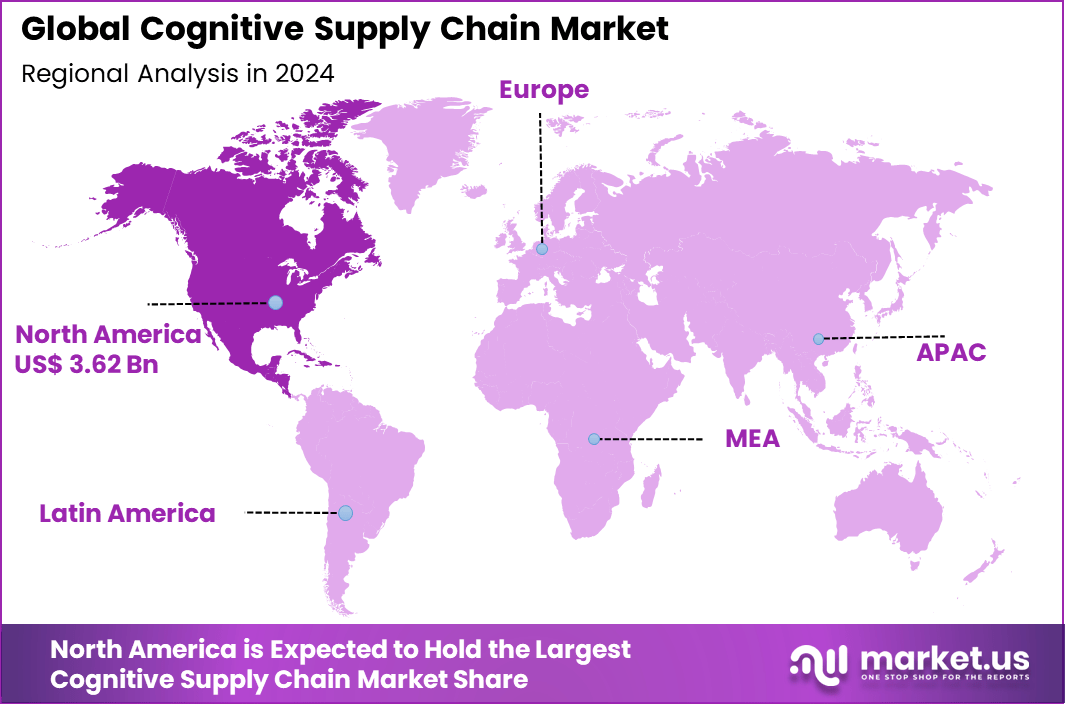
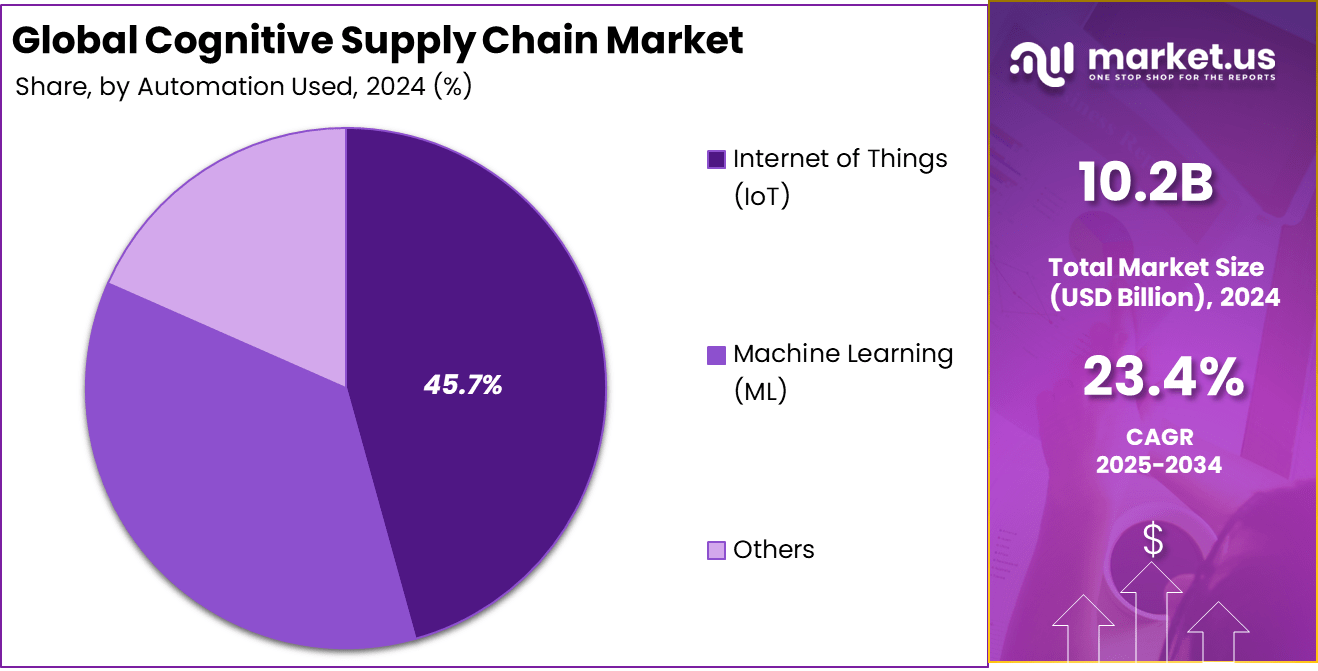
The global Cognitive Supply Chain market size accounted for USD 10.20 billion in 2024 and is predicted to increase from USD 12.60 billion in 2025 to approximately USD 83.50 billion by 2034, expanding at a CAGR of 23.40% from 2025 to 2034. In 2024, North America held a dominant market position, capturing more than a 35.5% share, holding USD 3.62 Billion revenue.
A cognitive supply chain refers to a self‑learning logistics network in which artificial intelligence, ML and advanced analytics are integrated into each stage of supply chain operations. It continually learns from real‑time data sourced from IoT sensors, market trends and internal systems to predict disruptions, optimize inventory and support decision‑making. This innovation goes beyond traditional automation by adding smart, adaptive features to procurement, production, transport, and delivery systems.
One of the top driving factors for the cognitive supply chain market is the need for better visibility and control across end-to-end operations. Rising global trade complexity, frequent disruptions, and unpredictable demand require more than simply reacting to problems. Companies want to predict issues before they arise and act swiftly to overcome obstacles.
Cognitive supply chain platforms help organizations by offering predictive insights and enhanced automation, allowing them to manage resources and logistics with much greater agility. Demand for cognitive supply chain technologies has soared in recent years as supply chain interruptions and rising consumer expectations have pushed organizations to find smarter solutions.
For instance, In October 2023, AI startup Altana launched Atlas, a real-time supply chain visibility tool. Designed for businesses, governments, and logistics providers, Atlas offers a dynamic map that delivers actionable insights, boosts efficiency, and supports faster responses to supply chain disruptions.
Companies are realizing that manual and legacy systems simply cannot keep up with today’s pace of change. A growing appetite for real-time, data-driven decisions is propelling businesses to invest in these systems. The demand is particularly strong in industries such as retail, automotive, and manufacturing, where even small improvements in efficiency can yield significant cost savings and competitive advantages.
Market Size and Growth
| Growth Factor | Description |
|---|---|
| Adoption of AI, ML, and IoT | Businesses are using artificial intelligence, machine learning, and Internet of Things to improve supply chain efficiency and decision-making. These technologies allow automation and smarter operations. |
| Predictive Analytics and Demand Forecasting | Cognitive tools help companies predict market demand, optimize inventory, and reduce waste by analyzing large amounts of data in real time. |
| Advanced Analytics & Big Data Integration | With more data generated from sensors and devices, companies can respond faster to changes and gain valuable insights for supply chain management. |
| Shift to Customer-Centric Operations | Companies are using cognitive tech to improve customer experiences by making deliveries faster and more reliable. |
| E-commerce and Global Trade Expansion | More online sales and global trading require efficient, data-driven supply chains. |
| Need for Cost Optimization | Firms use cognitive systems to save money by reducing inventory costs, streamlining logistics, and improving resource allocation. |
Key Features and Trends
| Key Feature / Trend | Description |
|---|---|
| Real-time Visibility | Cognitive systems provide live updates on shipments and inventory for better decisions. |
| Automation and Self-Optimization | These systems learn from data to automatically improve supply chain operations. |
| Integration of Blockchain and Edge Computing | Using blockchain ensures secure data sharing, and edge computing allows immediate local decisions. |
| Collaborative Human-AI Interfaces | New solutions allow workers to interact more easily, with AI providing helpful suggestions and automation. |
| Sustainability Analytics | Tracking and reducing carbon footprint and energy waste is now a big focus. |
| Predictive Maintenance and Risk Planning | Companies can predict and prevent breakdowns, and plan for risks using real-time and historical data. |
| Rapid AI and IoT Adoption | More companies across industries are using AI and IoT for smarter, data-driven supply chains. |
Drivers
Advancements in Artificial Intelligence and Machine Learning
The integration of Artificial Intelligence (AI) and Machine Learning (ML) into the cognitive supply chain market is driving significant advancements, enabling companies to enhance efficiency, predictive capabilities, and decision-making. AI and ML algorithms enable real-time analytics, predictive modeling, and smarter automation, helping businesses forecast demand, optimize inventory management, and improve customer experiences.
For instance, April 2025, Google Cloud announced an expanded multi-year partnership with Papa Johns to revolutionize the pizza maker’s ordering and delivery experience using the power of artificial intelligence (AI). Through the partnership Papa Johns has created an innovation team, named PJX, that will leverage Google Cloud’s AI, data analytics and ML capabilities to provide a more frictionless and consistent experience for customers both inside its restaurants and throughout its digital channels.
AI and ML enable predictive analytics, optimize real-time decision-making, and enhance supply chain automation. As more companies embrace AI-driven solutions, cognitive supply chains are becoming smarter, faster, and more resilient, thus helping organizations reduce operational costs, improve customer satisfaction, and gain a competitive edge. AI and ML advancements are boosting the cognitive supply chain market by helping businesses streamline operations and stay flexible in a changing global environment.
Restraint
Data Privacy and Security Concern
The deployment of cognitive supply chain systems is being constrained by significant concerns around data privacy and security. As platforms rely on extensive sharing and aggregation of data, businesses must ensure rigorous compliance with relevant regulations. This complexity can delay adoption and limit scaling initiatives.
Security vulnerabilities arising from cyberattacks or breaches within supplier ecosystems also represent a major restraint. Sensitive operational and transactional data may be exposed if robust protections are not implemented. Consequently some organizations remain cautious about entrusting mission‑critical functions to cognitive platforms without proven safeguards.
Opportunities
Automation of Routine Supply Chain Tasks
Automation is one of the most significant opportunities in the cognitive supply chain market. With the help of Robotic Process Automation (RPA) and AI, routine tasks such as order processing, invoice generation, and shipment tracking can be automated. This reduces human error, speeds up operations, and cuts down on operational costs.
By automating repetitive tasks, businesses can focus on more strategic activities, such as optimizing routes, improving supplier relationships, and enhancing customer experiences. As RPA technology evolves, its potential for streamlining supply chain operations will continue to grow, creating new opportunities for companies to improve their supply chain performance.
Key Market Segments
By Deployment
- Cloud
- On-premise
By Enterprise Size
- SMEs
- Large Enterprise
By Automation Used
- Internet of Things (IoT)
- Machine Learning (ML)
- Others
By Industry Verticals
- Manufacturing
- Retail & E-commerce
- Logistics and Transportation
- Healthcare
- Food and Beverage
- Others
Key Regions and Countries Covered in this Report
- North America
- The US
- Canada
- Europe
- Germany
- France
- The UK
- Spain
- Italy
- Russia
- Netherland
- Rest of Europe
- APAC
- China
- Japan
- South Korea
- India
- Australia & New Zealand
- ASEAN
- Rest of APAC
- Latin America
- Brazil
- Mexico
- Rest of Latin America
- Middle East & Africa
- GCC Countries
- South Africa
- Rest of MEA
Key Players Analysis
In the Cognitive Supply Chain Market, prominent players such as IBM Corporation, Oracle, and SAP SE have established strong positions by offering integrated AI and analytics platforms. These firms are leveraging advanced technologies to enable end-to-end supply chain visibility, predictive analytics, and cognitive automation. Their solutions help enterprises manage risks, optimize inventory, and streamline operations in real time.
Companies like Accenture plc, Intel Corporation, and NVIDIA Corporation are playing a vital role in shaping the future of cognitive supply chains through innovation in AI chipsets, digital twins, and cloud-based infrastructure. Their technologies are being used to build adaptive logistics networks and automate demand forecasting. These players are contributing significantly to real-time decision-making by combining deep learning models with high-performance computing, thereby enhancing agility and resilience in supply chain workflows.
In addition, firms such as Honeywell International Inc., C.H. Robinson Worldwide, Inc., and Panasonic are advancing cognitive logistics through robotics, IoT integration, and connected warehouse systems. These companies focus on real-time shipment tracking, supply chain orchestration, and automated fulfilment. Their industrial and operational technologies support smart warehousing and transportation systems.
Top Key Players in the Market
- IBM Corporation
- Oracle
- Amazon.com
- Accenture plc
- Intel Corporation
- NVIDIA Corporation
- Honeywell International Inc.
- H. Robinson Worldwide, Inc.
- Panasonic
- SAP SE
- Others
Recent Developments
- In April 2025, Bosch, a leading global supplier of technology and services announced the launch of its Supply Chain Studio, a cloud-based suite of tools aimed at enhancing supply chain efficiency and visibility.
- In January 2024, Blue Yonder introduced a major product update aimed at transforming supply chain performance through enhanced interoperability. This upgrade integrates the company’s cognitive platform with its proprietary data cloud to improve operational efficiency, reduce waste, and build stronger supply chain resilience.
- In January 2023, Accenture strengthened its position in digital supply chain innovation by acquiring Inspirage, a firm known for its deep expertise in Oracle Cloud applications. This strategic move allows Accenture to expand its offerings in supply chain transformation, particularly in adopting cutting-edge technologies like digital twins and touchless automation.

- 蓝茶市场(2026—2031)
0评论2026-09-15

- 泡沫材料市场(2026—2031)
0评论2026-09-15

- 重铬酸钠市场(2026—2031)
0评论2026-09-15

- 家族性淀粉样多发性神经病(FAP)市场(2026—2031)
0评论2026-09-15

- 次氯酸钙市场(2026—2031)
0评论2026-09-15

- 海上储能市场(2026—2031)
0评论2026-09-12

- 混凝土市场(2026—2031)
0评论2026-09-12

- 矫形器械市场(2026—2031)
0评论2026-09-12

- 木质素基树脂市场(2026—2031)
0评论2026-09-12

- 聚碳酸酯二元醇市场(2026—2031)
0评论2026-09-12