


Report Overview
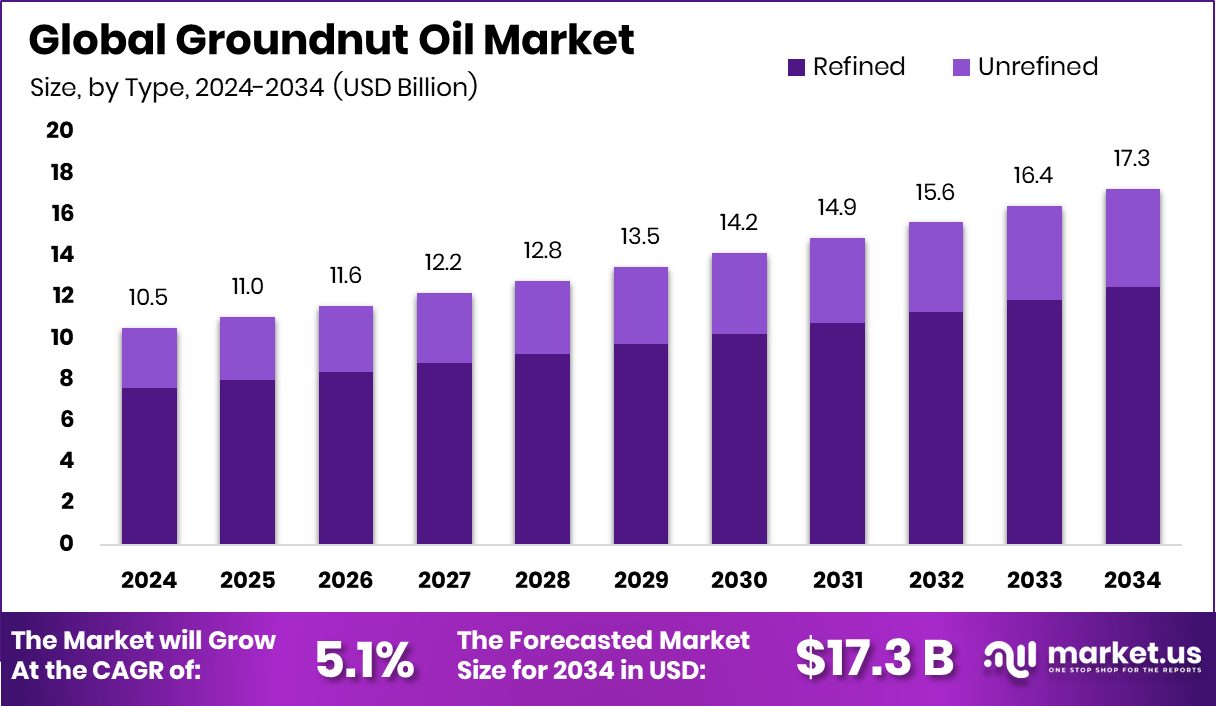
The Global Groundnut Oil Market is expected to be worth around USD 17.3 billion by 2034, up from USD 10.5 billion in 2024, and is projected to grow at a CAGR of 5.1% from 2025 to 2034. The USD 4.7 billion market in North America is driven by household demand.
Groundnut oil, also known as peanut oil, is a type of vegetable oil derived from the seeds of the peanut plant. It is commonly used in cooking due to its mild flavor, high smoke point, and stable composition. Groundnut oil is available in refined, cold-pressed, and roasted varieties, each offering distinct flavor profiles. Rich in unsaturated fats, vitamin E, and antioxidants, it is considered a heart-friendly oil and is often used in frying, baking, and sautéing across various cuisines, especially in Asian and African regions.
The groundnut oil market refers to the global trade, production, and consumption of peanut oil across food, industrial, and personal care applications. This market includes small-scale producers and large manufacturers who extract, process, and distribute the oil in various packaging forms. It supports multiple sectors, including food processing, cosmetics, and pharmaceuticals. The market is driven by demand from health-conscious consumers seeking natural oils and by its versatility in cooking and manufacturing.
One of the major growth drivers of the groundnut oil market is the increasing preference for plant-based and heart-healthy oils. Consumers are more aware of dietary fats and are shifting from saturated fats to oils rich in monounsaturated and polyunsaturated fatty acids. The nutritional profile of groundnut oil aligns with this trend, promoting its adoption in both households and the food processing industry. According to an industry report, the Santee peanut shelling plant receives $42 million in funding for an expansion project.
Opportunities in the groundnut oil market lie in expanding product applications beyond food use. The oil’s natural antioxidant content makes it suitable for skincare and cosmetic products, which opens up new revenue channels. Additionally, sustainable sourcing and value-added packaging can appeal to environmentally conscious buyers.
Key Takeaways
- The Global Groundnut Oil Market is expected to be worth around USD 17.3 billion by 2034, up from USD 10.5 billion in 2024, and is projected to grow at a CAGR of 5.1% from 2025 to 2034.
- Refined dominates Groundnut Oil Market with 72.3% due to wide usage in everyday cooking.
- Hot Pressed holds 69.9% of the groundnut oil market and is favored for its strong flavor and aroma.
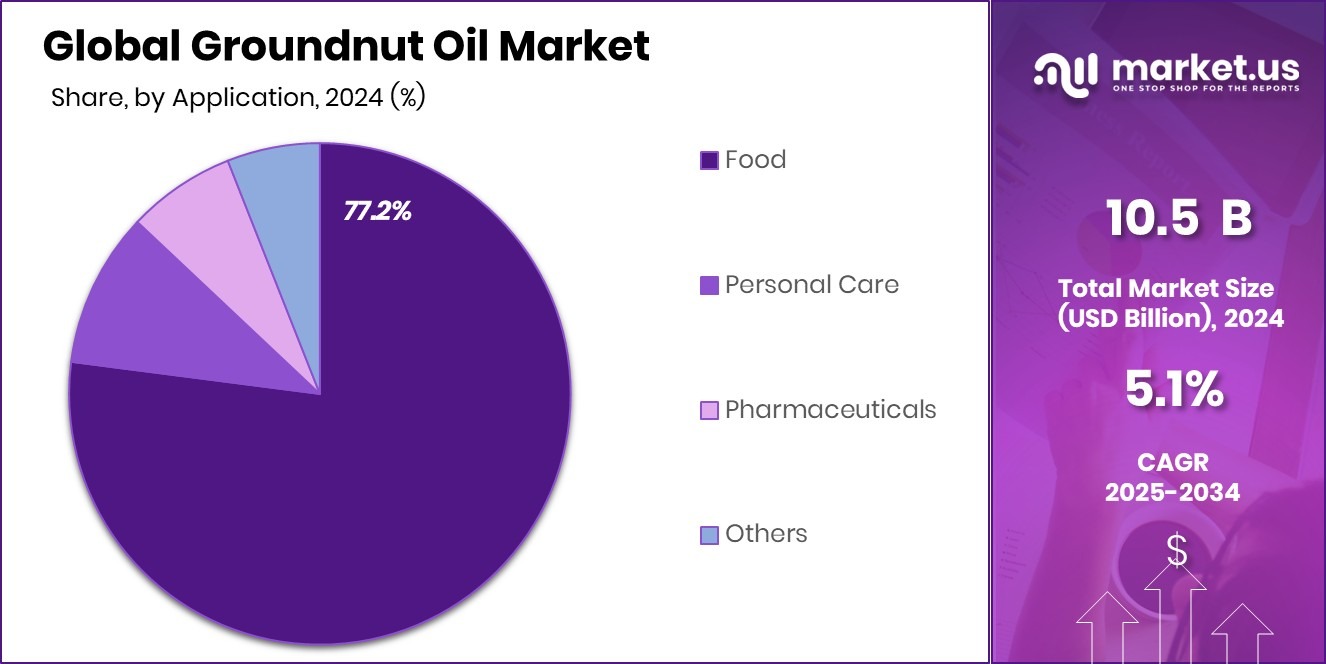
- Food application leads the groundnut oil market with 77.2%, driven by culinary and nutritional demand globally.
- Households account for 66.6% of the groundnut oil market as daily consumption rises in home kitchens.
- Supermarkets/Hypermarkets capture 39.2% in the Groundnut Oil Market, offering easy accessibility and product variety.
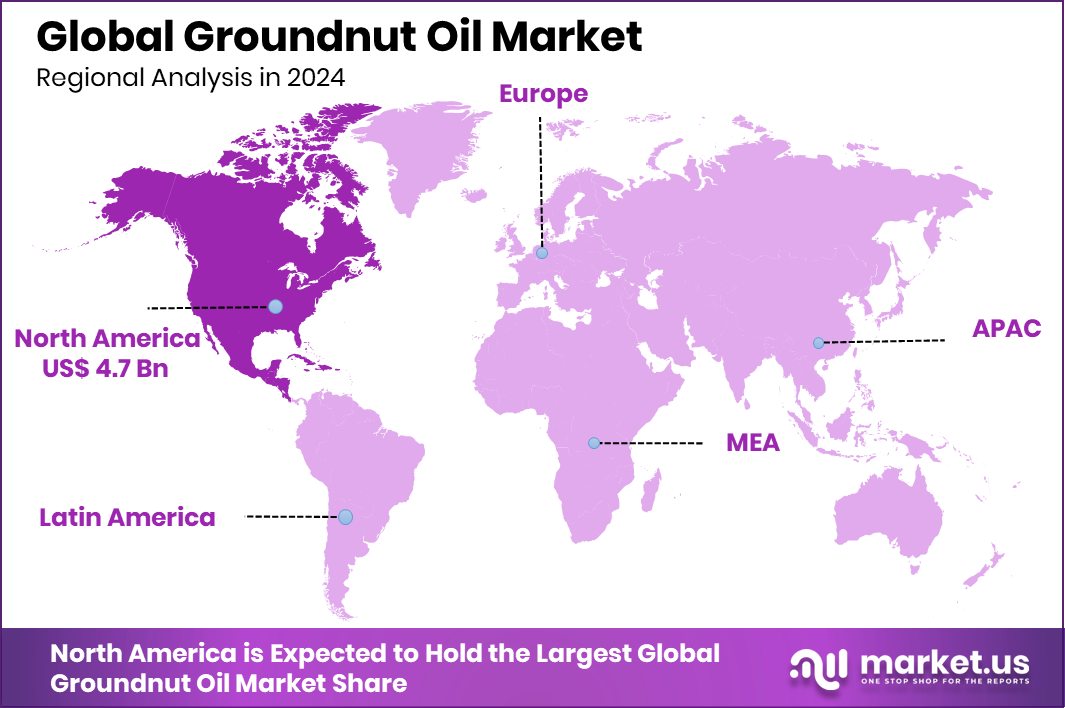
- North America’s dominance in groundnut oil reflects 45.7% rising health-focused consumer cooking preferences.
By Type Analysis
Refined groundnut oil dominates with 72.3% market share.
In 2024, Refined held a dominant market position in the By Type segment of the Groundnut Oil Market, with a 72.3% share. This dominance can be attributed to its wider usage in both household and commercial cooking due to its neutral taste, extended shelf life, and higher smoke point.
Refined groundnut oil is processed to remove impurities, odors, and allergens, making it suitable for large-scale food preparation and packaged food products. Its consistent texture and appearance also support its demand in urban retail markets, where consumers prefer convenience and standardized quality.
The widespread adoption of refined groundnut oil is further supported by strong distribution through supermarkets, hypermarkets, and food service providers, especially in urban and semi-urban regions. Its lower cost compared to specialty oils also positions it as an economical choice for bulk users such as restaurants, catering services, and food manufacturers.
Moreover, its longer storage stability under varying climatic conditions makes it ideal for regions with limited cold-chain infrastructure. Overall, the strong performance of the refined segment reflects a balance of consumer trust, processing benefits, and market accessibility, reinforcing its leading share in the type category of the groundnut oil market in 2024.
By Product Analysis
Hot pressed groundnut oil leads with 69.9% share.
In 2024, Hot Pressed held a dominant market position in the By Product segment of the Groundnut Oil Market, with a 69.9% share. This leading position is primarily driven by its higher oil yield and efficient extraction process, making it a preferred choice among manufacturers and bulk suppliers.
Hot-pressed groundnut oil undergoes heat treatment during extraction, which increases the volume of oil extracted from the seeds and results in a longer shelf life. This makes it especially suitable for large-scale food processing operations and packaged edible oil distribution.
The oil’s stability under heat also supports its use in frying and deep-cooking applications, which are common in commercial kitchens and food service establishments. Additionally, hot pressed oil maintains a consistent quality and appearance, appealing to both industrial users and end consumers looking for reliable cooking oil options.
The affordability and availability of hot-pressed groundnut oil further contribute to its widespread adoption, particularly in regions where cost-effectiveness and volume availability are key purchasing factors. The segment’s commanding share reflects a strong alignment with market demands for durable, high-yield oil, positioning hot-pressed groundnut oil as the dominant product category in 2024.
By Application Analysis
The food sector accounts for 77.2% groundnut oil demand.
In 2024, Food held a dominant market position in the By Application segment of the Groundnut Oil Market, with a 77.2% share. This strong lead is largely attributed to the oil’s extensive use in cooking and food preparation across households, restaurants, and the food processing industry. Its mild flavor, high smoke point, and nutritional profile make it a popular choice for frying, sautéing, and baking.
The dominance of the food segment is further reinforced by traditional consumption patterns in regions where groundnut oil is a staple ingredient. Refined and hot-pressed varieties are widely used in packaged snacks, ready-to-eat meals, and street foods, reflecting its deep integration into daily food habits.
Additionally, growing awareness of health benefits linked to unsaturated fats has encouraged households to switch to groundnut oil for regular cooking. The product’s ease of availability in retail and bulk packaging formats supports its widespread application in both domestic and commercial kitchens. The food segment’s significant 77.2% market share in 2024 highlights its central role in driving groundnut oil consumption across key markets.
By End User Analysis
Households consume 66.6% of groundnut oil globally.
In 2024, Households held a dominant market position in the end-user segment of the Groundnut Oil Market, with a 66.6% share. This dominance reflects the strong preference for groundnut oil as a staple cooking medium in domestic kitchens, particularly in regions where traditional cuisine relies heavily on vegetable oils. Households value groundnut oil for its neutral flavor, high smoke point, and health-friendly fat composition, making it suitable for a wide range of everyday cooking applications, including frying, tempering, and baking.
The segment’s leadership is also supported by the growing consumer shift toward plant-based oils that align with health and wellness goals. In many areas, groundnut oil is considered a trusted and familiar product, often passed down through generations, reinforcing its continued demand in household settings.
Easy accessibility through supermarkets, local grocery stores, and online retail platforms has further boosted its regular consumption at home. The availability of refined and hot-pressed variants in various pack sizes meets the needs of different household sizes and income groups. The 66.6% share held by the household segment in 2024 clearly illustrates its pivotal role in sustaining groundnut oil demand and driving market stability.
By Distribution Channel Analysis
Supermarkets/Hypermarkets hold 39.2 of % groundnut oil market share.
In 2024, Supermarkets/Hypermarkets held a dominant market position in the By Distribution Channel segment of the Groundnut Oil Market, with a 39.2% share. This leading position is largely driven by the organized retail sector’s ability to offer a wide variety of groundnut oil products under one roof, making it a convenient option for urban and semi-urban consumers. These stores provide customers with easy access to different oil types, pack sizes, and brands, often accompanied by discounts, promotions, and in-store guidance, which encourages bulk and repeat purchases.
The clean and structured shopping environment, along with product visibility and proper labeling, builds consumer trust, especially among health-conscious buyers. Moreover, supermarkets and hypermarkets are strategically located in high-footfall areas, which increases product exposure and purchasing frequency.
The strong presence of these outlets in metropolitan regions contributes significantly to sales volume, particularly among nuclear families and working professionals who prefer one-stop solutions for their grocery needs. The dominance of this channel, capturing 39.2% of the market share in 2024, highlights its critical role in shaping consumer access and purchase behavior for groundnut oil in the modern retail landscape.
Key Market Segments
By Type
- Refined
- Unrefined
By Product
- Cold Pressed
- Hot Pressed
By Application
- Food
- Personal Care
- Pharmaceuticals
- Others
By End User
- Hotels and restaurants
- Households
- Others
By Distribution Channel
- Supermarkets/Hypermarkets
- Specialty Stores
- Convenience Stores
- Online
- Others
Driving Factors
Rising Health Awareness Boosts Groundnut Oil Demand
One of the key driving factors of the groundnut oil market is the growing awareness among consumers about healthy eating habits. People are increasingly choosing oils that are low in saturated fats and rich in good fats, such as monounsaturated and polyunsaturated fatty acids. Groundnut oil fits this preference well, as it supports heart health and is considered a healthier option compared to many traditional fats.
Additionally, its natural antioxidant properties and vitamin E content make it appealing for regular cooking. As more consumers shift toward balanced diets and plant-based food products, the demand for groundnut oil continues to rise, especially in urban areas where health consciousness is growing rapidly across all age groups.
Restraining Factors
Price Fluctuations of Groundnut Seeds Affect the Market
One major restraining factor for the groundnut oil market is the frequent price fluctuations of raw groundnut seeds. Since groundnut oil is directly extracted from these seeds, any change in their availability or cost has a direct impact on the production cost of the oil. These fluctuations are often caused by unpredictable weather conditions, crop failures, and changes in agricultural policies.
When seed prices rise sharply, it increases the final price of groundnut oil, making it less affordable for consumers and less competitive compared to other cooking oils. This price instability affects both manufacturers and buyers, creating uncertainty in supply chains and limiting consistent growth in the market, particularly in price-sensitive regions.
Growth Opportunity
Expansion into Cosmetic and Skincare Applications
A compelling growth opportunity for the groundnut oil market lies in its expansion into the cosmetic and skincare sectors. Groundnut oil is rich in vitamin E and natural antioxidants, which are beneficial for skin nourishment and hydration. These properties make it suitable as a base ingredient in lotions, creams, massage oils, and hair-care formulations.
Consumer interest in clean-label and plant-based personal care products provides strong support for this application. By positioning groundnut oil as a natural, multifunctional ingredient, manufacturers can tap into a growing segment of health-conscious buyers seeking gentle and sustainable skincare solutions.
Moreover, collaboration with cosmetic brands or private-label producers offers scope for creating specialized product lines. Overall, leveraging groundnut oil’s nutritional and topical benefits can drive new product development and open fresh revenue streams beyond traditional culinary uses in the oil market.
Latest Trends
Growing Popularity of Cold-Pressed Groundnut Oil
A major trend shaping the groundnut oil market is the increasing popularity of cold-pressed groundnut oil among health-conscious consumers. Unlike refined or hot-pressed oil, cold-pressed oil is extracted without high heat or chemicals, helping retain its natural nutrients, flavor, and aroma.
Consumers are becoming more aware of the benefits of minimally processed oils, especially those rich in antioxidants and healthy fats. Cold-pressed groundnut oil is often seen as a premium product, especially appealing to urban buyers looking for natural and clean-label food options.
This trend is further supported by the rising demand for organic and traditional food items. As a result, more small producers and specialty brands are entering the market, offering cold-pressed oils in eco-friendly and premium packaging.
Regional Analysis
In 2024, North America held a 45.7% share, reaching USD 4.7 billion.
In 2024, North America emerged as the leading region in the groundnut oil market, capturing a dominant 45.7% share, with a market value of approximately USD 4.7 billion. This regional dominance is supported by the increasing preference for healthy, plant-based cooking oils among consumers, particularly in the United States and Canada. Groundnut oil’s high smoke point, nutritional profile, and versatility in cooking have contributed to its strong household demand across the region.
Europe, Asia Pacific, Middle East & Africa, and Latin America also represent important markets, though none surpassed North America’s share. The overall consumption in these regions remains steady, influenced by regional food cultures and the availability of groundnut oil in both refined and hot-pressed forms.
While Europe maintains a moderate demand for premium and cold-pressed variants in niche health-conscious segments, the Asia Pacific continues to use groundnut oil in traditional cooking across select countries. Middle East & Africa and Latin America show gradual growth potential, driven by evolving culinary preferences and expanding food service industries.
Key Regions and Countries
- North America
- US
- Canada
- Europe
- Germany
- France
- The UK
- Spain
- Italy
- Rest of Europe
- Asia Pacific
- China
- Japan
- South Korea
- India
- Australia
- Rest of APAC
- Latin America
- Brazil
- Mexico
- Rest of Latin America
- Middle East & Africa
- GCC
- South Africa
- Rest of MEA
Key Players Analysis
Cargill demonstrated strong distribution capabilities across multiple continents and maintained leadership in supplying refined groundnut oil to institutional and food-service channels. Its large-scale manufacturing infrastructure and efficient raw material sourcing allowed the company to meet high-volume demand reliably, contributing to the oil’s stable availability in major markets. Such operational strength helped uphold the dominance of refined groundnut oil in the market.
Eurovanille, with its specialized focus on high-quality and value-added products, secured a notable position in segments such as cold‑pressed and flavored groundnut oil. The company’s emphasis on premium processing, clean-label ingredients, and targeted branding enabled it to attract health-conscious consumers in urban centers. Eurovanille’s attention to niche variants supported market diversity and helped meet rising interest in antioxidant-rich, minimally processed oils.
Gemini Edibles & Fats India Ltd, headquartered in a leading peanut-producing nation, leveraged its access to abundant raw material and efficient manufacturing for both domestic and export markets. Its integrated supply chain—from farm-level procurement to branded retail packaging—helped it capitalize on emerging demand in the Asia Pacific and the Middle East regions. The company’s strength in both hot‑pressed and refined grades allowed it to tailor offerings across price-sensitive and premium consumer segments.
Top Key Players in the Market
- Archer Daniel Midland
- Cargill
- Eurovanille
- Gemini Edibles & Fats India Ltd
- Hain Celestial Group
- Olam International
- Ventura Foods
- Wilmar International
Recent Developments
- In June 2025, GEF India launched a heartfelt storytelling campaign for Freedom Groundnut Oil. The campaign focused on Telugu cuisine and family bonds, portraying how traditional dishes prepared with groundnut oil help reconnect generations and cultural roots. The narratives emphasize the emotional role of food in Indian households and position groundnut oil as more than just a cooking medium.
- In April 2024, ADM announced that its global regenerative agriculture programme had surpassed 2.8 million acres in 2023, ahead of its target. The company subsequently raised its 2024 goal to 3.5 million acres, and further revised its 2025 ambition upward from 4 million to 5 million acres. This initiative included significant acreage planted with peanuts, which supports feedstock quality and sustainability in peanut oil production.









