| Indie developers in the U.S. are increasingly leveraging platforms like Scenario and Promethean AI to automate the creation of game assets and environments, significantly reducing development time and cost. Major studios such as Ubisoft and Electronic Arts have also adopted AI solutions. Ubisoft, for example, uses its proprietary Ghostwriter tool to generate dialogue for non-playable characters (NPCs).
Additionally, companies like NVIDIA are pioneering AI-driven NPC behavior, as demonstrated in titles like Mecha BREAK and Retail Mage. According to a 2024 survey by a16z Games, 73% of U.S. game studios are already using AI, with 40% reporting productivity gains over 20% and 25% experiencing cost savings above 20%.
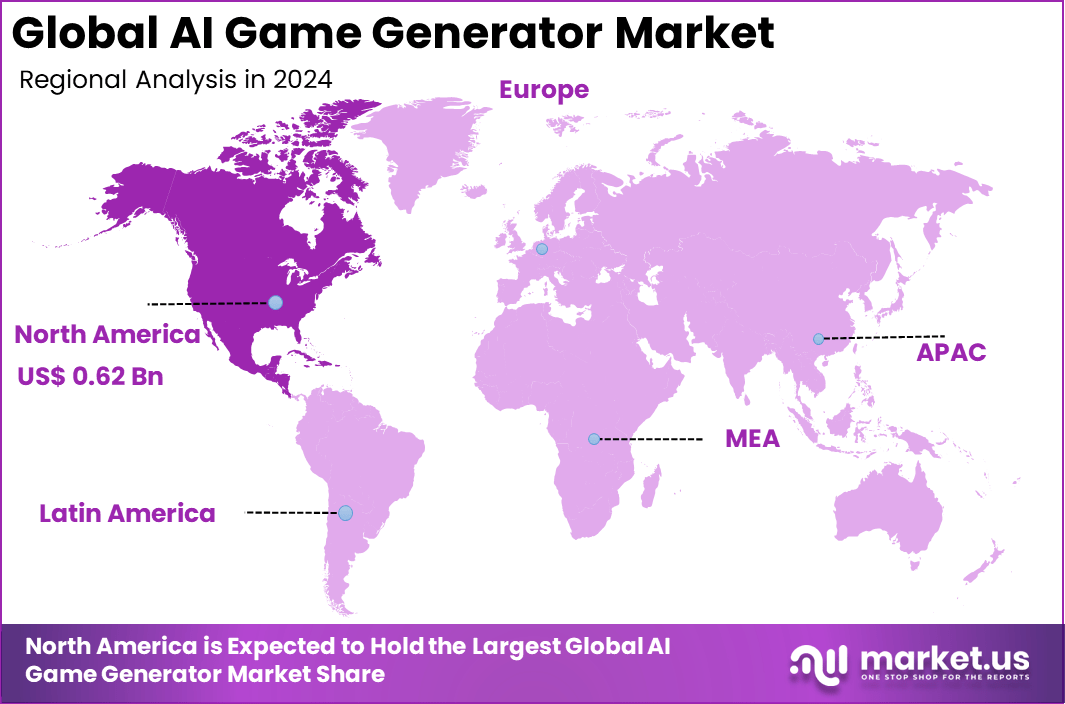
In 2024, North America held a dominant market position, capturing more than a 38% share and generating around USD 0.62 billion in revenue within the global AI game generator market. This leadership can be attributed to the region’s highly mature gaming industry, strong presence of AI innovation hubs, and advanced digital infrastructure.
The U.S., in particular, hosts a dense network of tech companies, gaming studios, and academic institutions that actively contribute to the development and rapid deployment of generative AI tools. This ecosystem provides developers with faster access to cutting-edge solutions, cloud platforms, and funding channels essential for scaling AI-generated content in games.
By Component Analysis
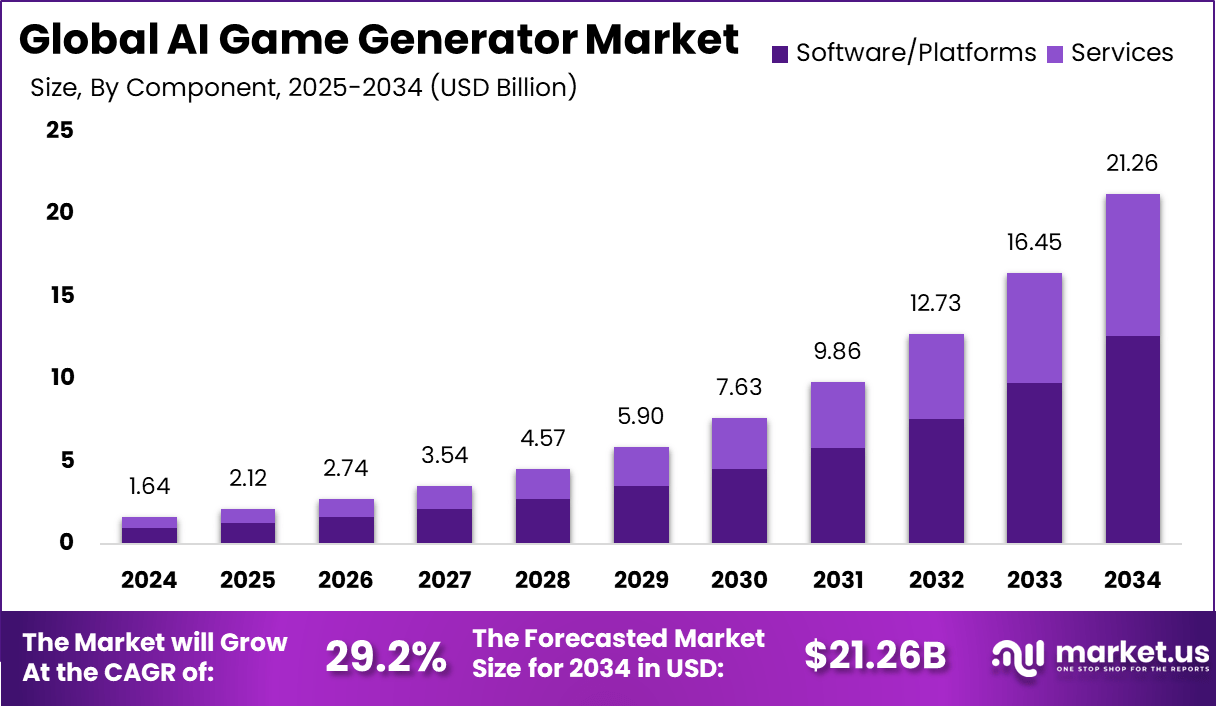
In 2024, the Software/Platforms segment dominated the AI Game Generator Market, accounting for 71% of the total share. This leadership is primarily driven by the widespread adoption of AI-powered platforms that allow game developers to automate asset creation, storyline development, level generation, and character behavior. These tools reduce development time and cost while enabling creators to focus on gameplay mechanics and user engagement.
The accessibility of these platforms has made it easier for developers to integrate advanced AI functionalities without deep programming knowledge. Whether for 2D, 3D, or VR environments, software-based AI generators are empowering both professionals and hobbyists to innovate faster and with greater creative freedom.
By Deployment Mode Analysis
In 2024, Cloud-based deployment captured 74% of the market share in 2024, emerging as the preferred model for AI game generation. The appeal lies in its scalability, low hardware dependency, and ability to support collaborative workflows across geographically dispersed teams. Game developers use cloud platforms to access powerful AI engines, run large training datasets, and generate real-time updates during game development cycles.
Additionally, cloud infrastructure enables seamless integration with game engines, asset libraries, and development tools. This flexibility allows developers to iterate quickly, deploy updates more efficiently, and reduce infrastructure overhead, which is critical for both indie creators and large studios.
According to Unity’s 2024 developer report, over 65% of AI tool users prefer cloud-based solutions for ease of integration into their existing workflows. Conversely, On-Premise deployment, though more limited in adoption, remains relevant for studios with stringent data privacy, security, or performance requirements. AAA studios using proprietary AI tools may opt for on-premise deployment to maintain full control over development pipelines.
By Technology Analysis
In 2024, Machine Learning represented 22% of the technology segment in 2024, standing out as a core enabler of automated and adaptive game development processes. ML models are used to learn from user behavior, generate new levels dynamically, and optimize in-game experiences based on player interaction.
These systems are also trained to produce realistic environments, character dialogues, and decision trees that evolve over time. Game developers increasingly rely on ML for creating personalized gameplay scenarios and enhancing replayability. As data from game usage accumulates, machine learning continues to power smarter and more immersive AI-driven content generation tools within the ecosystem.
By End-User Analysis
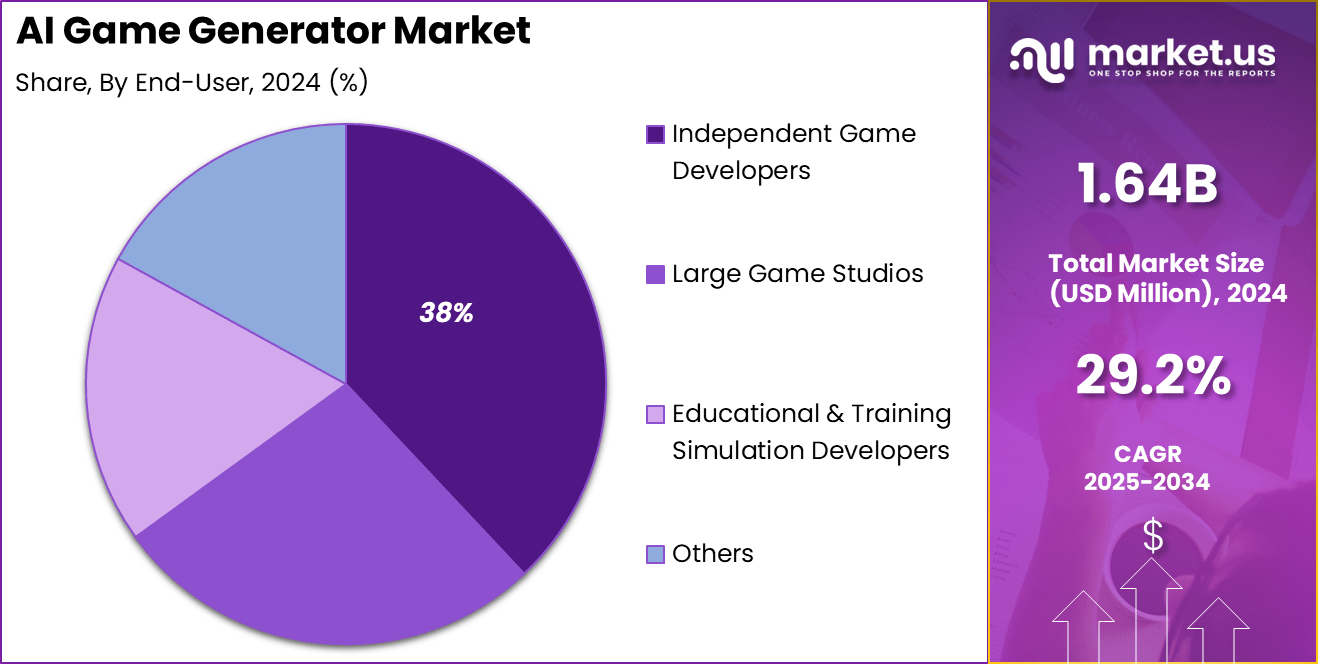
In 2024, Independent Game Developers emerged as the largest end-user segment, holding a 38% share in 2024. These developers benefit the most from AI game generation platforms, as they often face resource constraints yet seek to deliver high-quality, innovative games. AI tools allow them to automate routine tasks, reduce dependency on large teams, and experiment with new ideas rapidly.
The democratization of game development through AI is particularly valuable for indie creators looking to compete in a saturated market. Platforms that offer low-code or no-code interfaces have further boosted adoption among individuals and small studios seeking creative control with minimal technical burden.
Driving Factor
Increasing demand for automated game development tools to reduce time and cost
One of the primary drivers of the AI Game Generator Market is the ability of AI tools to significantly reduce game development time and associated costs. Traditional game development is often resource-intensive, requiring large teams of designers, artists, writers, and developers to spend months or even years building content.
AI-powered tools such as procedural level designers, narrative generators, and asset creation platforms automate many of these tasks, allowing developers to focus more on creativity and innovation rather than manual production. For example, Ubisoft uses its AI tool “Ghostwriter” to generate in-game dialogue, reducing the time writers spend on repetitive non-player character (NPC) conversations.
Similarly, Promethean AI helps artists create 3D environments by suggesting and placing objects based on context, cutting down design time by up to 80%. A study by Modl.ai, a company offering AI-powered game testing and behavior modeling, found that AI can reduce testing cycles by 30–50%. These efficiencies translate to lower development costs, enabling indie developers to produce high-quality games with smaller teams and budgets.
Restraining Factor
Concerns over content quality, coherence, and originality of AI-generated outputs
A key restraint in the AI Game Generator market is the concern over the quality, coherence, and originality of AI-generated content. While AI tools can rapidly produce game assets, narratives, and levels, the outputs often lack the depth, emotional nuance, and contextual awareness that human designers bring.
For example, AI-generated dialogue using models like GPT or similar large language models can become repetitive, inconsistent with character personalities, or contextually inappropriate over long gameplay sessions. This can break player immersion and compromise storytelling integrity. In procedural level design, some indie developers have reported that AI-generated maps or worlds may appear random or disjointed, requiring manual correction or curation.
Games like AI Dungeon, which rely heavily on GPT-powered storytelling, have faced criticism for generating incoherent or illogical plotlines, especially during extended gameplay. According to a 2023 survey by Game Developer Magazine, 42% of developers using AI tools cited “lack of narrative consistency” as a major drawback.
Moreover, originality is another issue, as AI models are trained on existing datasets, potentially leading to derivative or overly familiar content. These limitations hinder the ability of studios to fully rely on AI without extensive human oversight, thus affecting adoption and overall trust in AI-generated game development processes.
Growth Opportunity
Expansion into education, training simulations, and AR/VR gaming
The integration of AI game generators into education, training simulations, and AR/VR gaming presents a significant growth opportunity for the market. AI-generated content enables rapid development of interactive, scenario-based learning environments that are customizable, immersive, and cost-effective. In education, platforms like Minecraft Education Edition and Classcraft already use gamified environments to teach coding, critical thinking, and collaboration.
By adding AI-driven narrative generation and adaptive learning paths, these platforms can offer highly personalized learning experiences at scale. In corporate and military training, AI-generated simulations are increasingly used to replicate real-world scenarios. For instance, Boeing and the U.S. Army have explored AI-powered virtual environments for pilot and combat training, reducing the cost and risk of live simulations.
The opportunity further expands with the rise of AR/VR technologies. AI tools can generate immersive 3D assets, interactive dialogues, and dynamic storylines in real time, enhancing user engagement in VR classrooms or simulation labs. Immersive technologies in training can improve learning retention by up to 75%, underscoring the potential of AI-generated game content in shaping next-gen educational and training experiences.
Latest Trends
Adoption of transformer-based models for generating realistic dialogue and storytelling
A major trend shaping the AI Game Generator market is the increasing adoption of transformer-based models for creating realistic, engaging dialogue and immersive storytelling. Transformer architectures such as OpenAI’s GPT, Google’s BERT, and Meta’s LLaMA excel at understanding context, semantics, and character tone, enabling them to generate coherent and emotionally resonant narratives.
These models are revolutionizing how in-game characters interact with players by enabling natural, branching conversations and dynamic story evolution. Examples include Inworld AI, which uses transformer-based models to create intelligent, reactive NPCs that can hold unscripted conversations with players.
The impact is significant, according to a 2024 report by Unity, nearly 60% of game developers experimenting with AI for dialogue creation prefer transformer-based solutions due to their scalability and narrative depth. As models continue to improve, especially in multi-turn dialogue and emotion tracking, transformer-based storytelling is poised to become a core element in next-generation interactive games, offering highly personalized and replayable experiences.
Key Market Segments
By Component
- Software/Platforms
- Game Asset Generators (2D/3D assets, sprites)
- Narrative & Dialogue Generators
- Code & Logic Generators
- Procedural Level Designers
- Services
- Integration & Customization Services
- Consulting Services
- Managed Services
By Deployment Mode
By Technology
- Machine Learning
- Natural Language Processing (NLP)
- Generative Adversarial Networks (GANs)
- Transformer Models
- Computer Vision
- Procedural Content Generation (PCG)
By End-User
- Independent Game Developers
- Large Game Studios
- Educational & Training Simulation Developers
- Others
Key Regions and Countries
- North America
- Europe
- Germany
- France
- The UK
- Spain
- Italy
- Russia
- Netherlands
- Rest of Europe
- Asia Pacific
- China
- Japan
- South Korea
- India
- Australia
- Singapore
- Thailand
- Vietnam
- Rest of Latin America
- Latin America
- Brazil
- Mexico
- Rest of Latin America
- Middle East & Africa
- South Africa
- Saudi Arabia
- UAE
- Rest of MEA
Key Player Analysis
The AI Game Generator market is moderately fragmented, with key players holding a combined market share of around 45–50% in 2024. Leading companies such as Scenario, Promethean AI, Inworld AI, Latitude, and Modl.ai dominate through innovation in asset generation, NPC interaction, and procedural design.
Larger firms like Ubisoft and NVIDIA leverage in-house AI tools like Ghostwriter and AI-powered character modeling for AAA game production. These players focus on expanding cloud capabilities, enhancing generative model accuracy, and forming strategic partnerships to maintain a competitive edge in this rapidly evolving market landscape.
Top Key Players in the AI Game Generator Market
- Unity Technologies
- OpenAI
- VEED.io
- GDevelop
- Scenario
- Promethean AI
- Ludo.ai
- Rosebud.ai
- Layer.ai
- Hotpot.ai
- Leonardo AI
- InWorld
- Charisma
- Meshy AI
- GANimator
- Other Key Players
Recent Developments
- October 2024: Sony Interactive Entertainment acquires Promethean AI, an animation-focused AI studio, to strengthen its in-house design capabilities.
- September 2024: Electronic Arts (EA) acquires AI analytics firm Modl.ai, enhancing its automated testing and player behavior analysis tools.
- March 2025: Roblox launches a new Mesh Generator API, powered by its 1.8‑billion‑parameter model “CUBE 3D”, to enable creators to auto-generate 3D objects on the platform.
|---|