


Report Overview
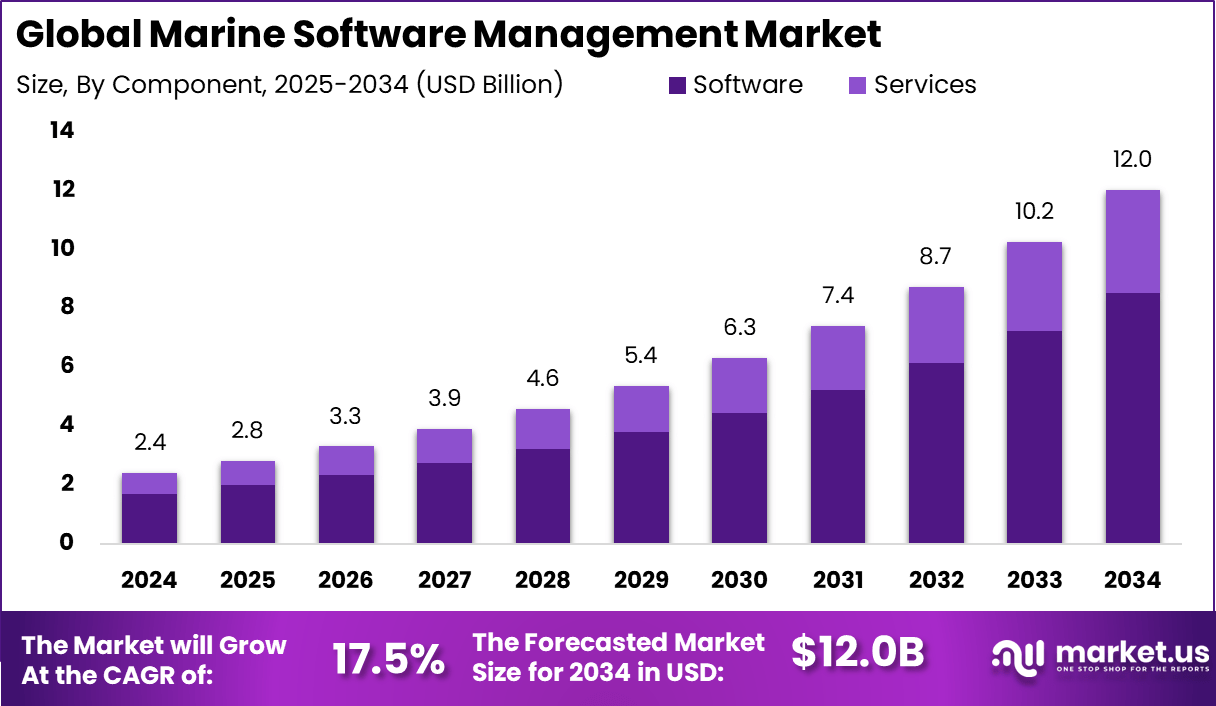
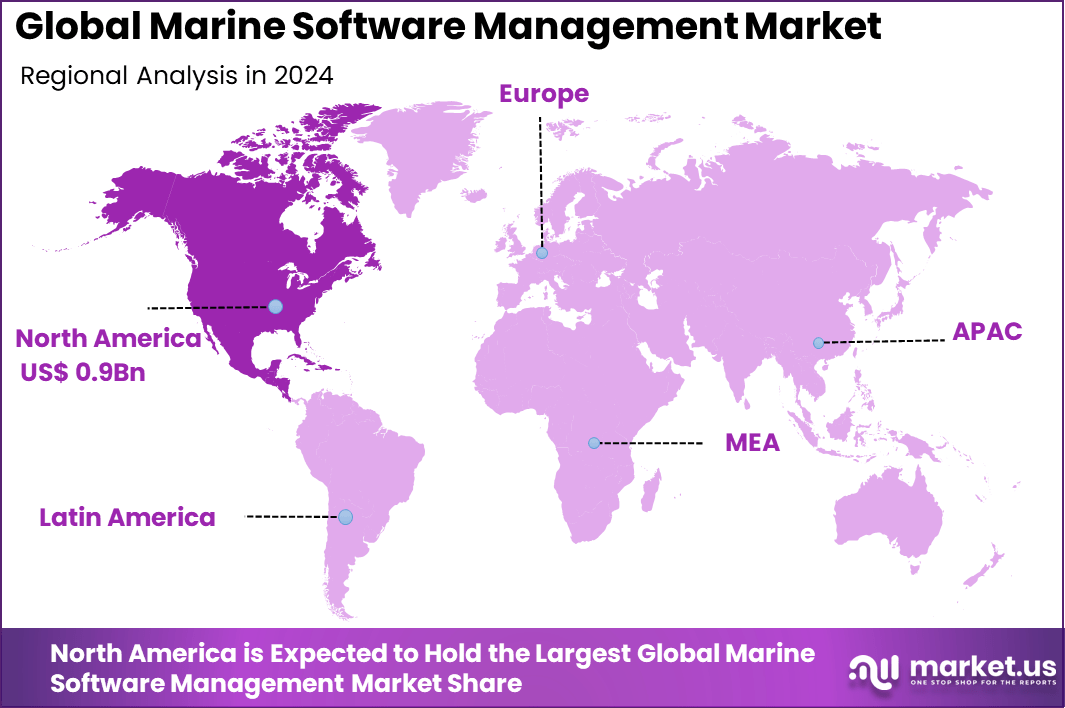
The Global Marine Software Management Market size is expected to be worth around USD 12 Billion By 2034, from USD 2.4 billion in 2024, growing at a CAGR of 17.5% during the forecast period from 2025 to 2034. In 2024, North America held a dominant market position, capturing more than a 38.5% share, holding USD 0.9 Billion revenue.
The Marine Software Management Market refers to the suite of digital platforms and integrated solutions deployed in maritime operations to manage fleet logistics, environmental compliance, crew administration, navigation and routing, maintenance, and financial tracking. These systems enable real‑time data aggregation from vessel sensors, supply chain networks, port terminals, and regulatory frameworks to support decision‐making and operational coordination across onboard and onshore systems.
The Top Driving Factors are the increasing complexity of global maritime operations and the demand for optimized supply chain efficiency. Growth in global trade volume and fleet sizes motivates operators to adopt centralized digital systems that reduce inefficiencies and administrative burdens. Simultaneously, tightening environmental and safety regulations at the international and regional level require more robust monitoring and compliance capabilities.
Market Size and Growth
| Key Trend | Description |
|---|---|
| AI & IoT Integration | AI and IoT enhance predictive maintenance, real-time tracking, and data-driven decision-making for fleet and logistics operations. |
| Cloud-Based & Remote Monitoring | Migration to cloud platforms and remote management tools offer scalability, flexibility, lower costs, and ease of upgrades. |
| Blockchain & Smart Contracts | Use of blockchain and smart contracts for secure, transparent, and automated transactions and logistics tracking. |
| Autonomous & Automated Vessels | Software supports autonomous vessel operations and unmanned fleet management, improving safety and reducing labor costs. |
| Smart Port & Digitalization Initiatives | Investments in smart port modernization, automation, and digital platforms fuel demand for integrated marine management software. |
Growth Factors
| Key Factor | Description |
|---|---|
| Rise in Global Maritime Trade | Expansion of international trade and growing fleet sizes drive demand for efficient vessel and supply chain management software. |
| Regulatory Compliance & Environmental Standards | Stricter environmental regulations (e.g., IMO 2020, MARPOL) require software for emission monitoring, reporting, and regulatory tracking. |
| Digital Transformation & Technological Advancements | Adoption of AI, IoT, big data analytics, and cloud solutions improves operational efficiency, predictive maintenance, and real-time monitoring. |
| Demand for Operational Efficiency & Cost Savings | Need for route optimization, fuel savings, cargo tracking, and streamlined logistics increases reliance on centralized software solutions. |
| Focus on Cybersecurity | As maritime operations digitize, robust security features in software are necessary to manage cyber threats and ensure regulatory compliance. |
By Component Analysis
In 2024, the Software segment accounted for 70.7% of the Marine Software Management Market. The rising demand for digital maritime operations and real-time analytics has driven strong adoption of software solutions across the industry. From voyage planning to compliance tracking, software platforms now offer integrated functionalities that support fuel efficiency, safety protocols, maintenance forecasting, and performance optimization.
As maritime operations become increasingly data-driven, software systems are central to enabling automation, reducing human error, and supporting decision-making. Their ability to integrate with vessel sensors and other digital tools has further strengthened their role in operational efficiency.
By Deployment Analysis
The On-Premises deployment model led the market with 58.5% share in 2024. Many maritime organizations prefer on-premises solutions due to concerns over data sovereignty, offline reliability, and strict cybersecurity requirements. Vessels operating in remote regions or with limited internet access benefit from locally hosted systems that ensure uninterrupted access and real-time control.
On-premises deployments are also favored for customization and internal infrastructure integration, particularly by larger operators managing sensitive operations. This model allows for greater control over software updates, security configurations, and data governance in regulated environments.
By Organization Size Analysis
In 2024, Large Enterprises dominated the market with a 65.9% share. These companies typically operate vast fleets or manage global shipping routes, requiring robust software systems to handle complex logistics, crew rotations, asset tracking, and regulatory compliance. Their greater financial resources allow for investment in advanced marine software platforms with features like predictive analytics, AI-powered insights, and cloud integration.
Additionally, large enterprises often face higher scrutiny in terms of international maritime regulations and environmental standards. As a result, they adopt sophisticated software tools to ensure operational transparency and regulatory alignment across their global operations.
By Location Analysis
Onboard systems led by holding 55.4% of the market share in 2024. Shipboard operations rely heavily on software that can function in real-time to support navigation, safety, crew communication, and equipment monitoring. Onboard solutions are essential for optimizing voyage execution, minimizing fuel consumption, and ensuring compliance with maritime laws while at sea.
These systems are designed to work offline or in hybrid mode, syncing with onshore databases when connectivity permits. The growing emphasis on autonomous and semi-autonomous ships has further driven the development and adoption of onboard software platforms.
By Application Analysis
In 2024, Crew Management emerged as the leading application, contributing 34.7% to the overall market. Managing a global, rotating workforce across vessels requires precise scheduling, certification tracking, payroll management, and health monitoring. Software solutions designed for crew management streamline these functions, improving compliance with international labor laws and boosting operational continuity.
Crew welfare, especially post-pandemic, has gained attention, leading operators to invest in tools that enhance onboard working conditions. These systems also help ensure the right personnel are assigned based on skill, certification, and operational requirements, reducing downtime and improving safety.
By End-Use Analysis
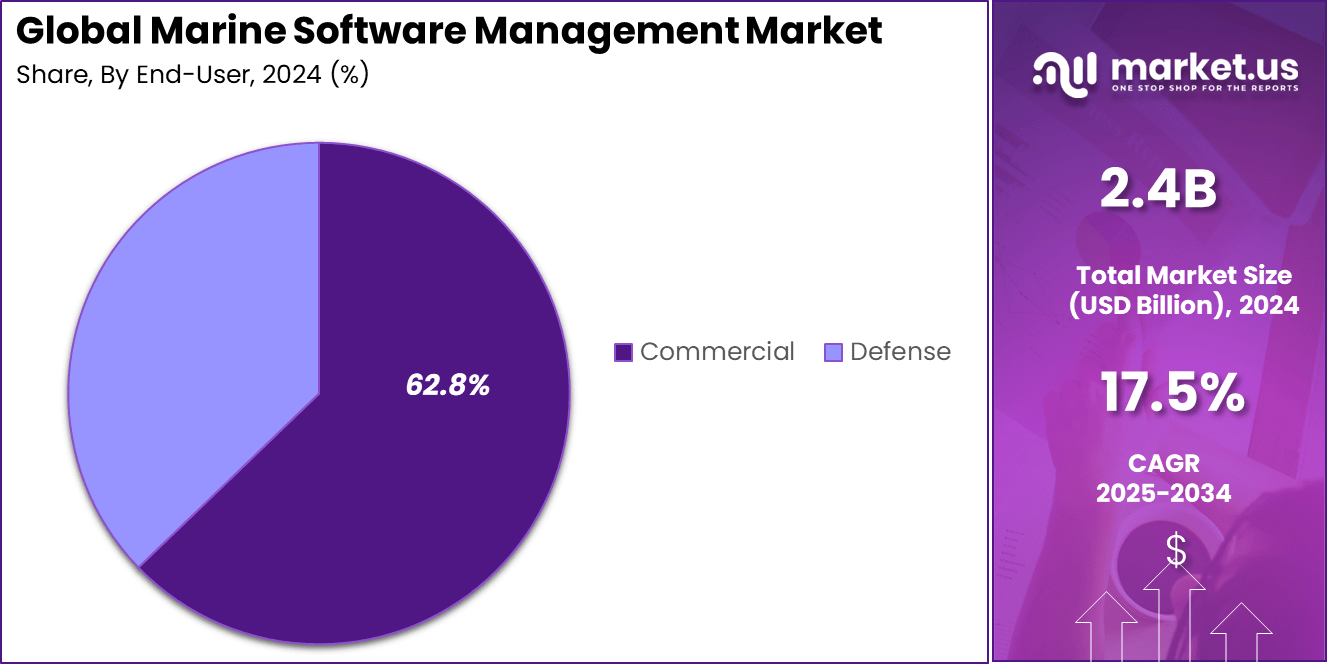
In 2024, the Commercial segment held a dominant 62.8% share, driven by widespread adoption across cargo shipping, logistics, offshore services, and passenger transportation. These sectors require highly coordinated operations, documentation, and real-time decision-making, all of which are enabled by advanced marine software systems.
With global trade expanding and environmental compliance tightening, commercial fleet operators are prioritizing digital tools to improve fuel efficiency, reduce emissions, and enhance competitiveness. Their reliance on scalable, integrated software systems positions this segment as the largest consumer of marine software management solutions.
Key Market Segments
By Component
Software
- Tracking & Monitoring
- Navigation & Routing
- Supply Chain & Logistics
- Finance & Accounting
- System Testing
- Others
Services
- Implementation & Integration
- Consulting & Training Services
- Support & Maintenance Services
By Deployment
- Cloud
- On-premises
By Organization Size
- Large Enterprises
- Small & Medium Enterprises (SMEs)
By Location
- Onboard
- Onshore
By Application
- Crew Management
- Port Management
- Harbor Management
- Reserve Management
- Cruise & Yacht Management
- Others
By End-use
- Commercial
- Defense
Key Regions and Countries
- North America
- US
- Canada
- Europe
- Germany
- France
- The UK
- Spain
- Italy
- Russia
- Netherlands
- Rest of Europe
- Asia Pacific
- China
- Japan
- South Korea
- India
- Australia
- Singapore
- Thailand
- Vietnam
- Rest of Latin America
- Latin America
- Brazil
- Mexico
- Rest of Latin America
- Middle East & Africa
- South Africa
- Saudi Arabia
- UAE
- Rest of MEA
Driver
Push for Operational Efficiency and Compliance
A major driver for adopting marine software management relates to the growing need for operational efficiency and strict regulatory compliance. As the maritime industry faces tougher international rules and heightened safety requirements, digital management platforms help operators keep up with schedules, reduce fuel consumption, and ensure alignment with environmental laws.
These software solutions streamline everything from tracking cargo and crew to automating compliance paperwork, allowing shipping firms to run smoother operations and avoid costly penalties while also enhancing sustainability.
Restraint
High Implementation and Integration Costs
Despite the benefits, one significant restraint is the high upfront and ongoing costs associated with implementing marine software. Smaller shipping companies, in particular, may struggle with expenses tied to software licensing, necessary hardware upgrades, installation, and integration with often outdated legacy systems.
Additionally, migration from traditional or paper-based management methods to advanced digital solutions can result in operational downtime and training demands, making it harder for smaller operators to justify or afford these investments.
Opportunity
Customization and Specialization
A promising opportunity lies in the creation of highly customizable and specialized marine software tailored to specific operational needs. The maritime sector covers a variety of activities – including cargo, passenger transport, port management, and cruise operations – each with its own requirements.
Demand is rising for solutions that are not one-size-fits-all but can be adapted and extended for unique workflows, compliance standards, and integration with other digital systems. This opens up a pathway for innovators and developers to offer bespoke platforms, increasing software adoption and operational value across the industry.
Challenge
Digital Skills Gaps and Change Management
A persistent challenge for effective marine software rollouts is the shortage of digital skills among crews and onshore staff. Many maritime professionals are more familiar with analog systems and manual processes, so transitioning to complex digital management tools can be daunting.
Without proper training and organizational support, companies risk underutilizing advanced features and not realizing the full return on their investment. Helping teams adapt to new technology, building confidence in digital workflows, and fostering a culture of continuous learning are all essential to overcoming resistance and ensuring successful adoption.
Key Player Analysis
In the Marine Software Management Market, several established companies are shaping the competitive landscape through innovation and digital integration. ABB and Oracle are widely recognized for offering end-to-end vessel and fleet management software that supports automation and predictive maintenance. Their platforms are often adopted by large shipping companies seeking operational transparency and cost optimization.
Meanwhile, Chetu Inc., Dockmaster, and Scribble Software Inc. have built strong reputations by serving niche segments such as marina operations, vessel inventory tracking, and accounting. These vendors offer customizable and modular solutions that cater to mid-sized enterprises. Their tools provide robust integrations with third-party applications and enhance user interface design for smoother workflows.
Smaller but rapidly evolving players like MARINA MASTER Ltd., Marine Cloud Ltd., MESPAS AG, TIMEZERO, and Lloyd’s Register Group Services Limited are investing heavily in user-centric design and mobile accessibility. These companies focus on delivering scalable platforms for voyage planning, compliance management, and maintenance scheduling. Their tools often incorporate weather analytics, IoT integration, and digital logbook functionalities.
Major players
- ABB
- Chetu Inc.
- Dockmaster
- Lloyd’s Register Group Services Limited.
- MARINA MASTER Ltd.
- Marine Cloud Ltd
- MESPAS AG
- Oracle
- Scribble Software Inc.
- TIMEZERO
- Others
Recent Developments
- April 2025: DockMaster announced upgrades to deliver a unified product platform, integrating boat sales, service, inventory, parts, and complete marina management into a single software suite. The platform scales from small marinas to large dealerships – this streamlining reduces complexity for businesses and improves operational efficiency across the board.
- July 2024: Chetu Inc. formed a services partnership with UKG, a leader in HR and workplace management solutions. This collaboration leverages Chetu’s custom software expertise with UKG’s AI-powered platforms, enhancing workplace and crew management for marine operators. Customers benefit from integrated, next-generation HR technology backed by over 24 years of Chetu’s industry experience.
- January 2024: ABB made headlines by acquiring DTN Shipping’s business in Europe and the Philippines. This move positioned ABB as a market leader in ship route optimization by expanding their capabilities in vessel routing software, analytics, and modeling. The deal added DTN’s weather routing solutions, bringing their total connected vessel count to over 5,000.

- 蓝茶市场(2026—2031)
0评论2026-09-15

- 泡沫材料市场(2026—2031)
0评论2026-09-15

- 重铬酸钠市场(2026—2031)
0评论2026-09-15

- 家族性淀粉样多发性神经病(FAP)市场(2026—2031)
0评论2026-09-15

- 次氯酸钙市场(2026—2031)
0评论2026-09-15

- 海上储能市场(2026—2031)
0评论2026-09-12

- 混凝土市场(2026—2031)
0评论2026-09-12

- 矫形器械市场(2026—2031)
0评论2026-09-12

- 木质素基树脂市场(2026—2031)
0评论2026-09-12

- 聚碳酸酯二元醇市场(2026—2031)
0评论2026-09-12