


Report Overview
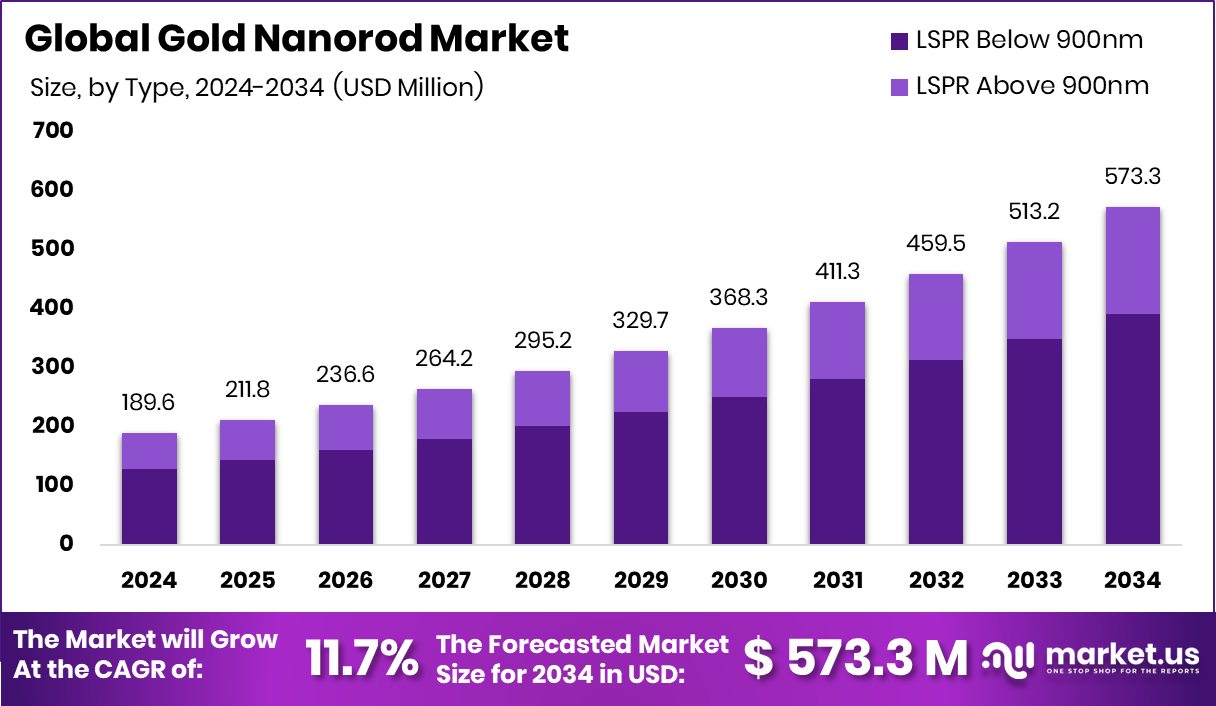
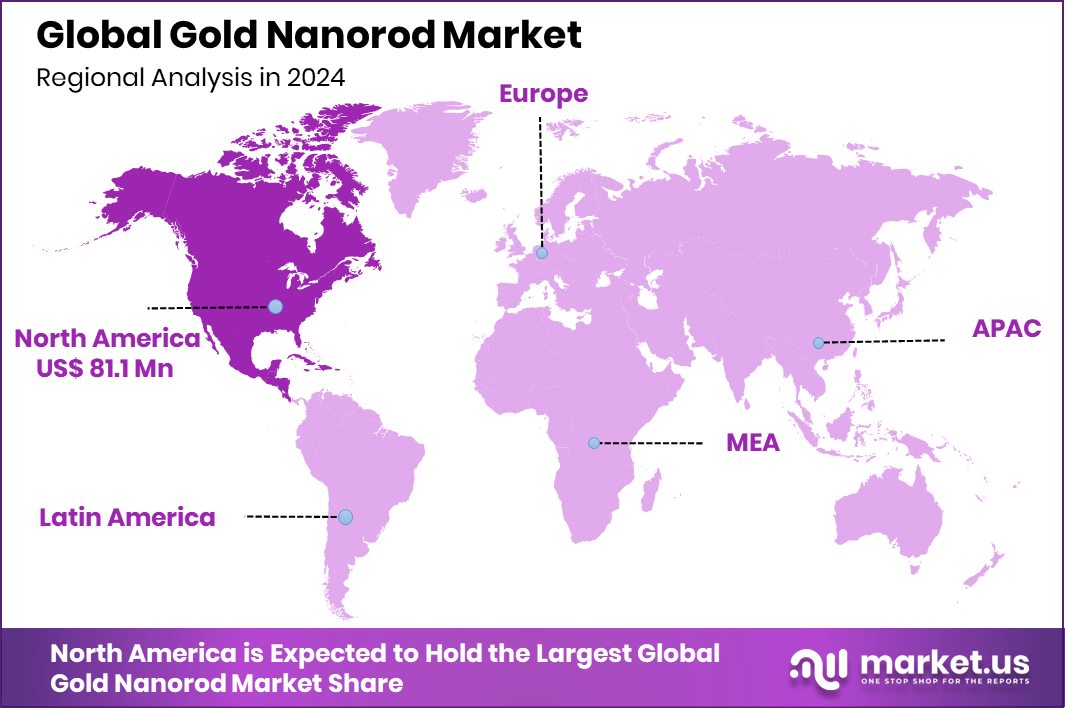
The Global Gold Nanorod Market is expected to be worth around USD 573.3 million by 2034, up from USD 189.6 million in 2024, and is projected to grow at a CAGR of 11.7% from 2025 to 2034. Strong healthcare investment supported North America’s 42.80% share, totaling USD 81.1 million.
Gold nanorods (GNRs) are classified within the chemical category of anisotropic plasmonic nanostructures, composed of elongated gold nanoparticles whose dimensions impart a tunable surface plasmon resonance. Their optical response, governed by size and aspect ratio, enables applications in fields such as photothermal therapy, sensing, and chemical imaging.
The synthesis of gold nanorods is commonly achieved via seed‑mediated colloidal methods, often employing surfactants like CTAB to control anisotropic growth. Surface ligands may subsequently be exchanged or modified to improve biocompatibility or targeting functionality
Support from national governments has been a critical driver of gold nanorod research. For instance, the U.S. National Nanotechnology Initiative (NNI), active since 2000, allocated over USD 1.5 billion annually by 2024 to nanotechnology R&D, including research into plasmonic nanomaterials such as gold nanorods. In Europe, the Horizon 2020 programme invested more than €2.7 billion in nanotechnology projects between 2014 and 2020, many of which explored advanced nanostructures with biomedical and sensing applications.
Government funding mechanisms often include multi‑agency grant platforms, dedicated nanotechnology centers, and commercialization incentives for small businesses and universities to translate gold nanorod research toward practical applications.
Key Takeaways
- The Global Gold Nanorod Market is expected to be worth around USD 573.3 million by 2034, up from USD 189.6 million in 2024, and is projected to grow at a CAGR of 11.7% from 2025 to 2034.
- In 2024, Gold Nanorod Market saw LSPR below 900nm dominate with a 68.2% share.
- Gold Nanorods sized 20–50 nm captured 32.4% market share, highlighting strong research preference.
- PEG-coated Gold Nanorods held a 32.6% share, driven by improved biocompatibility and extended circulation time.
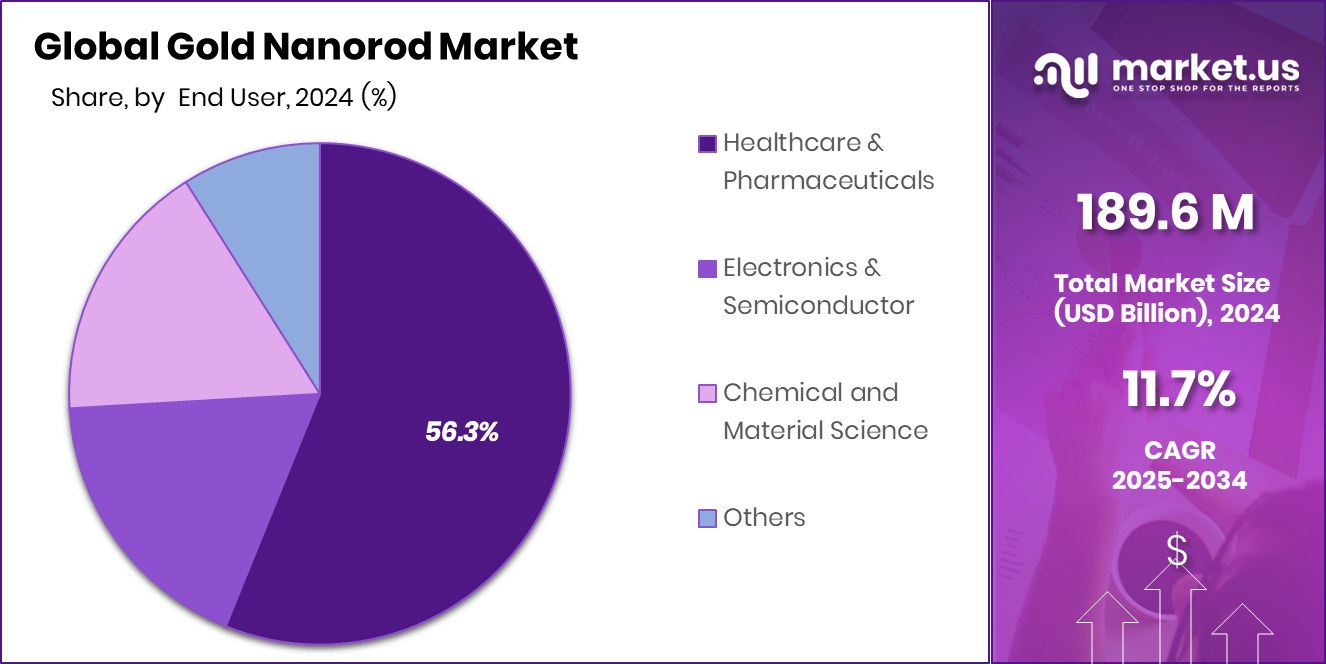
- Healthcare and Pharmaceuticals led end-user adoption in the gold nanorod market, accounting for 56.3% of the market share.
- The North American market reached a value of USD 81.1 million in 2024.
By Type Analysis
In 2024, LSPR below 900nm dominated Gold Nanorod Market.
In 2024, LSPR Below 900nm held a dominant market position in the By Type segment of the Gold Nanorod Market, with a 68.2% share. This leadership is attributed to its widespread use in biomedical imaging, biosensing, and photothermal therapy applications, where shorter longitudinal surface plasmon resonance (LSPR) wavelengths offer high optical sensitivity and enhanced performance in biological environments.
The preference for LSPR below 900nm nanorods is largely driven by their efficient absorption in the near-infrared (NIR) window, enabling better tissue penetration and minimal damage to surrounding healthy cells during diagnostic or therapeutic procedures.
Moreover, these nanorods are preferred in research settings due to their ease of synthesis and adaptability to surface modification, which allows for targeted delivery and improved biocompatibility.
Their optical tunability below 900nm ensures compatibility with various imaging systems and analytical devices used in laboratories and medical institutions. The consistent demand from academic and healthcare sectors has further reinforced the position of LSPR below 900nm nanorods as the leading type in 2024.
By Size Range Analysis
Gold Nanorod Market favors 20–50 nm size for applications.
In 2024, 20–50 nm held a dominant market position in the By Size Range segment of the Gold Nanorod Market, with a 32.4% share. This size range was favored primarily due to its optimal balance between stability, surface area, and aspect ratio, which makes it highly suitable for biomedical and imaging applications. Gold nanorods within the 20–50 nm range exhibit effective plasmonic resonance and are ideal for use in photothermal therapies, where precision and minimal invasiveness are critical.
Additionally, nanorods of this size range demonstrate strong biocompatibility and improved cellular uptake, enhancing their effectiveness in drug delivery systems and in vivo imaging techniques. Their relatively small dimensions allow for deeper tissue penetration and reduced risk of aggregation, which is essential for consistent performance in clinical and research environments.
The preference for the 20–50 nm category has also been reinforced by its compatibility with scalable synthesis methods, ensuring consistent quality and reproducibility in laboratory and commercial settings. These advantages have made this size range the most utilized across industries that rely on nanotechnology-based solutions, securing its dominant market position in 2024.
By Surface Modification Analysis
PEG surface modification captured 32.6% in the Gold Nanorod Market.
In 2024, Polyethylene Glycol (PEG) held a dominant market position in the By Surface Modification segment of the Gold Nanorod Market, with a 32.6% share. This dominance is primarily due to PEG’s ability to significantly enhance the biocompatibility and circulation time of gold nanorods in biological systems. PEGylation helps in reducing non-specific interactions with proteins and cells, making the nanorods more stable in physiological environments, which is essential for medical and diagnostic applications.
The 32.6% market share held by PEG-modified nanorods also reflects their effectiveness in preventing aggregation and improving dispersibility in aqueous media. These properties are crucial for ensuring consistent performance in imaging, drug delivery, and photothermal therapy applications. Moreover, PEG coatings allow for further functionalization, enabling targeted delivery by attaching specific ligands or antibodies.
The consistent preference for PEG surface modification indicates its established role in ensuring safety, stability, and efficiency across various nanomedicine processes. The proven track record of PEG in extending the circulation life of nanorods without compromising their plasmonic properties has reinforced its adoption, securing its leading share in this segment of the gold nanorod market in 2024.
By End User Analysis
Healthcare and pharmaceuticals led with 56.3% market share globally.
In 2024, Healthcare and Pharmaceuticals held a dominant market position in the By End User segment of the Gold Nanorod Market, with a 56.3% share. This leading position is primarily due to the growing use of gold nanorods in drug delivery systems, diagnostic imaging, and cancer treatment applications. Their unique optical and thermal properties allow for targeted photothermal therapy, which is increasingly being adopted in oncology due to its precision and minimal invasiveness.
The 56.3% market share reflects the sector’s strong focus on advanced nanomaterial-based technologies that offer both therapeutic and diagnostic benefits, often referred to as theranostics. Gold nanorods coated with biocompatible materials are being used in real-time imaging and targeted drug release, improving patient outcomes and reducing side effects compared to conventional treatments.
Healthcare institutions and pharmaceutical companies have also been investing in nanotechnology research and clinical trials involving gold nanorods, which have further supported their integration into medical protocols. This sustained demand from the healthcare and pharmaceutical industries has firmly established their dominant role in the end-user segment of the gold nanorod market in 2024, driven by the need for innovative, efficient, and safer therapeutic technologies.
Key Market Segments
By Type
- LSPR Below 900nm
- LSPR Above 900nm
By Size Range
- Below 10 nm
- 10-20 nm
- 20-50 nm
- 50-100 nm
- Above 100 nm
By Surface Modification
- Polyethylene Glycol (PEG)
- Citrate
- Cysteine
- Biotin
- Gold-Shell
- Others
By End User
- Healthcare and Pharmaceuticals
- Electronics and Semiconductors
- Chemical and Material Science
- Others
Driving Factors
Rising Use in Cancer Treatment Boosts Demand
One of the top driving factors of the gold nanorod market is their growing use in cancer treatment. Gold nanorods are highly effective in a method called photothermal therapy. In this treatment, the gold nanorods are injected into the patient’s body, where they target cancer cells. When exposed to near-infrared light, these rods heat up and destroy the cancer cells without harming healthy tissues.
This method is more accurate and less painful than traditional treatments like chemotherapy. Hospitals and research centers are using this technology more often because it gives better results with fewer side effects. As the need for safer and more targeted cancer therapies increases, the demand for gold nanorods in healthcare is expected to rise steadily.
Restraining Factors
High Production Cost Limits Market Growth
A key restraining factor in the gold nanorod market is the high cost of production. Making gold nanorods involves expensive raw materials like gold and complex manufacturing steps that require advanced laboratory equipment and skilled professionals. These processes need strict control to produce nanorods with the right size, shape, and quality.
Because of this, the overall production becomes costly, especially when scaling up for industrial or medical use. Small companies and research institutions may find it difficult to afford these costs, which limits broader adoption. As a result, even though gold nanorods have many useful applications, their market growth is held back by the challenge of making them affordable for wider use in healthcare and other sectors.
Growth Opportunity
Expanding Role in Diagnostic Imaging Technologies
A major growth opportunity for the gold nanorod market lies in their expanding use in diagnostic imaging. Gold nanorods can improve the clarity and accuracy of imaging techniques such as optical coherence tomography (OCT) and photoacoustic imaging. These rods help highlight tissues or cells in the body, making it easier for doctors to detect diseases early, especially cancer and other serious conditions.
As medical imaging becomes more advanced and widely used, there is a growing demand for materials that can provide clearer results with fewer side effects. Gold nanorods offer a promising solution due to their strong light absorption and ability to target specific areas, opening new opportunities in non-invasive diagnostics and early disease detection around the world.
Latest Trends
Hybrid Nanorods Combine Multiple Functional Effects
A recent trend in the gold nanorod market is the development of hybrid nanorods that combine gold with other materials, such as magnetic or polymer coatings, in a single structure. These hybrid particles are designed to serve multiple functions at once, such as heating cancer cells using infrared light while also enabling magnetic targeting or drug release in a controlled manner.
The combination of different properties in one nanocarrier simplifies treatment protocols and enhances precision. Researchers are increasingly exploring this design to improve treatment outcomes, reduce side effects, and support personalized healthcare approaches. As lab techniques become more advanced, hybrid gold nanorods are gaining attention as a next-generation option in nanomedicine and theranostics.
Regional Analysis
In 2024, North America led the Gold Nanorod Market with a 42.80% share.
In 2024, North America held a dominant position in the global Gold Nanorod Market, accounting for 42.80% of the total market share, with a valuation of USD 81.1 million. The region’s leadership is primarily driven by strong investments in nanomedicine, advanced healthcare infrastructure, and ongoing research in photothermal therapy and molecular imaging.
The United States, in particular, has witnessed significant adoption of gold nanorods across biomedical research institutions and pharmaceutical development programs, supported by favorable funding from government agencies and academic collaborations.
Europe followed with steady demand, supported by innovations in diagnostic imaging and drug delivery platforms. Regulatory support and rising adoption of precision medicine technologies have further enhanced gold nanorod integration in research labs and clinical trials.
Meanwhile, Asia Pacific has emerged as a promising region, with increasing government focus on nanotechnology and expanding pharmaceutical manufacturing capabilities in countries like China, Japan, and India. Latin America and the Middle East & Africa represent nascent markets, with gradual advancements observed in academic research and healthcare modernization efforts.
Key Regions and Countries
- North America
- US
- Canada
- Europe
- Germany
- France
- The UK
- Spain
- Italy
- Rest of Europe
- Asia Pacific
- China
- Japan
- South Korea
- India
- Australia
- Rest of APAC
- Latin America
- Brazil
- Mexico
- Rest of Latin America
- Middle East & Africa
- GCC
- South Africa
- Rest of MEA
Key Players Analysis
In 2024, BBI Solutions OEM Ltd. continued to play a strategic role in the global Gold Nanorod Market through its focus on providing high-quality gold nanoparticles, including gold nanorods, for research and diagnostic applications. The company’s emphasis on scalable production and customizable surface modifications has strengthened its relationships with diagnostic kit manufacturers and academic researchers. Their gold nanorods are widely utilized in lateral flow assays and biosensing platforms, which reinforces their market relevance as point-of-care technologies become more prominent globally.
Beijing DK Nano Technology Co. Ltd maintained its competitive edge by offering a broad range of nanomaterials with specialized sizes and optical properties. Its gold nanorods are recognized for their consistency and purity, qualities that are crucial for advanced photothermal therapies and molecular imaging. The company’s production capabilities and focus on delivering reliable nanorod solutions have contributed to its growing presence, especially across Asia-Pacific research institutions and biotech firms.
CD Bioparticles, Inc. demonstrated a strong commitment to functional nanomaterials by providing surface-modified gold nanorods tailored for targeted drug delivery and cellular imaging. The company’s product range supports innovation in nanomedicine, enabling researchers to select specific ligand coatings for controlled bio-distribution. Its focus on customizable formats, including PEGylated and antibody-conjugated gold nanorods, highlights its position as a reliable partner in R&D-focused markets.
Top Key Players in the Market
- American Elements
- BBI Solutions OEM Ltd.
- Beijing DK Nano Technology Co. Ltd
- CD Bioparticles, Inc
- Cytodiagnostics Inc.
- NanoComposix
- NanoHybrids Inc.
- Nanopartz Inc.
- Sona Nanotech Inc.
- Strem Chemicals, Inc.
Recent Developments
- In December 2024, the company released results from a third preclinical study in a colorectal (CT‑26) cancer model. THT-treated subjects demonstrated a 100% response rate and 50% complete tumor elimination, compared to no response in standard immunotherapy controls.
- In October 2024, the company introduced a series of Endotoxin‑Free Gold Nanoparticles optimized for biomedical research and bioassay applications. Offered in sizes ranging from 5 nm to 400 nm, these nanoparticles are citrate- or tannic acid-stabilized and feature endotoxin levels below 0.5 EU/mL. These products deliver high purity (>99%) and low toxicity for sensitive studies involving cell culture, immunoassays, imaging, and drug delivery platforms.









