


Report Overview
The Global Native Advertising Market size is expected to be worth around USD 399.79 Billion By 2034, from USD 106.9 billion in 2024, growing at a CAGR of 14.1% during the forecast period from 2025 to 2034. In 2024, North America held a dominant market position, capturing more than a 31.5% share, holding USD 33.67 Billion revenue.
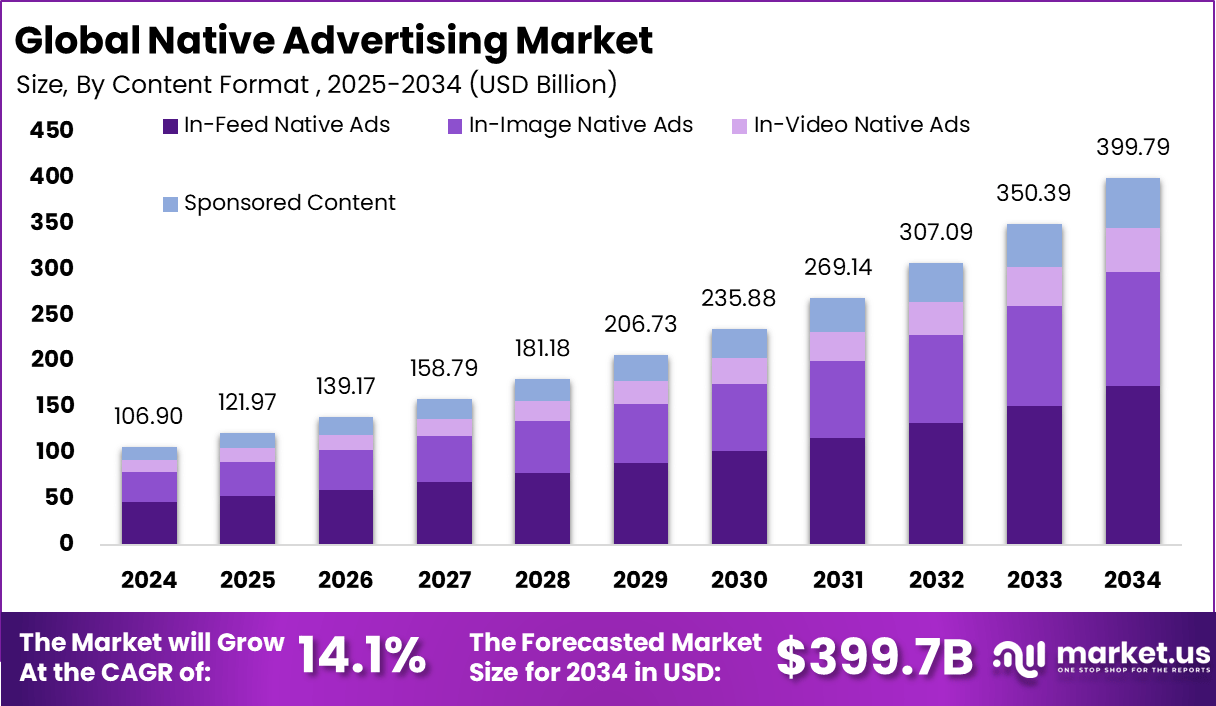
The native advertising market can be described as a form of paid promotion that is designed to match the look, feel and function of the platform on which it appears. It typically consists of articles, videos, images or posts that blend seamlessly within editorial content in feeds, on websites or social platforms. Despite being sponsored, these ads are intended to appear native to their environment, and require clear labelling to distinguish them from editorial material.
Based on data from Meetanshi, native digital display ad spending in the U.S. rose from $35.24 billion in 2018 to $52.76 billion in 2020. Trust remains higher for editorial sites, with 68% of users trusting native ads there versus 55% on social media. Additionally, 32% of users are likely to share native ads, compared to 19% for display ads.
According to Linearity, global digital ad spending reached $517 billion by end-2023, making up 66% of total ad spend. Instagram Stories reaches over 500 million daily users, and 73% of consumers say brand videos on social media influence their purchases.
Market Size and Growth
| Key Factors | Description |
|---|---|
| Mobile Device Proliferation | Continued global smartphone adoption drives native ad impressions |
| Shift to Non-Intrusive Advertising | Users and brands prefer content that integrates naturally instead of disruptive banners |
| Social Media Engagement | Native formats excel on newsfeeds and platforms like Facebook, Instagram, TikTok |
| Regulatory Compliance & Privacy | Contextual targeting and ad formats comply better with GDPR, CCPA, and data privacy trends |
| AI-Powered Personalization | Improved results from AI-driven campaign personalization, automation, and optimization |
Driver Analysis
Personalization Fuels Native Advertising Success
A primary driver behind native advertising’s rise is the increasing demand for personalized and relevant user experiences. As people consume more digital media on mobile and social platforms, they naturally become more selective about what captures their attention. Marketers have shifted from generic messaging to highly tailored content that resonates with individual preferences, behaviors, and demographics.
Using advanced data analysis and artificial intelligence, advertisers now craft campaigns that reach specific target groups, making ads more engaging and less intrusive. The seamless integration of such advertising within feeds and articles means it feels more like helpful content rather than a disruptive pitch, strengthening trust and conversion rates.
Restraint Analysis
Transparency and Trust Issues Loom Large
One of the most pressing restraints for native advertising is transparency. The blurred line between content and advertisement can sometimes mislead users, causing trust issues if people feel deceived. Regulators and experts have raised concerns about the need for clear labeling so that users can distinguish between sponsored and editorial content.
When ads are not adequately marked, they risk reducing the credibility of both the publisher and the advertiser, potentially causing damage to brand trust over time. Recognizing these risks, platforms and regulators are increasingly enforcing rules that mandate visibility and clarity in native ad disclosures.
Opportunity Analysis
Privacy Shifts Open New Doors
With the decline of third-party cookies and tightening privacy regulations, brands are being forced to rethink digital advertising strategies. Native advertising – by relying more on contextual relevance and first-party data – presents a privacy-forward opportunity.
Because these ad formats focus on delivering messages that match the context of the platform, rather than tracking users across the web, they align well with evolving legal frameworks and consumer expectations around privacy. Marketers can now harness their own audience insights to execute campaigns that are both effective and compliant, further solidifying native ads’ role in the digital future.
Challenge Analysis
Ethical and Regulatory Dilemmas
Native advertising faces significant hurdles related to ethics and regulation. Since its content often closely mimics editorial or organic posts, consumers might not immediately recognize material as advertising, raising concerns about manipulation or subtle persuasion.
Regulatory bodies are closely scrutinizing these practices, and advertisers must adapt by ensuring clear disclosures and upholding ethical marketing standards. As scrutiny increases, brands operating without transparency risk fines, negative publicity, and erosion of public trust, making this challenge crucial to long-term success.
Competitive Landscape
In the Native Advertising Market, Taboola, Outbrain, and Teads have emerged as key leaders. Their platforms enable content discovery and native ad placements across top publisher networks. These companies focus on enhancing user engagement through personalized content recommendations.
MGID, RevContent, and Nativo Inc. have also secured notable positions in this space. These platforms are recognized for offering advanced native formats and demand-side solutions tailored for performance marketers. Their real-time bidding, fraud detection tools, and transparent reporting systems have strengthened client retention.
TripleLift, Media.net, Sharethrough, and Verizon Media (Yahoo Native) bring strong programmatic capabilities into the native space. These companies emphasize header bidding, dynamic creative optimization, and omnichannel delivery. Their solutions align with both brand and performance marketing goals. Integration of video and commerce-driven content has boosted their platform value.
Top Key Players in the Market
- RevContent
- MGID
- Taboola
- Outbrain
- TripleLift
- Nativo Inc
- Media.net
- Sharethrough
- Verizon Media (Yahoo Native)
- Teads
Recent Developments
- In April 2025, Taboola expanded its partnership with Gannett to enhance its AI-powered Realize platform. The integration provides access to Gannett’s full display inventory, including USA TODAY and 200+ local sites, improving targeting and campaign outcomes through advanced first-party data use.
- In April 2025, MGID partnered with Integral Ad Science (IAS) to boost third-party ad measurement, offering real-time insights into viewability, attention, and brand safety. This collaboration supports more transparent and reliable native ad campaigns.

- 蓝茶市场(2026—2031)
0评论2026-09-15

- 泡沫材料市场(2026—2031)
0评论2026-09-15

- 重铬酸钠市场(2026—2031)
0评论2026-09-15

- 家族性淀粉样多发性神经病(FAP)市场(2026—2031)
0评论2026-09-15

- 次氯酸钙市场(2026—2031)
0评论2026-09-15

- 海上储能市场(2026—2031)
0评论2026-09-12

- 混凝土市场(2026—2031)
0评论2026-09-12

- 矫形器械市场(2026—2031)
0评论2026-09-12

- 木质素基树脂市场(2026—2031)
0评论2026-09-12

- 聚碳酸酯二元醇市场(2026—2031)
0评论2026-09-12