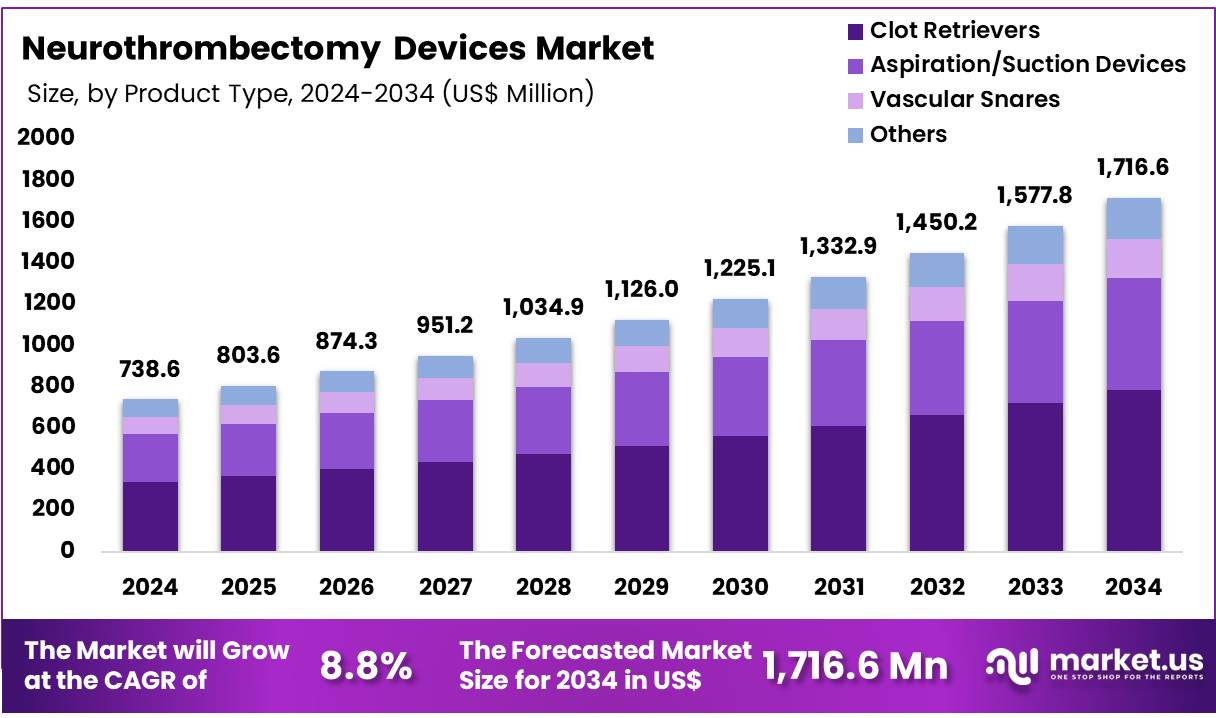
| Key Market Segments
By Product Type
- Clot Retrievers
- Aspiration/Suction Devices
- Vascular Snares
- Others
By End-User
- Hospitals
- Ambulatory Surgical Centers (ASCs)
- Emergency Clinics
- Specialty Clinics
Drivers
Increasing prevalence of Acute Ischemic Strokes, especially in aging populations
Being the most common type of stroke, ischemic stroke is a significant concern on the public health and poses a burden on the same. Moreover, ischemic stroke can happen to a diverse range of populations which causes many morbidity and mortality worldwide. According to a report by U.S. Centers for Disease Control and Prevention updated in October 2024, in the United States in 2022, 1 in 6 deaths (17.5%) from cardiovascular disease was due to stroke. About 87% of all strokes are ischemic strokes
As the most common type of stroke, ischemic strokes pose a significant burden on public health systems and individuals alike. With its pervasive impact across diverse patient populations, strokes constitute a significant source of morbidity and mortality worldwide. Understanding the underlying mechanisms, risk factors, and management strategies is crucial in mitigating the impact of this pervasive neurological condition.
Neurothrombectomy devices, which help remove clots from cerebral arteries, are increasingly recognized as a critical part of stroke management. Advances in technology have made these procedures more accessible and efficient, contributing to higher adoption rates. This growing demand for life-saving interventions is expected to continue driving market expansion, particularly in developed regions.
Restraints
High procedural costs and limited access to Advanced Medical Technologies
A key challenge for the neurothrombectomy devices market is the high cost of procedures and limited access to advanced treatment options, particularly in low- and middle-income countries. These factors prevent a significant portion of the population from benefiting from life-saving neurothrombectomy procedures. The complex technology needed for these devices, coupled with the demand for highly skilled healthcare professionals, drives up the cost of treatment.
For example, according to Cost Analysis by Prudour Pvt Ltd, the total cost of hospitalization for patients undergoing mechanical (i.e., neuro-) thrombectomy for acute stroke was approximately US$24,154 (with a range reported between US$18,365 and US$29,942 for different scenarios and institutions). Similarly, the total cost associated with mechanical thrombectomy was US$148,600, compared to US$142,000 for standard medical therapy in 2024 showing that thrombectomy increases overall treatment expenditures.
Opportunities
Technological Advancements in Device efficiency and Miniaturization
These technological advancements are transforming neurothrombectomy procedures, offering clinicians more effective tools to treat acute ischemic strokes and ultimately improving patient outcomes. For example, enhanced stent retriever designs are being implemented, e.g. NeVa™ by Vesalio features a multi-segmental design with three “Drop Zones” that allow for single-pass clot capture, improving first-pass success rates and reducing procedure times.
Advanced aspiration systems are also under development which provides additional benefits and features. For instance, Penumbra JET® 7 is a neurothrombectomy device which comes with XTRA FLEX™ Technology providing improved aspiration capabilities, allowing for more effective clot removal in challenging anatomies.
Moreover, Artificial Intelligence (AI) is being employed to analyze real-time imaging data, aiding in the identification of optimal thrombectomy sites and predicting procedural outcomes. This integration supports clinicians in making informed decisions during interventions.
For instance, in May 2024, Rapid Medical, a prominent innovator in neurovascular devices, has successfully completed its first robotic thrombectomy procedure in Medellín, Colombia. The procedure involved two patients being treated with the Robotic TIGERTRIEVER, the first endovascular thrombectomy device capable of autonomously adjusting to a patient’s unique anatomy.
Impact of Macroeconomic / Geopolitical Factors
The ability of healthcare systems and individuals to afford neurothrombectomy devices is closely linked to broader economic conditions. High GDP countries (e.g., US, Germany) with substantial healthcare spending see greater market adoption, while economic downturns or limited national budgets restrict device purchases and deployment. In the US, rising healthcare expenditure going from US$11,859 in 2020 to US$12,318 in 2021 enables broader access to advanced devices and procedures.
Favorable reimbursement policies often in developed regions help drive demand by reducing out-of-pocket costs for hospitals and patients. For example, North America’s strong healthcare spending coupled with supportive reimbursement structures has helped maintain its leading market position. Surging government healthcare investments (e.g., US government spending increased 35% in 2020) accelerate adoption and market growth.
Geopolitical factors such as government regulations, trade and supply chain, the political stability of the country and government support can all impact the neurothrombectomy device market significantly. For instance, during the COVID-19 pandemic, supply chain bottlenecks and resource reallocations impacted global access to neurothrombectomy devices, disproportionately affecting low- and middle-income countries.
Recent political focus on chronic disease management in the Asia-Pacific region is a good example of this which as a result, is driving increased public and private healthcare investment, expanding access in China and India. Although the high device cost and need for specialized medical personnel remain barriers. Sanctions or trade barriers between major economies (e.g., US-China tensions) can complicate device import/export, causing localized shortages or slower technology rollout.
Latest Trends
Shift Towards Minimally Invasive Procedures
Due to non-compliance in the patient treatment for open surgeries, patients and healthcare providers are preferring minimally surgeries and opting for thrombectomy devices that offer faster recovery times, less discomfort, and fewer risks compared to traditional surgical interventions. Especially, aspiration-based thrombectomy devices are gaining more attention in the recent years.
In April 2025, Anaconda Biomed, S.L., a medical technology company focused on developing next-generation neurothrombectomy devices, announced the enrollment and treatment of the first U.S. patient in its ATHENA clinical trial. The procedure was conducted by Dr. Shahram Majidi, Associate Professor of Neurosurgery, Neurology, and Radiology at Icahn School of Medicine at Mount Sinai, New York.
ATHENA is a global, randomized pivotal study involving 327 patients, aimed at evaluating the safety and effectiveness of Anaconda’s proprietary ANA Funnel Catheter™. This device is designed to assist in stent retriever-based thrombectomy by restricting blood flow during clot retrieval, enabling simultaneous aspiration and minimizing the risk of clot fragmentation for patients with large vessel occlusion acute ischemic stroke.
Additionally, the adoption of advanced robotic assistance and real-time imaging technologies is enhancing the precision and success of these procedures. This trend is expected to continue, shaping the future of stroke care and device development in neurovascular treatments.
Regional Analysis
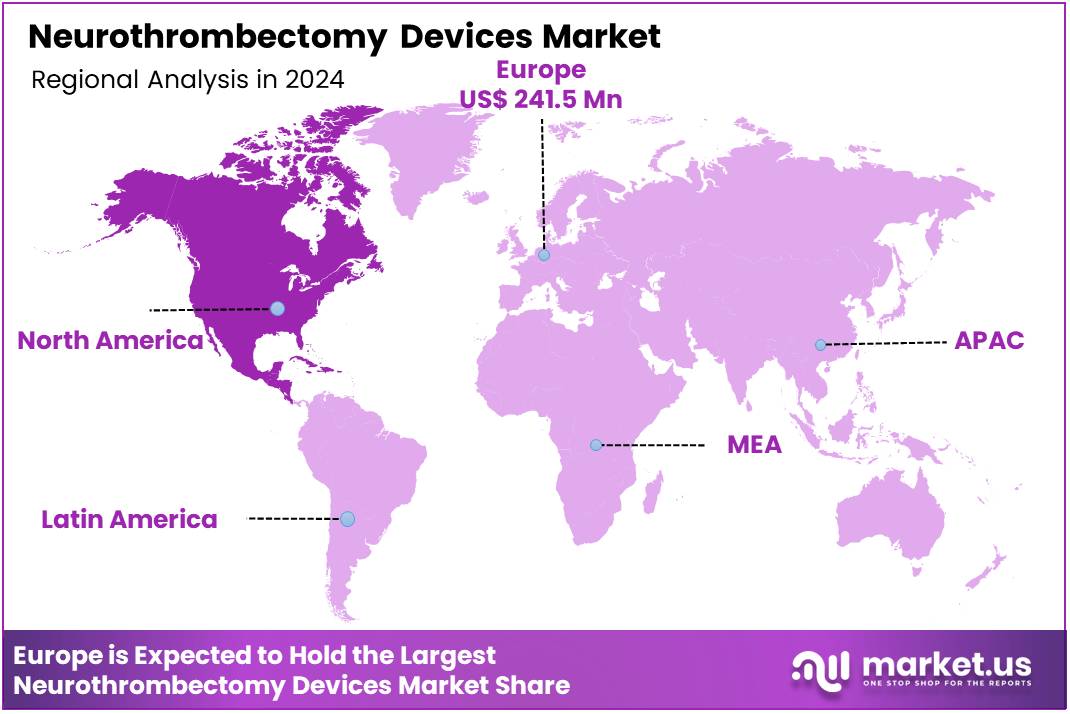
Europe is leading the Neurothrombectomy Devices Market
The prevalence of stroke especially AIS in Europe, particularly in the Germany, is a primary driver. Europe boasts state-of-the-art medical facilities and a high adoption rate of innovative medical technologies, facilitating the widespread use of neurothrombectomy devices. Europe held the majority of the global market share in 2024 with 32.7%, dominating the market.
Key players in the Europe neurothrombectomy devices market include Medtronic, Stryker Corporation, Penumbra Inc., and Acandis GmbH. These companies are focusing on product innovation, strategic partnerships, and expanding their market presence to capitalize on the growing demand for neurovascular interventions.
In February 2024, CERENOVUS, Inc., a part of Johnson & Johnson MedTech, announced the launch of the CEREGLIDE™ 71 Intermediate Catheter, a next-generation catheter designed with TruCourse™ technology, aimed at helping patients with acute ischemic stroke undergo revascularization. The CEREGLIDE 71 is the newest addition to the CEREGLIDE Family of Catheters within the CERENOVUS STROKE SOLUTIONS™ portfolio. It is optimized for effective direct aspiration and the delivery of compatible stent retrievers, including the EMBOTRAP™ III Revascularization Device, into the neurovasculature. This innovation enhances the efficiency and precision of stroke treatment interventions.
Key Regions and Countries
North America
Europe
- Germany
- France
- The UK
- Spain
- Italy
- Russia
- Netherland
- Rest of Europe
Asia Pacific
- China
- Japan
- South Korea
- India
- Australia
- New Zealand
- Singapore
- Thailand
- Vietnam
- Rest of APAC
Latin America
- Brazil
- Mexico
- Rest of Latin America
Middle East & Africa
- South Africa
- Saudi Arabia
- UAE
- Rest of MEA
Key Players Analysis
Key players in the Neurothrombectomy Devices market includes Medtronic Plc, Stryker Corporation, Penumbra Inc., MicroVention Inc. (Terumo Corporation), Acandis GmbH, Phenox GmbH, Vesalio LLC, Boston Scientific Corporation, Abbott Laboratories, Edwards Lifesciences Corporation, INARI Medical, LeMaitre Vascular, Inc., AngioDynamics, Inc., and Other key players.
Medtronic offers the Solitaire™ X Revascularization Device, a stent retriever designed for effective clot retrieval during thrombectomy procedures in acute ischemic stroke patients. The device features reliable clot engagement and accurate capture, with real-time visualization capabilities to enhance procedural outcomes.
Additionally, Stryker’s Trevo NXT ProVue Retriever is a next-generation stent retriever optimized for combination techniques, utilizing a responsive delivery wire for smoother navigation. Penumbra’s Neuro Thrombectomy System is a fully integrated system designed specifically for mechanical thrombectomy. It includes components like the Penumbra ENGINE® aspiration source and RED® Reperfusion Catheters, enabling effective clot removal in acute ischemic stroke patients.
Top Key Players
- Medtronic Plc
- Stryker Corporation
- Penumbra Inc.
- MicroVention Inc. (Terumo Corporation)
- Acandis GmbH
- Phenox GmbH
- Vesalio LLC
- Boston Scientific Corporation
- Abbott Laboratories
- Edwards Lifesciences Corporation
- INARI Medical
- LeMaitre Vascular, Inc.
- AngioDynamics, Inc.
- Other Prominent Players
Recent Developments
- In July 2025, Imperative Care, Inc. announced the FDA 510(k) clearance and the successful treatment of its first patients using the Zoom 7X catheter for aspiration thrombectomy in acute ischemic stroke. This device is the newest addition to the company’s comprehensive Zoom stroke system.
- In May 2024, Ceretrieve announced the successful outcomes of its multicenter, single-arm study, demonstrating the effectiveness of its advanced aspiration catheter in treating stroke. The study, conducted across two centers, involved 20 patients with acute ischemic stroke caused by intracranial large vessel occlusion (LVO), all of whom were eligible for thrombectomy within 24 hours of symptom onset. The primary goal of the study was to evaluate the safety and initial performance of the Ceretrieve device.
- In July 2023, iVascular announced that the S3MTIC study, which will include 225 patients across 20 sites in four countries: Spain (14 sites), Belgium (one site), Germany (three sites), and France (two sites) is underway, with the primary goal of assessing the safety and efficacy of treating large vessel occlusions using the company’s three neurothrombectomy devices: the iNedit balloon distal access catheter, the iNdeep microcatheter, and the iNtercept stent retriever.
|---|