


Report Overview
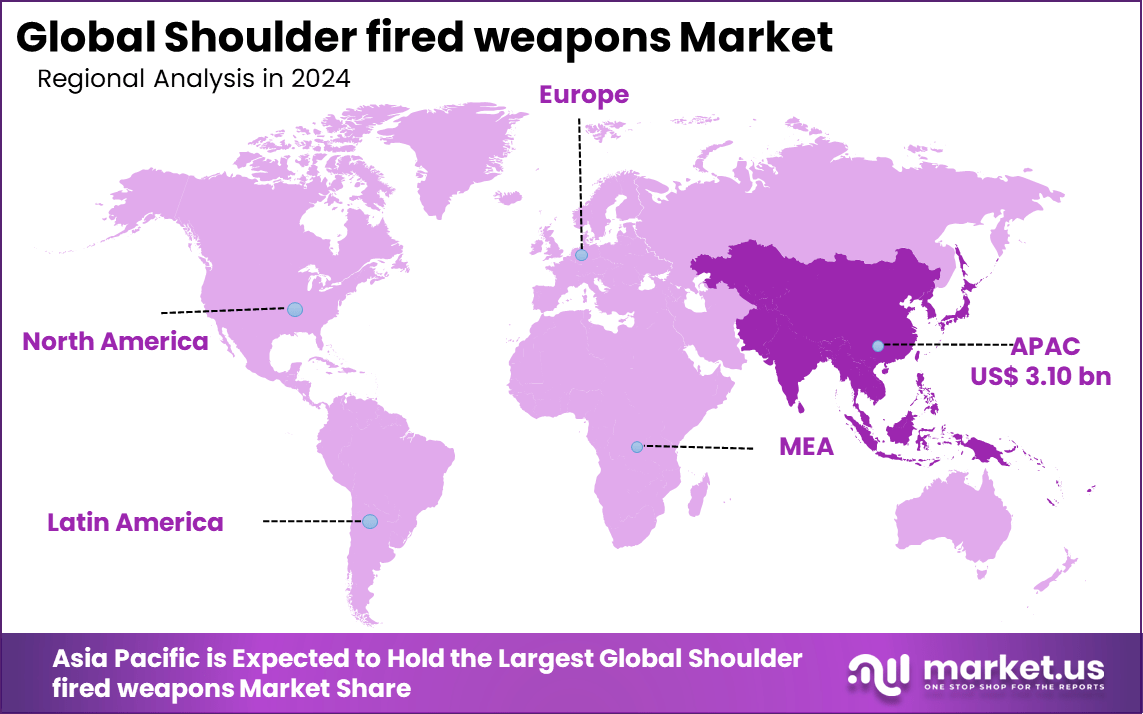
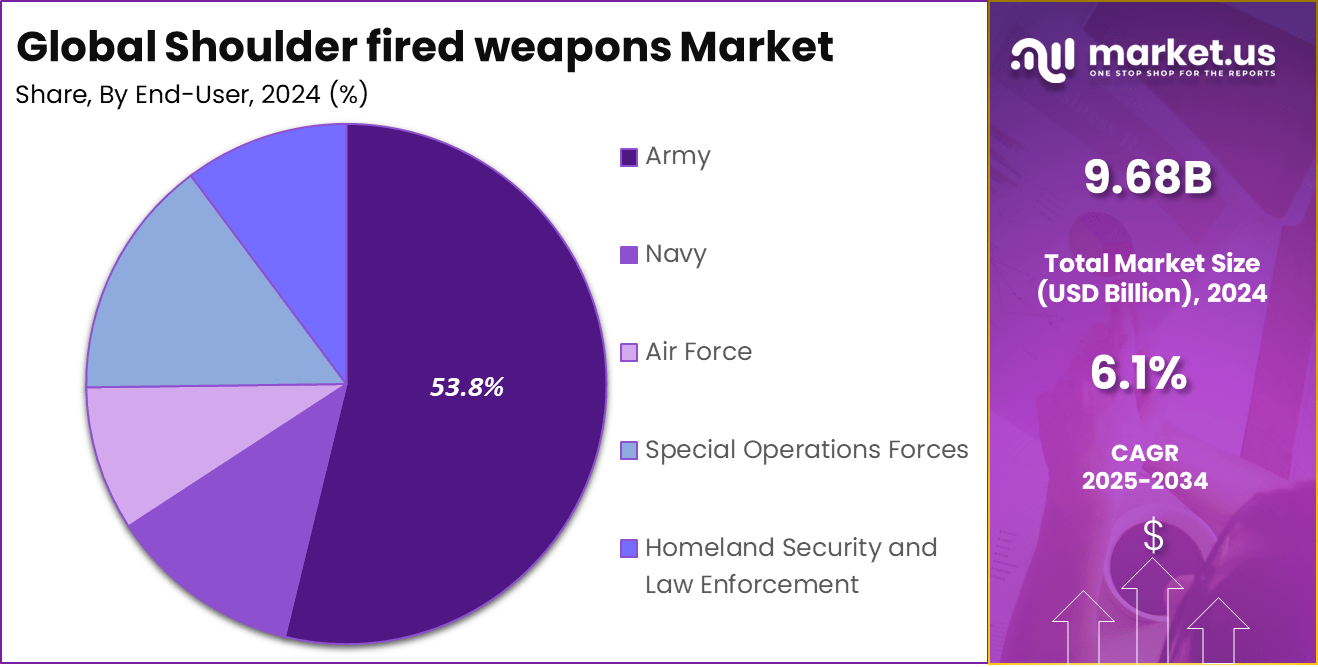
The Global Shoulder fired weapons Market size is expected to be worth around USD 17.50 billion by 2034, from USD 9.68 billion in 2024, growing at a CAGR of 6.1% during the forecast period from 2025 to 2034. In 2024, Asia Pacific held a dominant market position, capturing more than a32.1% share, holding USD 3.10 billion in revenue.
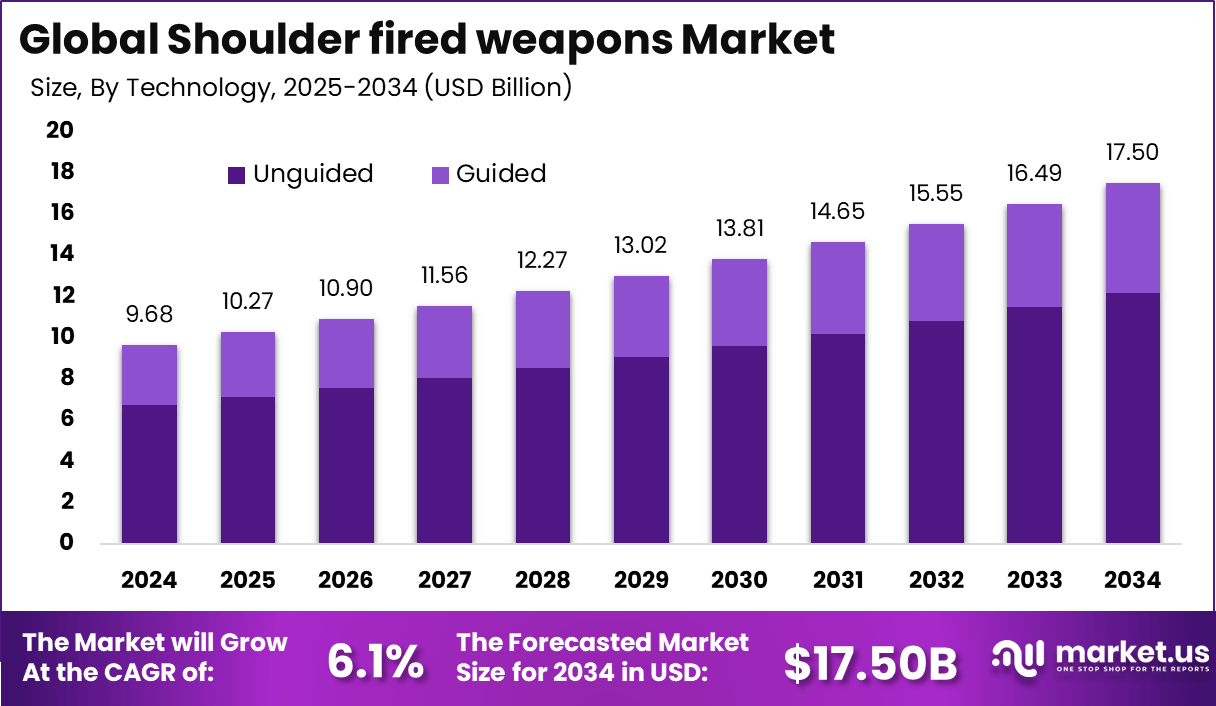
The shoulder-fired weapons market revolves around portable, man-carried projectile weapons designed for rapid deployment and effective combat use by infantry. These weapons, which include anti-tank guided missiles, man-portable air defense systems, and rocket-propelled grenades, are essential in modern warfare due to their versatility, mobility, and precision. Their small size lets soldiers fire them from the shoulder to quickly target vehicles, aircraft, and bunkers.
A primary driver of the shoulder-fired weapons market is the increasing geopolitical tensions and ongoing border conflicts that necessitate effective portable defense solutions. Modern military modernization efforts emphasize enhancing mobility and firepower at the infantry level, pushing demand for advanced systems that integrate improved targeting, lighter materials, and modular designs.
According to SIPRI, European countries recorded a 16% increase in defense spending in 2024. Notably, eastern NATO members such as Poland and Finland raised their defense budgets by over 30%, reflecting heightened preparedness against regional threats. Shoulder-fired weapons like the FGM-148 Javelin and NLAW have demonstrated proven combat effectiveness in Ukraine, reinforcing their role as critical tactical assets in modern conflict scenarios.
Market Size and Growth
| Trend/Innovation | Description |
|---|---|
| Advanced Guided Fire-Control Systems | Integration of algorithm-driven systems for moving target lock-on, airburst, and delay detonation modes |
| Lightweight Composite Materials | Use of carbon-fiber launch tubes and high-energy propellants to reduce carry weight by about 20% |
| Extended Range Systems | Developing shoulder-fired weapons capable of engaging targets beyond 2 km while maintaining portability |
| Anti-Drone and Dual-Role Capabilities | Increasing deployment of shoulder-fired systems with counter-UAV functionality and versatile payloads |
| Networked Battlefield Integration | Enhanced compatibility with tactical communications, command-and-control architectures, and battlefield networking |
Top 5 Growth Factors
| Key Factors | Description |
|---|---|
| Intensifying Asymmetric Warfare | Demand for portable anti-armor and anti-air weapons in conflict zones, especially in Middle East, Africa, and Eastern Europe |
| Defense Modernization Programs | Military modernization amid geopolitical tensions driving procurement of advanced shoulder-fired systems |
| Rising Counter-Drone Needs | Growing need for cost-effective MANPADS to counter low-cost and agile UAV threats |
| Lightweight and Multi-Role Launchers | Adoption of portable, versatile launchers by special forces and modern militaries to enhance battlefield agility |
| Indigenous Production & Industrial Localization | Growth of domestic manufacturing capabilities in Asia-Pacific, Middle East, and Latin America fueling market expansion |
Key Market Segments
By Technology
- Guided
- Unguided
By Weapon Type
- Man-Portable Air Defense Systems (MANPADS)
- Rocket-Propelled Grenade Launchers (RPGs)
- Anti-Tank Guided Missile (ATGM) Launchers
- Recoilless Rifles
- Shoulder-Launched Assault Weapons (SLAW)
By Range
- Short (Less than 500 m)
- Medium (500 – 2 km)
- Long (Greater than 2 km)
By Projectile
- Launcher/Tube
- Projectile/Missile
- Fire-Control and Sighting Systems
By End-User
- Army
- Navy
- Air Force
- Special Operations Forces
- Homeland Security and Law Enforcement
Drivers
Modernization of Armed Forces
Countries are concentrating on improving their military capabilities by developing lighter and more portable weapons to enhance the skills of infantrymen, particularly in difficult situations like urban or street battles. The development of India’s Very Short Range Air Defence System (VSHORADS) is a clear indication of this trend, as it is designed to handle low-flying air attacks.
Countries are seeking to improve their ability to respond quickly and with greater effectiveness in different scenarios, leading to a surge in demand for shoulder-based weapons that can be fired from the shoulder, particularly for their quick response and effective defense in various battle scenarios.
For instance, In July 2025, Poland secured a $4 billion U.S. loan guarantee to modernize its armed forces. The funding supports the acquisition of advanced shoulder-fired weapon systems, reflecting a broader shift toward modern, portable arms for infantry. This move highlights rising global demand for next-generation shoulder-fired weapons.
Restraint
Regulatory and Export Controls
The International Traffic in Arms Regulations (ITAR) and the Missile Technology Control Regime (MTCR) are among the international agreements for arms control that enforce strict regulations on the sale of advanced weapons.
These controls limit the sale of shoulder-fired weapons to non-allied nations, hampering market growth in certain regions. Additionally, countries are cautious about the potential misuse or dissemination of their technology, which can lead to non-Western companies taking over markets with limited sales.
For instance, in August 2024, the ongoing discussions around the AUKUS defense agreement highlight the significant impact of regulatory and export controls on the shoulder-fired weapons market. The agreement between Australia, the UK, and the U.S. emphasizes the need for reforms in defense trade controls to enhance collaboration while ensuring compliance with international regulations.
Opportunities
New Technologies and Applications
Advancements in smart guidance, networked targeting, and non-line-of-sight (NLOS) strike capabilities open new possibilities for the shoulder-fired weapons market. As armed forces require more versatile and multi-role launchers, these emerging technologies present opportunities for manufacturers to develop advanced systems that meet evolving defense needs.
For instance, In May 2025, the U.S. Army advanced its shoulder-launched missile systems, such as the Stinger, by integrating solid-fueled ramjet technology. This upgrade enables longer-range engagements and improved versatility. The development reflects a broader shift toward smart guidance, networked targeting, and non-line-of-sight strike capabilities.
Challenges
Training and Maintenance Requirements
Special training and regular care, and support are necessary for soldiers who use weapons fired from their shoulders correctly. These needs can put a strain on the defense spending and resources of smaller or less developed countries. Keeping up with rapidly evolving technology poses significant challenges for armed forces, particularly in maintaining advanced systems and training personnel.
For instance, in September 2024, the U.S. Army introduced a new shoulder-launched munition designed to lighten the load for infantry while delivering greater firepower. This new weapon system requires specialized training to ensure its effective deployment. Troops must undergo rigorous training to master the system’s handling, targeting, and maintenance, ensuring operational readiness.
Key Players Analysis
General Dynamics Corporation, Lockheed Martin Corporation, and Northrop Grumman Corporation are recognized as dominant players in the shoulder fired weapons market. These companies have maintained strong global footprints through innovation, advanced R&D capabilities, and strategic government contracts.
Saab AB and RTX Corporation have further expanded their presence by integrating smart guidance systems and improving multi-role launcher versatility. These firms are focused on enhancing product reliability, range, and operational adaptability to meet modern battlefield requirements.
Rafael Advanced Defense Systems Ltd., Rheinmetall AG, and MBDA have demonstrated significant progress through precision engineering and modular launcher systems. Bharat Dynamics Ltd. and AirTronic USA LLC are focusing on cost-effective solutions and customized systems for domestic and international forces. Kongsberg Gruppen ASA and Nexter KNDS Group are advancing networked targeting systems to boost soldier efficiency and situational awareness.
Israel Aerospace Industries Ltd., Denel SOC Ltd., and Nammo AS are diversifying their product lines to cater to varied mission needs, including anti-armor, anti-air, and bunker-busting roles. Roketsan A.Ş. is strengthening its exports through partnerships and new-generation portable launchers. BAE Systems plc is focusing on lightweight, rugged launchers for rapid deployment.
Top Key Players in the Market
- General Dynamics Corporation
- Rafael Advanced Defense Systems Ltd.
- Rheinmetall AG
- Roketsan A.Ş.
- Bharat Dynamics Ltd.
- AirTronic USA LLC
- Northrop Grumman Corporation
- Kongsberg Gruppen ASA
- Saab AB
- Lockheed Martin Corporation
- RTX Corporation
- MBDA
- BAE Systems plc
- Israel Aerospace Industries Ltd.
- Nexter KNDS Group
- Denel SOC Ltd.
- Nammo AS
- Others
Recent Developments
- In July 2025, Rheinmetall commenced series production of the SSW40, the world’s first magazine-fed automatic shoulder-fired grenade launcher capable of firing both low-velocity (LV) and medium-velocity (MV) 40mm ammunition. This innovation enhances infantry firepower with a flatter trajectory and an effective range of up to 900 meters.
- In July 2025, Bharat Dynamics Ltd. secured an ₹809 crore (approximately $100 million) order from the Armoured Vehicles Nigam Limited (AVNL) for the supply of ATGMs. This contract highlights India’s commitment to enhancing its indigenous shoulder-fired weapon capabilities.

- 蓝茶市场(2026—2031)
0评论2026-09-15

- 泡沫材料市场(2026—2031)
0评论2026-09-15

- 重铬酸钠市场(2026—2031)
0评论2026-09-15

- 家族性淀粉样多发性神经病(FAP)市场(2026—2031)
0评论2026-09-15

- 次氯酸钙市场(2026—2031)
0评论2026-09-15

- 海上储能市场(2026—2031)
0评论2026-09-12

- 混凝土市场(2026—2031)
0评论2026-09-12

- 矫形器械市场(2026—2031)
0评论2026-09-12

- 木质素基树脂市场(2026—2031)
0评论2026-09-12

- 聚碳酸酯二元醇市场(2026—2031)
0评论2026-09-12