


Report Overview
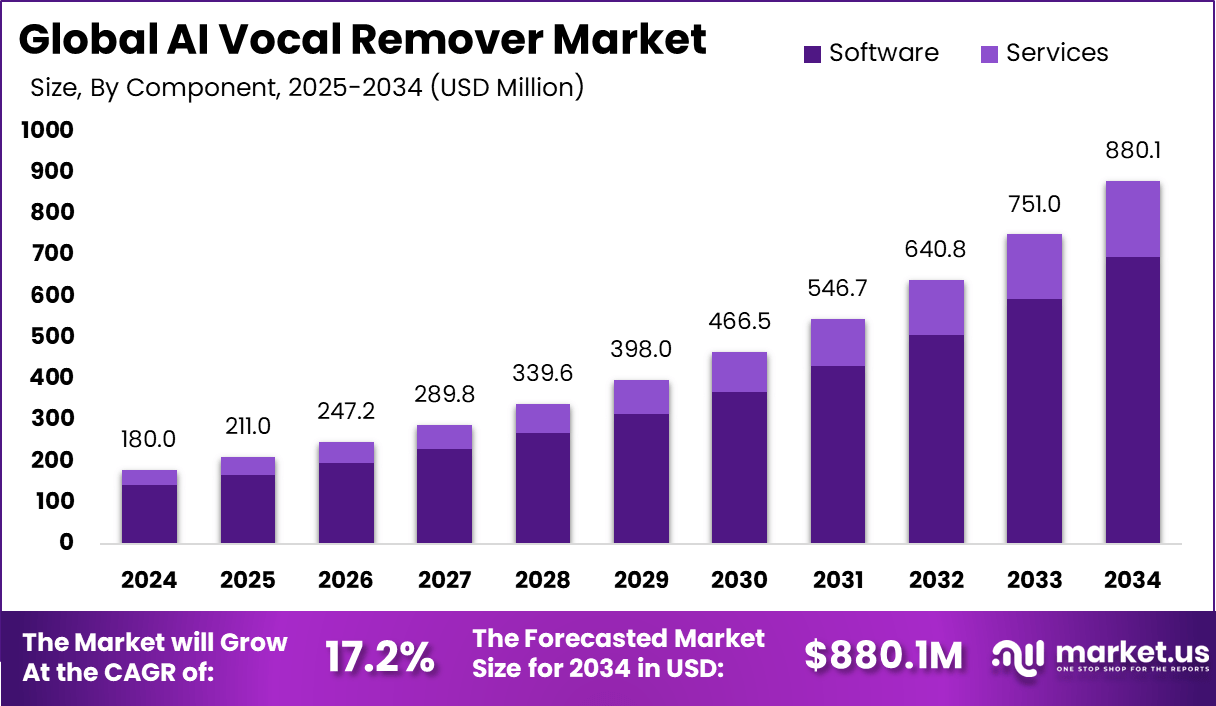
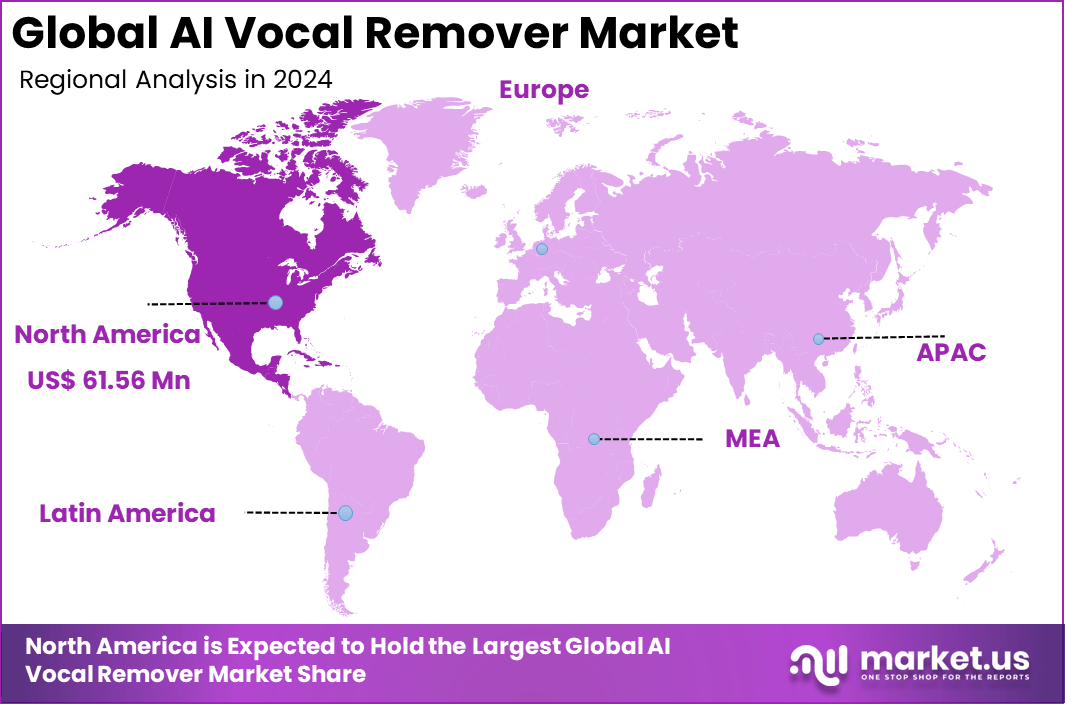
The Global AI Vocal Remover Market size is expected to be worth around USD 880.1 million by 2034, from USD 180.0 million in 2024, growing at a CAGR of 17.2% during the forecast period from 2025 to 2034. In 2024, North America held a dominant market position, capturing more than a 34.2% share, holding USD 61.56 million in revenue.
The AI Vocal Remover market is rapidly shaping modern music production and digital content creation. Using advanced artificial intelligence, vocal remover tools can isolate vocals from an audio track, giving users the ability to generate instrumentals for karaoke, remixes, and multimedia projects. These platforms analyze complex audio frequencies and employ deep learning models to distinguish vocal sounds from instruments, offering results that used to require hours of manual editing.
Top driving factors fueling adoption in this market center around accessibility and efficiency. AI vocal removers deliver results within minutes, streamlining workflows for creators and professionals alike. They remove the need for costly studio sessions or expert engineering, which means even hobbyists on a budget can experiment with new audio arrangements.
The rise of music tech and social media is driving demand for fast, high-quality instrumentals for covers, remixes, and karaoke. Demand has grown considerably, penetrating multiple sectors beyond just music. Karaoke enthusiasts, budding singers, audio engineers, and social media influencers all see tangible benefits in extracting vocals from tracks for their unique uses.
This transformation is further catalyzed by the increased consumption of digital content, with audio customization remaining at the forefront of user expectations. The ease of use and instant feedback provided by AI vocal removers have made them essential tools in both home studios and professional setups.
Market Size and Growth
| Growth Factor | Description |
|---|---|
| Surge in Digital Content Creation | More amateur/professional users want fast, high-quality audio editing for music, video, and podcasts |
| Advancements in AI/ML Algorithms | Rapid breakthroughs in deep learning enable more accurate and artifact-free vocal/instrument isolation |
| Accessibility & Cost Effectiveness | Online/cloud-based tools make advanced editing affordable and usable for non-experts |
| Expansion of Karaoke/Remix Culture | User-generated music, karaoke, and remixes fuel need for vocal separation tools |
| Integration with Production Platforms | AI vocal removers embedded across DAWs, video editors, and mobile apps drive further adoption |
Top 5 Trends and Innovations
| Trend/Innovation | Description |
|---|---|
| Real-Time Processing | Growing demand for—and delivery of—instant vocal isolation for live and streaming uses |
| Multi-Track and Stem Separation | Beyond vocals, tools now split drums, bass, piano, etc. for advanced remixes/production |
| Cloud-Based and Browser Apps | Shift from local software to web platforms enables easy, hardware-independent access |
| Improved Accuracy/Quality | Constant algorithm upgrades deliver clearer stems with fewer artifacts and higher audio fidelity |
| Regulatory & Copyright Consideration | Compliance and copyright-aware tech become key, due to rising concerns over IP and content use |
Key Market Segments
Component
- Software
- Cloud-Based Vocal Removers
- On-Premise/Offline Vocal Remover Software
- Services
- Custom Audio Processing Services
- Technical Support & Maintenance
- API Integration Services
Deployment Mode
- Cloud-Based
- On-Premise
Application
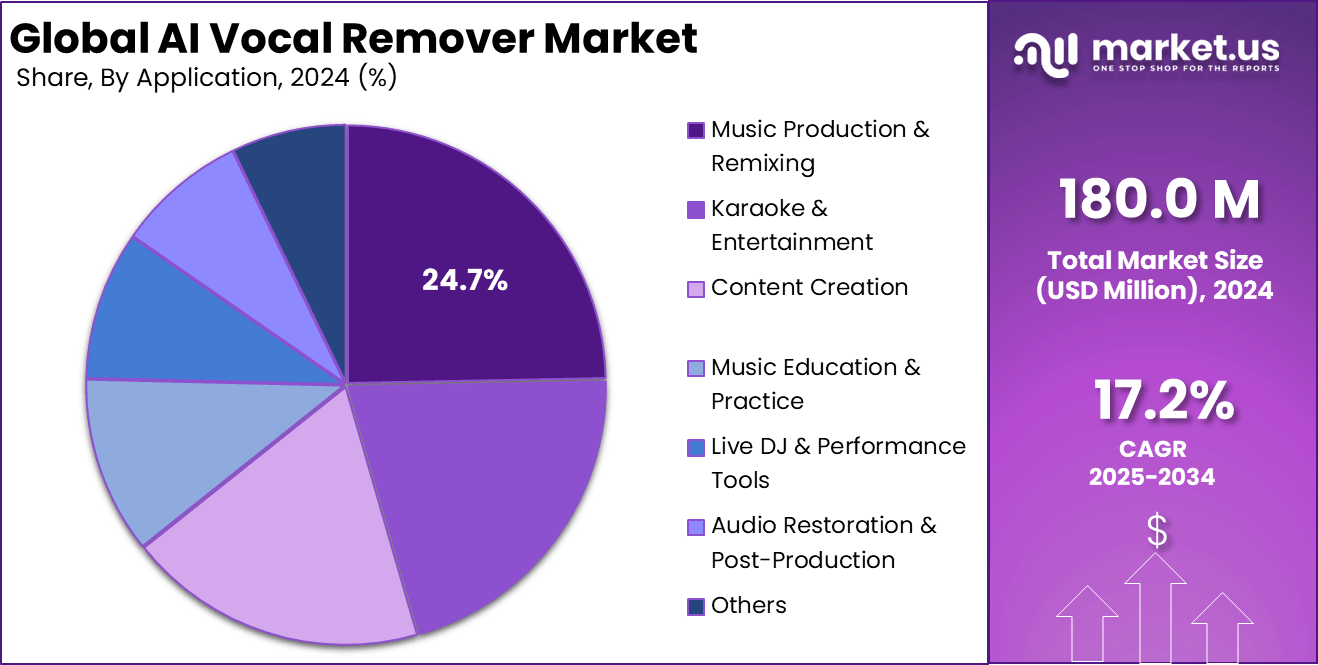
- Music Production & Remixing
- Karaoke & Entertainment
- Content Creation
- Music Education & Practice
- Live DJ & Performance Tools
- Audio Restoration & Post-Production
- Others
End-User
- Independent Musicians & DJs
- Content Creators & Streamers
- Music Production Studios
- Karaoke Companies & Venues
- Educational Institutions (Music Schools)
- Media & Entertainment Companies
Key Regions and Countries Covered in this Report
- North America
- The US
- Canada
- Europe
- Germany
- France
- The UK
- Spain
- Italy
- Russia
- Netherland
- Rest of Europe
- APAC
- China
- Japan
- South Korea
- India
- Australia & New Zealand
- ASEAN
- Rest of APAC
- Latin America
- Brazil
- Mexico
- Rest of Latin America
- Middle East & Africa
- GCC Countries
- South Africa
- Rest of MEA
Driving Factor
Proliferation of Online Content Creators
The explosive growth of online content creators has become a significant driver for the AI vocal remover market. Platforms like YouTube, TikTok, Instagram, and Twitch have enabled millions of individuals to produce music, podcasts, reaction videos, and karaoke content from home. Over 50 million people globally identified as content creators in 2024, with the number steadily rising due to increased access to digital tools.
These creators frequently require background music without vocals for vlogs, educational videos, tutorials, or live streams. AI vocal removers offer an efficient and cost-effective solution by separating vocals from instrumental tracks without needing professional audio engineers. For instance, streamers on Twitch use vocal removers to repurpose copyrighted tracks into background music, avoiding DMCA strikes.
Similarly, karaoke content creators leverage tools like Moises.ai and LALAL.AI to generate clean instrumental versions for sing-along videos. As demand for user-generated content surges, so does the reliance on easy-to-use, cloud-based audio processing tools, making this segment a key growth engine for the AI vocal remover market.
Restraining Factor
Audio Quality Limitation
Despite the advancements in AI-powered vocal removers, audio quality limitations remain a key restraint in their widespread professional adoption. These tools, particularly those relying on deep learning or spectral subtraction, often produce artifacts, loss of harmonics, or residual vocal traces, especially when dealing with complex mixes or low-quality input files.
For example, while tools like Spleeter or PhonicMind can separate vocals from instrumentals, the resulting tracks may still have bleeding sounds or distorted frequencies, which make them unsuitable for commercial release or studio use. A MusicTech review noted that even leading platforms sometimes struggle to isolate vocals cleanly in songs with layered instrumentation or effects like reverb and delay.
Moreover, accuracy rates of 70–85% in separation still leave room for improvement. This limitation discourages adoption by high-end studios, broadcasters, and audiophiles who demand pristine sound fidelity. As a result, while vocal remover tools are effective for casual or semi-professional users, the need for cleaner, studio-grade outputs continues to limit their reach in top-tier music production environments.
Growth Opportunity
Proliferation of Online Content Creators
Localization and multilingual capabilities present a significant growth opportunity in the AI vocal remover market, particularly as global content consumption diversifies. As vocal remover tools gain popularity in non-English speaking regions like Latin America, Asia, and the Middle East, there’s a rising need for platforms that support local languages, cultural music styles, and region-specific UI/UX.
Many existing tools primarily train their models on English-language tracks, resulting in reduced accuracy when applied to regional genres like K-pop, Indian classical, Arabic pop, or Latin reggaeton. By incorporating multilingual training datasets and regionally tailored features, companies can unlock vast untapped user bases.
Similarly, integrating language-specific lyric separation or metadata tagging can help educational institutions and music students in non-English markets. With nearly 75% of internet users accessing content in local languages, building inclusive, multilingual platforms will be key to scaling globally and gaining a competitive edge.
Key Player Analysis
In the AI Vocal Remover Market, Moises.ai, Vocal Remover Org, and PhonicMind have gained significant recognition. These platforms are widely used by musicians, podcasters, and content creators for extracting vocals and instrumentals. Splitter and Fadr have expanded their appeal by offering easy-to-use interfaces and support for real-time stem separation.
X-Minus Pro and Ultimate Vocal Remover (UVR) are popular in professional circles for offering deeper customization and open-source options. Their presence reflects growing demand for accessible, high-precision vocal isolation tools across creative segments. Music.ai, AudioStrip, and Notta.ai are positioning themselves through AI-powered innovation. These tools allow faster separation of vocals while preserving audio quality.
OmniSale GMBH, through its AI solutions, and Voice AI, have expanded capabilities in multilingual processing and real-time vocal adjustments. MVSEP and AudioCleaner also support advanced AI filters that enhance music editing for both casual and professional users. Together, these players are shaping the ecosystem by focusing on audio quality, processing speed, and cloud-based integration.
In addition, tools like AutoTune by Antares, EaseUS Vocal Remover, and Singify offer AI-assisted tuning and pitch correction features. Wondershare, FlexClip by PearlMountain, and RecCloud AI support voice editing as part of broader media creation suites. Adobe Audition remains relevant for professionals who combine AI vocal removal with layered audio editing.
Top Key Players in the AI Vocal Remover Market
- AI (OmniSale GMBH)
- Voice AI
- Vocal Remover Org
- Music.ai
- PhonicMind
- Splitter
- Moises.ai
- Fadr
- X-Minus Pro
- Ultimate Vocal Remover (UVR)
- AudioStrip
- Notta.ai
- AutoTune by Antares
- MVSEP
- AudioCleaner
- EaseUS Vocal Remover
- Wondershare
- FlexClip by PearlMountain
- Singify
- RecCloud AI
- Adobe Audition
- Other Key Players
Recent Developments
- February 2025: Perseus AI expands its capabilities to include instrument stem separation, specifically Acoustic Guitar, Electric Guitar, and Piano, allowing finer control over multi‑stem extraction workflows.
- September-October 2024: Launch of Lead & Back Vocal Splitter, enabling precise separation of lead and backing vocals, opening new creative possibilities for remixing, vocal training, and karaoke content.
- September 2024: Rollout of Perseus AI, one of the first transformer-based neural networks for vocal separation. It delivers roughly 15% better vocal extraction quality than previous models and is enabled by default across LALAL.AI’s stem-processing tools.
- August 2024: Release of Echo & Reverb Remover, aimed at improving audio clarity by eliminating unwanted acoustic artifacts, especially useful for podcast and vocal recordings.
- April 2024: Launch of LALAL.AI Voice Changer, a new feature allowing users to apply AI-generated voice transformations to sound like artists such as Drake or Taylor Swift. This functionality supports multiple languages and formats, enhancing creative flexibility.
- February 2024: Partnership between Bravelab and LALAL.AI, marking wider technical integration support and enhancing adoption among music professionals who can now integrate LALAL.AI capabilities into custom workflows.

- 蓝茶市场(2026—2031)
0评论2026-09-15

- 泡沫材料市场(2026—2031)
0评论2026-09-15

- 重铬酸钠市场(2026—2031)
0评论2026-09-15

- 家族性淀粉样多发性神经病(FAP)市场(2026—2031)
0评论2026-09-15

- 次氯酸钙市场(2026—2031)
0评论2026-09-15

- 海上储能市场(2026—2031)
0评论2026-09-12

- 混凝土市场(2026—2031)
0评论2026-09-12

- 矫形器械市场(2026—2031)
0评论2026-09-12

- 木质素基树脂市场(2026—2031)
0评论2026-09-12

- 聚碳酸酯二元醇市场(2026—2031)
0评论2026-09-12