


Report Overview
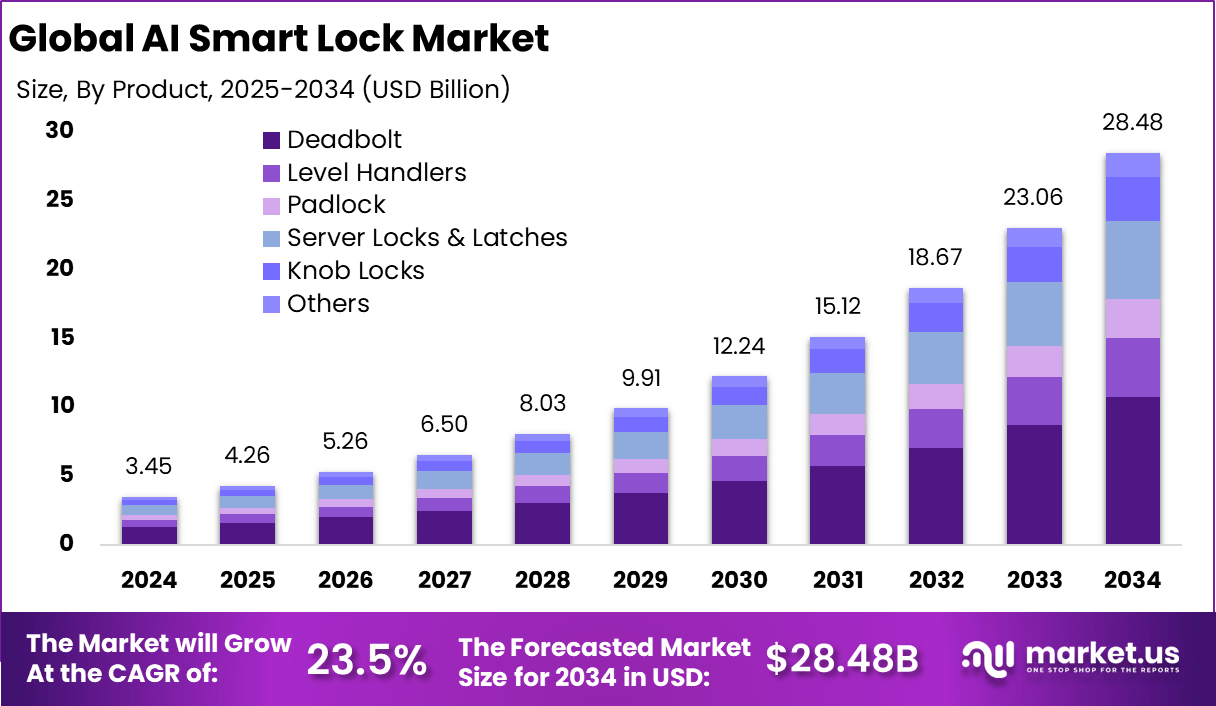
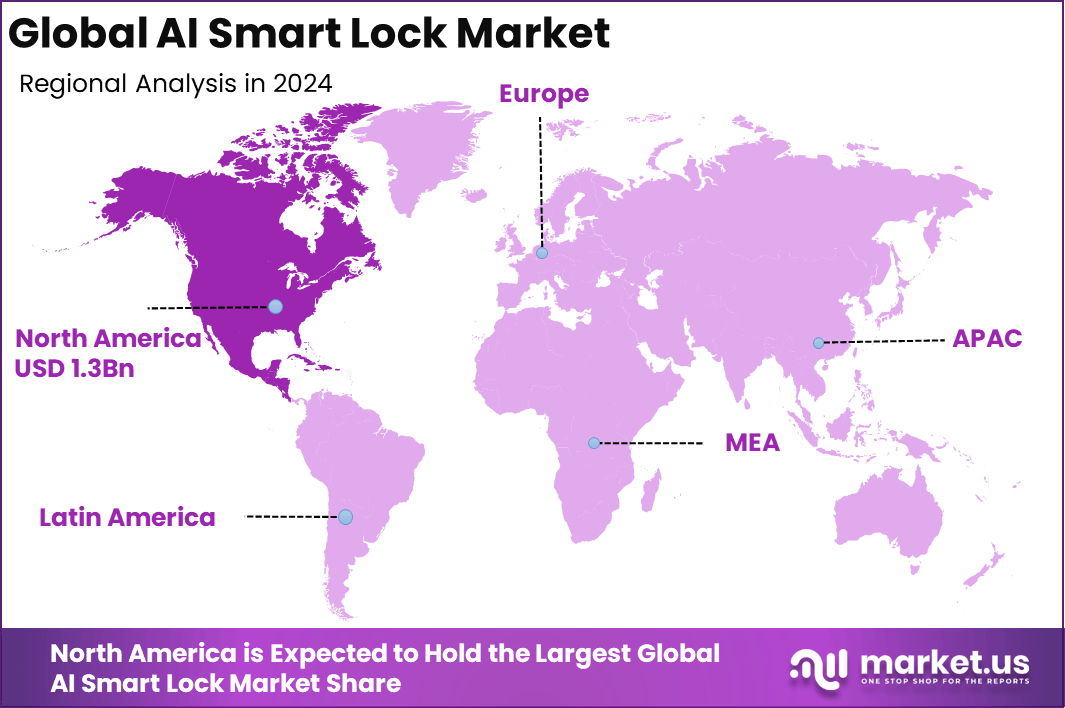
The Global AI Smart Lock Market generated USD 3.45 billion in 2024 and is predicted to register growth from USD 4.26 billion in 2025 to about USD 28.48 billion by 2034, recording a CAGR of 23.5% throughout the forecast span. In 2024, North America held a dominan market position, capturing more than a 38.2% share, holding USD 1.3 Billion revenue.
The AI Smart Lock Market focuses on electronic locking systems that use artificial intelligence to improve access control, security, and convenience. These locks feature advanced functions such as facial recognition, voice authentication, motion sensing, and adaptive learning. They are integrated into smart home networks and IoT ecosystems.
The main factor driving this market is the increasing demand for intelligent home and commercial security solutions. Consumers prefer automated systems that recognize users, adapt to habits, and provide instant alerts. The expansion of smart homes and IoT devices creates an environment where AI-based locks can thrive. Continuous advancements in connectivity technologies such as Wi-Fi, Bluetooth, and Zigbee also support market expansion.
Investment opportunities in AI smart locks are strong, as growth is fueled by continuous innovation, increasing consumer interest, and expanding smart city projects worldwide. Investors are focused on startups and established companies innovating with AI-driven security analytics, biometric authentication, and interoperable smart home integration.
Business benefits of AI smart locks include heightened security and reduced operational costs through automation and predictive maintenance. Smart locks eliminate the need for physical keys, lowering risks of lost keys and unauthorized duplication. Remote access and monitoring also improve user convenience and control. Automation using voice commands and smart home integration enhances energy efficiency and user convenience, giving homeowners and property managers a clear competitive advantage.
Quick Market Facts
- The Deadbolt segment led the market with 37.8%, driven by widespread adoption in residential and commercial properties due to its enhanced security and durability.
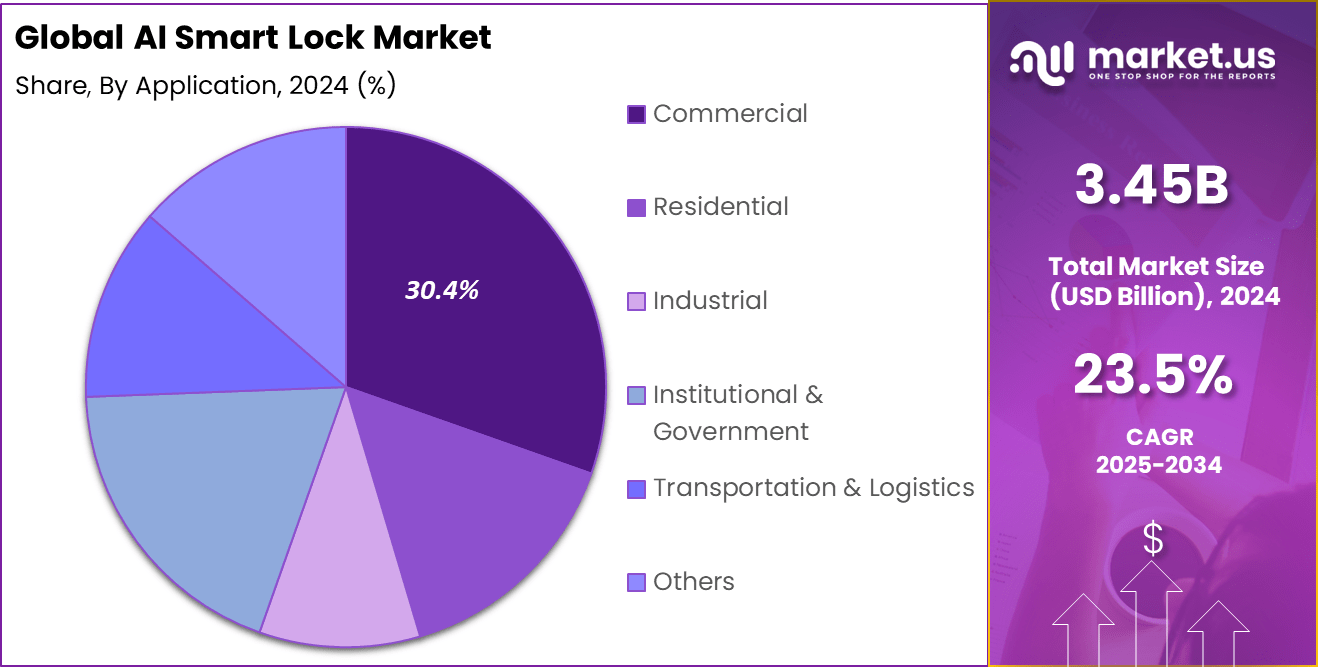
- The Commercial application segment held 30.4%, reflecting growing demand from offices, hospitality, and retail sectors for AI-enabled access control systems.
- Natural Language Processing (NLP) technology dominated with 44.7%, highlighting the growing integration of voice and AI-driven authentication features in smart lock systems.
- The Bluetooth protocol accounted for 40.6%, supported by its convenience, low power consumption, and compatibility with mobile devices for keyless entry.
- The Keypad authentication method captured 28.8%, favored for its reliability and versatility in multi-user environments.
- North America represented 38.2% of the global market, driven by strong adoption of smart home technologies and IoT infrastructure.
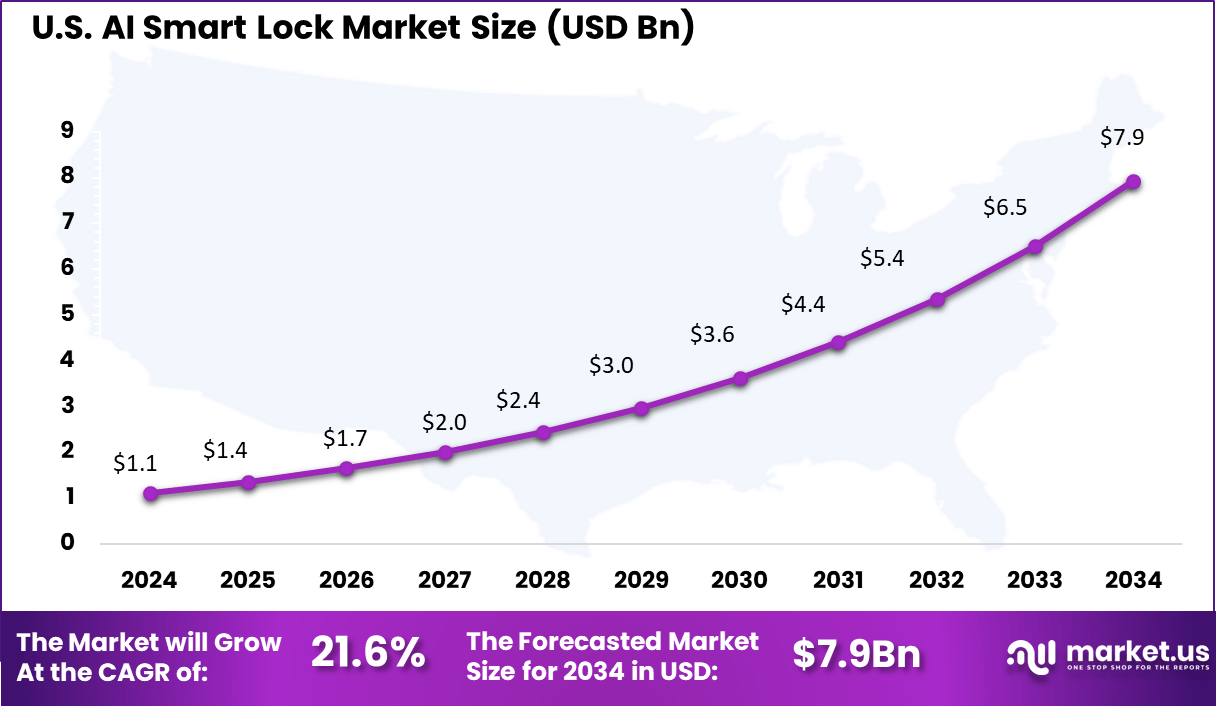
- The US market reached USD 1.12 Billion in 2024, growing at a robust 21.6% CAGR, supported by increasing security awareness and integration of AI-based access management solutions.
North America Market Size
In 2024, North America commands a 38.2% share of the AI smart lock market, reflecting its advanced smart home ecosystem and strong consumer awareness around security technologies. The region benefits from high internet penetration, widespread smartphone use, and significant investments in smart infrastructure, all contributing to strong adoption rates.
In the United States, the market stands near USD 1.12 billion with an expected compound annual growth rate of 21.6%. The US leads adoption due to a combination of demand for advanced home and commercial security solutions, early adoption of AI technologies, and robust infrastructure supporting IoT integration. These factors drive sustained innovation and market expansion in the AI smart lock segment.
By Product
In 2024, Deadbolt locks lead the AI smart lock market with a 37.8% share. These locks are favored for their robust security features and ease of integration into both residential and commercial buildings. Deadbolt smart locks combine traditional mechanical strength with modern AI-enabled functionalities such as remote control, biometric access, and status monitoring, making them a popular choice for users seeking heightened security with convenience.
The deadbolt segment benefits from continuous improvements in locking mechanisms and materials that enhance durability and resistance to tampering. Its compatibility with most existing door frames and standards allows easy upgrades for users transitioning from conventional locks to smart systems. This widespread applicability fuels its steady dominance in the market.
By Application
In 2024, Commercial applications hold a 30.4% share, driven by increasing adoption of AI smart locks in offices, retail, and institutional infrastructures. Businesses prioritize secure, flexible access control solutions to protect sensitive areas while enabling authorized personnel’s seamless entry.
AI smart locks provide features like user authentication, activity logging, and integration with enterprise security systems, which addresses evolving commercial security needs. Growth in commercial smart lock adoption also reflects tighter compliance requirements and demand for scalable security systems in multi-user environments.
AI technology enables intelligent management where access permissions can be dynamically adjusted based on roles or time schedules, increasing operational efficiency and safety. These advantages underline the commercial sector’s significant market share.
By Technology
In 2024, Natural Language Processing (NLP) leads with 44.7% of the market, highlighting the increasing use of voice commands and AI-driven voice recognition for smart lock control. NLP allows users to operate locks hands-free via conversational interfaces, improving accessibility and user experience. This technology integrates easily with broader smart home or building management systems through platforms like Alexa, Google Assistant, and Siri.
Continued advancements in NLP enhance accuracy and security by understanding context and speaker identification. Enhanced voice authentication reduces unauthorized access risks while providing a natural, intuitive option for lock operation. The growing consumer preference for voice-enabled devices is thus reflected in this dominant technology share.
By Protocol
In 2024, Bluetooth dominates the communication protocol segment with 40.6% share. Bluetooth offers low power consumption, reliable short-range connectivity, and broad compatibility with smartphones and wearable devices, which supports its popularity in AI smart locks.
It facilitates secure device pairing and local control without requiring internet connectivity, appealing to users valuing privacy and simplicity. Bluetooth’s ease of implementation in diverse product designs and its integration with mobile apps provide an effective user interface for monitoring and controlling locks remotely.
Additionally, Bluetooth low energy (BLE) protocols enable longer battery life, essential for maintaining lock functionality without frequent maintenance. The protocol’s balance of security, efficiency, and user convenience keeps it at the forefront of AI smart lock communications.
By Authentication Method
In 2024, Keypads hold a 28.8% market share, reflecting preference for PIN or passcode-based access among consumers seeking keyless convenience. Keypad authentication combines familiarity with security flexibility, allowing multiple users to have unique entry codes and easy control over access. This method is commonly used in both residential and commercial settings, offering a cost-effective and straightforward entry solution.
The keypad method is valued for its reliability and independence from external devices or internet services. Users appreciate its simplicity and the ability to change codes without physical key exchanges, reducing risks from lost or duplicated keys. This authentication method remains a cornerstone of smart lock security options.
Emerging Trends
The smart lock market is undergoing transformation with increased integration of the Internet of Things (IoT) and biometric innovations such as facial and iris recognition. These technologies replace traditional keys, delivering seamless keyless entry experiences with enhanced convenience. Currently, the market witnesses growing use of remote management features, enabling users to grant temporary access and receive real-time notifications, which is especially valuable for rental property owners.
IoT integration also allows smart locks to work effortlessly with other home devices like security cameras and voice assistants, creating a unified home security system. Another notable trend is the emphasis on cybersecurity as smart locks become more connected. Manufacturers are focusing on encryption, secure network connectivity, and regular software updates to prevent hacking attempts.
At the same time, eco-friendly designs such as longer battery life and solar-powered locks are gaining traction, responding to consumer demands for sustainability alongside security. Consumers increasingly expect their locks to be part of a broader connected ecosystem, working smoothly with platforms like Amazon Alexa or Google Assistant.
Growth Factors
The surge in smart home adoption and rising safety concerns are primary growth drivers for AI smart locks. Homeowners prioritize secure and easy-to-use solutions, as smart locks offer real-time monitoring, remote locking, and keyless entry that reduce risks linked to lost or stolen keys.
Increasing crime rates and a preference for advanced security systems fuel demand for smart locks, which integrate with home security networks to provide peace of mind. The convenience of allowing trusted visitors access remotely without compromising security further encourages adoption. Additionally, the expanding IoT ecosystem significantly fuels growth.
Smart locks’ ability to connect with various devices like alarms, cameras, and smart lights enhances user experience by enabling automation, such as locking doors automatically when homeowners leave. This integration simplifies home management while increasing confidence in security measures. Compatibility with major smart home platforms accelerates market growth, as consumers seek comprehensive and user-friendly automation packages.
Key Market Segments
By Product
- Deadbolt
- Level Handlers
- Padlock
- Server Locks & Latches
- Knob Locks
- Others
By Application
- Residential
- Individual Household
- Commonhold
- Commercial
- Hospitality
- Healthcare
- BFSI
- Enterprise
- Critical Infrastructure
- Educational Institution
- Industrial
- Manufacturing
- Energy & Utilities
- Oil & Gas
- Institutional & Government
- Transportation & Logistics
- Others
By Technology
- Natural Language Processing (NLP)
- Machine Learning
- Computer Vision
- Others
By Protocol
- Bluetooth
- Wi-Fi
- Z-Wave
- Zigbee
- Others
By Authentication Method
- Keypad
- Card Key
- Touch-based
- Key Fob
- Smartphone-based
- Biometric
- Others
Regional Analysis and Coverage
- North America
- US
- Canada
- Europe
- Germany
- France
- The UK
- Spain
- Italy
- Russia
- Netherlands
- Rest of Europe
- Asia Pacific
- China
- Japan
- South Korea
- India
- Australia
- Singapore
- Thailand
- Vietnam
- Rest of Latin America
- Latin America
- Brazil
- Mexico
- Rest of Latin America
- Middle East & Africa
- South Africa
- Saudi Arabia
- UAE
- Rest of MEA
Driver
Rising Adoption of Smart Home Technologies
One key driver of the AI smart lock market is the rapid adoption of smart home technologies and connected devices. As more households embrace devices like smartphones, smart hubs, and other IoT gadgets, smart locks become a natural extension of this ecosystem. These locks enable keyless entry and remote control through apps, offering users convenience and enhanced security without physical keys.
The growing trend of home automation also fuels demand, as consumers seek integrated solutions that connect locks with security cameras, alarms, and lighting systems. This seamless interoperability within smart homes provides users with better control and peace of mind, encouraging widespread adoption of AI-enabled smart locks.
Restraint
Limited Consumer Awareness
A significant restraint in the AI smart lock market is the lack of consumer awareness and understanding. Many potential users hesitate to adopt this technology due to unfamiliarity with its benefits or the complexity involved in setup and operation. Smart locks often integrate various technologies like biometrics, RFID, Wi-Fi, and Bluetooth, which can be overwhelming to average consumers.
Additionally, concerns about costs and the need for technical knowledge can discourage some from investing in smart locks. This gap in awareness limits market penetration, and companies must invest in educational marketing and promote the tangible benefits of smart locks to overcome this barrier.
Opportunity
Integration with Advanced Biometric Security
The integration of advanced biometric technologies presents a strong opportunity for the AI smart lock market. Features such as fingerprint scanning, facial recognition, and behavioral authentication provide highly personalized and secure access. These capabilities not only enhance security but also add convenience by eliminating the need for physical keys or codes.
Furthermore, AI-powered biometric systems can learn user patterns and detect anomalies, alerting owners to unusual activity. This advanced security appeals to both residential and commercial users looking for reliable, next-generation access control solutions, driving growth and innovation in the market.
Challenge
Data Privacy and Security Concerns
A major challenge facing the AI smart lock market is addressing data privacy and cybersecurity risks. Since these locks are connected devices that transmit and store sensitive user information, they are vulnerable to hacking and unauthorized access. Vulnerabilities in software or weak encryption can expose users to security breaches.
Concerns about data protection and privacy protection can deter potential buyers wary of cyber threats. Ensuring robust security protocols, regular firmware updates, and transparent privacy policies is critical for manufacturers to build trust and encourage wider adoption amid growing cybersecurity threats.
Competitive Analysis
The AI Smart Lock Market is dominated by global security and home automation leaders such as ASSA ABLOY (including August Home, Kwikset, and MUL-T-LOCK TECHNOLOGIES LTD.) and Honeywell International Inc. (including Onity, Inc.). These companies are leveraging artificial intelligence to enhance access control, user authentication, and predictive threat detection in both residential and commercial spaces.
Prominent participants such as Schlage (Allegion Plc), Salto Systems, S.L., dormakaba International Holding AG, Nuki Home Solutions GmbH, and RemoteLock are expanding their portfolios with cloud-managed smart locking solutions. These systems combine voice recognition, adaptive learning, and IoT integration, allowing real-time monitoring and access customization.
Emerging innovators including Avent Security, Gate Labs, FRIDAY Home, Cansec Systems Ltd., SentriLock, LLC, SMARTLOCK, UniKey Technologies, Inc., HavenLock, Inc., and Zigbang Co., Ltd., along with other market participants, are contributing to AI-driven smart security ecosystems.
Top Key Players in the Market
- August Home (ASSA ABLOY)
- Avent Security
- Cansec Systems Ltd.
- Danalock
- dormakaba International Holding AG
- FRIDAY Home
- Gate Labs
- HavenLock, Inc.
- Honeywell International Inc.
- Kwikset (ASSA ABLOY)
- RemoteLock
- MUL-T-LOCK TECHNOLOGIES LTD. (ASSA ABLOY)
- Nuki Home Solutions GmbH
- Onity, Inc. (Honeywell International, Inc.)
- Salto Systems, S.L.
- Schlage (Allegion Plc)
- SentriLock, LLC
- SMARTLOCK
- UniKey Technologies, Inc.
- Yale Locks (ASSA ABLOY)
- Zigbang Co., Ltd.
- Others
Recent Developments
- September 2025, The Lockly Vision Prestige introduced AI-powered 3D facial recognition and biometric fingerprint access, pushing the boundaries of smart lock security and convenience. This model combines advanced surveillance with seamless smartphone compatibility, making it ideal for tech-savvy homeowners seeking layered protection.









