


Report Overview
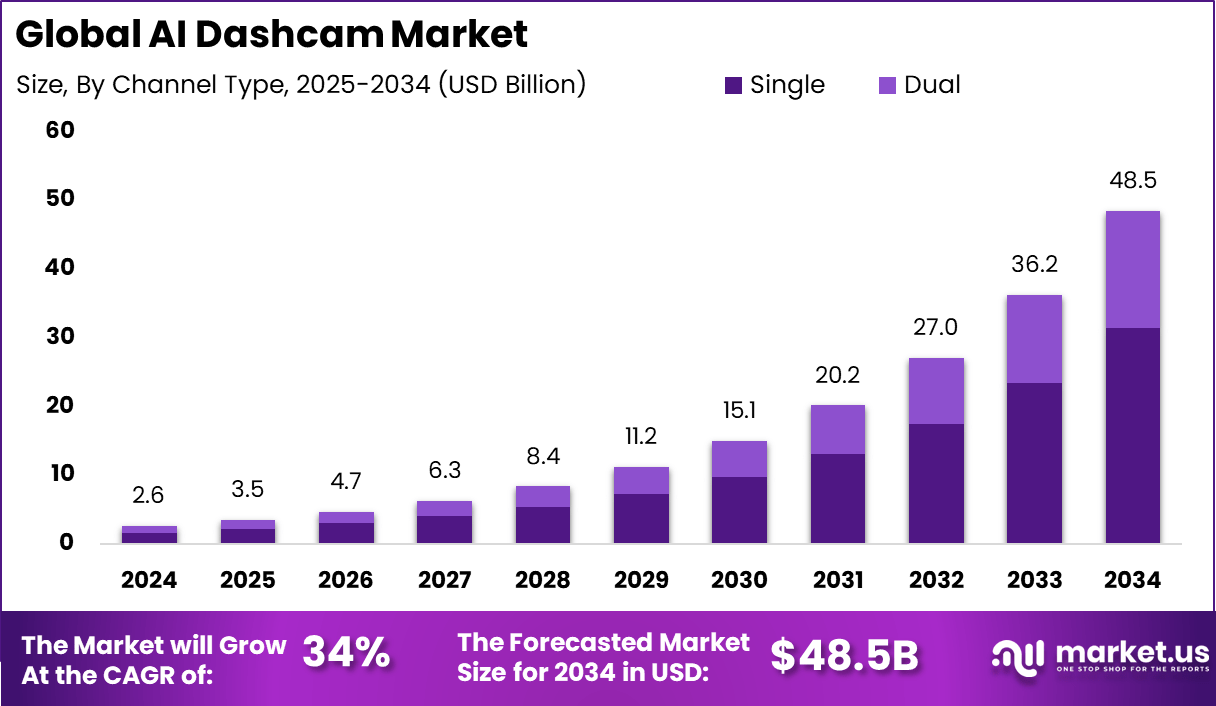
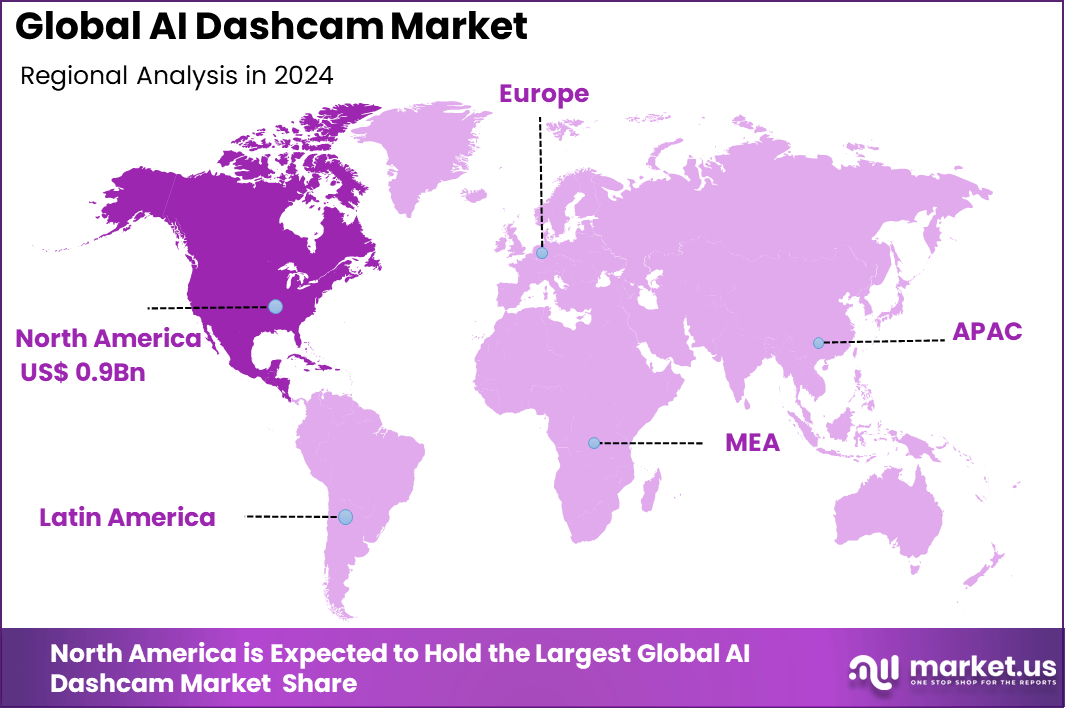
The AI Dashcam Market was valued at USD 2.6 billion in 2024 and is projected to rise to USD 3.5 billion in 2025, growing at a CAGR of 34% to reach USD 48.5 billion by 2034. In 2024, North America held a dominant market position, capturing more than a 38.2% share, holding USD 0.9 Billion revenue.
The AI Dashcam market is experiencing significant growth as advanced artificial intelligence technologies revolutionize vehicle safety and monitoring systems. AI dashcams go beyond traditional recording by offering real-time analytics such as driver behavior monitoring, collision detection, lane departure warnings, and fatigue alerts. These systems improve road safety by alerting drivers, preventing accidents, and recording footage for insurance and legal use.
The top driving factors fueling the AI dashcam market include increasing global awareness of road safety, stricter government regulations mandating vehicle safety features, and rapid technological advancements in AI and computer vision. Commercial fleet operators and individual vehicle owners alike are recognizing the value of AI-enabled dashcams in improving driver accountability, reducing accidents, and lowering insurance costs.
Also, the adoption of connected vehicle ecosystems and the rise of autonomous and semi-autonomous vehicles add momentum to the demand for sophisticated AI monitoring solutions. Demand for AI dashcams is surging across personal, commercial, and public sectors, driven by the need for enhanced security, efficient fleet management, and accurate incident documentation.
Market Size and Growth
| Trend/Innovation | Description |
|---|---|
| Edge Computing Capabilities | AI processing onboard the dashcam reduces reliance on connectivity, enabling faster real-time decisions. |
| 4G/5G Connectivity Integration | Enables seamless data transmission and remote fleet monitoring. |
| Enhanced Driver Coaching Features | AI delivers alerts and coaching to drivers to mitigate risky behavior. |
| Multi-Camera Systems & 360° Views | Adoption of surround-view AI dashcams for better situational awareness and accident documentation. |
| Growing Adoption in Personal Vehicles | Expansion beyond commercial use into consumer markets due to affordability and safety awareness. |
Growth Factors
| Key Factors | Description |
|---|---|
| Increasing Emphasis on Road Safety | Stricter government regulations and insurance incentives drive adoption of AI dashcams. |
| Fleet Management Efficiency Demand | Commercial fleets seek AI dashcams to reduce accidents, improve accountability, and save costs. |
| Technological Advancements | Improvements in AI, computer vision, camera quality, and telematics enable enhanced functionalities. |
| Rising Vehicle Connectivity & Smart Cities | Growth of connected vehicles and smart city infrastructure fuels AI dashcam integration. |
| Declining Hardware Costs | Making advanced AI dashcams more accessible to personal vehicle owners and smaller fleets. |
By Technology
In 2024, Natural language processing (NLP) accounts for 34.2% of the technology segment within the AI dashcam market. This technology enhances the functionality of dashcams by enabling voice commands, automated incident reporting, and improved interaction between drivers and devices. NLP helps transform raw audio data into actionable insights, allowing dashcams to respond to verbal prompts and assist in real-time monitoring without distracting the driver.
Integrating NLP into dashcams not only facilitates hands-free operation but also helps in generating detailed, voice-based reports after incidents, improving both safety and convenience. As voice-enabled interfaces become more sophisticated, NLP is increasingly critical for enabling intuitive, user-friendly dashcam systems that cater to driver needs.
By Channel Type
In 2024, Single-channel dashcams dominate the channel type segment, capturing 64.8% of the market. These dashcams typically record video from a forward-facing camera mounted on the windshield, providing essential coverage of the road ahead. Their simplicity, ease of installation, and affordability make them the preferred choice for most passenger car owners.
The single-channel design addresses basic surveillance and recording needs, such as capturing accident footage and monitoring driving behavior. Its cost-effectiveness and straightforward operation position it as the leading option in the growing AI dashcam market, especially among budget-conscious consumers.
By Vehicle Type
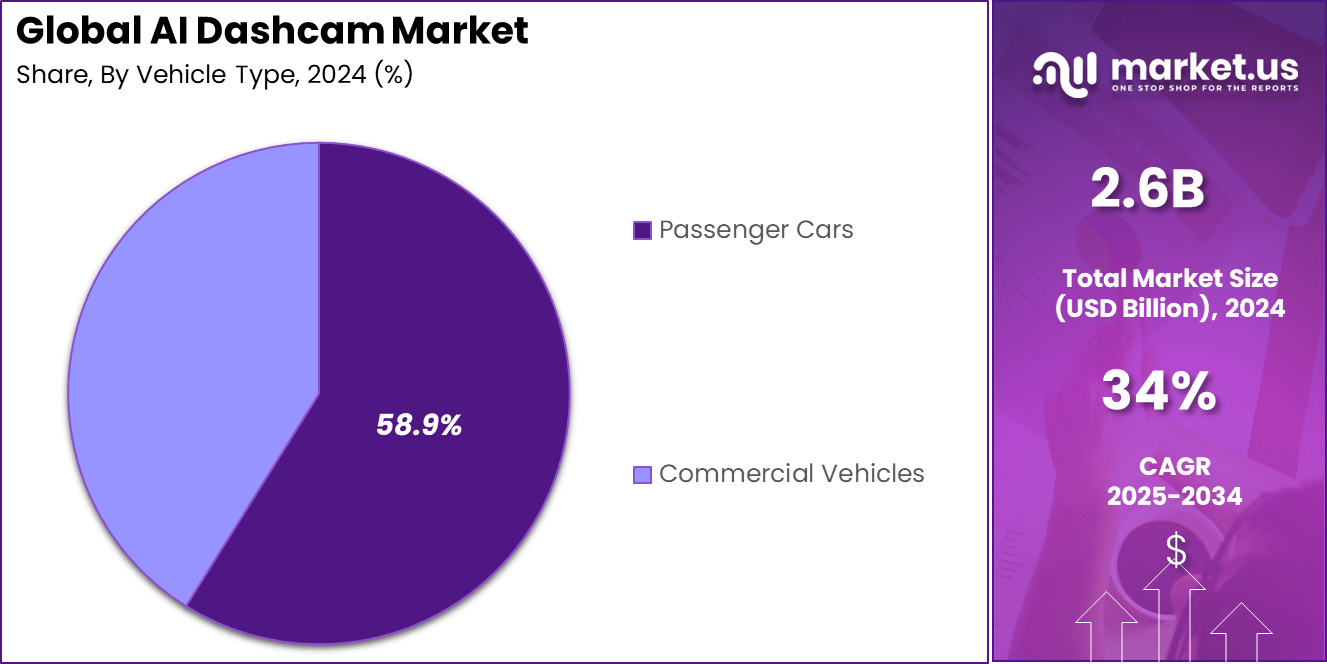
In 2024, Passenger cars constitute 58.9% of the AI dashcam market by vehicle type, reflecting the widespread adoption of these devices among everyday vehicle owners. Dashcams in passenger cars serve a range of purposes including accident evidence collection, theft deterrence, and driver safety monitoring. The increasing integration of AI technologies enhances these capabilities, making dashcams a critical accessory for private vehicle owners.
The prominence of passenger cars in this market segment is driven by the high volume of vehicles and growing awareness about road safety. As dashcam features expand to include intelligent alerts and driver assistance, passenger car owners continue to adopt these devices to enhance their driving experience and protection.
By Distribution Channel
In 2024, In-store distribution accounts for 55.5% of AI dashcam sales, making it the leading channel for consumers to purchase these products. Physical retail stores provide buyers with the opportunity to view product features, compare models, and receive expert advice in-person, which strengthens consumer confidence and helps with purchase decisions.
The in-store presence is especially favored by buyers who prefer immediate product availability and hands-on demonstrations. Despite the rise of online shopping, the convenience and trust associated with physical stores keep in-store distribution a vital sales avenue in the AI dashcam market.
Key Market Segments
By Technology
- Deep learning
- Natural Language Processing
- Computer Vision
- Context-Aware Computing
- Others
By Channel Type
- Single
- Dual
By Vehicle Type
- Passenger Cars
- Commercial Vehicles
- Light Commercial Vehicle
- Heavy Commercial Vehicle
By Distribution Channel
- Online
- In-Store
Regional Analysis and Coverage
- North America
- US
- Canada
- Europe
- Germany
- France
- The UK
- Spain
- Italy
- Russia
- Netherlands
- Rest of Europe
- Asia Pacific
- China
- Japan
- South Korea
- India
- Australia
- Singapore
- Thailand
- Vietnam
- Rest of Latin America
- Latin America
- Brazil
- Mexico
- Rest of Latin America
- Middle East & Africa
- South Africa
- Saudi Arabia
- UAE
- Rest of MEA
Driver Analysis
The AI dashcam market growth is driven by heightened concerns over road safety and the increasing adoption of stringent government regulations mandating advanced safety features in vehicles. The escalating number of road accidents worldwide propels demand for proactive safety technologies that can prevent collisions and improve driver accountability.
Commercial fleets represent a significant market segment due to their need for improved safety, operational efficiency, and insurance cost reduction, making AI dashcams essential for fleet management. Furthermore, technological advancements lowering hardware costs and the increasing demand for connected vehicle ecosystems also fuel adoption.
Restraint Analysis
Despite the promising outlook, the AI dashcam market faces several restraints that may slow widespread adoption. High initial costs remain a significant barrier, especially in price-sensitive markets and developing regions, limiting access to advanced AI dashcams.
Additionally, the complexity of integrating AI technology into dashcams requires substantial research and development investment, increasing production expenses. Data privacy and security concerns also pose major challenges, as these devices collect extensive sensitive data including location and driver behavior.
Compliance with stringent regulations like the GDPR necessitates careful handling of user data, adding operational and legal burdens for manufacturers. Moreover, the need for reliable internet infrastructure to support real-time data transmission restricts deployment in areas with poor connectivity.
Opportunity Analysis
The expanding smart city initiatives and connected vehicle ecosystems present substantial opportunities for AI dashcams. Integration with telematics systems and intelligent transportation infrastructure can enhance traffic management, law enforcement, and urban planning.
Usage-based insurance and telematics-driven premiums offer new revenue streams by leveraging AI dashcam data for risk assessment and fraud prevention. Additionally, emerging markets with increasing vehicle ownership and regulatory pressure for road safety represent strong growth areas. Advances in AI algorithms offer opportunities to develop more sophisticated features such as real-time driver coaching, accident prediction, and personalized safety alerts.
Further alignment with electric and autonomous vehicles will fuel demand as these technologies become mainstream. Partnerships between AI dashcam suppliers and automotive manufacturers promise broader integration and innovation in safety solutions.
Challenge Analysis
A critical challenge is maintaining a balance between advanced AI capabilities and data privacy protections. The massive amount of data generated by AI dashcams calls for robust cybersecurity and compliance frameworks to ensure user trust and regulatory adherence.
High costs and technical complexities of AI system integration require continuous R&D and skilled personnel, which may limit rapid innovation and market penetration. Ensuring interoperability and standardization across diverse vehicle platforms adds further complexity.
Additionally, achieving widespread infrastructure support, especially reliable high-speed internet for cloud processing and real-time features, remains challenging in many regions. The evolving regulatory landscape also demands adaptability from manufacturers to meet varying privacy and safety mandates globally.
Competitive Analysis and Coverage
The AI dashcam market comprises several prominent players that offer innovative solutions for advanced driver monitoring, real-time analytics, and video evidence. Companies like ABEO Technology, Amcrest Technologies, CNSLink, and Cobra Electronics are actively engaged in hardware-based dashcams with integrated AI capabilities.
Other notable participants such as DigiLife Technologies, DOD Technologies, FINEDIGITAL, and Garmin Ltd. are contributing to product diversification by integrating features like dual-camera support, night vision, and GPS tracking. These companies are investing in research to improve object recognition and event detection using AI models.
Lukas Dashcam, Nexar, and Panasonic Corporation have enhanced their product portfolios by adding cloud storage and mobile app connectivity. Their offerings support seamless data access, which is increasingly important in insurance claims and legal dispute resolution. Key contributors also include Pittasoft, Qubo (Hero Electronix), Zhixingsheng Electronic, and STEELMATE, who focus on AI-driven diagnostics, driver scoring, and predictive analytics.
Top Key Players in the Market
- ABEO Technology CO., Ltd
- Amcrest Technologies, LLC
- CNSLink Ltd.
- Cobra Electronics Corporation
- DigiLife Technologies Co. Ltd
- DOD Technologies, Inc
- FINEDIGITAL INC.
- Garmin Ltd.
- Lukas Dashcam
- Nexar Inc.
- Panasonic Corporation
- Pittasoft Co. Ltd.
- Qubo (Hero Electronix)
- Shenzhen Zhixingsheng Electronic Co., Ltd.
- STEELMATE COMPANY LIMITED
- TourMate
- WatchGuard Technologies, Inc.
- Waylens, Inc.
- Others
Recent Developments
- In March 2025, Nextbase, the world’s leading dashcam brand with over 5 million units sold globally, made a notable acquisition by purchasing AI product, platform, and intellectual property assets from British automotive AI innovator Humanising Autonomy. This move solidifies Nextbase’s position in enhancing its AI capabilities focused on driver safety and efficiency.
- In May 2025, DDPAI unveiled its next-generation AI dashcams, including the advanced Z60 Pro and Z50 Pro models, at the Malaysia Autoshow. These flagship devices offer cutting-edge features such as 3-channel recording for broader perspectives, 4G connectivity for remote monitoring and instant incident alerts, and AI-powered real-time safety alerts.

- 蓝茶市场(2026—2031)
0评论2026-09-15

- 泡沫材料市场(2026—2031)
0评论2026-09-15

- 重铬酸钠市场(2026—2031)
0评论2026-09-15

- 家族性淀粉样多发性神经病(FAP)市场(2026—2031)
0评论2026-09-15

- 次氯酸钙市场(2026—2031)
0评论2026-09-15

- 海上储能市场(2026—2031)
0评论2026-09-12

- 混凝土市场(2026—2031)
0评论2026-09-12

- 矫形器械市场(2026—2031)
0评论2026-09-12

- 木质素基树脂市场(2026—2031)
0评论2026-09-12

- 聚碳酸酯二元醇市场(2026—2031)
0评论2026-09-12