


Report Overview
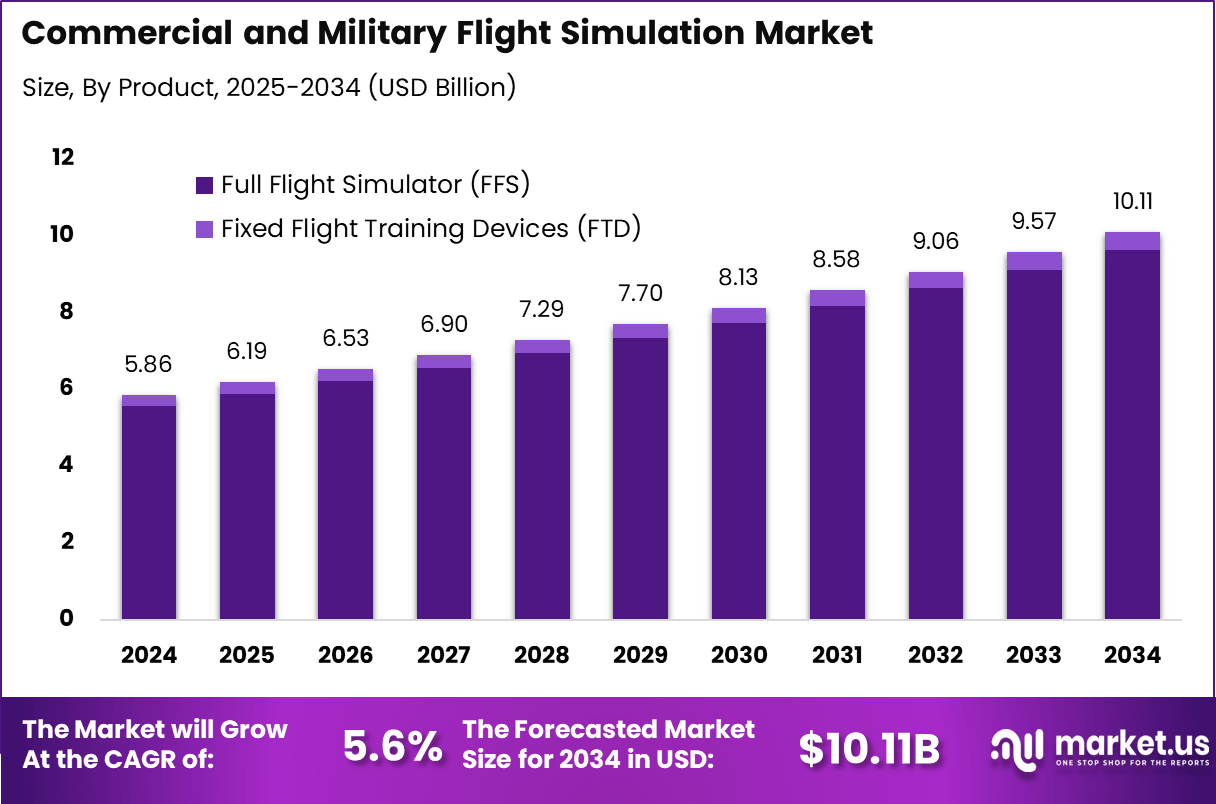
The Global Commercial and Military Flight Simulation Market size is expected to be worth around USD 10.11 billion by 2034, from USD 5.86 billion in 2024, growing at a CAGR of 5.6% during the forecast period from 2025 to 2034. In 2024, Europe held a dominant market position, capturing more than a31.8% share, holding USD 1.86 billion in revenue.
The Commercial and Military Flight Simulation market is a rapidly evolving sector playing a crucial role in pilot and crew training across both civil aviation and defense industries. Flight simulators provide realistic, immersive environments that replicate actual flying conditions, enabling trainees to practice a wide range of scenarios safely and cost-effectively.
This dual application supports pilot readiness, operational safety, and mission preparedness while reducing dependency on costly and environmentally impactful live flight training. Key drivers of this market include the growing global demand for trained pilots amid increasing air traffic, expansion of commercial airline fleets, and rising defense budgets driven by geopolitical tensions.
The need for advanced training tools that can simulate complex aircraft systems and emergency combat situations without risk is critical. Furthermore, environmental concerns enhance the appeal of flight simulators due to their role in reducing carbon footprints associated with traditional flight hours.
For instance, in May 2024, Boeing showcased its advanced defense capabilities, sustainability efforts, and cutting-edge flight simulation technologies at CANSEC 2024. Among the highlights was the E-7A demonstration trailer, equipped with a B737-NG flight deck simulator. The E-7A is a key asset for airborne early warning and control missions, selected by NATO, the U.S. Air Force, and the U.K. Royal Air Force.
Key Takeaway
- The Full Flight Simulator (FFS) segment led the global market with a commanding 95.2% share, underscoring its critical role in delivering high-fidelity, immersive training for both commercial pilots and military personnel.
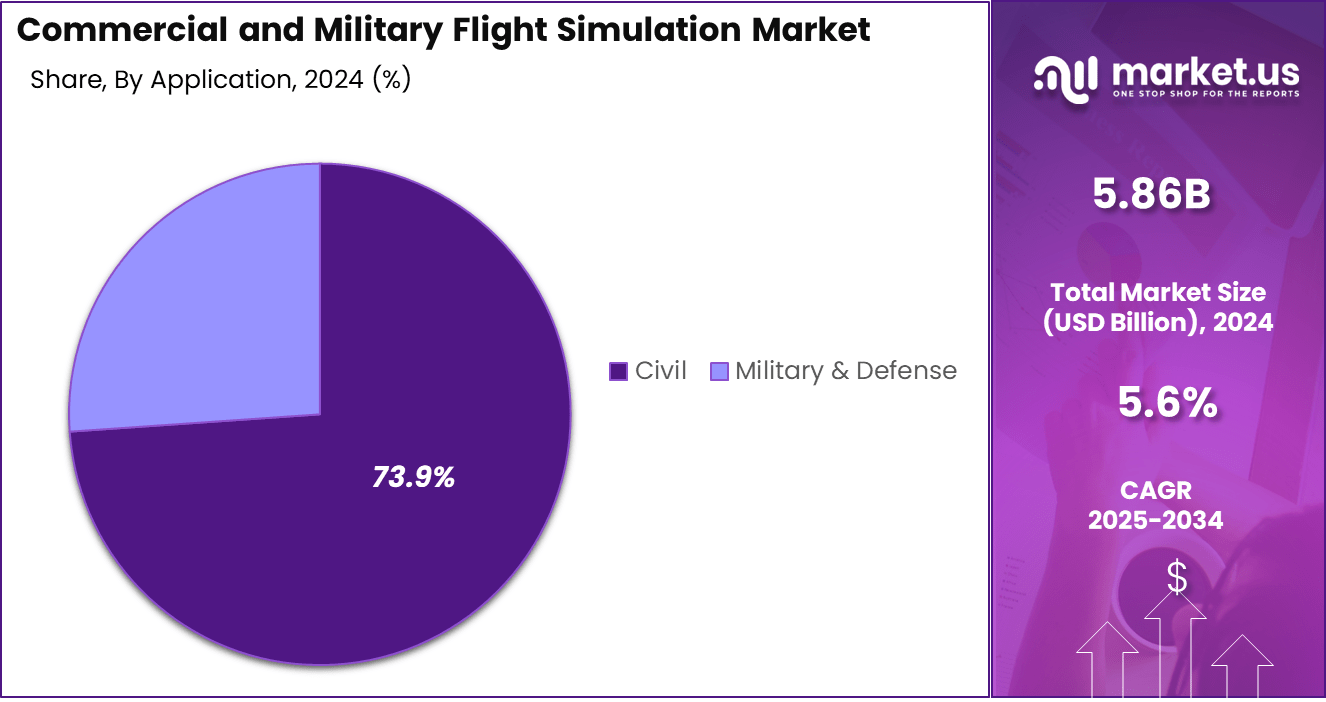
- The Civil segment held a dominant 73.9% share, reflecting the increasing demand for commercial pilot training amid global aviation recovery and rising air travel demand.
- Fixed Wing Simulators accounted for 78.3% of the market, driven by the need for standardized, regulatory-compliant pilot certification programs across commercial airlines and defense aviation.
- The U.K. market was valued at USD 0.43 billion in 2024, supported by a steady CAGR of 4.22%, as the country continues to invest in pilot training infrastructure and simulation upgrades.
- Europe maintained a leading regional position with a 31.8% global share, backed by strong aerospace programs, defense sector investments, and stringent aviation training standards.
Role of AI
| Role/Function | Description |
|---|---|
| Enhanced Training Realism | AI integrates advanced flight dynamics, behavior modeling, and adaptive scenario generation for immersive, realistic training experiences. |
| Virtual and Augmented Reality | AI-powered VR/AR simulations increase engagement, enable multi-sensory, instructor-led and remote training. |
| Predictive Analytics & Pilot Behavior | AI analyzes pilot responses and performance to customize training and improve skill retention. |
| Automated Scenario Generation | AI dynamically creates diverse training conditions including emergencies, combat missions, and weather variations. |
| Remote and Cloud-Based Training | AI enables scalable, distributed training environments accessible globally via cloud platforms. |
| Integration with IoT and Sensors | Real-time data from aircraft and simulation sensors enhances accuracy and feedback loops. |
U.K. Market Size
The market for Commercial and Military Flight Simulation within the U.K. is growing tremendously and is currently valued at USD 0.43 billion, the market has a projected CAGR of 4.22%. The growing demand for pilot training in sectors like offshore energy, search and rescue, and emergency medical services is driving the need for advanced flight simulation solutions in the U.K.
The country’s strong aviation and military sectors, along with regulatory pressures for strict pilot certification and environmentally sustainable aircraft, further boost adoption. Investments in technologies such as VR are enhancing the realism and effectiveness of training. This trend offers significant opportunities for both commercial airlines and defense forces to improve operational readiness, safety, and overall training quality.
For instance, in March 2025, ZeroAvia announced a partnership with FlightSafety International to enhance pilot and maintenance training for zero-emission flights. This collaboration highlights the U.K.’s growing focus on innovative aviation technologies, including the development of environmentally sustainable aircraft.
In 2024, Europe held a dominant market position in the Global Commercial and Military Flight Simulation Market, capturing more than a 31.8% share, holding USD 1.86 billion in revenue. The growth of the European market is fueled by strict aviation regulations that mandate comprehensive pilot training, boosting the need for high-fidelity simulators.
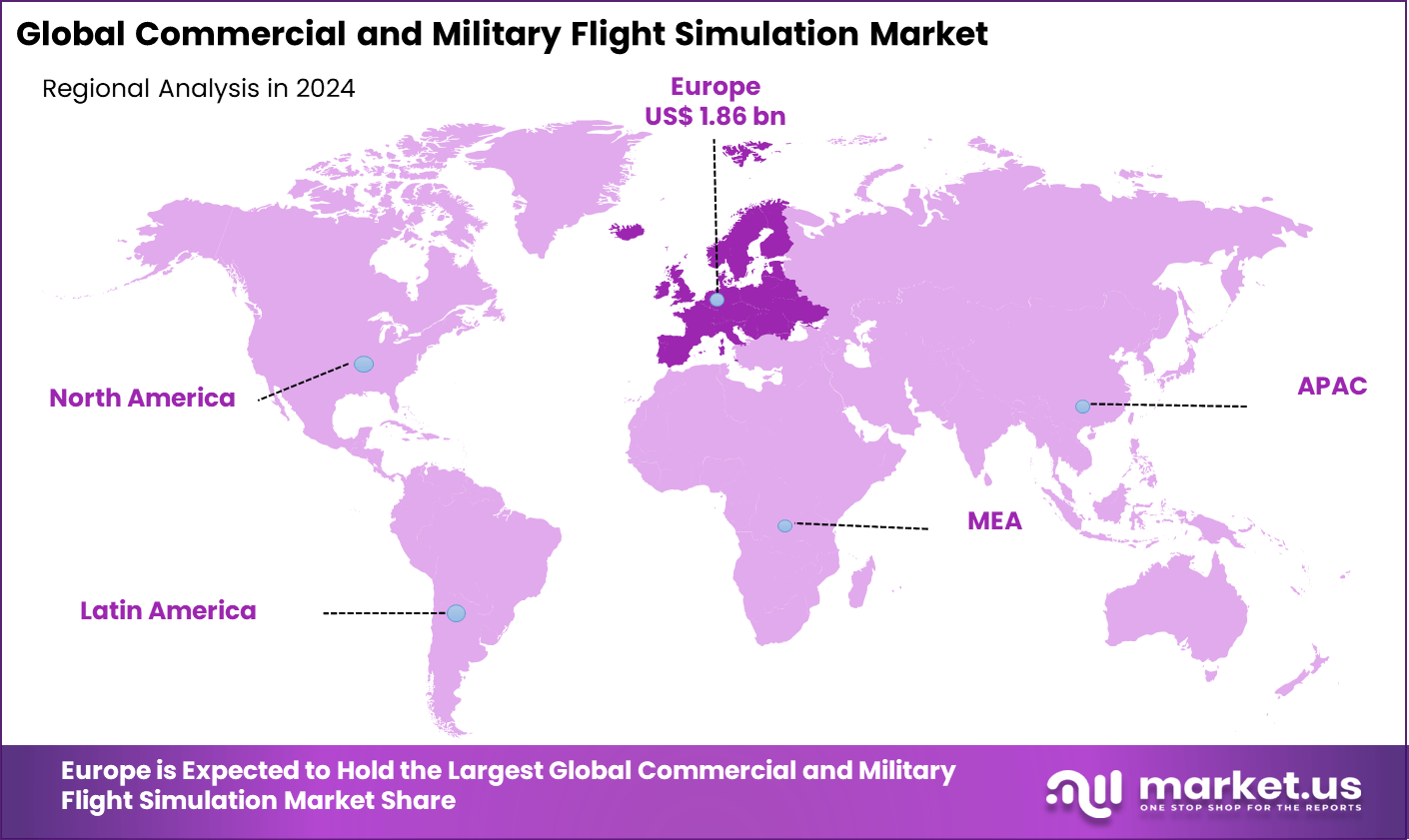
Significant investments in advanced simulation technologies and defense modernization in countries like Germany, the UK, France, and Russia have also contributed to rising demand. Moreover, Europe’s emphasis on technological innovations, such as VR and AI, is enhancing training effectiveness, ensuring that flight simulators meet the region’s evolving needs for both commercial and military aviation training.
For instance, In March 2025, a new helicopter training center was announced for Europe, set to open in 2026 with the Reiser Full Flight Simulator. This highlights rising demand for advanced simulation as Europe’s aviation sector grows. The center will train both civil and military pilots, boosting safety and readiness.
Top 5 Growth Factors
| Growth Factor | Description |
|---|---|
| Rising Pilot Demand | Growth in global air travel and airline fleet expansion increases need for training new commercial and military pilots. |
| Advanced Aircraft Technologies | Increasing aircraft complexity requires more sophisticated simulators with realistic controls and environment. |
| Stringent Regulatory Requirements | Mandatory simulator training hours and certifications for pilot licensing across civil aviation authorities worldwide. |
| Defense Modernization Programs | Military investments in pilot preparedness, combat readiness, and synthetic training environments drive demand. |
| Technological Innovations | Integration of AI, VR/AR, cloud computing, and real-time data analytics continuously enhances simulator capabilities. |
Product Analysis
In 2024, the Full Flight Simulator (FFS) segment held a dominant market position, capturing a 95.2% share of the Global Commercial and Military Flight Simulation Market. The dominance of the Full Flight Simulator (FFS) segment is largely driven by the rising demand for skilled pilots, fueled by increasing air travel and pilot retirements, as well as the need for safe and cost-effective training.
The use of FFS produces training situations that simulate real-life flying. The certification process is governed by official regulations and includes comprehensive pilot training for both commercial and military operations. Its ability to simulate various flight scenarios, including emergencies, makes it the preferred solution for high-quality, efficient pilot training.
For Instance, in February 2024, Thales secured a contract with Airbus Helicopters to provide Reality H Full Flight Simulators for the German Armed Forces’ H145M helicopters. These simulators, which will be installed at the Bückeburg International Helicopter Training Center, will offer advanced, high-fidelity training solutions.
Application Analysis
In 2024, the Civil segment held a dominant market position, capturing a 73.9% share of the Global Commercial and Military Flight Simulation Market. The demand is growing due to the rapid growth of air travel, increasing the need for pilot training and certification. The expansion of commercial airline fleets and low-cost carriers further boosts this demand.
Advanced technologies like AI, VR, and motion cueing enhance training effectiveness and safety, making simulators essential for pilot certification and recurrent training. Additionally, strict regulatory requirements for pilot proficiency and safety have accelerated the adoption of flight simulators in the civil aviation sector.
For instance, In August 2024, TRU Simulation + Training delivered a Cessna Longitude Full Flight Simulator to FlightSafety International. This simulator supports civil and commercial pilot training with advanced visual and motion systems. It helps improve pilot readiness by offering realistic flight scenarios for effective training and certification.
Platform Analysis
In 2024, the Fixed Wing Simulator segment held a dominant market position, capturing a 78.3% share of the Global Commercial and Military Flight Simulation Market. This dominance is due to the extensive use of fixed-wing aircraft in commercial aviation and military operations, creating a strong demand for specialized training solutions.
Fixed-wing simulators provide high-fidelity, realistic flight scenarios, ensuring effective and safe pilot training. Their realism makes them crucial for initial certification, recurrent training, and type rating. Additionally, their ability to meet stringent regulatory certification requirements makes them a preferred choice in the flight simulation market.
For instance, In February 2025, a new LED panel system was introduced to improve fixed-wing flight simulators. This system enhances visual clarity and realism, providing more accurate environmental displays. With advanced LED technology, pilot training becomes more effective by closely replicating real flight conditions.
Key Market Segments
By Product
- Full Flight Simulator (FFS)
- Fixed Flight Training Devices (FTD)
By Application
- Military & Defense
- Civil
By Platform
- Fixed Wing Simulator
- Rotary Wing Simulator
- UAV Simulator
Drivers
Increasing Demand for Pilot Training
The rise of global air travel has led to a surge in the need for skilled pilots. Flight simulators are a practical, secure, and economical solution for meeting this need. Their approach allows for flying practice without the high expenses associated with real-life flights. It is crucial for both commercial and military sectors, where the quality and availability of trained pilots directly impact safety, operations, and the ability to meet growing aviation demands worldwide.
For instance, in February 2025, Tecnam placed an order for new aircraft to be showcased at Pilot Expo 2025, responding to the growing demand for pilot training. As air traffic continues to rise globally, the need for qualified pilots has never been greater. This order reflects the broader trend of increasing investments in pilot training infrastructure.
Restraint
High Initial Investment
The expense of purchasing and implementing flight simulators is substantial, which can be challenging for smaller schools or organizations with limited finances. Even though simulators can save money in the long run, some locations may overpay for sophisticated equipment like software and hardware. Despite their potential to be beneficial in the long run, financial limitations can prevent the use of flight simulation tools, especially for small-scale flight training centers or new markets.
For instance, in November 2024, Simaero and Havelsan teamed up to launch a new A320 NEO full-flight simulator. This partnership highlights the significant initial investment required to develop and deploy advanced flight simulation systems. The development of such high-fidelity simulators involves substantial costs in terms of technology, research, and infrastructure, making it a major financial commitment.
Opportunities
Growth in Emerging Markets
Emerging economies, particularly in regions like Asia-Pacific, Africa, and the Middle East, are rapidly expanding their aviation industries. As air travel and defense needs grow, these regions are increasingly investing in flight simulation training to enhance pilot proficiency and military readiness.
This growth presents a significant opportunity for flight simulation providers to expand their reach, offering customized training solutions that meet the specific needs of these fast-developing markets, which often require cost-effective yet high-quality training options.
For instance, In July 2025, Air Algérie ordered 16 ATR 72-600 aircraft along with a full-flight simulator to strengthen pilot training. This reflects Africa’s expanding aviation infrastructure and rising demand for advanced training solutions. Such investments support pilot readiness and boost operational efficiency across the region.
Challenges
Regulatory Barriers
Flight simulation providers face significant challenges navigating the varied regulatory environments across different countries. Each nation has its own standards and certification processes for aviation training, making it difficult for simulation companies to achieve compliance on an international scale.
Meeting these diverse regulatory requirements can be time-consuming and costly, creating barriers to market entry and complicating the adoption of new simulation technologies globally. This challenge can delay the deployment and acceptance of innovative solutions in various regions.
For instance, in June 2023, the FAA announced that it would publish new pilot training requirements for eVTOL (electric vertical takeoff and landing) aircraft, adding to the regulatory complexity in the aviation industry. These new regulations are expected to impact both commercial and military flight simulation systems as they must meet specific certification standards.
Key Players Analysis
In the commercial and military flight simulation market, major aerospace manufacturers such as AIRBUS, Boeing, and Lockheed Martin Corporation play an essential role. These companies focus on developing next-generation simulators that replicate real-time cockpit environments for both pilot and mission training.
A significant presence is also held by simulation specialists like CAE Inc., L3Harris Technologies, Inc., and Thales. These firms contribute to training system design, scenario-based simulation software, and turnkey simulator infrastructure. Their solutions are widely adopted by air forces and commercial airlines for full-flight and part-task training.
Other notable players such as Kratos Defense & Security Solutions, Leonardo S.p.A., VirTra Inc., Exail Technologies, and Fidelity Technologies Corporation are expanding their influence in niche areas including tactical training, small arms simulation, and immersive VR environments.
Top Key Players in the Market
- AIRBUS
- Boeing
- CAE Inc.
- Collins Aerospace
- Exail Technologies
- Fidelity Technologies Corporation
- Kratos Defense & Security Solutions, Inc.
- L3Harris Technologies, Inc.
- Leonardo S.p.A.
- Lockheed Martin Corporation
- Meggitt PLC
- Saab AB
- Teledyne Brown Engineering
- Thales
- The DiSTI Corporation
- VirTra Inc.
- Others
Recent Developments
- In June 2025, Lockheed Martin introduced its latest F-16 Full Mission Trainer designed for the F-16 Block 70/72 and F-16V fighter aircraft. The new simulator offers a fully immersive training experience, providing realistic and highly detailed scenarios for pilots.
- In February 2024, Leonardo S.p.A. and FlightSafety International announced a partnership to evaluate potential collaborations in the field of helicopter training and simulation in the United States. The partnership aims to design, produce, and operate advanced training devices for helicopters, enhancing training solutions for both civil and military sectors.









