


Report Overview
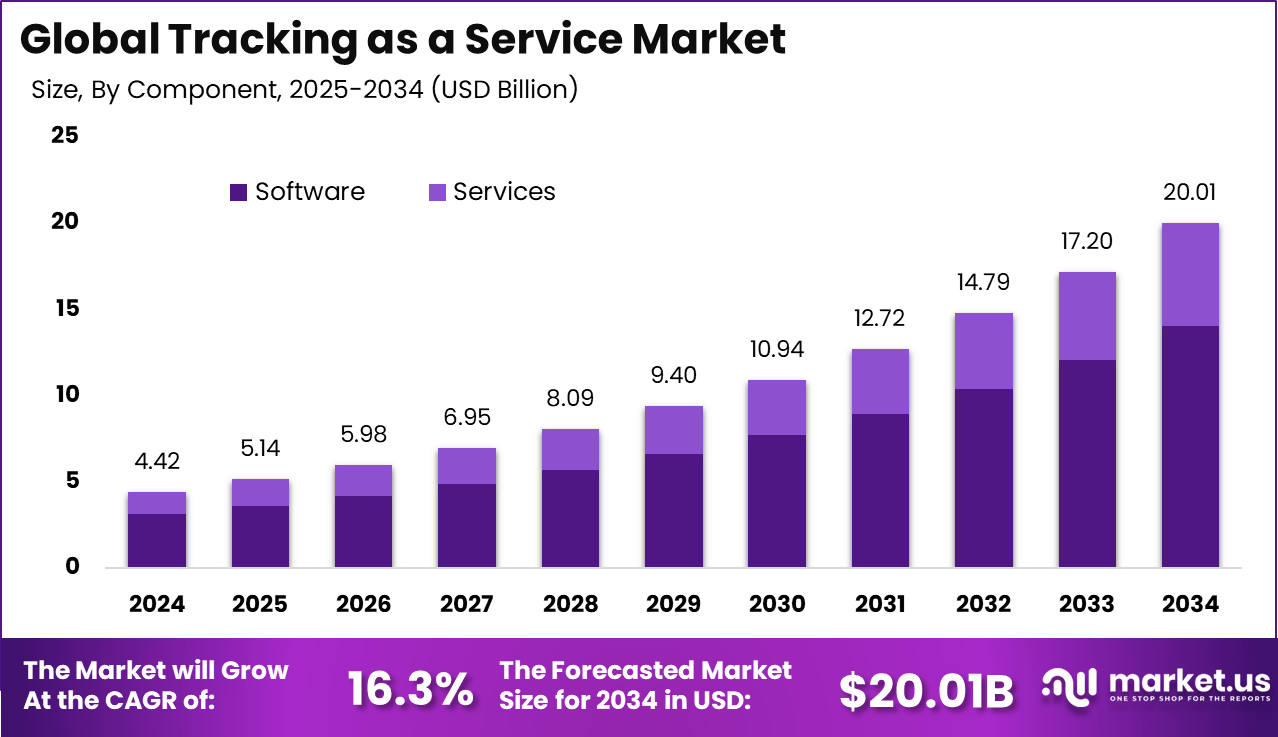
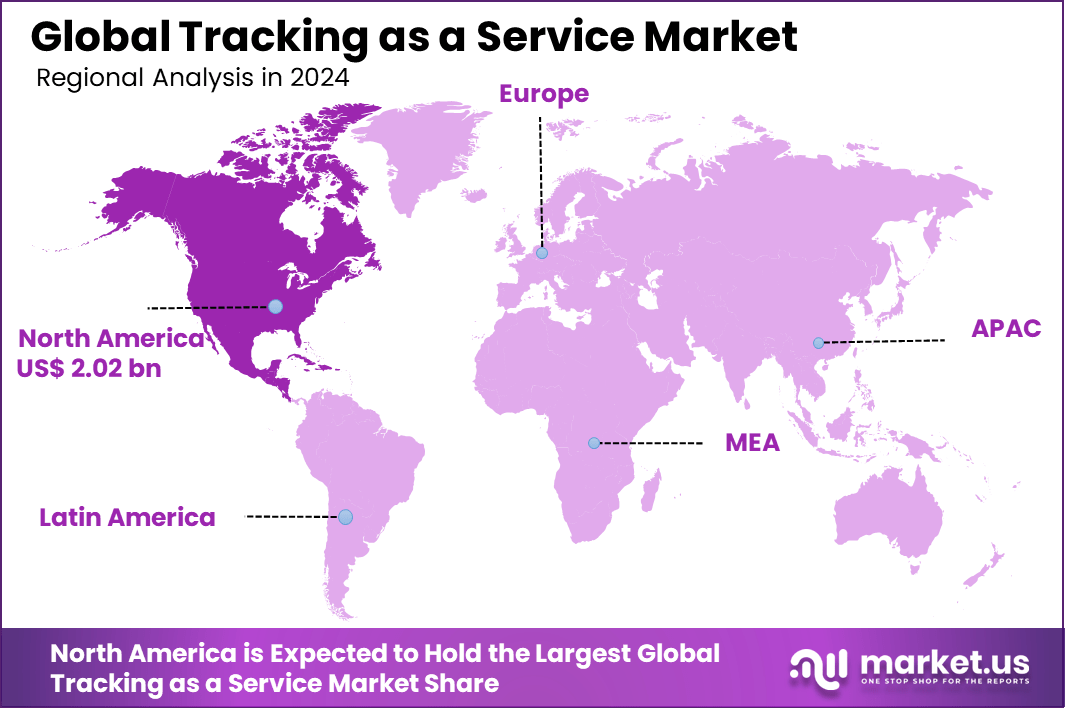
The Global Tracking as a Service Market size is expected to be worth around USD 20.01 billion by 2034, from USD 4.42 billion in 2024, growing at a CAGR of 16.3% during the forecast period from 2025 to 2034. In 2024, North America held a dominant market position, capturing more than a45.8% share, holding USD 2.02 billion in revenue.
The Tracking as a Service (TaaS) Market is emerging as a vital segment within the digital transformation landscape, providing cloud-based platforms that enable real-time tracking and monitoring of assets, vehicles, inventory, and personnel across various industries. This service leverages advances in Internet of Things (IoT) connectivity, GPS, data analytics, and cloud computing to offer seamless and scalable tracking solutions that improve operational efficiency,
Key Takeaways
- By component, Software led with a 70.3% share, driven by demand for real-time analytics, asset monitoring, and integration with enterprise systems.
- Cloud-based deployment accounted for 65.8%, reflecting the need for scalable, accessible, and cost-efficient tracking solutions.
- Large enterprises represented 58.1% of the market, adopting tracking platforms to manage complex, high-volume asset flows across global operations.
- By asset type, Manufacturing Assets held 35.4%, underscoring the focus on optimizing production efficiency and minimizing downtime.
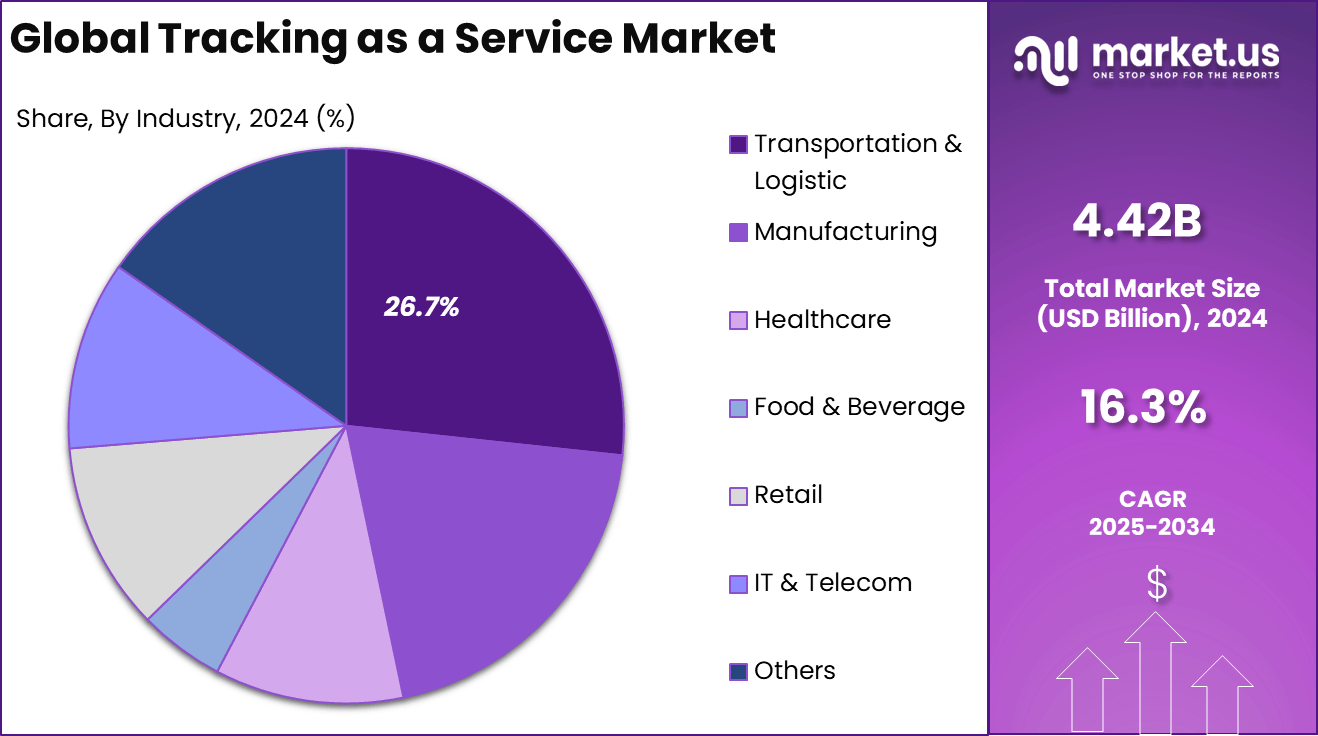
- The Transportation & Logistics industry led by end-use with a 26.7% share, leveraging tracking services for supply chain visibility, fleet monitoring, and delivery optimization.
- The U.S. market was valued at USD 1.93 billion in 2024, expected to grow at a CAGR of 14.1%, driven by digital supply chain initiatives and IoT adoption.
- North America dominated globally with a 45.8% share, generating USD 2.02 billion in revenue, supported by advanced logistics infrastructure and strong cloud adoption rates.
Market Size and Growth
| Growth Factor | Description |
|---|---|
| Expansion of E-commerce & Logistics | Rapid growth in online retail and increasing delivery demands drive adoption of tracking solutions |
| Increasing Demand for Real-Time Visibility | Businesses require real-time asset and shipment monitoring to improve supply chain transparency and efficiency |
| Government Initiatives & Regulations | Investments and regulations promoting GPS tracking in transportation and public infrastructure boost adoption |
| Technological Advancement & IoT Adoption | Advances in sensor tech, cloud computing, 5G connectivity, and AI analytics enhance TaaS capabilities |
| Rising Emphasis on Operational Efficiency | Companies seek cost savings, route optimization, and predictive maintenance to enhance fleet and asset use |
Component Analysis
In 2024, The Software segment held a dominant market position, capturing a 70.3% share of the Global Tracking as a Service Market. This dominance is due to the increasing reliance on cloud-based platforms and advanced analytics for real-time tracking, route optimization, and asset management.
Software solutions enable businesses to efficiently manage their operations, providing seamless integration with IoT devices and other technologies. Additionally, the growing demand for scalable, customizable, and user-friendly tracking solutions has further driven the adoption of software in TaaS.
For Instance, in February 2025, Force Fleet Tracking and Jobber teamed up to simplify dispatching with integrated fleet tracking for home service professionals. This collaboration combines Force Fleet Tracking’s advanced real-time tracking capabilities with Jobber’s service management software, creating a seamless solution for managing mobile workforces.
Deployment Analysis
In 2024, the Cloud-Based segment held a dominant market position, capturing a 65.8% share of the Global Tracking as a Service Market. The dominance is due to the flexibility, scalability, and cost-efficiency offered by cloud-based solutions.
These platforms allow businesses to easily manage large volumes of tracking data, access real-time insights, and scale operations as needed without the need for heavy on-site infrastructure. Cloud-based TaaS also enhances collaboration, ensures seamless updates, and supports remote access, making it highly attractive to companies across various industries.
For instance, in May 2025, Microsoft announced the migration of its IT infrastructure management to the cloud with Microsoft Azure. This move enhances its ability to offer scalable, cloud-based solutions, including Cloud-Based Tracking as a Service (TaaS).
Enterprise Size Analysis
In 2024, the Large Enterprises segment held a dominant market position, capturing a 58.1% share of the Global Tracking as a Service Market. This dominance is due to the greater financial resources and complex logistical needs of large organizations.
These companies require advanced tracking solutions to manage vast supply chains, ensure real-time visibility, and optimize operations across multiple regions. Additionally, large enterprises can invest in scalable, customizable TaaS solutions, driving the widespread adoption of these technologies to improve efficiency and reduce costs.
For Instance, in February 2025, Tradlinx unveiled its unlimited vessel tracking service, designed to empower logistics professionals worldwide. This service offers real-time tracking capabilities, enabling large enterprises in the shipping and logistics sectors to monitor vessels, optimize routes, and improve supply chain visibility.
Asset Type Analysis
In 2024, The Manufacturing Assets segment held a dominant market position, capturing a 35.4% share of the Global Tracking as a Service Market. This dominance is due to the growing need for real-time visibility and management of equipment, machinery, and raw materials in manufacturing environments.
Tracking solutions help manufacturers optimize asset utilization, reduce downtime, and improve maintenance schedules. Additionally, the increasing focus on operational efficiency, cost reduction, and minimizing disruptions in the production process has driven widespread adoption of TaaS for managing manufacturing assets.
For Instance, in October 2024, IFS accelerated its industrial AI capabilities with the release of IFS Cloud 24R2. This update integrates advanced AI-driven features designed to enhance asset management and real-time tracking in manufacturing environments. By leveraging IFS Cloud’s capabilities, manufacturers can track and optimize their assets more efficiently, improving operational visibility and reducing downtime.
Industry Analysis
In 2024, the Transportation & Logistics segment held a dominant market position, capturing a 26.7% share of the Global Tracking as a Service Market. This dominance is driven by the growing demand for real-time tracking of shipments, vehicles, and cargo across extensive supply chains. TaaS allows transportation and logistics companies to optimize routes, minimize delays, and enhance inventory management, boosting customer satisfaction.
Additionally, government initiatives supporting digital logistics infrastructure and the surge in e-commerce activities further strengthen the segment’s position. With a strong focus on cost efficiency, timely deliveries, and end-to-end visibility, TaaS has become crucial for operational success in the transportation and logistics sector.
For Instance, in September 2024, Geotab released its latest MyGeotab updates, further enhancing its fleet management platform. These updates focus on improving tracking capabilities, offering better visibility into vehicle and asset performance. Geotab’s new features include advanced data analytics, more robust reporting tools, and enhanced integration with other IoT devices.
Top Trends and Innovations
| Trend/Innovation | Description |
|---|---|
| AI-Driven Predictive Analytics | AI-powered platforms deliver actionable intelligence on asset health, delays, and risk mitigation |
| IoT-Enabled Tracking Systems | Integration of IoT devices for comprehensive monitoring and environmental sensing |
| Cloud-Based, Scalable Platforms | Flexible solutions accessible remotely with real-time data synchronization across geographies |
| 5G Network Integration | Enhanced connectivity enables faster data transmission and more reliable tracking performance |
| Increased Focus on Data Security | Deployment of encryption, access control, and privacy-compliant protocols to secure tracking data |
| Sector Expansion into Healthcare & Agriculture | Growing use in patient monitoring, medical device tracking, crop monitoring, and resource optimization |
Key Market Segments
By Component
- Software
- Services
By Deployment
- On-premises
- Cloud-based
By Enterprise Size
- Large Enterprises
- Small & Medium Enterprises
By Asset Type
- Electronics & IT Assets
- In-transit Equipment
- Manufacturing Assets
- Others
By Industry
- Transportation & Logistic
- Manufacturing
- Healthcare
- Food & Beverage
- Retail
- IT & Telecom
- Others
Drivers
E-commerce Growth
A major driver for the TaaS market is the surge in e-commerce and logistics activities requiring precise real-time tracking to fulfill demand for faster deliveries and better customer satisfaction. The rising need to improve fleet operators’ efficiency through route optimization, fuel management, and driver behavior monitoring is pushing widespread adoption.
Additionally, the proliferation of connected devices and smart infrastructure, fueled by IoT growth and adoption of 5G, enables seamless communication and tracking of assets across complex supply chains. Regulatory mandates for GPS tracking and safety compliance in sectors like transportation and healthcare also stimulate market growth.
For instance, In October 2024, DHL Express introduced proactive tracking and direct signature services to enhance e-commerce deliveries. These solutions provide real-time tracking updates, improving customer visibility throughout the delivery process. By integrating Tracking as a Service into its offerings, DHL helps businesses boost supply chain transparency, optimize delivery operations, and increase customer satisfaction.
Restraint
Data Privacy Concerns
Despite positive outlooks, the market faces challenges, chiefly the high initial implementation costs and technological complexities associated with integrating advanced tracking solutions into legacy systems. Smaller businesses with limited budgets often hesitate to invest in comprehensive TaaS platforms due to hardware, software, and maintenance expenses.
Data privacy and cybersecurity concerns are prominent restraints because tracking services handle sensitive location and movement data. Compliance with diverse regulations like GDPR or CCPA increases operational costs and complexity for providers. Infrastructure limitations in certain regions, such as poor internet connectivity or GPS coverage, hinder the effective deployment of tracking solutions.
For instance, in April 2025, a Florida driver filed a lawsuit against Toyota and Progressive over concerns regarding data sharing through connected analytic services. The lawsuit highlights the growing issue of data privacy in the context of Tracking as a Service (TaaS) solutions.
Opportunities
Expansion into Emerging Markets
As digital infrastructure improves in developing regions, there is a growing opportunity for Tracking as a Service (TaaS) to expand. The expansion of industries and online shopping sectors in Asia-Pacific, Africa, and Latin America is driving a surge in demand for logistics and tracking services in new markets.
TaaS providers can leverage this expansion to enhance supply chain visibility and optimize logistics for businesses in these regions, fostering growth and increasing operational efficiency as they modernize their infrastructures.
For instance, in May 2025, Africa welcomed a new dollar billionaire from the world of car tracking technology. This individual’s success highlights the rapid growth of the Tracking as a Service (TaaS) market, particularly in regions like Africa, where the demand for vehicle tracking and fleet management solutions is increasing.
Challenges
Market Competition
The TaaS market is becoming more competitive, with many companies entering to meet the increasing demand. This leads to increased price pressure, which also prompts businesses to continuously innovate in pursuit of their objectives.
Businesses can only compete if they offer exclusive features, integrated systems, or more detailed analytics to stay ahead of the competition. TaaS providers must adapt to the changing market and customer preferences to remain competitive.
For instance, in August 2025, Papa John’s launched a new app and pizza delivery tracking service, reflecting the increasing market competition in the Tracking as a Service (TaaS) sector. With more companies offering real-time tracking solutions to enhance customer experience, the competition in the TaaS market has intensified.
Regional Highlights: A Global Perspective
Asia-Pacific has emerged as the fastest-growing region for TaaS, supported by rapid industrialization, a booming e-commerce sector, and large-scale investments in IoT, AI, and blockchain-enabled smart logistics. Governments and enterprises in China, India, Japan, and South Korea are modernizing supply chains through innovative initiatives such as blockchain-based port logistics.
Europe is maintaining steady TaaS market expansion, driven by stringent regulations that promote supply chain transparency, sustainability, and advanced tracking adoption, including 5G-enabled solutions. Leading economies such as Germany, the UK, France, Italy, and Spain are investing in warehouse automation, logistics management platforms, and cloud-native tracking systems.
Latin America is progressing toward broader TaaS adoption, supported by growing e-commerce, transportation, and manufacturing sectors. Efforts are concentrated on improving supply chain visibility, especially in last-mile delivery. Global tracking technology providers are expanding through distribution partnerships and local manufacturing, enabling faster modernization.
The Middle East & Africa show significant growth potential, fueled by logistics, healthcare, and manufacturing industries adopting GPS and real-time tracking technologies to improve performance. Large-scale infrastructure investments in the UAE, Saudi Arabia, and Oman are accelerating implementation, while in Africa, the adoption of cloud-based tracking services is rapidly increasing.
Key Regions and Countries
- North America
- US
- Canada
- Europe
- Germany
- France
- The UK
- Spain
- Italy
- Russia
- Netherlands
- Rest of Europe
- Asia Pacific
- China
- Japan
- South Korea
- India
- Australia
- Singapore
- Thailand
- Vietnam
- Rest of APAC
- Latin America
- Brazil
- Mexico
- Rest of Latin America
- Middle East & Africa
- South Africa
- Saudi Arabia
- UAE
- Rest of MEA
Key Players Analysis
Leading players in the Tracking as a Service market are focusing on advanced IoT integration, real-time analytics, and cloud-based solutions to enhance operational visibility. Companies such as Motorola Solutions, Wabco Holdings Inc., AT&T Inc., and Zebra Technologies Corp. are investing in AI-driven tracking systems and scalable software platforms.
Prominent technology providers, including Verizon Communications, Geotab Inc., Blackline Safety Corp., and Spider Tracks Limited, are emphasizing safety compliance, predictive maintenance, and connected fleet management. Their platforms integrate GPS tracking, telematics, and advanced reporting tools to support industries such as transportation, oil and gas, and manufacturing.
Software-focused vendors like MicroMain, Sortly, EZO, Finale Inventory, and Infor are concentrating on inventory management, workflow automation, and user-friendly interfaces. These solutions are designed for small, medium, and large enterprises, enabling real-time asset tracking with minimal manual intervention. Trimble Inc., Rockwell Automation, Midmark Co., Mojix, and PCCW Solutions are advancing RFID, barcode scanning, and sensor network innovations.
Top Key Players in the Market
- Motorola Solutions
- Wabco Holdings Inc.
- AT&T Inc.
- Zebra Technologies Corp.
- Verizon Communications
- Geotab Inc.
- Blackline Safety Corp.
- Spider Tracks Limited
- Honeywell International Inc.
- Trimble Inc.
- Rockwell Automation
- MicroMain
- Sortly
- EZO
- Finale Inventory
- Infor
- Midmark Co.
- Mojix
- PCCW Solutions
- Others
Recent Developments
- In March 2025, Geotab released its 2024 Sustainability and Impact Report, highlighting its efforts in promoting sustainable practices through its fleet management solutions. The report emphasizes the integration of environmentally friendly technologies into its TaaS offerings, including energy-efficient routing, reduced emissions, and advanced data analytics.
- In April 2024, Verizon reported strong wireless service revenue growth, solid cash flow, and continued momentum in its business. The company highlighted its commitment to expanding its digital infrastructure, which supports the growth of Tracking as a Service (TaaS) solutions.
- In January 2024, GlobalNav Satellite Systems introduced a new Real-Time Asset Tracking solution that combines IoT and satellite technology to deliver highly accurate and reliable tracking across industries such as logistics and transportation. This development strengthens operational visibility and efficiency for businesses seeking advanced tracking capabilities.
- In March 2024, GeoTab formed a strategic partnership with Orbcomm to integrate telematics and advanced Tracking as a Service solutions. This collaboration expands their market reach and enhances fleet management offerings, enabling customers to benefit from improved connectivity and comprehensive asset monitoring.
- In May 2024, Trimble secured ~USD 500.2 million in funding to accelerate the growth of its Tracking as a Service offerings and advance its Geospatial Cloud platform. This investment positions the company to deliver greater value to sectors like agriculture, construction, and transportation, while reinforcing its competitive standing in the market.

- 蓝茶市场(2026—2031)
0评论2026-09-15

- 泡沫材料市场(2026—2031)
0评论2026-09-15

- 重铬酸钠市场(2026—2031)
0评论2026-09-15

- 家族性淀粉样多发性神经病(FAP)市场(2026—2031)
0评论2026-09-15

- 次氯酸钙市场(2026—2031)
0评论2026-09-15

- 海上储能市场(2026—2031)
0评论2026-09-12

- 混凝土市场(2026—2031)
0评论2026-09-12

- 矫形器械市场(2026—2031)
0评论2026-09-12

- 木质素基树脂市场(2026—2031)
0评论2026-09-12

- 聚碳酸酯二元醇市场(2026—2031)
0评论2026-09-12