


Report Overview
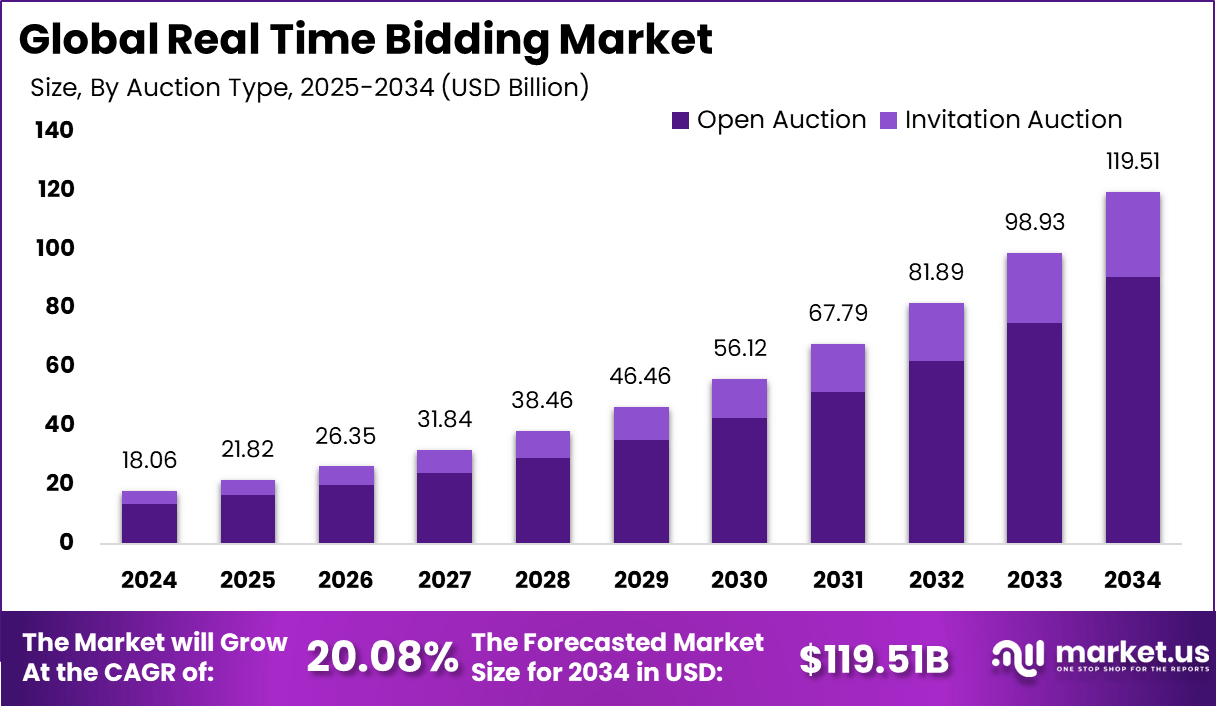
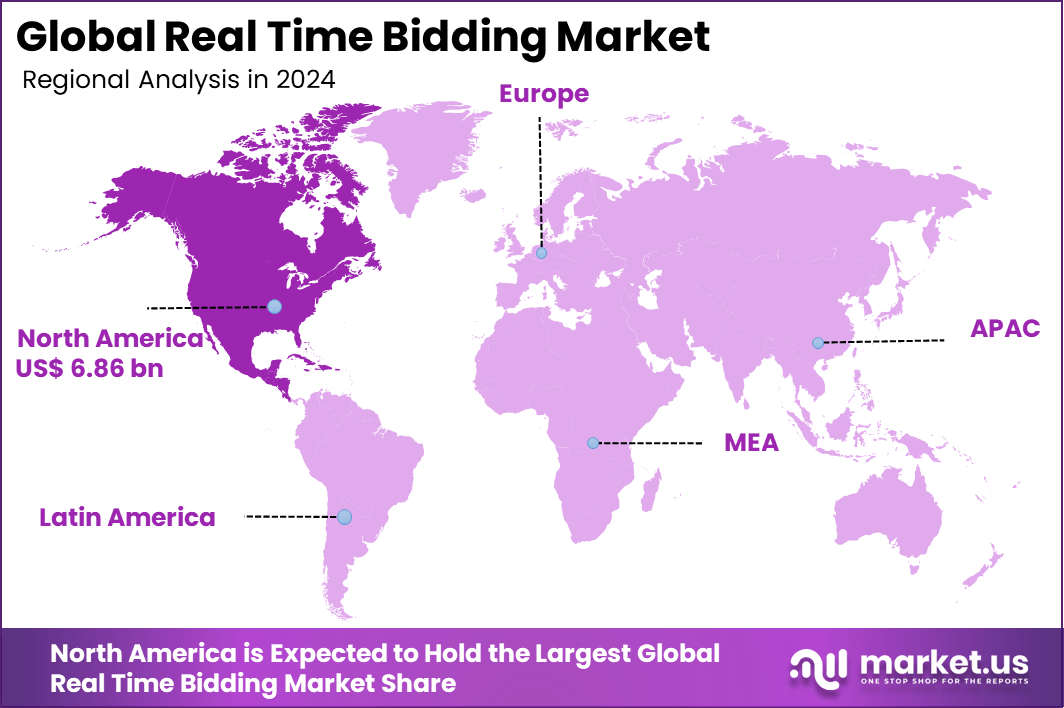
The Global Real-Time Bidding Market size is expected to be worth around USD 119.51 billion by 2034, from USD 18.06 billion in 2024, growing at a CAGR of 20.8% during the forecast period from 2025 to 2034. In 2024, North America held a dominant market position, capturing more than a38% share, holding USD 6.86 billion in revenue.
The Real-Time Bidding (RTB) market revolves around a dynamic digital advertising technology that allows advertisers to buy and sell ad impressions through automated auctions that happen within milliseconds. When a user visits a website or app, an auction occurs in real time where marketers bid for the opportunity to display their ad to that specific user, based on data such as demographics, interests, and browsing behavior.
Key Takeaways
- By auction type, Open Auction dominated with a 76% share, reflecting its broad accessibility and widespread use among advertisers seeking large audience reach.
- Video advertising led by format with 58%, driven by rising demand for engaging, high-impact ad creatives across streaming platforms and social media.
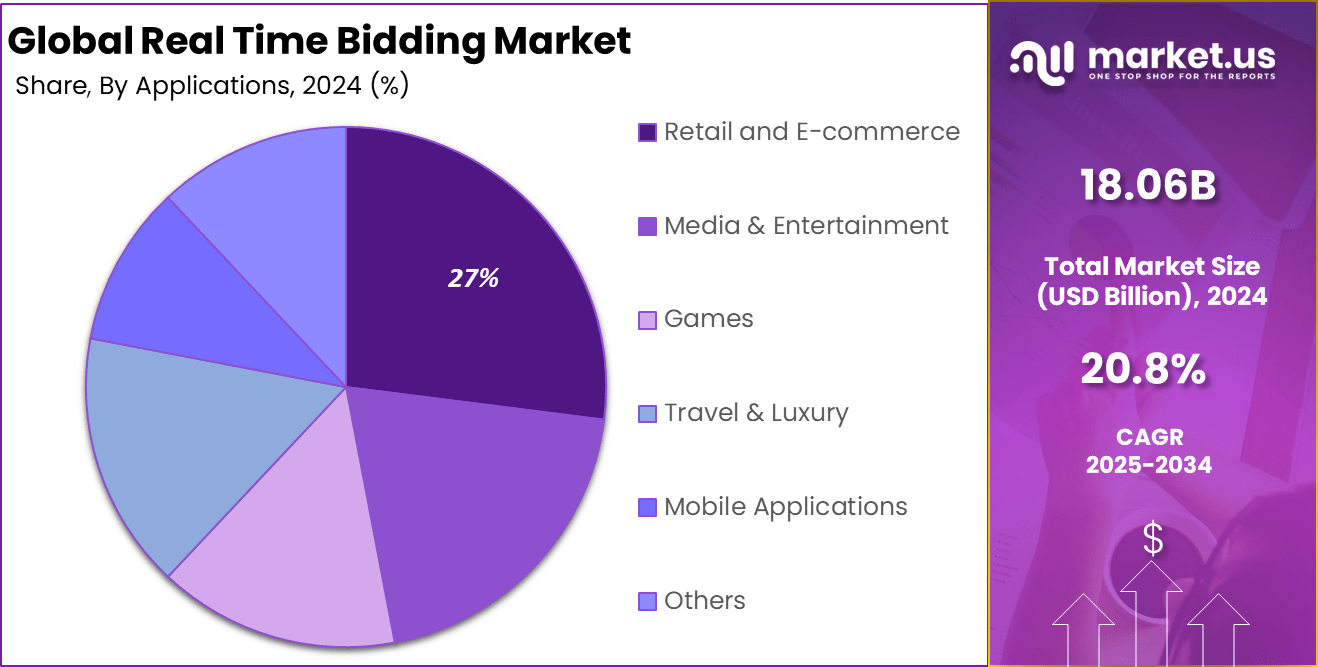
- The Retail & E-commerce sector accounted for 27% of RTB applications, leveraging targeted ads to boost conversions and customer acquisition.
- Mobile devices held a commanding 65% share, underscoring the dominance of mobile-first advertising strategies and in-app programmatic campaigns.
- North America captured 38% of the global market, supported by mature ad-tech ecosystems and high advertiser spend.
- The U.S. market was valued at USD 6.5 billion in 2024 and is expected to grow at a strong CAGR of 18.3%, driven by increasing adoption of AI-powered ad targeting and dynamic bidding strategies.
Market Size and Growth
| Key Factors | Description |
|---|---|
| Increasing Adoption of Programmatic Advertising | Automated, data-driven ad placement growing preferred over traditional buying for efficiency and scale |
| Expansion of Mobile and Video Advertising | Rising video content consumption and mobile device usage fuel RTB demand across channels and formats |
| Connected TV (CTV) Advertising Growth | Major streaming platforms incorporate RTB for premium inventory, offering advertisers scale and precision |
| Rise of E-commerce and Digital Consumerism | Online shopping triggers greater advertising spend and dynamic ad placements via real-time auctions |
| Advances in AI & Data Analytics | AI-powered personalization, predictive analytics, and machine learning optimize targeting and budgeting |
Key Trends and Innovations
| Trend/Innovation | Description |
|---|---|
| Increasing Contextual & Cookieless Targeting | Responding to privacy regulations, advertisers focus on context-based ads combined with AI for effective reach |
| First-Price Auctions and Header Bidding | Shift from second-price to first-price auctions and server-side header bidding improves transparency and revenues |
| Integration with Multi-Channel Marketing | Unified auctions and cross-device targeting enhance campaign consistency on mobile, desktop, CTV, and DOOH |
| AI and Machine Learning Enhancements | Reinforcement learning, advanced predictive models, and real-time campaign tuning become standard features |
| Emphasis on Brand Safety & Fraud Prevention | Adoption of sophisticated AI tools to mitigate ad fraud, ensuring safer, more reliable advertising environments |
Key Market Segments
By Auction Type
- Open Auction
- Invitation Auction
By Advertisement Format
- Video
- Image
By Application
- Retail and E-commerce
- Media & Entertainment
- Games
- Travel & Luxury
- Mobile Applications
- Others
By Device
- Mobile
- Desktop
- Others
Drivers
Increasing Digital Ad Spend
A pronounced shift in marketing budgets from traditional media to digital advertisement underpins the growth of RTB. This trend is further accelerated by the expanding user base across mobile and connected devices, which is fueling increased investment in programmatic advertising and real-time bidding technologies.
The enhanced targeting capabilities and automation efficiencies of Real-Time Bidding are positioning it as a core mechanism for advertisers aiming to optimize reach and engagement in an increasingly digital-first environment.
According to the TAM AdEx Digital Advertising Report 2024, RTB made up 36% of India’s programmatic ad insertions, with mobile devices leading delivery at 71%, followed by desktops at 22%. E-commerce accounted for 22% of RTB usage, with media and entertainment close behind at 19%.
Restraint
Data privacy concerns and regulatory complexities
The RTB market faces challenges primarily rooted in data privacy concerns and regulatory complexities. The reduction in third-party cookies and stricter privacy regulations like GDPR and CCPA complicate user data collection and targeting accuracy, impacting advertiser confidence and operational practices.
Ad fraud remains a persistent issue, with fraudulent clicks, impressions, and invalid traffic leading to wasted advertising budgets and undermining trust in RTB platforms. Ensuring ad inventory quality and brand safety in a fast-moving auction environment also presents hurdles, as advertisers seek control over where their ads appear.
Additionally, high implementation costs for sophisticated RTB platforms, integration complexities with legacy systems, and the need for skilled personnel to manage real-time data-driven bidding processes can restrain adoption, especially among smaller players. Increased competition among RTB providers drives a need for continual innovation to maintain differentiation and profitability.
Opportunities
Cross-Device and Omnichannel Integration
Real-time bidding platforms that successfully integrate cross-device tracking and expand into omnichannel environments, including OTT (over-the-top), CTV (connected TV), and audio advertising, can offer advertisers a unified and comprehensive view of consumer engagement. This integration enables holistic campaign management and improved attribution, thereby enhancing return on investment and driving more effective media spending across diverse digital touchpoints.
For instance, in June 2024, Madhive, a leading technology provider for local Connected TV (CTV) advertising, announced the acquisition of Frequence, a platform specializing in omnichannel advertising automation, as reported by Business Wire.
This strategic move enables Madhive to integrate Real-Time Bidding (RTB) capabilities across a broader range of media channels, delivering full-service, end-to-end advertising solutions to enterprise and agency clients. The combined offering enhances local media market access, enabling more precise audience targeting and campaign optimization through unified, programmatic infrastructure.
Challenges
Persistent Ad Fraud
Despite advances in fraud detection and verification technologies, ad fraud remains a persistent and costly issue within the real-time bidding ecosystem. Malicious activities such as fraudulent traffic, bot-driven impressions, and invalid clicks erode advertiser budgets, with billions lost annually.
Combatting this requires a continued adoption of industry standards and transparency tools like ads.txt and sellers.json, aimed at validating inventory quality and ensuring that only legitimate ad impressions are transacted. Maintaining trust and inventory integrity remains a critical challenge for the long-term sustainability of real-time bidding markets.
For instance, in April 2025, a recent analysis by MarTech Cube sheds light on the growing challenge of mobile ad fraud within the MarTech industry, particularly in environments driven by Real-Time Bidding (RTB). The report highlights that fraudsters exploit RTB’s automated and rapid-fire nature to deploy tactics such as spoofed traffic, click injection, and app install fraud, significantly inflating marketing costs and undermining campaign integrity.
Regional Highlights: A Global Perspective
APAC Real Time Bidding Market Trends
The Asia Pacific region is emerging as the fastest-growing market for real-time bidding (RTB), driven by massive smartphone penetration, expanding digital advertising budgets, and a booming e-commerce sector. Countries like China, India, and Southeast Asia are at the forefront, with advertisers leveraging mobile-first strategies and programmatic advertising to reach large, digitally savvy audiences.
Europe Real Time Bidding Market Trends
Europe holds a significant share of the global RTB market and is characterized by steady growth marked by strong emphasis on user privacy and data compliance, especially under GDPR regulations. The market here is evolving with a focus on precision targeting, transparency, and mobile-first advertising strategies. Advertisers increasingly adopt RTB to enhance campaign effectiveness while adhering to strict data protection laws.
Latin America Real Time Bidding Market Trends
Latin America is gaining momentum in the RTB space, with key markets such as Brazil and Mexico leading adoption. The region’s rising internet penetration and mobile commerce activities are boosting the digital advertising ecosystem. Data-driven advertising is increasingly embraced, helping marketers optimize real-time ad placements and audience targeting. Latin America, though still emerging, offers strong RTB growth potential as digital infrastructure expands and brand investment in programmatic rises.
Middle East & Africa Real Time Bidding Market Trends
The Middle East and Africa region is witnessing dynamic changes in the RTB market with increasing investments in digital infrastructure and programmatic advertising solutions. The rise in social media usage and mobile content consumption is creating fertile ground for real-time bidding expansion. Advertisers in this region are becoming more tech-savvy, adopting data-driven approaches to improve ad efficiency and targeting precision.
Key Regions and Countries
- North America
- US
- Canada
- Europe
- Germany
- France
- The UK
- Spain
- Italy
- Russia
- Netherlands
- Rest of Europe
- Asia Pacific
- China
- Japan
- South Korea
- India
- Australia
- Singapore
- Thailand
- Vietnam
- Rest of APAC
- Latin America
- Brazil
- Mexico
- Rest of Latin America
- Middle East & Africa
- South Africa
- Saudi Arabia
- UAE
- Rest of MEA
Key Players Analysis
Leading technology companies such as Adobe Inc., Google LLC, and Facebook Inc. play a significant role in shaping the Real Time Bidding (RTB) market. Their advanced programmatic advertising platforms, extensive data ecosystems, and AI-driven targeting capabilities enable advertisers to achieve higher precision and ROI.
Prominent demand-side and supply-side platform providers, including AppNexus Inc., Criteo SA, and MediaMath, Inc., are instrumental in facilitating automated, data-driven ad transactions. These companies focus on improving transparency, fraud prevention, and cross-device targeting to optimize advertiser spending. Their partnerships with publishers, agencies, and data providers strengthen their market presence.
Specialized ad tech firms such as PubMatic, Inc., The Rubicon Project, Inc., and Smaato, Inc. contribute to expanding RTB adoption across mobile, video, and in-app advertising. They emphasize efficient monetization strategies, real-time inventory optimization, and robust programmatic infrastructure for publishers.
Top Key Players in the Market
- Adobe Inc.
- AppNexus Inc.
- Criteo SA
- Facebook Inc.
- Google LLC
- Match2One AB
- MediaMath, Inc.
- MoPub/ Twitter, Inc.
- PubMatic, Inc.
- Salesforce.com, inc.
- Smaato, Inc.
- The Rubicon Project, Inc.
- Verizon Media
- WPP plc
- Yandex Europe AG
- Others
Recent Developments
- In January 2025, Disney integrated RTB into its live sports advertising inventory through partnerships with Google, The Trade Desk, and Yahoo, enabling real-time bidding for premium ad slots on ESPN+ and other streaming platforms. This allows advertisers to achieve precise targeting and optimized reach during live broadcasts.
- In May 2025, mobile app developers embraced white-label RTB solutions to take direct control of their programmatic infrastructure, customizing demand sources, pricing, and data usage. This shift enhances yield, transparency, and alignment between ad delivery and user experience objectives.
- In April 2024, SpotX enhanced its server-to-server bidding product, enabling media owners to integrate yield management strategies with third-party header bidders. The upgraded suite, built on SpotX’s cloud-based ad serving technology, now offers both server-side and client-side header bidding capabilities.

- 蓝茶市场(2026—2031)
0评论2026-09-15

- 泡沫材料市场(2026—2031)
0评论2026-09-15

- 重铬酸钠市场(2026—2031)
0评论2026-09-15

- 家族性淀粉样多发性神经病(FAP)市场(2026—2031)
0评论2026-09-15

- 次氯酸钙市场(2026—2031)
0评论2026-09-15

- 海上储能市场(2026—2031)
0评论2026-09-12

- 混凝土市场(2026—2031)
0评论2026-09-12

- 矫形器械市场(2026—2031)
0评论2026-09-12

- 木质素基树脂市场(2026—2031)
0评论2026-09-12

- 聚碳酸酯二元醇市场(2026—2031)
0评论2026-09-12