


Report Overview
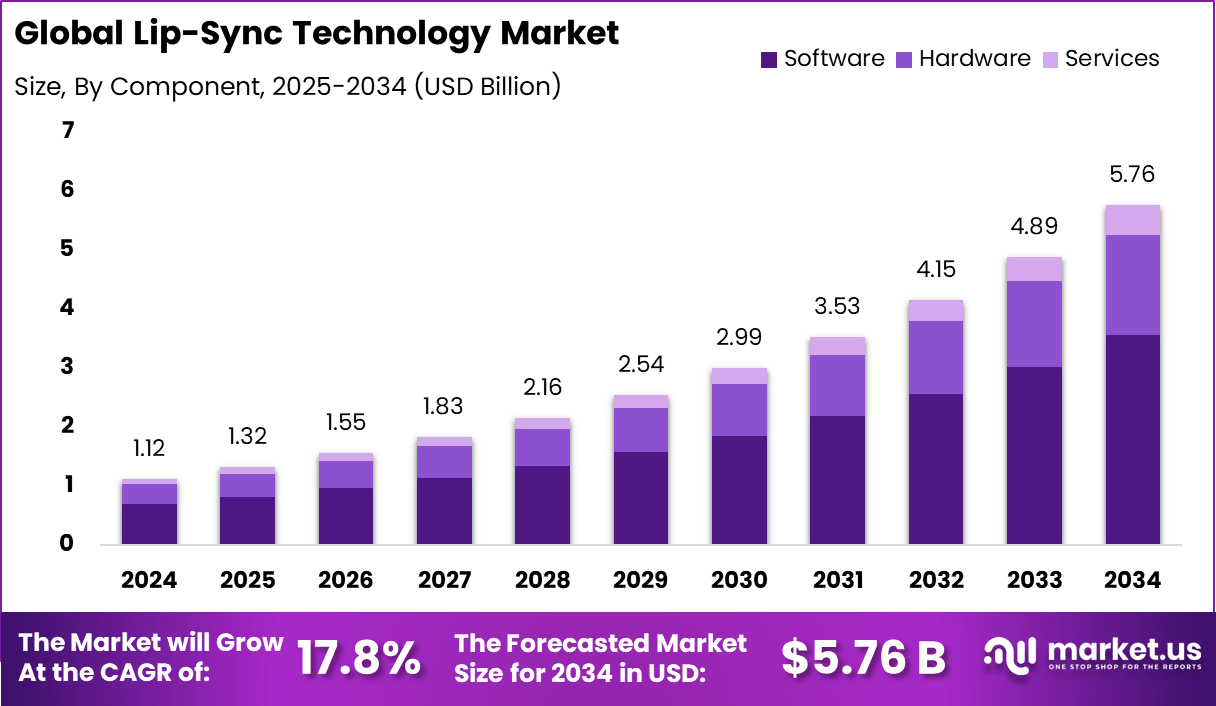
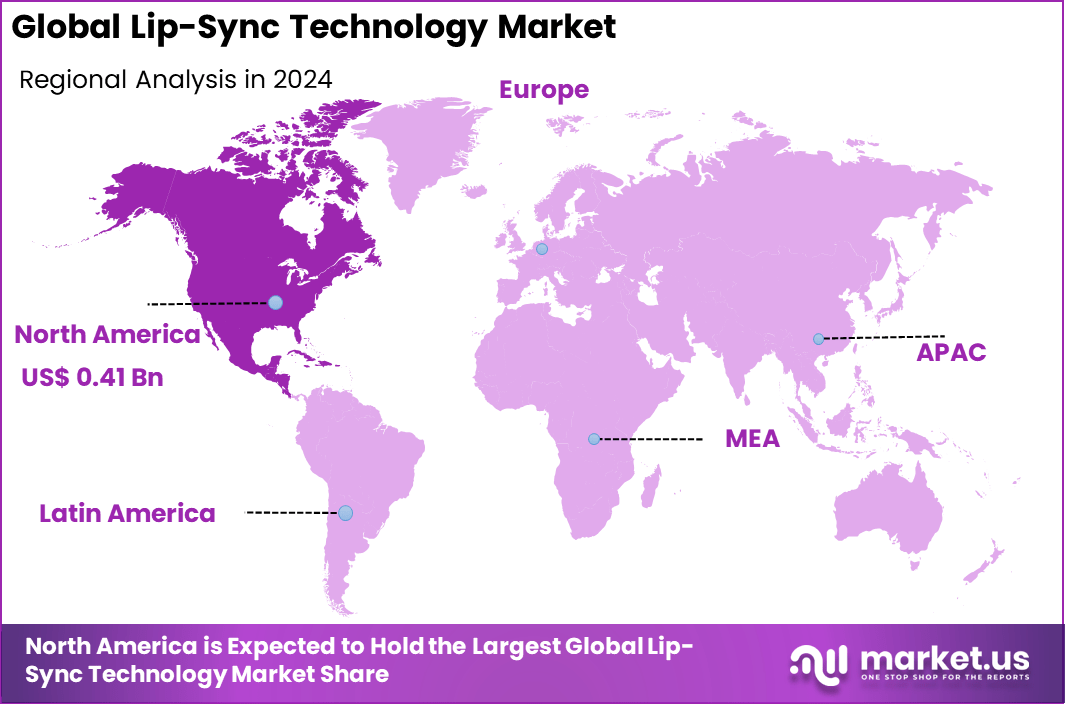
The Global Lip-Sync Technology Market size is expected to be worth around USD 5.76 billion by 2034, from USD 1.12 billion in 2024, growing at a CAGR of 17.8% during the forecast period from 2025 to 2034. In 2024, North America held a dominant market position, capturing more than a 37.3% share, holding USD 0.42 billion in revenue.
The Lip-Sync Technology Market refers to the deployment of systems that synchronize mouth movements with spoken audio in applications such as animation, dubbing, virtual avatars, and real-time translation. These technologies have progressed from rule-based alignment to advanced machine learning frameworks including generative adversarial networks and models like Wav2Lip that deliver high accuracy across different facial conditions and languages.
A major driver is the growing demand for immersive digital content across entertainment, gaming, virtual reality, and multilingual communications. The need to reduce manual effort and improve realism has led to wider adoption of AI-based lip-sync solutions. GAN-driven models and neural synthesis have played a critical role in enhancing both speed and visual fidelity.
Based on data from akool, platforms such as TikTok have experienced up to a 45% rise in user engagement when lip-sync features are used in content. Around 70% of new lip-sync applications launched in 2023 integrated AI and machine learning to enhance synchronization accuracy and shorten production timelines. Additionally, more than 60% of animated films and series released in 2023 employed advanced lip-sync technologies to deliver seamlessly synchronized character dialogues.
Key Takeaways
- The global market is valued at USD 1.12 billion in 2024 and is projected to grow at a CAGR of 17.8% from 2025 to 2034, indicating strong adoption potential across industries.
- Software dominates the component segment with 61.5% share, reflecting the heavy reliance on AI-driven algorithms and real-time rendering tools over hardware or service-based offerings.
- Audio-Driven Machine Learning (AI-Based) is the leading technology with 40.7% share, driven by advances in deep learning models enabling high accuracy and natural lip movements.
- Cloud-based deployment leads with 56.3% share, highlighting the demand for scalable, on-demand processing and easier integration for remote and collaborative workflows.
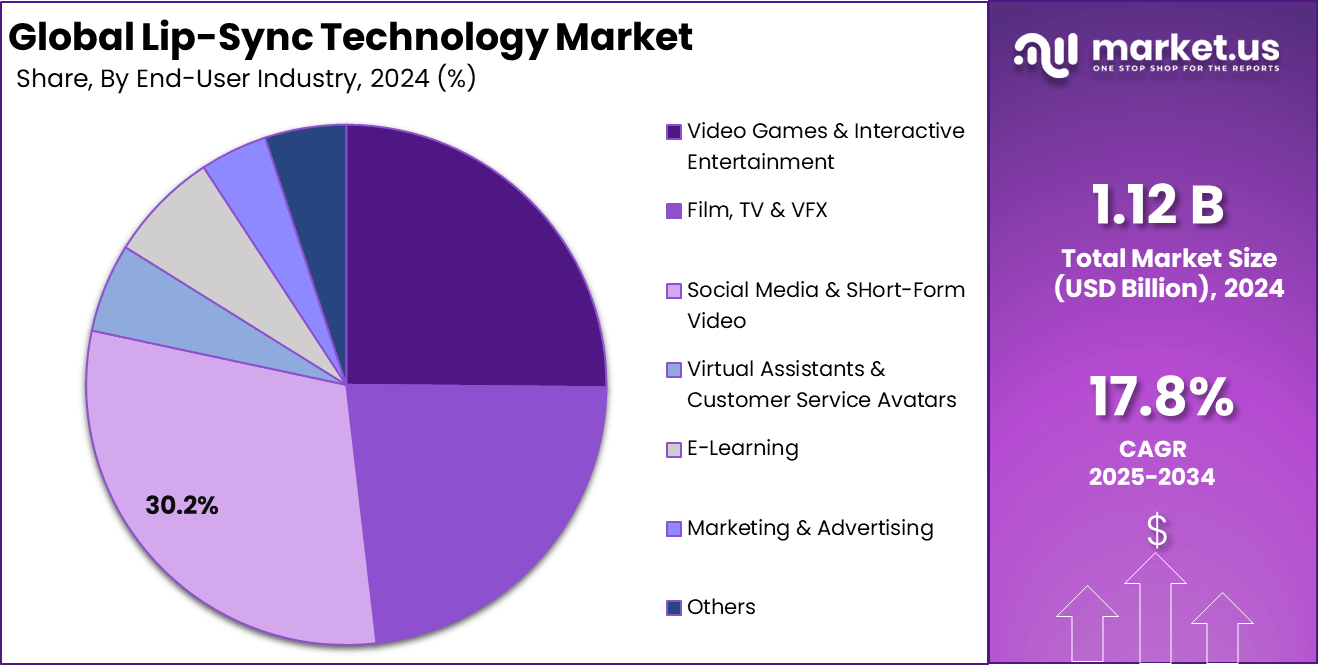
- Social Media & Short-Form Video is the top end-user industry with 30.2% share, fueled by platforms like TikTok, Instagram Reels, and YouTube Shorts leveraging AI lip-sync for user-generated and influencer content.
- North America holds the largest regional share at 37.3%, supported by early technology adoption, a strong entertainment sector, and a mature AI ecosystem.
- The United States alone accounts for USD 0.39 billion in 2024, growing at a CAGR of 15.5%, showcasing a robust domestic market with applications in entertainment, marketing, and virtual assistants.
Market Size and Growth
| Key Factors | Description |
|---|---|
| Streaming Content Boom | Rising demand for high-quality, multilingual streaming content |
| AI Media Production Investment | Increased funding in AI tools to reduce costs and improve dubbing efficiency |
| Multilingual Accessibility | Need for localized content to reach regional markets |
| Rise in Animated & Avatar Content | Demand for realistic character lipsyncs in gaming, metaverse, social media |
| Real-Time Integration | Technological progress enabling live streaming and broadcast lip sync |
Trends and Innovations
| Trend/Innovation | Description |
|---|---|
| Real-Time Lip Sync | AI enables live video and broadcast synchronization |
| VR/AR Content Integration | Lip sync tech being adopted in immersive experiences |
| Multi-Language AI Dubbing | Supports 90+ languages with cultural nuances |
| Lip Sync + Face Swap Pipelines | Combined workflows for automated, flexible content creation |
| Developer APIs & Toolkits | Platforms releasing APIs for quick integration in apps and creative tools |
Key Market Segments
By Component
- Software
- Hardware
- Services
By Technology
- Viseme/Phoneme Mapping
- Audio-Driven Machine Learning (AI-Based)
- Performance Capture
- Hybrid Systems
- Others
By Deployment Mode
- Cloud-Based
- On-Premises
By End-User Industry
- Video Games & Interactive Entertainment
- Film, TV & VFX
- Social Media & Short-Form Video
- Virtual Assistants & Customer Service Avatars
- E-Learning
- Marketing & Advertising
- Others
Driving Factor
The primary drivers of the lip-sync technology market include the rapid growth of streaming platforms and the global demand for localized and multilingual content. As international content consumption rises, there is an increasing need for automated, efficient lip sync dubbing solutions that maintain audio-visual harmony across diverse languages.
Technological innovations such as generative adversarial networks (GANs) and diffusion models improve synchronization precision, attracting professionals in video production, marketing, and social media. The rise of AI-powered virtual influencers and digital humans also fuels demand, as these require natural lip movements for authentic audience engagement.
Furthermore, content creators and businesses seek tools that reduce production costs and time, enhancing creative flexibility and scalability. The expansion of AI lip-reading applications in healthcare, security, and accessibility contributes to related market growth, highlighting the technology’s broadening impact.
Restraining Factor
Challenges restraining the market include high development and implementation costs, particularly for startups and smaller creators who may lack access to advanced AI tools. Ensuring perfect lip sync across various face types, lighting conditions, and languages remains technically complex.
Data privacy and ethical concerns arise due to the extensive use of facial data and synthetic media, necessitating regulatory compliance and user trust building. Additionally, the market faces competition from traditional subtitling and voice-over methods, which, despite being less immersive, can be more cost-effective for certain projects.
Skill gaps in operating sophisticated lip-sync software and integrating it into existing workflows can slow adoption among some industry segments. Lastly, the need to balance automation with human creativity presents ongoing challenges in achieving naturalistic results.
Growth Opportunity
There are substantial opportunities to expand lip-sync technology applications across diverse sectors. The gaming industry, virtual reality (VR), and augmented reality (AR) offer fertile ground for immersive lip-synced character interactions. AI lip sync also supports the growing creator economy by enabling accessible content localization and personalized storytelling.
Emerging markets, particularly in Asia-Pacific and Latin America, are poised for rapid adoption driven by rising digital media consumption and entertainment industry growth. Advances in real-time lip-sync solutions can open new avenues in live streaming, virtual meetings, and interactive education.
Partnerships between tech firms and content producers to develop integrated tools combining lip sync with facial expression and emotion tracking will further enhance user experience. Environmental sustainability gains come from reducing re-shoots and post-production resources, aligning with broader industry goals.
Challenge Analysis
The lip-sync technology market must navigate key challenges including maintaining accuracy and realism while scaling for high-volume content production. Addressing ethical concerns related to the creation and misuse of deepfake-style media is crucial to ensuring responsible technology deployment.
Integrating lip sync solutions smoothly with various video platforms and editing software requires ongoing technical innovation. The fragmentation of tools and varying quality levels among providers complicate standardization and user decision-making. Market players also face pressure to continuously innovate amid fast technological evolution and rising user expectations.
Regulations around AI-generated media, intellectual property rights, and cross-border data flows present compliance complexities. Successful companies will need to balance automation with creative control, security, and transparency to sustain growth and trust in this dynamic market.
Key Player Analysis
In the Lip-Sync Technology Market, Sync.so, Vozo AI, and Gooey AI are recognized for their advanced AI-driven solutions that enable realistic mouth movement and speech alignment. These companies focus on precision in animation, catering to content creators, gaming studios, and virtual production houses. Heygen and 1 More Shot have strengthened their market position by integrating real-time rendering and multilingual capabilities.
OmniHuman, Lipdub AI, and Magic Hour AI, Inc. are making significant advancements in virtual human creation, combining lip-sync capabilities with advanced facial animation tools. Akool, Everypixel Labs, and Rask AI are leveraging machine learning models to improve synchronization accuracy and adapt to various languages and accents.
Lipsync.video, Perso AI, and Convai Technologies Inc. are gaining attention for their scalable solutions tailored for streaming platforms and social media integration. Reallusion Inc. (iClone) and Mango AI have established strong user bases in animation and 3D modeling communities, offering professional-grade customization tools. Other key players are focusing on expanding their technology portfolios through R&D and strategic partnerships.
Top Key Players in the Lip-Sync Technology Market
- Sync.so
- Vozo AI
- Gooey AI
- Heygen
- 1 More Shot
- OmniHuman
- Lipdub AI
- Magic Hour AI, Inc.
- Akool
- Everypixel Labs
- Rask AI
- Lipsync.video
- Perso AI
- Convai Technologies Inc.
- Reallusion Inc. (iClone)
- Mango AI
- Other Key Players
Recent Developments
- April 2025: Tavus, backed by Sequoia, launched Hummingbird-0, a zero-shot lip sync model enabling instant, high-quality video-audio synchronization without training. Designed for localization, personalization, and content repurposing, it outperforms competitors in visual quality, accuracy, and identity preservation, streamlining creative workflows for developers and content creators.
- August 2024: Israel-based AI startup D-ID launched Video Translate, a tool that translates videos, clones the speaker’s voice, and syncs lip movements. Offered free to subscribers, it enables creators to produce multilingual content quickly for impactful global campaigns.
- November 2024: Panjaya.ai, founded by former Apple TV and Vimeo executives, launched BodyTalk, an AI video translation platform delivering natural lip-sync, speech, and gestures. Trusted by TED and JFrog, it boosts engagement with culturally authentic multilingual content, backed by $9.5M funding for global expansion.

- 蓝茶市场(2026—2031)
0评论2026-09-15

- 泡沫材料市场(2026—2031)
0评论2026-09-15

- 重铬酸钠市场(2026—2031)
0评论2026-09-15

- 家族性淀粉样多发性神经病(FAP)市场(2026—2031)
0评论2026-09-15

- 次氯酸钙市场(2026—2031)
0评论2026-09-15

- 海上储能市场(2026—2031)
0评论2026-09-12

- 混凝土市场(2026—2031)
0评论2026-09-12

- 矫形器械市场(2026—2031)
0评论2026-09-12

- 木质素基树脂市场(2026—2031)
0评论2026-09-12

- 聚碳酸酯二元醇市场(2026—2031)
0评论2026-09-12