


Report Overview
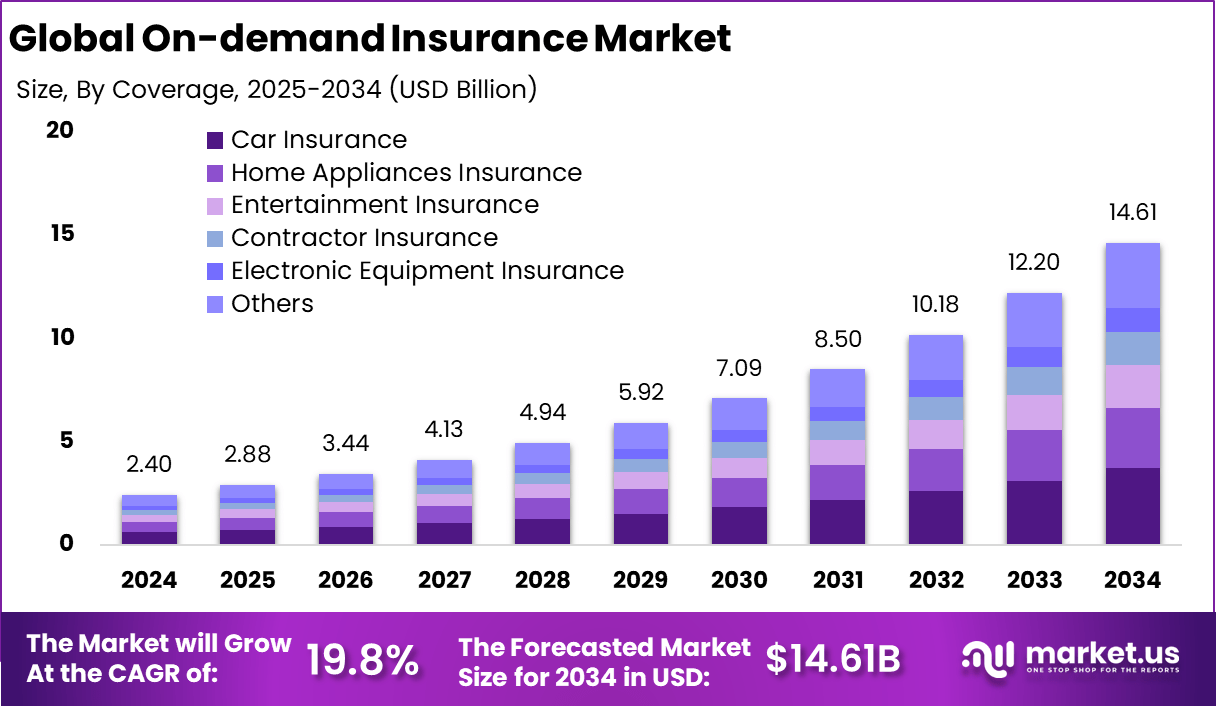
The Global On-demand Insurance Market size is expected to be worth around USD 14.61 Billion By 2034, from USD 2.40 billion in 2024, growing at a CAGR of 19.8% during the forecast period from 2025 to 2034. In 2024, North America held a dominan market position, capturing more than a 31.2% share, holding USD 0.7 Billion revenue.
The On‑Demand Insurance Market is defined by coverage that may be activated by users precisely when it is needed, often via mobile applications or digital platforms, rather than through continuous, long-term policies. It is commonly applied to sectors such as travel, personal belongings, short-term vehicle use, and event-specific scenarios. In its essence, this model offers episodic protection tailored to user activity and risk exposure.
Based on data from forbes, In 2024, total premiums paid for individual life insurance in the U.S. reached $16.2 billion, marking a historic peak and the fourth consecutive annual record, according to LIMRA. Policy volumes remained largely unchanged from 2023, suggesting that the increase in premium value, rather than the number of policies, drove growth.
Data from the American Council of Life Insurers (ACLI) indicates that 134,193,000 individual life insurance policies were in force in 2023, alongside more than 118,000,000 group life insurance policies. This strong dual presence underscores the widespread reliance on both personal and employer-sponsored coverage, reinforcing life insurance as a central pillar of long-term financial planning in the U.S.
Strategic Insights
- By coverage type, Car Insurance led the market with a 25.5% share, supported by rising demand for flexible, usage-based policies catering to short-term and infrequent drivers.
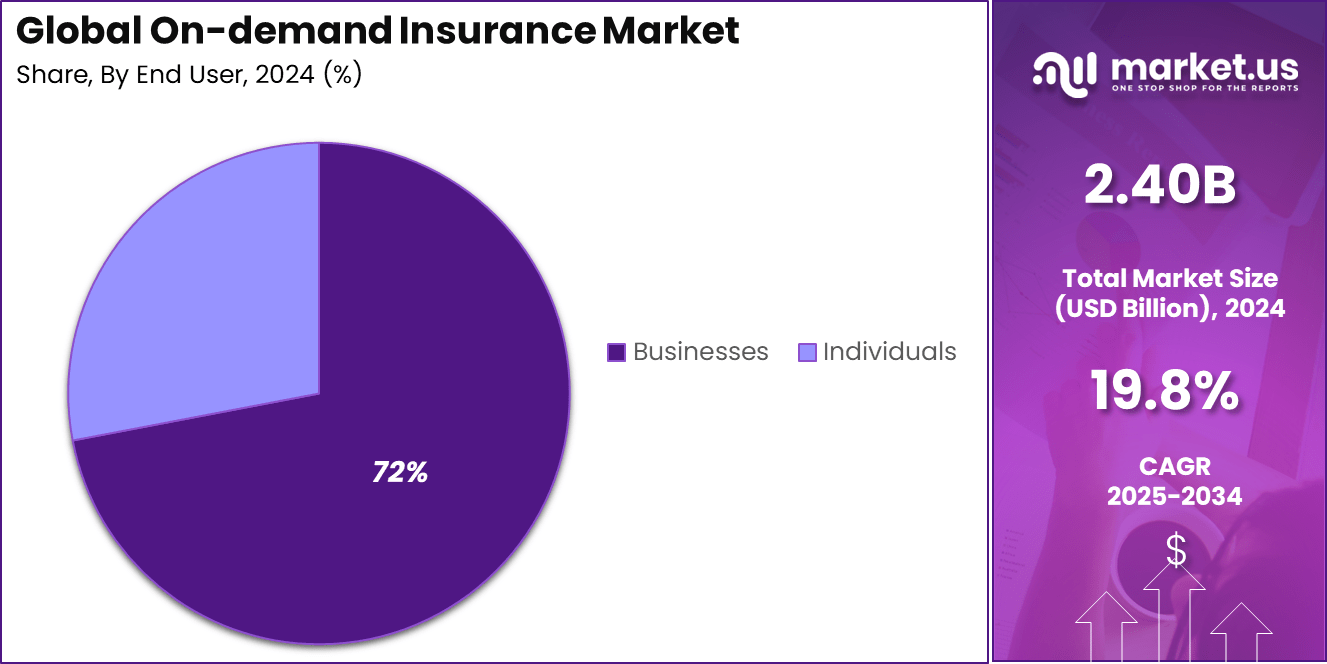
- By end-user, Businesses dominated with a 72.0% share, reflecting the strong uptake among fleet operators, mobility services, and enterprises seeking scalable insurance models.
- The U.S. market was valued at USD 0.3 billion in 2024 and is projected to grow at a robust CAGR of 26.9%, driven by the expansion of gig economy platforms, rental services, and digital insurance adoption.
- North America held a 31.2% global share, supported by advanced insurtech ecosystems, regulatory flexibility, and high smartphone penetration enabling instant policy access.
Market Size and Growth

| Growth Factor | Description |
|---|---|
| Digital Transformation & Mobile-first | Increased smartphone use and digital ecosystems propel easy access to on-demand policies |
| Gig Economy Expansion | More contractors/freelancers demand episodic, flexible coverage |
| Personalization Expectations | Consumers favor insurance tailored to their usage, needs, and events |
| Embedded & Embedded Insurance Channels | Seamless insurance embedded in travel, auto rentals, e-commerce, and fintech apps |
| Regulatory Support & Sandboxes | Sandbox initiatives and flexible regulations foster digital innovation |
Key Trends & Innovations
| Trend/Innovation | Description |
|---|---|
| Micro-duration/Micro-coverage Policies | Policies for hours/days/projects, or for single devices/trips, increasing flexibility |
| Usage-based and Telematics Insurance | Pay-as-you-drive, motion-activated auto/motor insurance (ex: Zuno SWITCH app) |
| AI-driven Claims & Underwriting | Automated claim review, risk scoring, and instant payments |
| Embedded Insurance & API Ecosystems | Insurance offered instantly in checkout flows or as part of third-party digital platforms |
| Peer-to-Peer & Group Models | Communities pool risk using digital platforms |
| Growth in APAC & Emerging Markets | Rapid adoption driven by tech, underinsurance, and regulatory innovation |
By Coverage – Car Insurance (25.5%)
In 2024, Car insurance accounts for 25.5% of the on-demand insurance market. This significant share highlights the growing popularity of flexible insurance coverage options for vehicle owners who require protection only when their car is in use, rather than through traditional annual policies. On-demand car insurance makes it convenient for users to activate or deactivate coverage via mobile apps, catering to individuals who drive infrequently or use shared mobility services.
The appeal of on-demand models in car insurance is driven by evolving lifestyles and a shift toward pay-as-you-go solutions that align with actual usage patterns. This approach allows consumers to control insurance costs, easily manage policies, and ensure immediate coverage for temporary driving, rental, or car-sharing needs.
By End-User – Businesses (72.0%)
In 2024, Businesses represent 72.0% of the on-demand insurance market’s end-user segment. Organizations often require flexible insurance products to cover assets, employees, or operations for specific durations, such as during corporate travel, project work, event hosting, or equipment rentals.
On-demand insurance solutions help businesses manage risk more efficiently by providing real-time coverage tailored to short-term or variable needs. The dominance of business adoption is influenced by the demand for cost savings and operational efficiency.
Companies can quickly adapt coverage to changing requirements, avoiding over-insurance and streamlining claims processes, which makes on-demand insurance a preferred choice for modern, agile business operations.
Key Market Segments
By Coverage
- Car Insurance
- Home Appliances Insurance
- Entertainment Insurance
- Contractor Insurance
- Electronic Equipment Insurance
- Others
By End-user
- Individuals
- Businesses
Regional Analysis and Coverage
- North America
- US
- Canada
- Europe
- Germany
- France
- The UK
- Spain
- Italy
- Russia
- Netherlands
- Rest of Europe
- Asia Pacific
- China
- Japan
- South Korea
- India
- Australia
- Singapore
- Thailand
- Vietnam
- Rest of Latin America
- Latin America
- Brazil
- Mexico
- Rest of Latin America
- Middle East & Africa
- South Africa
- Saudi Arabia
- UAE
- Rest of MEA
Driver Analysis
Changing Consumer Behavior and Technology Adoption
One of the primary drivers fueling the growth of on-demand insurance is the evolving behavior of consumers who increasingly prioritize convenience and flexibility. Modern customers, particularly younger generations and gig economy workers, want the option to pay solely for the coverage they actively use, on their own terms.
This demand coincides with the widespread adoption of smartphones and mobile apps, which make it easier than ever to access, activate, and manage insurance policies anytime and anywhere. The ability to receive instant quotes and purchase insurance within moments aligns well with today’s fast-paced lifestyles and preference for on-the-go service.
In addition to consumer expectations, technological advances play a critical role in enabling this model. Artificial intelligence, machine learning, IoT devices, and big data analytics collectively allow insurers to assess risk accurately, automate underwriting, and personalize pricing in real time. These technological capabilities transform insurance from a static product into a dynamic service tailored to actual usage patterns and risk profiles.
Restraint Analysis
Regulatory Complexity and Compliance Challenges
Despite the promising growth and innovation in on-demand insurance, regulatory complexity remains a significant restraint. Insurance is a heavily regulated industry with rules that vary widely by region, jurisdiction, and coverage type. On-demand insurance products, often designed for short durations or specific use cases, do not always fit neatly within existing regulatory frameworks. This creates legal ambiguities and compliance burdens that can slow market entry or increase operational costs for providers.
Moreover, because on-demand insurance relies extensively on data collection and analysis – including sensitive personal information – compliance with data protection laws such as GDPR adds another layer of challenge. Insurers must maintain robust data security measures and ensure transparency to preserve consumer trust.
The evolving nature of these regulations demands constant adaptation, which can be particularly difficult for newer or smaller insurers lacking extensive legal and compliance teams. Consequently, regulatory uncertainty and associated compliance costs pose ongoing hurdles for broader adoption and seamless scaling of on-demand insurance.
Opportunity Analysis
Expansion into Emerging and Underserved Markets
The expanding appetite for on-demand insurance presents a significant opportunity to tap into emerging and underserved markets globally. Large population segments in regions such as Asia-Pacific, Latin America, and Africa remain inadequately protected by traditional insurance models, often due to affordability issues or lack of tailored product offerings.
The flexibility and cost-effectiveness of on-demand insurance, which allows pay-per-use or event-specific coverage, align well with the needs of these markets. This model enables insurers to design products that suit local conditions and consumer behaviors, including micro-insurance or short-term policies accessible via mobile devices.
The use of digital platforms helps overcome distribution challenges common in these regions. By adopting on-demand insurance, providers can foster financial inclusion, extend protection to broader demographics, and open new revenue streams. The consumer shift towards personalized services also enables insurers to innovate niche products such as on-demand travel, pet, or event insurance, capturing specific customer segments more effectively.
Challenge Analysis
Building Consumer Awareness and Trust
A crucial challenge facing the on-demand insurance market is the need to build widespread consumer awareness and trust. Many potential customers remain unfamiliar with how on-demand insurance works or doubt its reliability compared to traditional policies.
Misinformation and lack of understanding can cause hesitation in adopting these newer models, especially among less tech-savvy consumers or those accustomed to conventional insurance purchasing methods. Educating customers about the benefits, flexibility, and security of on-demand insurance is essential to overcome skepticism. Insurers need to simplify policy terms and enhance transparency to foster confidence.
Additionally, protecting consumer data and ensuring smooth claims processes are vital to maintaining trust in a market heavily reliant on digital platforms. Creating strong brand reputation and customer loyalty requires ongoing efforts to demonstrate value and service quality in this relatively novel insurance space.
Competitive Analysis
Slice Insurance Technologies Inc., VSure.life, and Xceedance, Inc. have strengthened their positions in the on-demand insurance market by offering flexible, technology-enabled solutions. These companies focus on digital platforms that enable quick policy issuance, micro-duration coverage, and seamless claims processing. Advanced data analytics and AI-driven risk assessment have been integrated to improve underwriting efficiency.
SkyWatch Insurance Services, Inc., Zuno General Insurance Limited, and JaSure have expanded market reach by introducing niche, usage-based insurance models. These solutions target specific industries such as mobility services, travel, and event-based coverage. By adopting telematics, IoT integration, and real-time risk monitoring, they provide dynamic pricing and enhanced customer engagement.
Thimble, JAUNTIN, Cuvva, Snap-it Cover, and other emerging providers are reshaping competitive dynamics through user-first mobile applications and embedded insurance models. Their emphasis lies in subscription-based plans, instant activation, and cancellation flexibility. These companies also invest in AI-powered chatbots and digital claims assistants to reduce processing times and improve customer satisfaction.
Top Key Players in the Market
- Slice Insurance Technologies Inc.
- VSure.life
- Xceedance, Inc.
- SkyWatch Insurance Services, Inc.
- Zuno General Insurance Limited
- JaSure
- Thimble
- JAUNTIN
- Cuvva
- Snap-it Cover
Recent Developments
- In January 2024, NFP acquired Advanced Insurance Consultants Limited in London, expanding its commercial insurance footprint and capability to offer integrated risk mitigation solutions in key sectors like agriculture and construction.
- In January 2024, Travelers completed its $435 million acquisition of Corvus Insurance, enhancing its cyber underwriting and risk management capabilities to address evolving digital risks. This acquisition highlighted the strategic focus on technology-driven specialized insurance solutions.

- 蓝茶市场(2026—2031)
0评论2026-09-15

- 泡沫材料市场(2026—2031)
0评论2026-09-15

- 重铬酸钠市场(2026—2031)
0评论2026-09-15

- 家族性淀粉样多发性神经病(FAP)市场(2026—2031)
0评论2026-09-15

- 次氯酸钙市场(2026—2031)
0评论2026-09-15

- 海上储能市场(2026—2031)
0评论2026-09-12

- 混凝土市场(2026—2031)
0评论2026-09-12

- 矫形器械市场(2026—2031)
0评论2026-09-12

- 木质素基树脂市场(2026—2031)
0评论2026-09-12

- 聚碳酸酯二元醇市场(2026—2031)
0评论2026-09-12