


Report Overview
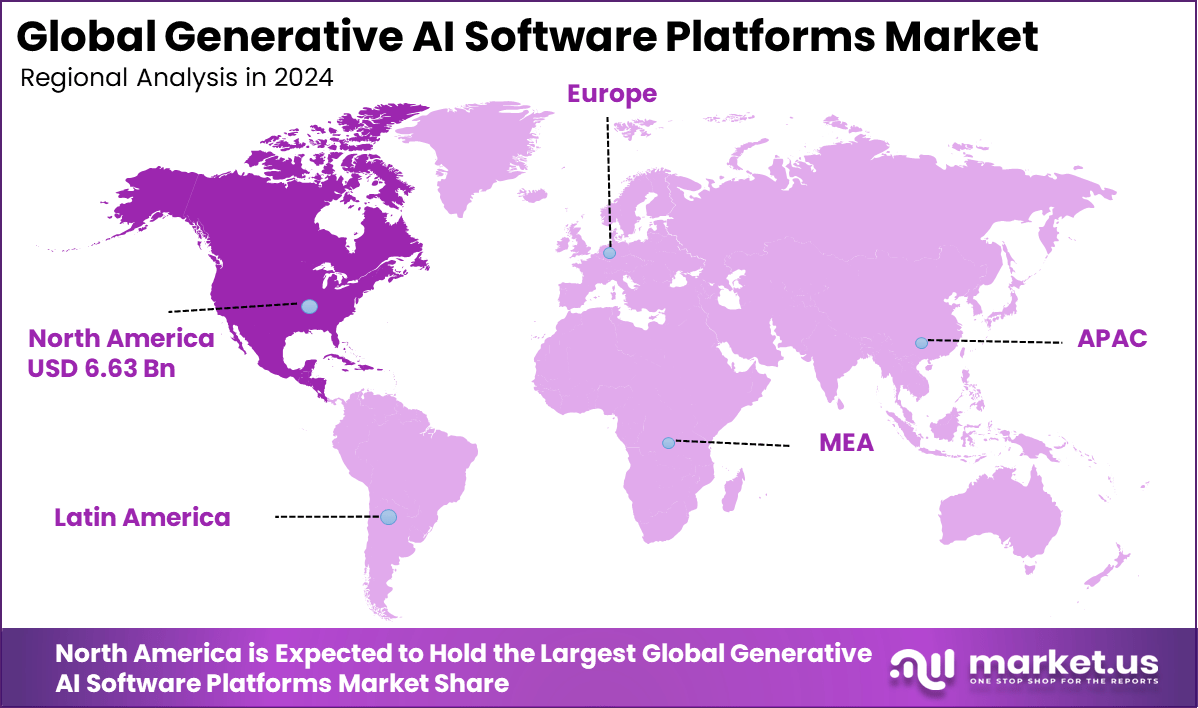
The Global Generative AI Software Platforms Market size is expected to be worth around USD 237.43 billion by 2034, from USD 18.75 billion in 2024, growing at a CAGR of 28.9% during the forecast period from 2025 to 2034. In 2024, North America held a dominant market position, capturing more than a35.4% share, holding USD 6.63 billion in revenue.
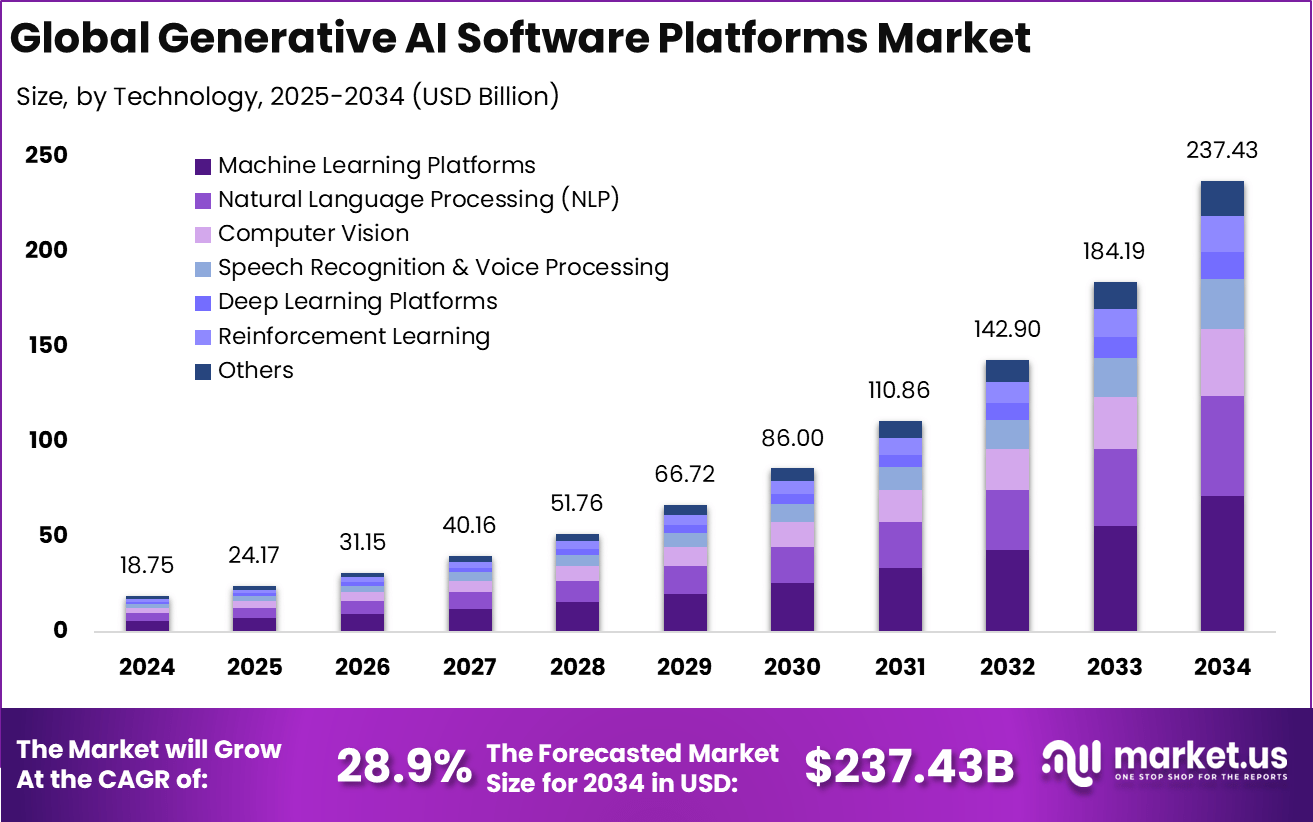
The Generative AI software platforms market is experiencing robust growth as businesses across industries integrate AI-driven content creation, automation, and decision-making capabilities into their core workflows. Generative AI refers to advanced machine learning technology capable of producing original content – including text, images, audio, and video – by learning patterns from existing data.
For instance, in October 2024, Adobe unveiled a range of AI-powered tools at its MAX 2024 conference, further enhancing its Creative Cloud platform. The new tools, which include expanded capabilities for Firefly- Adobe’s generative AI model – aim to streamline creative workflows by enabling faster content generation, image editing, and video production.
Market Size and Growth
| Key Factors | Description |
|---|---|
| Rapid AI Adoption Across Enterprises | Increasing need to automate workflows, enhance creativity, and improve decision-making drives platform integration |
| Advances in Foundation Models and APIs | Development of powerful, large-scale generative models (like GPT-4) and APIs enables scalable deployment and customization |
| Demand for Automation and Hyper-Personalization | Enterprises seek to reduce costs, enhance productivity, and deliver tailored customer experiences |
| Cloud Infrastructure and SaaS Enablement | Cloud computing and SaaS delivery facilitate flexible, scalable, and cost-effective access to generative AI tools |
| Strong Investment and Innovation Ecosystem | Heavy venture capital and developer activity spur rapid innovations and broaden market applications |
Key Trends
| Trend/Innovation | Description |
|---|---|
| Embedded Generative AI in Applications | Generative AI embedded directly into productivity and creative software like Microsoft 365 Copilot and Adobe Firefly to transform workflows and boost user engagement. |
| Multimodal Generation | Support for combined generation of text, images, audio, and video within single platforms, expanding use cases and creativity. |
| Domain-Specific AI Models | Customized generative AI tailored for industries such as finance, healthcare, and retail to address specific sector needs and compliance requirements. |
| Foundation Model Proliferation | Growth in large and small language models enabling scalable deployment in cloud, on-premises, and edge environments. |
| Privacy and Governance Focus | Increased emphasis on data privacy, ethical AI use, transparency, and regulatory compliance integrated into platforms. |
Key Market Segments
By Technology
- Machine Learning Platforms
- Natural Language Processing (NLP)
- Computer Vision
- Speech Recognition & Voice Processing
- Deep Learning Platforms
- Reinforcement Learning
- Others
By Deployment Mode
- Cloud-Based
- On-Premise
By Component
- Solution
- Software Tools & SDKs
- Application Programming Interfaces (APIs)
- Model Training & Deployment Infrastructure
- Data Preparation & Annotation Tools
- Others
- Services
- Professional Services
- Managed Services
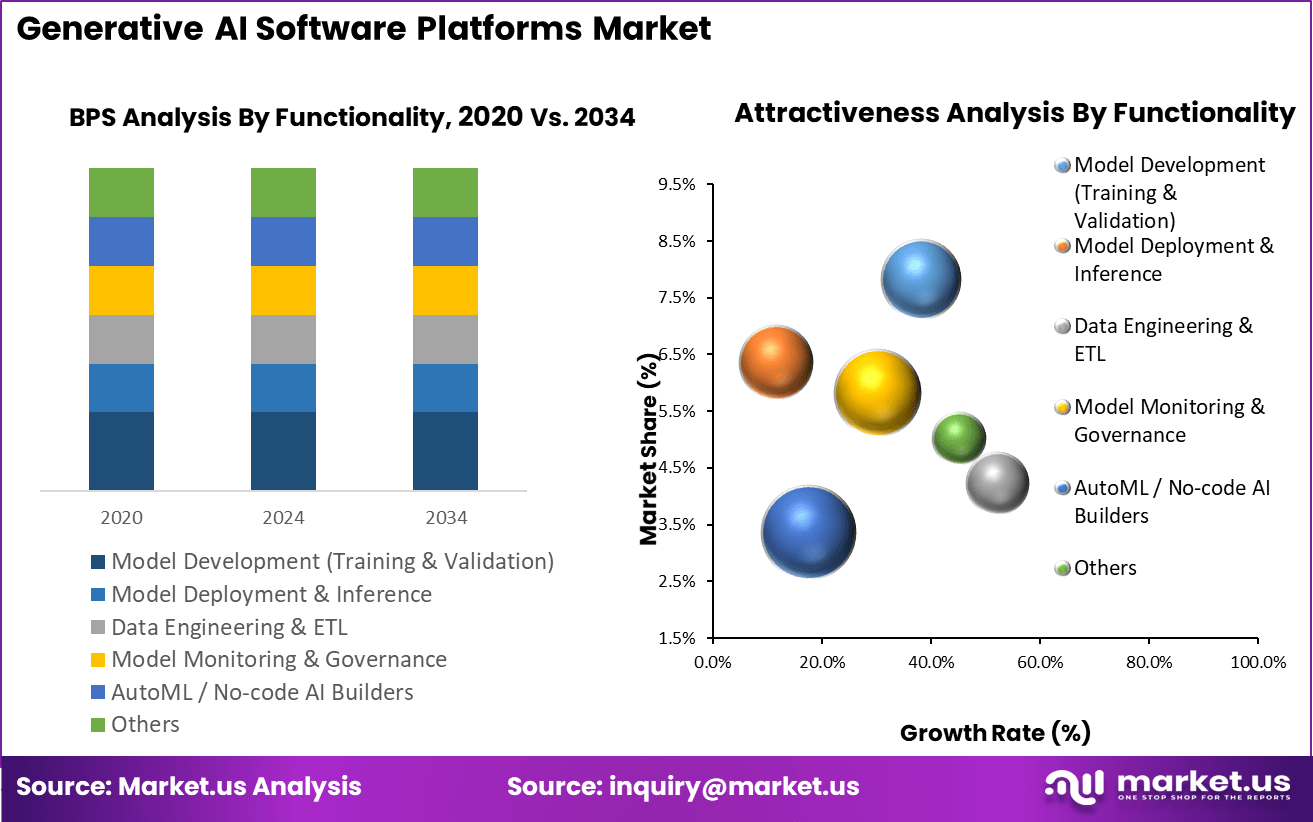
By Functionality
- Model Development (Training & Validation)
- Model Deployment & Inference
- Data Engineering & ETL
- Model Monitoring & Governance
- AutoML / No-code AI Builders
- Others
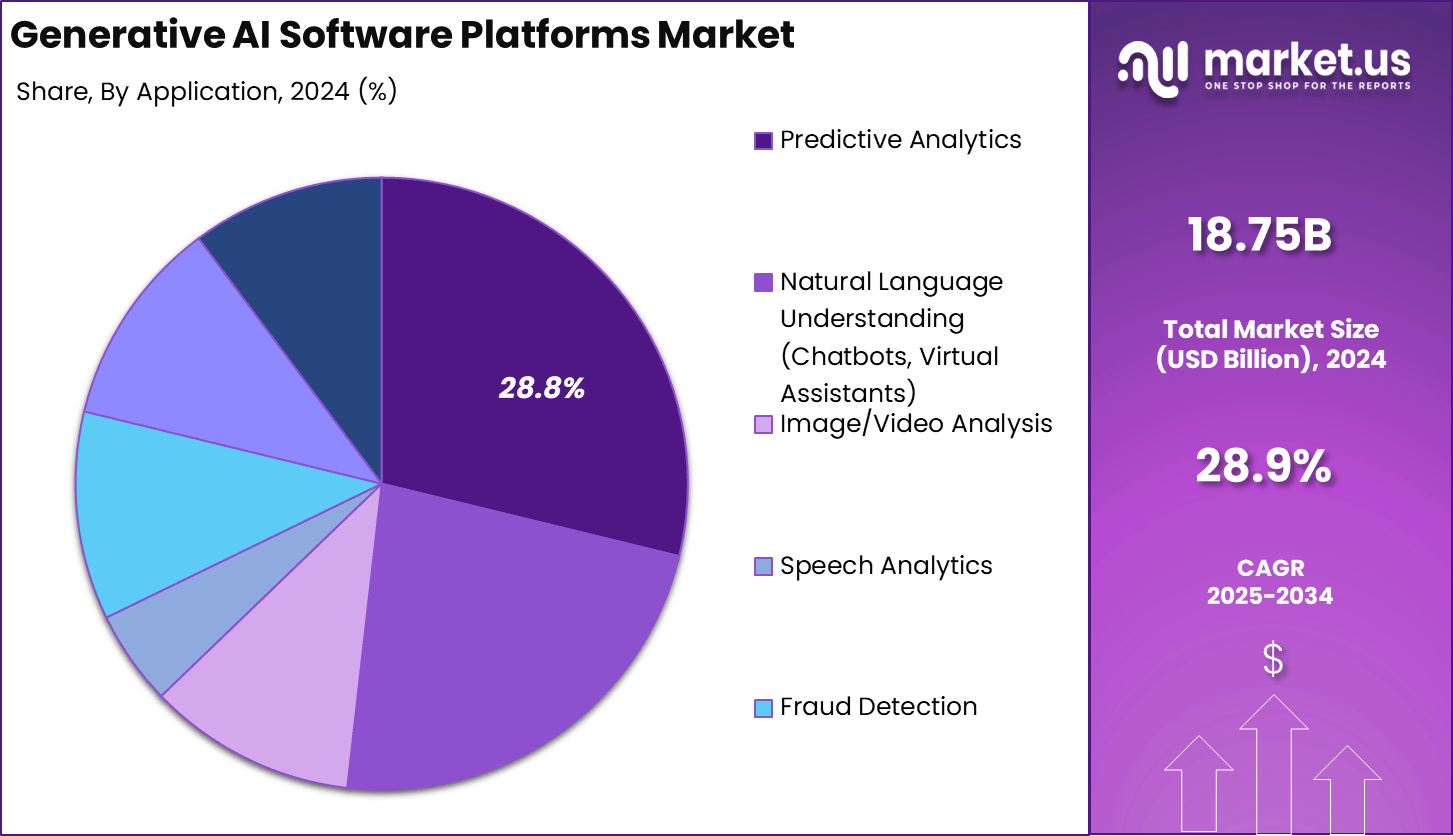
By Application
- Predictive Analytics
- Natural Language Understanding (Chatbots, Virtual Assistants)
- Image/Video Analysis
- Speech Analytics
- Fraud Detection
- Recommendation Engines
- Others
By End Use Industry
- Healthcare & Life Sciences
- Banking, Financial Services & Insurance (BFSI)
- Retail & E-Commerce
- Manufacturing
- Transportation & Logistics
- IT & Telecom
- Media & Entertainment
- Energy & Utilities
- Government & Defense
- Others
By Enterprise Size
- Large Enterprises
- Small & Medium Enterprises (SMEs)
Regional Analysis and Coverage
- North America
- US
- Canada
- Europe
- Germany
- France
- The UK
- Spain
- Italy
- Russia
- Netherlands
- Rest of Europe
- Asia Pacific
- China
- Japan
- South Korea
- India
- Australia
- Singapore
- Thailand
- Vietnam
- Rest of Latin America
- Latin America
- Brazil
- Mexico
- Rest of Latin America
- Middle East & Africa
- South Africa
- Saudi Arabia
- UAE
- Rest of MEA
Drivers
Demand for Automation and Personalized Content Creation
The expansive demand for automation and hyper-personalized content generation is a key driver propelling the generative AI software platforms market. Businesses across sectors are leveraging generative AI to automate repetitive tasks such as code writing, text generation, image synthesis, and customer interaction, enabling them to save time and reduce costs while improving output quality.
The surge in digital content consumption, coupled with the need for real-time and customized user experiences, fuels the adoption of AI tools that can generate diverse multimedia outputs tailored to specific audiences or individual preferences. Additionally, the availability of powerful large language models and multimodal AI architectures propels innovation in software platforms capable of supporting these capabilities.
For instance, in June 2024, SAP showcased significant advancements in generative AI at its annual Sapphire event. The company announced new AI-powered solutions and strategic partnerships aimed at enhancing automation, personalization, and decision-making across enterprise applications. These innovations enable businesses to leverage AI for tasks like data analysis, process optimization, and content generation.
Restraint
Data Privacy and Security Concerns
As generative AI models rely on large datasets for training, data privacy and security have become major concerns. The use of sensitive and personal data raises issues regarding compliance with privacy regulations like GDPR, which ensures user data protection.
Companies developing AI platforms must prioritize robust security measures and transparent data practices to mitigate privacy risks. Failing to meet these regulatory standards could lead to legal repercussions and erode user trust, hindering the growth of generative AI technologies.
For instance, In January 2025, data privacy and security continued to be major concerns in generative AI development. With AI models relying on large datasets, including sensitive personal information, scrutiny has increased over data collection, storage, and usage. Ensuring strong encryption, data anonymization, and compliance with global regulations like GDPR is essential to protect user information and uphold public trust.
Opportunities
Innovative Applications in Industries
Generative AI offers vast potential across multiple sectors, driving innovation in fields like healthcare, finance, and education. In healthcare, AI aids in drug discovery and medical imaging, enhancing diagnosis accuracy. In finance, it supports risk modeling and financial predictions.
Education benefits from AI’s ability to personalize learning, adapting content to individual needs. These applications create opportunities for businesses to unlock new revenue streams, improve efficiency, and address complex challenges with innovative AI-driven solutions tailored to each industry.
For instance, in April 2025, Waystar, a leading healthcare technology company, launched new generative AI and advanced automation features across its software platform to tackle inefficiencies in healthcare administration. The initiative aims to address billions in administrative waste, which often results from manual tasks like billing, claims processing, and patient interactions.
Challenges
Regulation and Compliance
Generative AI faces significant challenges related to regulation and compliance, as governments are still developing frameworks for its responsible use. In the U.S., regulations like the AI Accountability Act aim to ensure transparency and ethical use of AI technologies, addressing issues like bias and privacy.
Companies must navigate these evolving laws, such as ensuring compliance with data protection standards and mitigating risks of misuse. These uncertainties can slow down innovation and expansion in the generative AI market.
For instance, In February 2025, the European Union’s AI Act, the first comprehensive regulatory framework for artificial intelligence, began shaping the generative AI software landscape. The legislation mandates that AI systems operate safely, ethically, and transparently, with strict requirements for data privacy, transparency, accountability, and bias mitigation.
Key Players Analysis
In the Generative AI Software Platforms Market, several technology leaders are driving innovation through advanced AI model development, cloud integration, and enterprise-focused solutions. Adobe, AWS, Baidu, and C3.ai are at the forefront, offering platforms with strong scalability and domain-specific AI capabilities. DataRobot and Google Cloud AI Platform strengthen market competitiveness through AutoML features and large-scale data processing capabilities.
H2O.ai and HPE continue to enhance open-source frameworks and enterprise AI adoption, enabling faster deployment cycles and customized AI model creation for varied industry needs. IBM Watson Studio, Intel, and Microsoft Azure AI have significantly advanced model training efficiency and inference speed through hardware optimization and integrated development environments.
NVIDIA plays a central role with its GPU-powered AI infrastructure, while Oracle and Palantir deliver robust AI-driven analytics for decision intelligence. Salesforce Einstein and SAP SE integrate generative AI into CRM and ERP systems, improving operational efficiency, predictive insights, and customer engagement for large enterprises.
SAS Institute, TIBCO Software, Veritone, and Zoho’s Zia AI Platform cater to specialized sectors with tailored AI applications, from predictive analytics to cognitive search. These players focus on combining generative models with domain expertise, creating platforms capable of handling diverse use cases such as content generation, automation, and advanced data analytics.
Top Key Players in the Market
- Adobe Inc.
- Amazon Web Services (AWS)
- Baidu Inc.
- C3.ai
- DataRobot
- Google LLC (Google Cloud AI Platform)
- H2O.ai
- Hewlett-Packard Enterprise (HPE)
- IBM Corporation (Watson Studio)
- Intel Corporation
- Microsoft Corporation (Azure AI)
- NVIDIA Corporation
- Oracle Corporation
- Palantir Technologies
- Salesforce Inc. (Einstein Platform)
- SAP SE
- SAS Institute Inc.
- TIBCO Software
- Veritone Inc.
- Zoho Corporation (Zia AI Platform)
- Others
Recent Developments
- C3.ai launched the C3 Generative AI: Standard Edition on the Google Cloud Marketplace in early 2024. This no-code and self-service solution democratizes access to generative AI, enabling enterprise customers to extract insights easily from documents and unstructured data. The company also held its annual AI conference focusing on safe and effective adoption of generative AI across sectors.
- Google Cloud AI has aggressively expanded its AI portfolio with over 1,000 new products and features announced at Google Cloud Next 2024. Google’s Gemini large language models emphasize accuracy, performance, and cost-efficiency in generative AI applications. Google’s strategy centers on providing an open and vertically optimized AI stack, supporting broad developer adoption and digital transformation.

- 蓝茶市场(2026—2031)
0评论2026-09-15

- 泡沫材料市场(2026—2031)
0评论2026-09-15

- 重铬酸钠市场(2026—2031)
0评论2026-09-15

- 家族性淀粉样多发性神经病(FAP)市场(2026—2031)
0评论2026-09-15

- 次氯酸钙市场(2026—2031)
0评论2026-09-15

- 海上储能市场(2026—2031)
0评论2026-09-12

- 混凝土市场(2026—2031)
0评论2026-09-12

- 矫形器械市场(2026—2031)
0评论2026-09-12

- 木质素基树脂市场(2026—2031)
0评论2026-09-12

- 聚碳酸酯二元醇市场(2026—2031)
0评论2026-09-12