


Report Overview
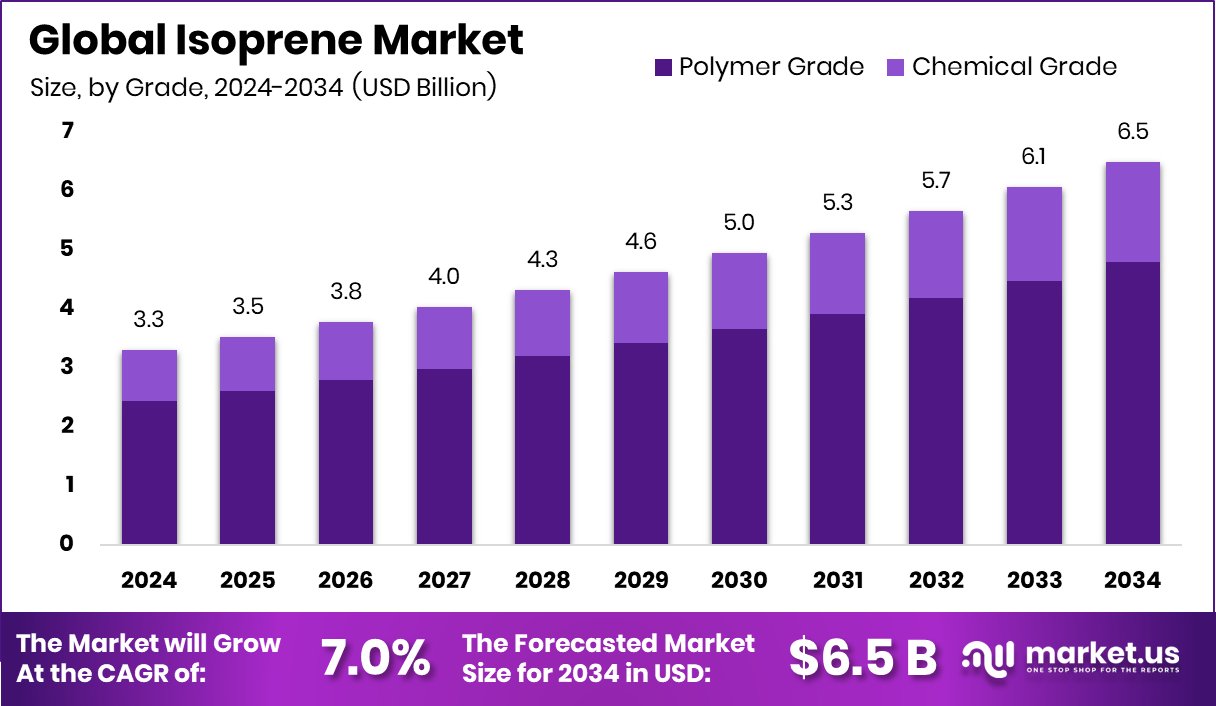
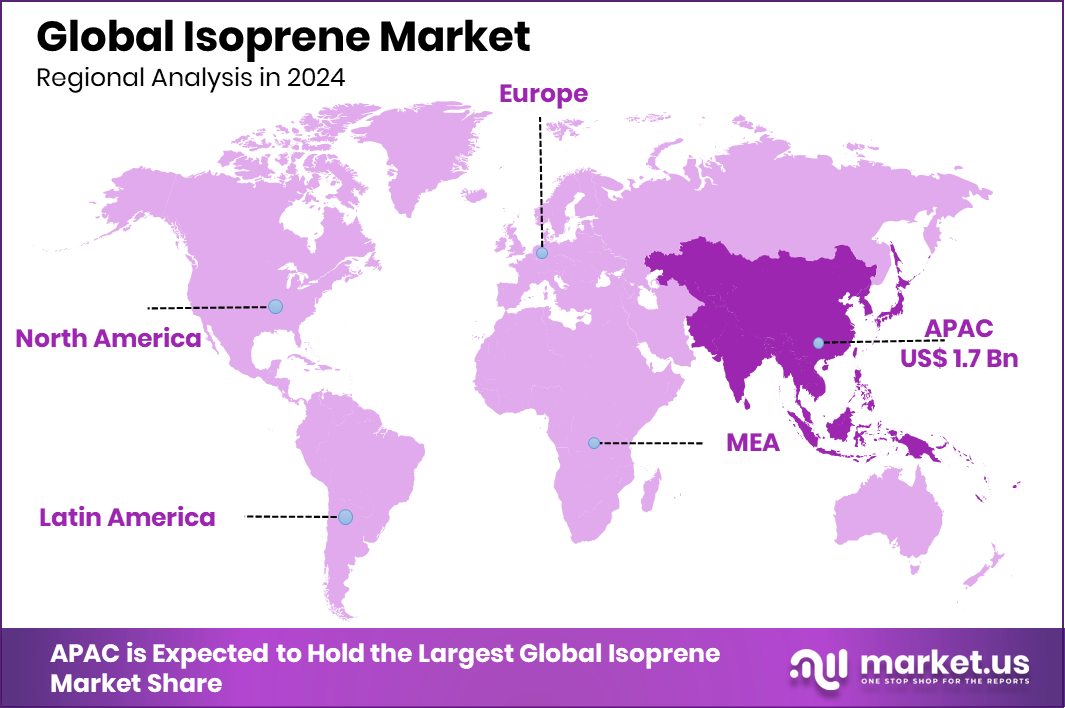
The Global Isoprene Market is expected to be worth around USD 6.5 billion by 2034, up from USD 3.3 billion in 2024, and is projected to grow at a CAGR of 7.0% from 2025 to 2034. With a 53.10% share, Asia Pacific, valued at USD 1.7 Bn, expanded rapidly.
Isoprene is a colorless, volatile liquid hydrocarbon that serves as a key raw material for producing synthetic rubbers, elastomers, and specialty chemicals. Naturally found in plants and also produced industrially, it plays a critical role in the manufacturing of tires, adhesives, coatings, and other polymer-based products. Its versatile chemical structure allows it to be polymerized into materials with high elasticity, strength, and resistance, making it an important building block for several industries.
The isoprene market refers to the global trade, production, and consumption of isoprene across different applications. It is largely driven by industries that require high-performance rubber and polymers, including automotive, construction, and healthcare. The market is shaped by trends in industrialization, manufacturing output, and demand for sustainable material alternatives. Growth is closely linked to expanding industrial activities and the rising use of synthetic elastomers in everyday products.
One major growth factor for the isoprene market is the strong demand from the tire and automotive sector. With vehicle production increasing worldwide and the shift toward durable, fuel-efficient tires, the consumption of isoprene-based synthetic rubber has grown steadily. According to an industry report, Cariflex has inaugurated the world’s largest polyisoprene latex plant in Singapore after investing more than US$350 million.
The demand for isoprene is also supported by its applications in adhesives, coatings, and medical products. Industries are looking for materials with flexibility, durability, and chemical resistance, and isoprene-based polymers provide those qualities, ensuring steady industrial uptake. According to an industry report, EF Polymer has secured $6.6 million in funding to strengthen its sustainable agriculture initiatives.
Key Takeaways
- The Global Isoprene Market is expected to be worth around USD 6.5 billion by 2034, up from USD 3.3 billion in 2024, and is projected to grow at a CAGR of 7.0% from 2025 to 2034.
- Polymer Grade held 73.9% in the Isoprene Market, reflecting its wide industrial usage.
- Styrene Isoprene Styrene captured a 32.6% share in the Isoprene Market, highlighting growing demand.
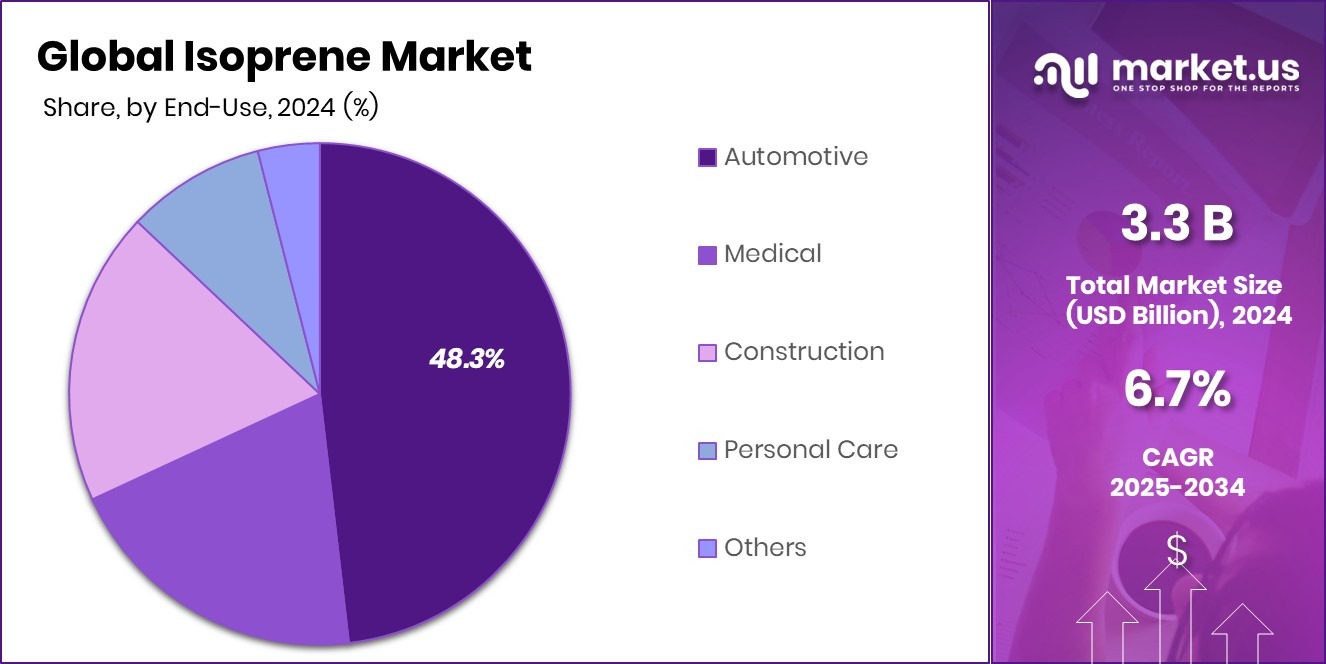
- Automotive dominated with 48.3% in the Isoprene Market, driven by tire and rubber applications.
- Asia Pacific’s 53.10% dominance at USD 1.7 Bn reflects strong industrial growth.
By Grade Analysis
Polymer grade holds 73.9%, highlighting strong demand for synthetic rubber.
In 2024, Polymer Grade held a dominant market position in the By Grade segment of the Isoprene Market, with a 73.9% share. This strong lead reflects its critical importance in producing synthetic rubber and elastomers, which are widely used across industrial applications. Polymer grade isoprene offers the purity and consistency required for large-scale manufacturing, making it the preferred choice for industries that demand high-performance materials.
Its dominance is closely tied to the automotive sector, where synthetic rubber derived from polymer-grade isoprene is a core component in tire production, ensuring durability, fuel efficiency, and safety in vehicles.
The growing demand for high-quality tires in both passenger and commercial vehicles has been a key factor supporting the segment’s growth. As global vehicle production continues to rise, coupled with increasing consumer focus on long-lasting and efficient tires, the reliance on polymer-grade isoprene is expected to remain strong.
Beyond tires, this grade also finds applications in adhesives, coatings, and medical equipment, further reinforcing its large market share. The 73.9% position underlines how polymer grade has become the backbone of the isoprene industry, and its importance is projected to expand as industries seek advanced materials with consistent quality and performance.
By Application Analysis
Styrene-isoprene-styrene captures 32.6%, driving performance material consumption.
In 2024, Styrene Isoprene Styrene held a dominant market position in the By Application segment of the Isoprene Market, with a 32.6% share. This leadership highlights its growing importance as a versatile block copolymer used in adhesives, sealants, coatings, and various elastomeric applications.
The strength of this segment comes from the unique properties of Styrene Isoprene Styrene (SIS), which combines elasticity, flexibility, and durability, making it a preferred choice for industrial and consumer products. Its excellent adhesion performance and ability to withstand stress without losing strength have positioned it as a key material for pressure-sensitive adhesives, packaging solutions, and construction materials.
The increasing global demand for advanced adhesives and sealants has been one of the main drivers of SIS adoption. Industries such as packaging, footwear, and healthcare rely heavily on its performance advantages, particularly where strong bonding and flexibility are critical.
Additionally, the shift toward lightweight and high-performance materials in manufacturing has further elevated the role of SIS in modern applications. Holding a 32.6% market share reflects how central this material has become in the value chain, and its relevance is expected to grow further as industries continue to seek innovative solutions that blend strength, cost-effectiveness, and adaptability.
By End-Use Analysis
Automotive leads with 48.3%, reflecting rising tire and elastomer needs.
In 2024, Automotive held a dominant market position in the By End-Use segment of the Isoprene Market, with a 48.3% share. This dominance stems from the heavy reliance of the automotive sector on synthetic rubber and elastomers derived from isoprene, particularly for tire manufacturing.
Tires represent one of the most critical components of a vehicle, and their performance, durability, and fuel efficiency are directly influenced by the quality of rubber materials used. The growing production of passenger and commercial vehicles worldwide has continued to fuel demand for polymer-grade isoprene, solidifying the automotive sector’s leading share.
The market strength in this segment is further reinforced by the increasing emphasis on long-lasting, fuel-efficient, and environmentally friendly tires. Automotive manufacturers are focusing on materials that not only deliver performance but also align with sustainability goals, and isoprene-based rubber has proven to be a reliable solution.
Additionally, beyond tires, the use of isoprene extends into automotive adhesives, coatings, and sealing materials, supporting vehicle safety and performance. Holding a 48.3% share, the automotive sector stands as the backbone of isoprene demand, and its influence is expected to grow further as global mobility expands and technological innovations in tire design continue to advance.
Key Market Segments
By Grade
- Polymer Grade
- Chemical Grade
By Application
- Styrene Isoprene Styrene
- Isobutylene Isoprene
- Polyisoprene
- Block Co-Polymer
- Others
By End-Use
- Automotive
- Medical
- Construction
- Personal Care
- Others
Driving Factors
Rising Vehicle Production Fuels Strong Isoprene Demand
One of the biggest driving factors for the isoprene market is the rising production of vehicles worldwide. The automotive sector accounts for nearly half of isoprene consumption, mainly because it is a key raw material in tire manufacturing. As global mobility expands and demand for passenger as well as commercial vehicles grows, the need for high-performance, durable, and fuel-efficient tires has surged.
Polymer-grade isoprene provides the strength and flexibility required to meet these needs, making it indispensable for the industry. Additionally, the trend toward long-lasting and eco-friendly tires further supports demand. This close link between automotive growth and isoprene consumption ensures the market remains on a steady upward path, driven by continuous industrial and consumer requirements.
Restraining Factors
Fluctuating Crude Oil Prices Limit Market Growth
A key restraining factor for the isoprene market is its strong dependence on crude oil. Since isoprene is largely produced as a by-product of petroleum cracking, any volatility in crude oil prices directly impacts production costs and availability. Sharp price fluctuations create uncertainty for manufacturers, making it difficult to plan long-term investments and maintain stable profit margins.
This cost instability also affects end-use industries, especially tire and rubber manufacturers, who rely heavily on steady supplies of polymer-grade isoprene. Moreover, reliance on fossil fuel feedstocks raises sustainability concerns, as industries and governments are pushing for greener alternatives.
Growth Opportunity
Bio-Based Isoprene Unlocks Future Growth Potential
A major growth opportunity for the isoprene market lies in the development of bio-based production methods. Traditional isoprene depends heavily on petroleum feedstocks, but rising environmental concerns and stricter regulations are pushing industries to explore greener alternatives.
Bio-based isoprene, produced from renewable resources such as biomass or plant-derived sugars, offers a sustainable solution that reduces carbon footprint and ensures long-term supply stability. Many industries, especially automotive and packaging, are increasingly interested in adopting eco-friendly materials, creating strong demand potential.
As research and commercialization of bio-isoprene advance, companies can reduce reliance on crude oil while meeting consumer demand for sustainable products. This shift represents a clear pathway for the market to achieve long-term, environmentally responsible growth.
Latest Trends
Sustainable Tire Innovation Drives Isoprene Market Trends
One of the latest trends in the isoprene market is the growing focus on sustainable tire innovation. Tire manufacturers are increasingly adopting advanced formulations that enhance durability, improve fuel efficiency, and reduce environmental impact. Since polymer-grade isoprene is a crucial ingredient in synthetic rubber, its role has become even more important in developing eco-friendly tire solutions.
Rising consumer awareness about sustainability and government regulations promoting low-emission vehicles have accelerated this shift. Companies are investing in research to design tires that last longer and use fewer resources during production. This trend not only strengthens the demand for isoprene but also highlights its evolving role in supporting greener mobility and energy-efficient transportation systems worldwide.
Regional Analysis
In 2024, the Asia Pacific held a 53.10% share, reaching USD 1.7 Bn.
The Isoprene Market shows varied regional dynamics, with Asia Pacific emerging as the clear leader. In 2024, the Asia Pacific dominated the global market, accounting for a 53.10% share and valued at USD 1.7 billion. This strong position is driven by rapid industrialization, rising vehicle production, and expanding tire manufacturing capacity across major economies such as China, India, and Japan. The region’s growing middle-class population and increasing mobility needs have significantly boosted automotive sales, which directly fuels demand for polymer-grade isoprene in tire and rubber production.
Furthermore, favorable government policies supporting infrastructure development and manufacturing growth add to the momentum, making the Asia Pacific the fastest-growing and most influential regional market. North America and Europe continue to remain important markets, supported by advanced research, healthcare applications, and strong adoption of high-performance elastomers.
Meanwhile, the Middle East & Africa and Latin America show gradual development, primarily tied to industrial expansion and increasing demand for automotive components. However, it is Asia Pacific’s dominance that sets the tone for global growth, with its 53.10% market share highlighting the central role the region plays in shaping both demand and supply patterns in the global isoprene industry.
Key Regions and Countries
- North America
- US
- Canada
- Europe
- Germany
- France
- The UK
- Spain
- Italy
- Rest of Europe
- Asia Pacific
- China
- Japan
- South Korea
- India
- Australia
- Rest of APAC
- Latin America
- Brazil
- Mexico
- Rest of Latin America
- Middle East & Africa
- GCC
- South Africa
- Rest of MEA
Key Players Analysis
Shell Plc remains a key participant, leveraging its extensive refining and petrochemical operations to ensure a consistent supply of isoprene as a by-product of naphtha cracking. Its global presence allows the company to align with demand from both mature and emerging markets.
LyondellBasell Industries Holdings B.V. plays a significant role as well, using its established petrochemical network to strengthen the availability of high-quality polymer-grade isoprene for downstream applications in synthetic rubber and elastomers.
Kuraray Co., Ltd. distinguishes itself with a focus on specialty polymers and elastomer solutions, where isoprene serves as a critical feedstock. Its emphasis on innovation and tailored solutions adds depth to the market, especially in adhesives and advanced materials.
ExxonMobil Corporation, with its integrated energy and chemical operations, continues to be a dominant force, channeling its scale and technological resources to maintain leadership in synthetic rubber supply for the automotive sector.
Top Key Players in the Market
- Shell Plc
- LyondellBasell Industries Holdings B.V.
- Kuraray Co., Ltd.
- ExxonMobil Corporation
- Shandong Yuhuang Chemical Group Co., Ltd
- Braskem
- Chevron Phillips Chemical Company LLC
- China Petrochemical Corporation
- LOTTE Chemical Corporation
Recent Developments
- In May 2024, Shell announced it would sell its Energy and Chemicals Park in Singapore, including its integrated refining and petrochemical assets on Bukom and Jurong islands, to a joint venture (CAPGC) of Chandra Asri and Glencore.
- In February 2024, LyondellBasell acquired mechanical recycling assets from PreZero in California, including a facility in Jurupa Valley. This site, with an annual capacity of about 50 million pounds, will produce post-consumer recycled resins under the Circulen Recover brand. Operations are set to begin in 2025.









