


Report Overview
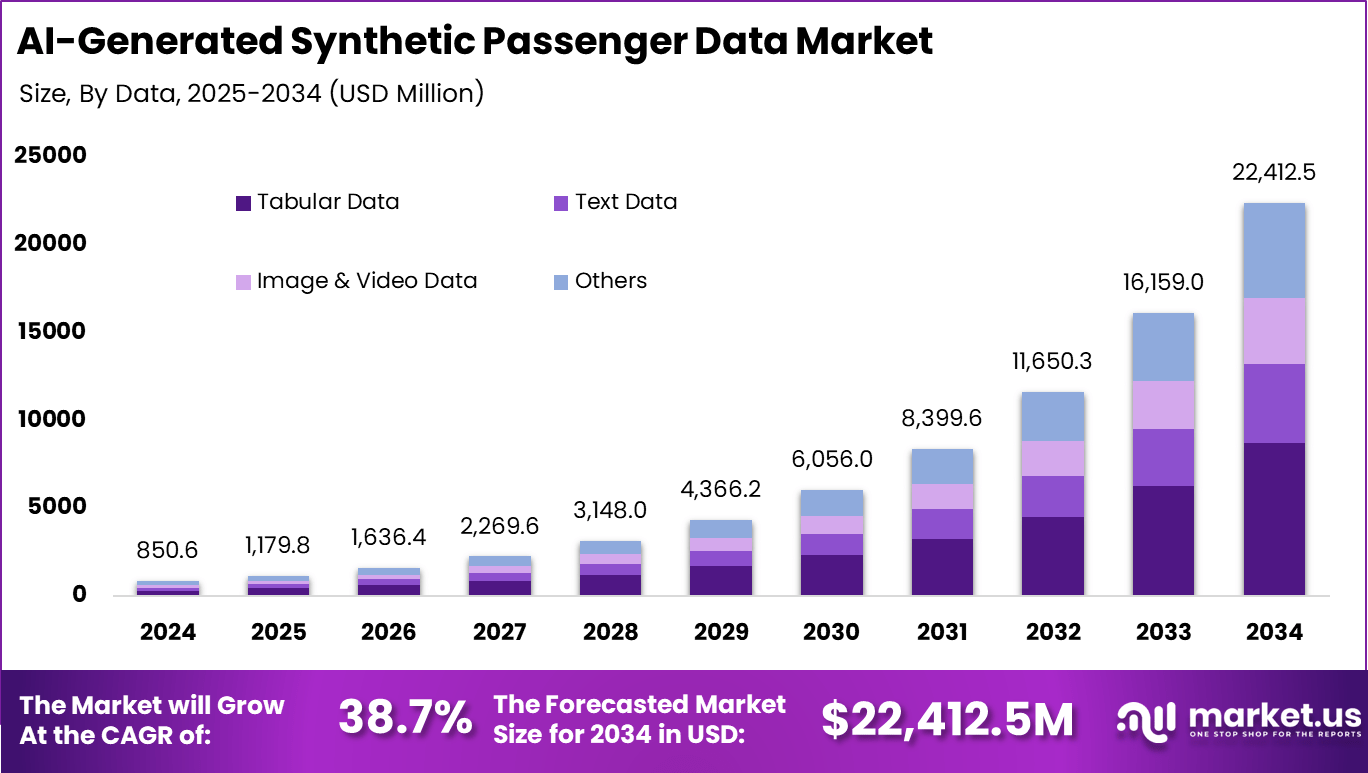
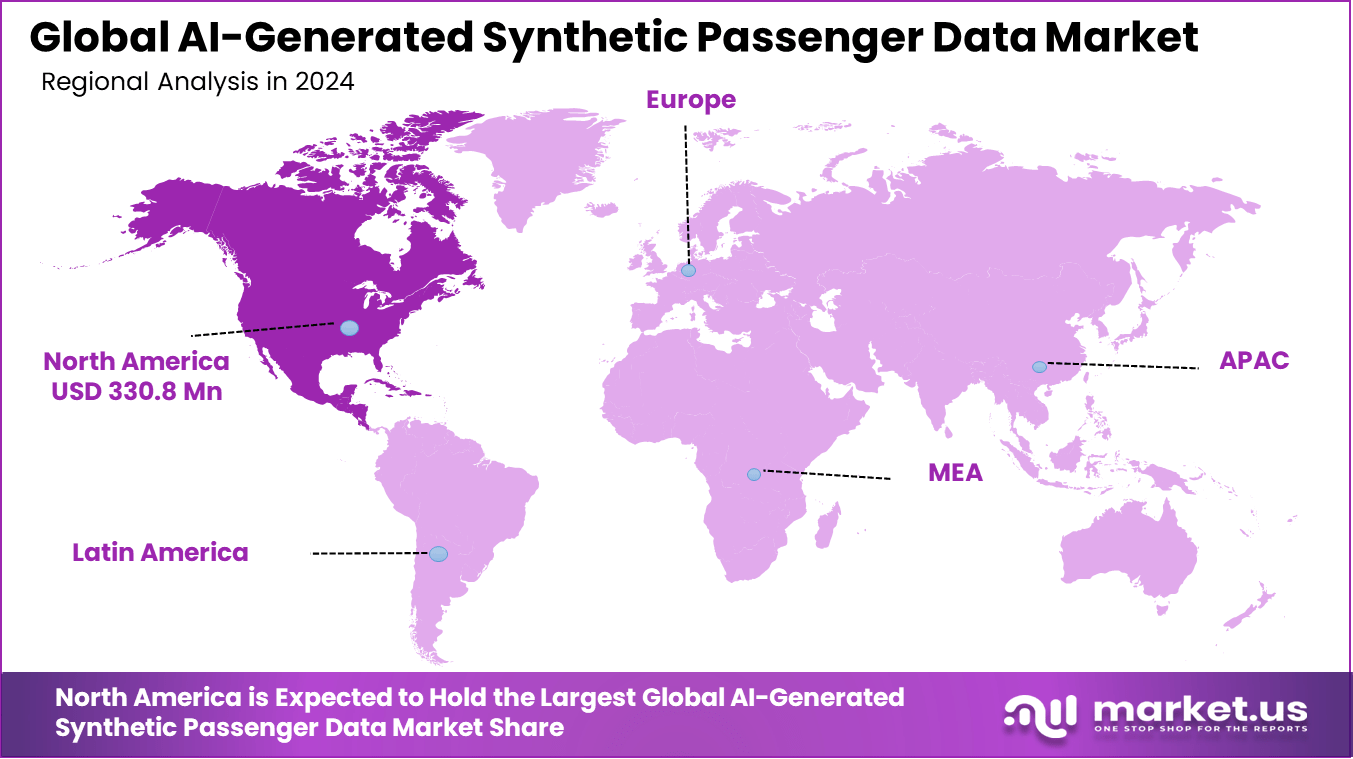
The Global AI-Generated Synthetic Passenger Data Market size is expected to be worth around USD 22,412.5 million by 2034, from USD 850.6 million in 2024, growing at a CAGR of 38.7% during the forecast period from 2025 to 2034. In 224, North America held a dominant market position, capturing more than a38.9% share, holding USD 330.8 million in revenue.
The AI-Generated Synthetic Passenger Data Market focuses on the creation of artificial passenger data using artificial intelligence techniques. This synthetic data mimics real passenger data while protecting personal privacy and complying with regulations. It is crucial for industries like transportation, aviation, and travel to simulate passenger behaviors, test systems, improve services, and train AI models without exposing actual sensitive data.
A primary driving factor behind this market is the increasing demand for privacy-preserving data solutions amid growing concerns over data breaches and stricter regulations such as GDPR and HIPAA. Transport operators and service providers require rich datasets to optimize scheduling, enhance customer experience, and improve safety. However, the availability of real passenger data is limited due to privacy issues. .
For instance, in August 2025, HopeAI showcased its AI-powered synthetic data solutions at the ASCO 2025 conference, aiming to accelerate cancer drug trials. By using synthetic data, HopeAI can simulate diverse patient populations, treatment responses, and clinical scenarios, significantly reducing the time and cost involved in traditional clinical trials.
Key Takeaway
- In 2024, the Tabular Data segment led with a 38.9% share, reflecting its importance in structured passenger data generation.
- The Agent-based Modeling segment dominated with a 62.6% share, showing its effectiveness in simulating passenger behaviors and movements.
- The Fully Synthetic Data segment accounted for a 44.4% share, highlighting demand for privacy-compliant, non-identifiable passenger datasets.
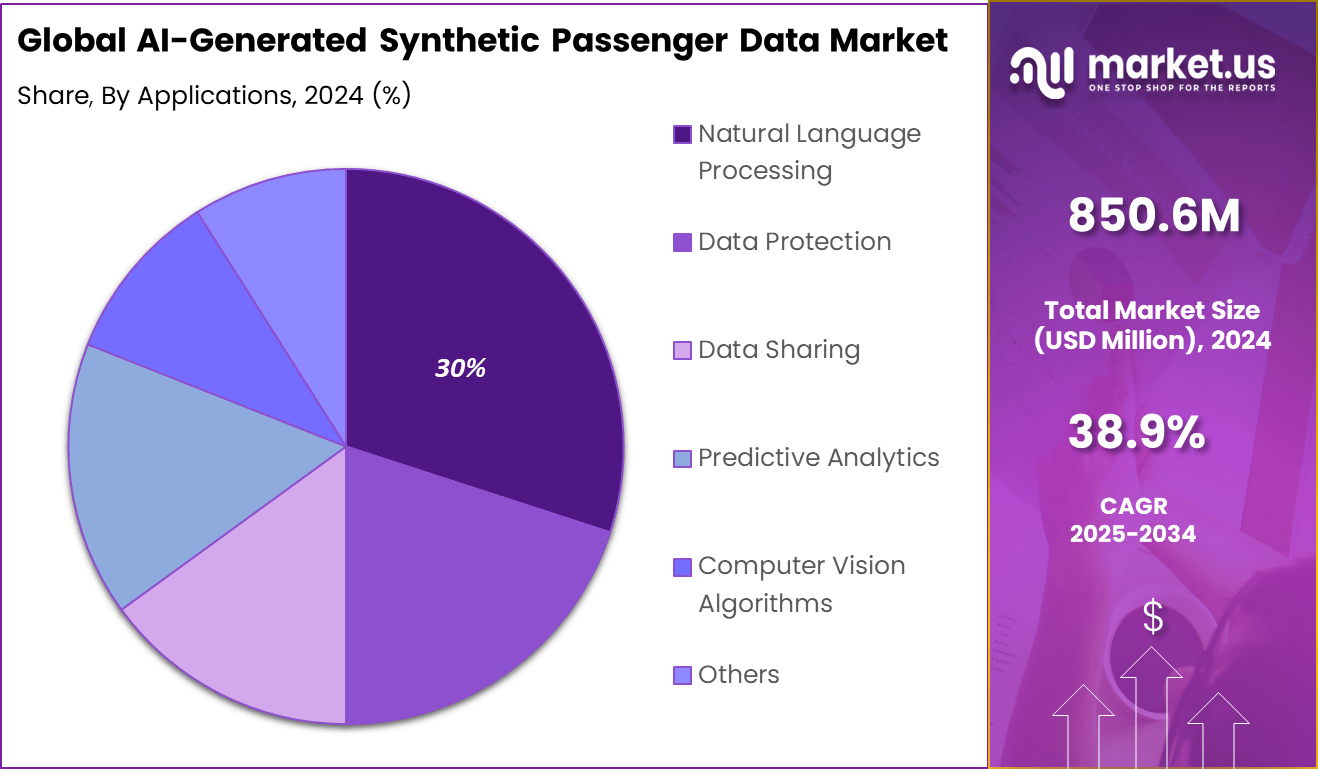
- Natural Language Processing (NLP) held a 30% share, driven by text-based passenger interaction and records generation.
- The Healthcare & Life Sciences segment was the leading end-use sector, capturing 28.7% share, as synthetic data aids research and compliance.
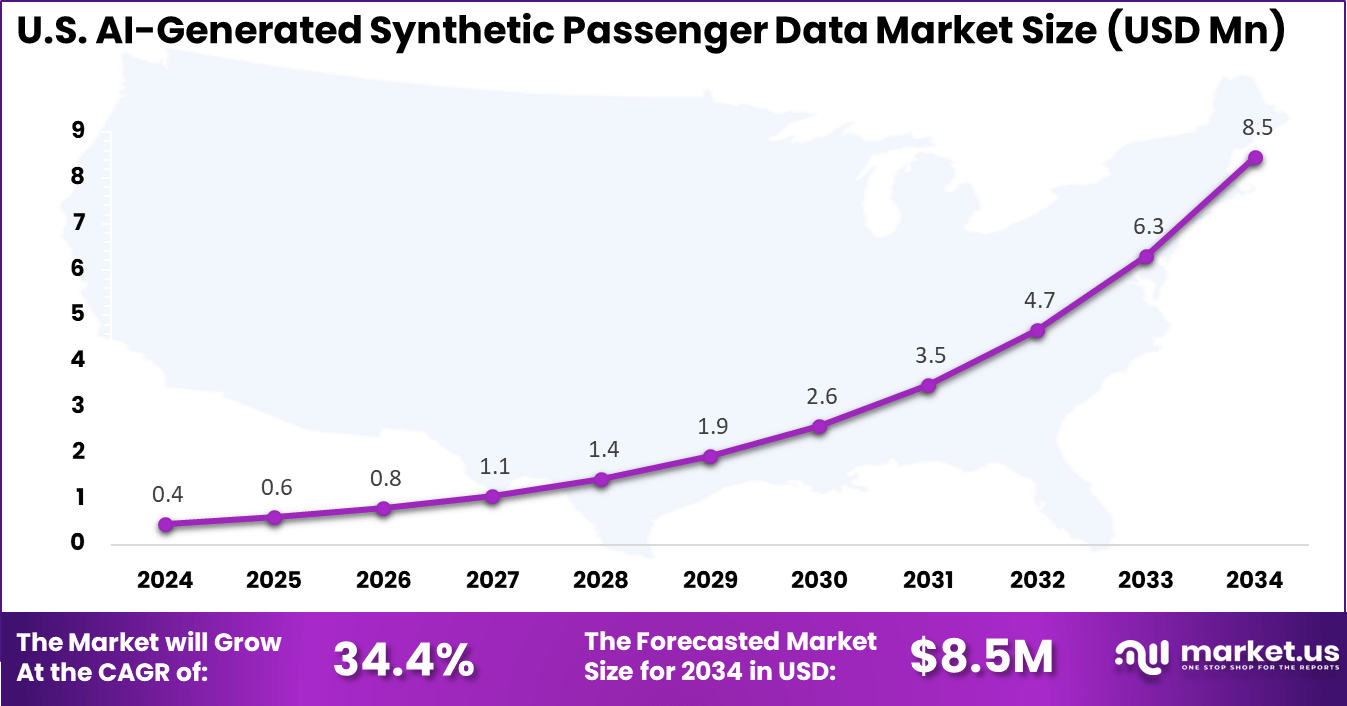
- The U.S. market was valued at USD 440.0 Million in 2024 and is projected to grow at a CAGR of 34.4%.
- North America dominated regionally with a 38.9% share, reflecting strong adoption across industries requiring high-quality passenger data models.
U.S. Market Size
The market for AI-Generated Synthetic Passenger Data within the U.S. is growing tremendously and is currently valued at USD 440.0 million, the market has a projected CAGR of 34.4%. The market is growing tremendously due to the increasing need for data-driven insights in transportation, urban planning, and customer service optimization.
With a focus on enhancing privacy compliance, synthetic data allows companies to simulate diverse passenger behaviors while bypassing the risks associated with real-world data collection. Additionally, the rapid advancement of AI and machine learning technologies, coupled with a rising demand for personalized travel experiences and smart city initiatives, further fuels this growth.
For instance, in September 2024, Toluna launched Harmonaize, a platform designed to transform market research by integrating AI-generated synthetic data. The platform aims to help companies in the U.S. leverage synthetic data for more accurate, scalable, and privacy-compliant research, particularly in customer behavior and market trends.
In 2024, North America held a dominant market position in the Global AI-Generated Synthetic Passenger Data Market, capturing more than a 38.9% share, holding USD 330.8 million in revenue. The market is growing due to its strong technological infrastructure, significant investments in AI and machine learning, and a high demand for innovative solutions.
The region’s focus on smart cities, autonomous vehicles, and personalized customer experiences has accelerated the adoption of synthetic data. Additionally, stringent privacy regulations, such as GDPR and CCPA, have driven the need for privacy-compliant, synthetic data solutions, further bolstering market growth in North America.
For instance, in January 2025, Rockfish Data, a Dallas-based startup, secured $4 million in venture capital to drive its efforts to transform AI with synthetic data for enterprise workflows. The investment highlights the growing dominance of North America in the AI-generated synthetic data market, with the region leading advancements in data privacy and AI development.
Economic Impact
| Impact Area | Details |
|---|---|
| Cost Reduction | Reduces need for expensive, complex real data collection and management |
| Privacy Risk Mitigation | Enables AI and analytics while ensuring data privacy compliance |
| Enhanced Model Performance | Improves AI accuracy with diverse, balanced datasets |
| Innovation Support | Facilitates development of personalized travel experience tools and operational efficiencies |
Emerging Trends
| Trend | Description |
|---|---|
| Integration with Generative AI | Large models used to synthesize realistic passenger datasets |
| Multi-modal Synthetic Data | Combining travel logs, transactional, social media, and sensor data synthesis |
| Federated Learning & Privacy | Enhancing federated learning systems with synthetic data augmentation |
| Real-time Data Simulation | Dynamic synthetic data for real-time operational decision-making |
| Expansion in Use Cases | Growing applications in customer personalization, risk assessment, and predictive maintenance |
Data Analysis
In 2024, the Tabular Data segment held a dominant market position, capturing a 38.9% share of the Global AI-Generated Synthetic Passenger Data Market. This dominance is due to the widespread use of tabular data in various applications, such as passenger behavior analysis, route optimization, and demand forecasting.
Tabular data is highly structured, making it ideal for AI and machine learning algorithms to process efficiently. Its versatility in handling large datasets and providing actionable insights has made it a preferred choice across industries.
For Instance, in September 2023, Mostly AI introduced synthetic text generation to complement its tabular data offerings. This enhancement allows organizations to generate realistic, privacy-preserving textual data, expanding the scope of synthetic data applications in areas like natural language processing and customer service simulations.
Modelling Analysis
In 2024, the Agent-based Modeling segment held a dominant market position, capturing a 62.6% share of the Global AI-Generated Synthetic Passenger Data Market. The dominance is due to the growing need to simulate complex, real-world passenger interactions and behaviors.
Agent-based modeling enables the creation of detailed, realistic scenarios for optimizing traffic management, passenger flow, and route planning. Its ability to model individual decision-making processes and interactions has made it essential for improving system efficiency and safety in urban mobility.
For instance, in December 2022, the IMHOTEP project envisioned creating a multimodal European transport system, utilizing Agent-based Modeling and AI-generated synthetic passenger data. This approach simulates passenger behavior across various transport modes to optimize flow, enhance airport experiences, and improve overall system efficiency.
Offering Band Analysis
In 2024, the Fully Synthetic Data segment held a dominant market position, capturing a 44.4% share of the Global AI-Generated Synthetic Passenger Data Market. This dominance is due to the increasing need for high-quality, privacy-compliant data that can closely replicate real-world passenger behavior without the risks associated with using personal data.
Fully synthetic data offers the flexibility to simulate a wide range of scenarios, making it ideal for training AI models in transportation, smart city planning, and personalized services while ensuring data privacy and security.
For Instance, in February 2025, Mostly AI launched an industry-grade open-source toolkit for creating fully synthetic data. This toolkit is designed to help businesses across various industries generate high-quality, privacy-compliant synthetic datasets that mimic real-world data.
Application Analysis
In 2024, the Natural Language Processing segment held a dominant market position, capturing a 30% share of the Global AI-Generated Synthetic Passenger Data Market. This dominance is due to the increasing reliance on NLP for analyzing and understanding passenger interactions, feedback, and preferences in transportation systems.
NLP enables companies to process large volumes of text-based data, such as customer reviews, support tickets, and social media interactions, for improving services, personalizing experiences, and enhancing customer satisfaction in the mobility sector.
For Instance, in September 2023, Snowflake demonstrated the power of generative AI in creating synthetic data and enabling Natural Language Processing (NLP) to interact with this data. By combining synthetic data generation and NLP, Snowflake allows organizations to create realistic passenger data and interact with it using natural language queries.
End Use Analysis
In 2024, the Healthcare & Life Sciences segment held a dominant market position, capturing a 28.7% share of the Global AI-Generated Synthetic Passenger Data Market. This dominance is due to the growing use of synthetic data to simulate patient movement, behavior, and interactions in healthcare transportation.
It helps model healthcare logistics, patient flow, and public health scenarios while ensuring privacy. This data is crucial for enhancing healthcare services, optimizing medical transport, and improving patient care in urban settings. Additionally, it aids in training AI models for diagnostics, drug discovery, and personalized medicine, driving innovation while maintaining compliance with privacy regulations like HIPAA and GDPR.
For Instance, in May 2025, MDClone and Tectonic announced a partnership to unlock the full potential of Canada’s health data for scalable, system-wide impact. This collaboration aims to leverage advanced synthetic data technologies to enhance healthcare research, patient care, and system efficiencies across the country.
Customer Insights
| Insights | Observations |
|---|---|
| Enhanced Privacy Assurance | Customers and regulators increasingly emphasize privacy |
| Improved Demand Forecasting | Airlines find synthetic data helpful in planning and operations |
| Preference for AI-Based Personalization | Synthetic data enables more fine-tuned customer experience models |
| Adoption Challenges | Requires high quality and realistic data; integration with legacy systems can be complex |
Key Market Segments
By Data
- Tabular Data
- Text Data
- Image & Video Data
- Others
By Modelling
- Direct Modeling
- Agent-based Modeling
By Offering Band
- Fully Synthetic Data
- Partially Synthetic Data
- Hybrid Synthetic Data
By Application
- Data Protection
- Data Sharing
- Predictive Analytics
- Natural Language Processing
- Computer Vision Algorithms
- Others
By End Use
- BFSI
- Healthcare & Life Sciences
- Transportation & Logistics
- IT & Telecommunication
- Retail and E-commerce
- Manufacturing
- Consumer Electronics
- Others
Regional Analysis and Coverage
- North America
- US
- Canada
- Europe
- Germany
- France
- The UK
- Spain
- Italy
- Russia
- Netherlands
- Rest of Europe
- Asia Pacific
- China
- Japan
- South Korea
- India
- Australia
- Singapore
- Thailand
- Vietnam
- Rest of Latin America
- Latin America
- Brazil
- Mexico
- Rest of Latin America
- Middle East & Africa
- South Africa
- Saudi Arabia
- UAE
- Rest of MEA
Drivers
Growing Need for Data Privacy and Compliance
The rise in data privacy regulations like GDPR and CCPA is a major driver pushing companies toward AI-generated synthetic passenger data. Organizations must comply with strict rules about storing and sharing personal data, which limits access to real-world passenger information for research and service improvement.
Synthetic data provides a privacy-safe alternative that retains statistical accuracy while eliminating risks related to personal data exposure. This helps organizations innovate and improve travel experiences without legal or ethical concerns, accelerating adoption of AI-synthetic data solutions.
For instance, in May 2025, companies like Foretellix could use AI-generated synthetic data to enhance the testing and safety evaluation of autonomous vehicles. This data-driven approach allows developers to simulate countless real-world driving scenarios in a controlled, virtual environment, which is essential for training AI systems that power autonomous vehicles.
Restraint
Challenges in Maintaining Data Accuracy and Realism
A key restraint is ensuring that synthetic passenger data accurately represents real-world travel patterns. Poorly generated synthetic data can miss important nuances such as rare travel behaviors or dynamic changes caused by external factors like seasonal demand or disruptions.
Maintaining fidelity is complex, as synthetic data must balance privacy with realism. Any misrepresentation risks leading to flawed models and suboptimal decisions, making organizations cautious about fully relying on synthetic datasets until their quality is verified.
For instance, in October 2022, the concerns about data bias in synthetic transportation planning data were highlighted in the context of improving public transport safety for women. If synthetic data used in transportation systems isn’t carefully designed, it may inherit biases from historical data, leading to skewed insights that don’t reflect the needs or behaviors of all passengers equally.
Opportunities
Enhanced Simulation for Urban Mobility and Travel Analytics
AI-generated synthetic passenger data opens opportunities for improved simulation of urban mobility scenarios and travel demand management. Cities and transport operators can test infrastructure changes, route optimizations, and new service models on rich synthetic datasets before actual implementation.
This reduces planning risks and supports smarter investments in public transport and shared mobility. Additionally, travel companies can enhance personalization and pricing strategies by training AI models on expansive synthetic data, leading to better customer experience and operational efficiency.
For instance, in August 2023, NVIDIA highlighted the role of synthetic data in developing smart city traffic management systems. Using tools like OpenUSD, the company demonstrated how synthetic data can be leveraged to simulate and optimize traffic flows, pedestrian movement, and vehicle behavior in urban environments.
Challenges
Managing Large-Scale Synthetic Data Generation and Storage
A practical challenge is the computational cost and infrastructure required to generate, validate, and store large-scale synthetic passenger datasets. Realistic simulations often demand significant processing power, especially when datasets need to be updated frequently to reflect evolving travel trends.
Managing these resource requirements while keeping costs reasonable is a hurdle for many organizations. Efficient data management and scalable cloud solutions are necessary to handle the volume and complexity of synthetic data effectively.
Key Players Analysis
In the AI-generated synthetic passenger data market, companies such as Mostly AI, Hazy, Tonic.ai, Synthesized, DataGen, YData, and Gretel.ai are leading innovators. These firms focus on generating realistic synthetic datasets that help organizations address privacy concerns while improving data utility. Their solutions are widely adopted by transport operators and research institutes for simulation, model training, and passenger behavior analysis.
Another important cluster of participants includes MDClone, Statice, Kogni, Synthea, Civis Analytics, Reverie, and Truera. These companies emphasize healthcare, government, and enterprise applications where compliance with strict data protection rules is critical. Their platforms allow organizations to replicate large-scale passenger and mobility datasets without exposing personally identifiable information.
Established technology providers such as Informatica, Datomize, Delphix, ParallelM (now part of DataRobot), DataRobot, and IBM also play a crucial role. With strong global networks and enterprise-grade solutions, these firms bring scalability and integration capabilities that smaller players often lack. Their expertise in data management, cloud services, and AI platforms positions them to deliver synthetic passenger datasets as part of larger digital transformation strategies.
Top Key Players in the Market
- Mostly AI
- Hazy
- Tonic.ai
- Synthesized
- DataGen
- YData
- Gretel.ai
- MDClone
- Statice
- Kogni
- Synthea
- Civis Analytics
- Reverie
- Truera
- Informatica
- Datomize
- Delphix
- ParallelM (now part of DataRobot)
- DataRobot
- IBM
- Others
Recent Developments
- In June 2025, SAS acquired Hazy, a leader in synthetic data generation. This acquisition enables SAS to integrate Hazy’s advanced synthetic data technologies into its analytics platform, offering enhanced data privacy and compliance solutions for industries such as healthcare and finance.
- In September 2024, YData announced a strategic partnership with Databricks to empower enterprises with advanced synthetic data solutions. This collaboration combines YData’s expertise in generating realistic, privacy-compliant synthetic data with Databricks’ powerful data analytics platform.









