


Report Overview
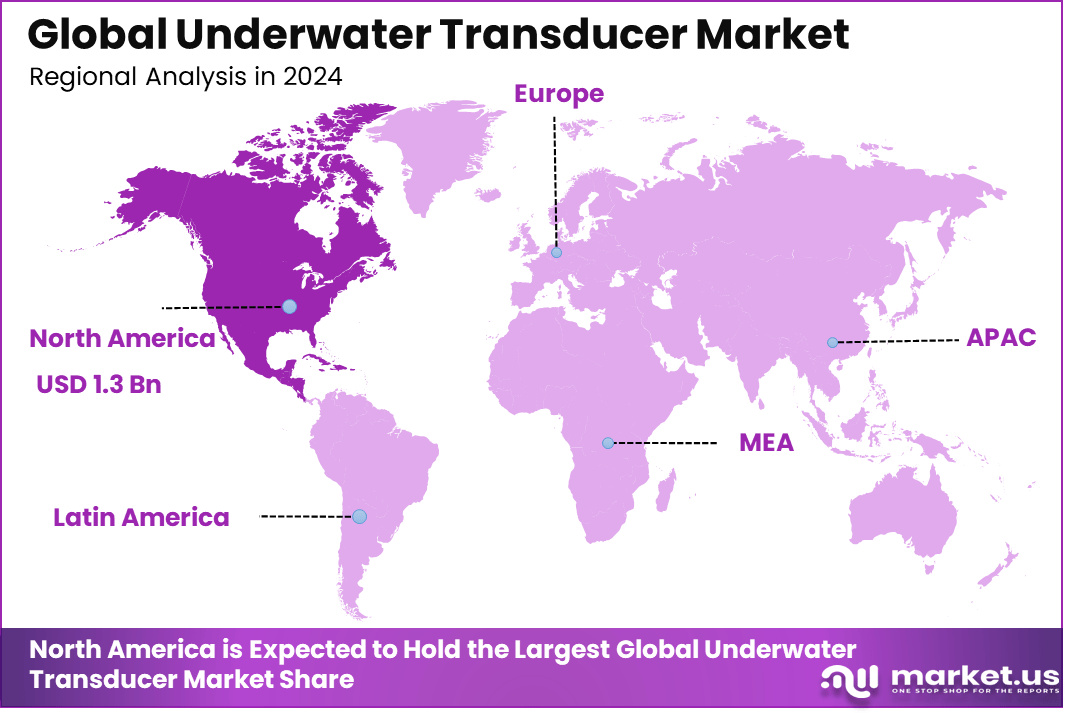
The Global Underwater Transducer Market generated USD 3.5 billion in 2024 and is predicted to register growth from USD 3.8 billion in 2025 to about USD 7.9 billion by 2034, recording a CAGR of 8.6% throughout the forecast span. In 2024, North America held a dominan market position, capturing more than a 38.4% share, holding USD 1.3 Billion revenue.
A major driver for the underwater transducer market is the growing adoption of autonomous underwater vehicles (AUVs) and remotely operated vehicles (ROVs). These platforms rely heavily on transducers for navigation, mapping, and object detection, especially in deep-sea environments. Additionally, increased investments in offshore oil and gas exploration, marine environmental monitoring, and underwater infrastructure inspection are pushing demand higher.
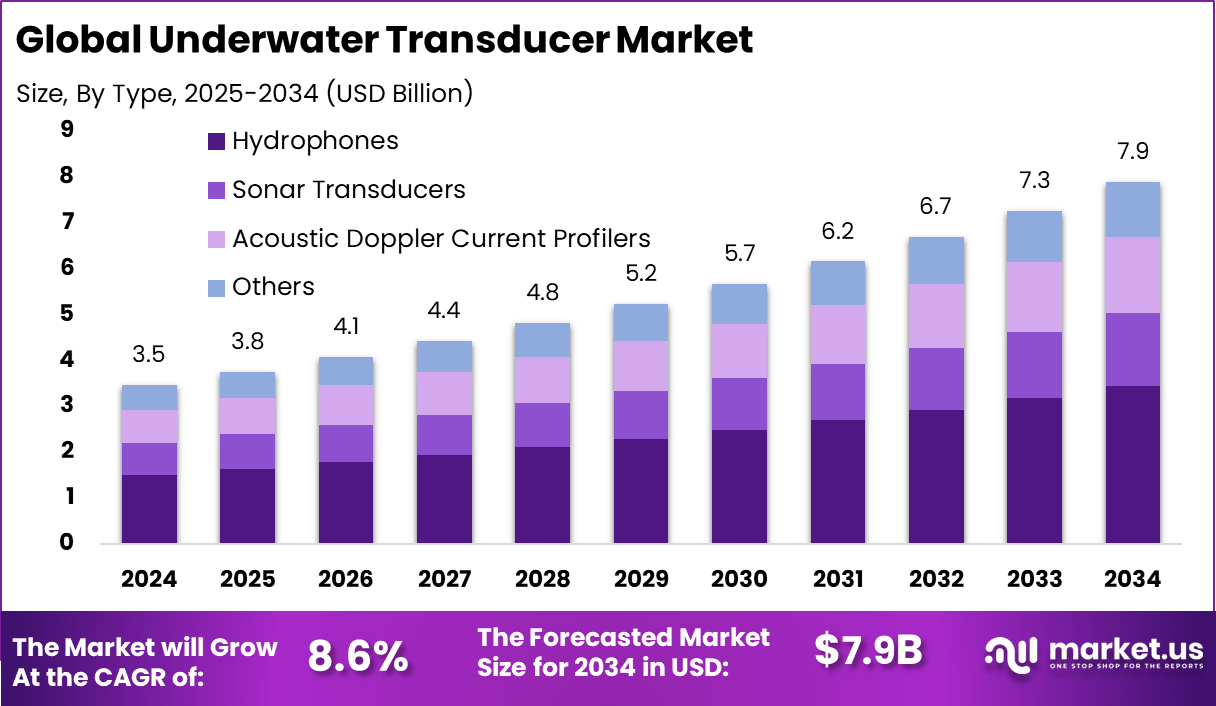
Demand for underwater transducers is expanding rapidly, with sectors like oil and gas, scientific research, fisheries, and defense all contributing to growth. The oil and gas industry uses transducers for seabed mapping and pipeline inspection, while scientific research relies on them for oceanographic surveys and marine mammal studies. Fisheries benefit from cost-effective and durable transducers for fish finding and stock assessment.
Quick Market Facts
- The Hydrophones segment dominated the market with a 43.7% share, driven by their essential role in underwater sound detection, sonar systems, and acoustic monitoring.
- The Marine Research segment held a 38.4% share, supported by the increasing need for oceanographic studies, environmental assessment, and underwater exploration.
- Piezoelectric Ceramics led the market by material with a 52.6% share, owing to their superior sensitivity, durability, and performance in deep-water acoustic applications.
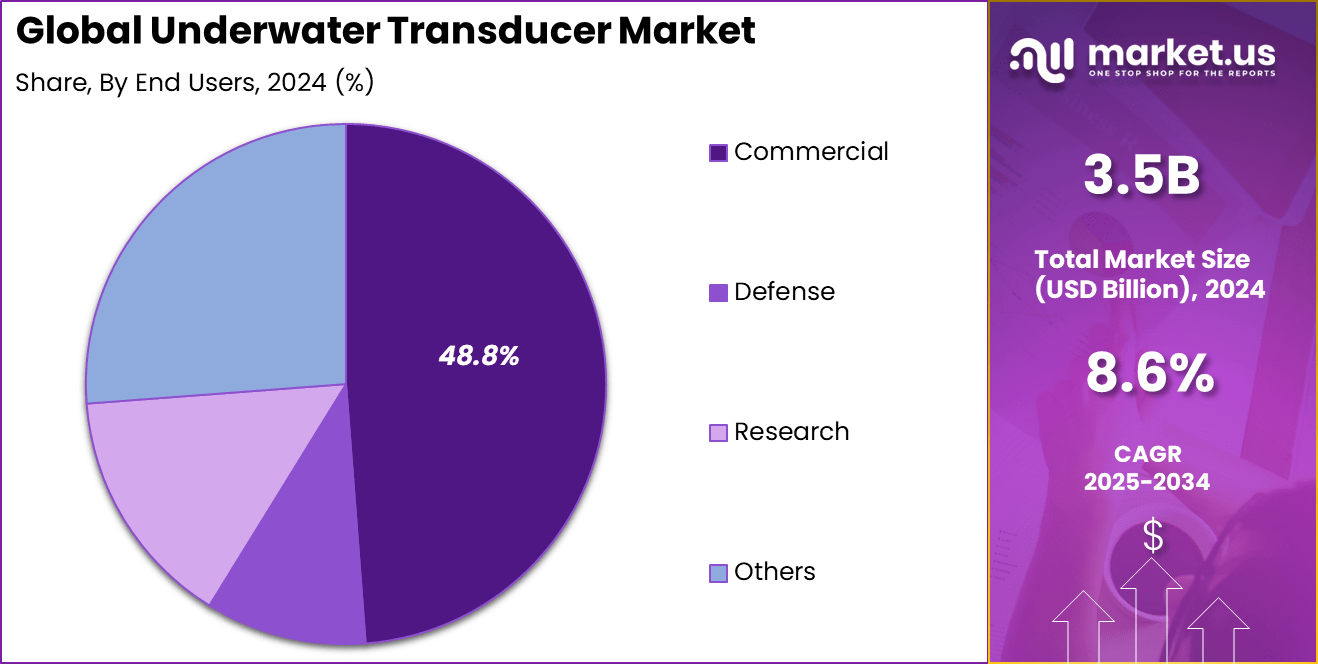
- The Commercial end-user segment accounted for 48.8%, fueled by growing use of underwater transducers in offshore energy operations, marine infrastructure, and fisheries.
- North America held a dominant 38.4% share of the global market, reflecting strong investment in defense and maritime research technologies.
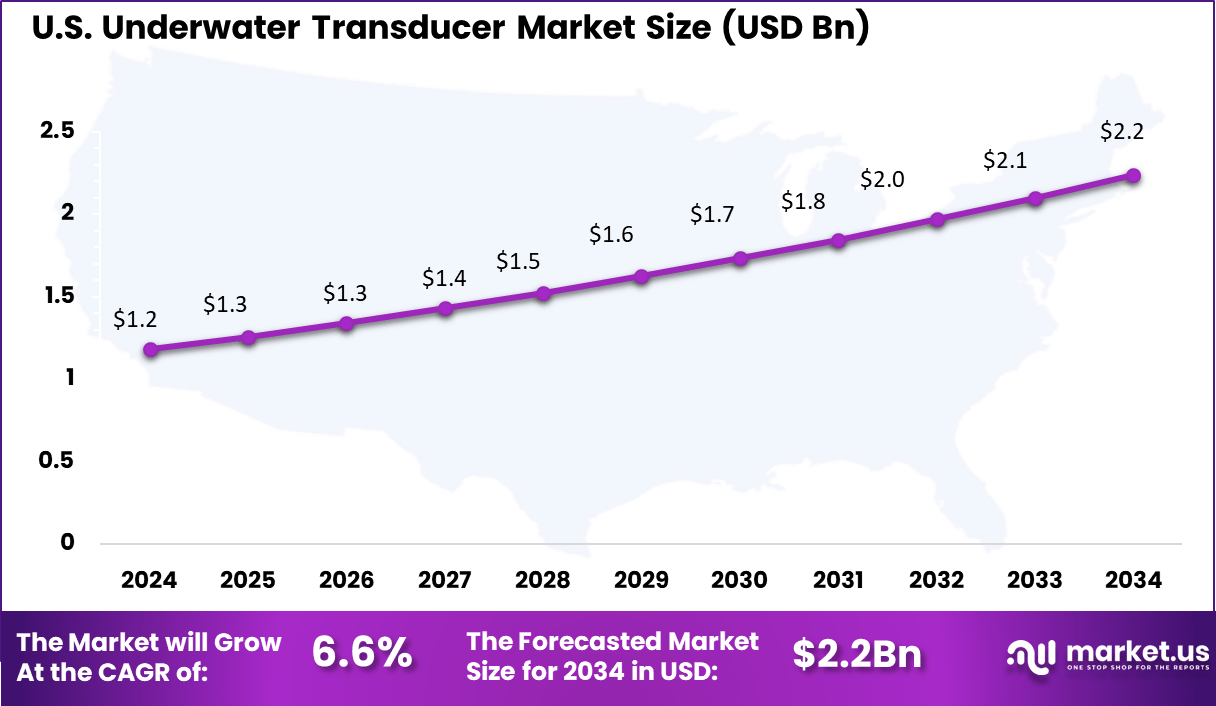
- The U.S. market reached USD 1.18 billion in 2024, expanding steadily at a CAGR of 6.6%, underlining its leadership in advanced underwater acoustic solutions.
Analyst Viewpoints
Recent years have seen a surge in the adoption of advanced technologies like high-frequency transducers, multi-beam sonar, and wireless transducers. For instance, Garmin’s Panoptix PS70 live sonar, launched in early 2024, offers real-time imaging up to a thousand feet underwater, combining multiple sonars and image stabilization for rough conditions. Such innovations are making transducers more versatile and accessible for both professional and recreational users.
Organizations are adopting underwater transducers for their ability to deliver accurate, real-time data in challenging environments. The integration of artificial intelligence and machine learning is enhancing data analysis and decision-making, while miniaturization and improved signal processing are making transducers more efficient and easier to deploy. Multi-sensor integration, such as combining transducers with cameras and pressure sensors, is also improving the quality and scope of underwater data collection.
US Market Size
The US underwater transducer market is valued at over USD 1.18 billion and is growing at a CAGR of 6.6%. This growth is fueled by ongoing investments in offshore oil and gas exploration, defense projects, and marine research. The US remains a key hub for technological innovation, with a strong emphasis on developing advanced transducers for both commercial and scientific applications.
The market’s expansion is supported by a mature regulatory environment and a focus on asset integrity and safety. As the US continues to invest in underwater monitoring and exploration, the demand for reliable and high-performance transducers is expected to rise, reinforcing the country’s position as a global leader in this field.
In 2024, North America holds a 38.4% share of the global underwater transducer market. The region’s strong presence is supported by advanced technological infrastructure, significant investments in offshore exploration, and a robust research ecosystem. North America is home to many leading manufacturers and research institutions, which drive innovation and adoption of underwater transducer technologies.
By Type: Hydrophones
In 2024, Hydrophones are the most widely used type of underwater transducer, accounting for 43.7% of the market. These devices are designed to detect and measure underwater sound waves, making them essential for a variety of marine applications. Their popularity stems from their ability to capture acoustic signals with high sensitivity, which is crucial for tasks such as underwater communication, environmental monitoring, and defense operations.
Hydrophones are available in both omni-directional and directional forms, with omni-directional models being especially favored for their ability to receive sound from all directions. This versatility makes them suitable for research, surveillance, and industrial monitoring, where the source of sound may not be predictable. The demand for hydrophones continues to grow as more sectors rely on accurate underwater acoustic data for safety, navigation, and scientific discovery.
By Application: Marine Research
In 2024, Marine research is the leading application segment for underwater transducers, representing 38.4% of the market. Scientists and researchers use these devices to study oceanographic phenomena, monitor marine life, and map seabed topography. The ability to collect detailed acoustic data allows for better understanding of underwater ecosystems and environmental changes.
The growth in marine research is driven by increasing investments in oceanographic studies and conservation efforts. Transducers play a vital role in gathering data for climate modeling, pollution detection, and biodiversity assessments. As research institutions and governments prioritize marine science, the demand for advanced underwater transducers is expected to remain strong.
By Material: Piezoelectric Ceramics
In 2024, Piezoelectric ceramics are the dominant material used in underwater transducers, holding a 52.6% share of the market. These ceramics convert electrical energy into mechanical vibrations and vice versa, making them ideal for generating and detecting sound waves underwater. Their reliability and efficiency have made them the preferred choice for both commercial and scientific applications.
Lead zirconate titanate (PZT) ceramics are the most common type, valued for their strong piezoelectric properties and adaptability to different frequencies. Ongoing research is focused on improving the sensitivity and durability of these materials, further expanding their use in medical imaging, industrial sensing, and marine technology. The continued development of piezoelectric ceramics ensures their central role in the evolution of underwater transducer technology.
By End-User: Commercial
In 2024, Commercial users make up 48.8% of the underwater transducer market. Industries such as offshore oil and gas, fisheries, shipping, and aquaculture rely heavily on transducers for navigation, depth measurement, and equipment monitoring. The commercial sector’s demand is driven by the need for reliable and efficient underwater acoustic systems to support operations in challenging marine environments.
The expansion of offshore energy projects and the growth of aquaculture and commercial fishing are key factors boosting transducer adoption. These industries require robust and accurate transducers to ensure safety, optimize resource management, and comply with regulatory standards. As global marine activities increase, the commercial segment is expected to maintain its leading position in the market.
Key Market Segments
By Type
- Hydrophones
- Sonar Transducers
- Acoustic Doppler Current Profilers
- Others
By Application
- Marine Research
- Defense & Military
- Oil & Gas Exploration
- Underwater Communication
- Others
By Material
- Piezoelectric Ceramics
- Magnetostrictive Materials
- Others
By End-User
- Commercial
- Defense
- Research
- Others
Regional Analysis and Coverage
- North America
- US
- Canada
- Europe
- Germany
- France
- The UK
- Spain
- Italy
- Russia
- Netherlands
- Rest of Europe
- Asia Pacific
- China
- Japan
- South Korea
- India
- Australia
- Singapore
- Thailand
- Vietnam
- Rest of Latin America
- Latin America
- Brazil
- Mexico
- Rest of Latin America
- Middle East & Africa
- South Africa
- Saudi Arabia
- UAE
- Rest of MEA
Driver Analysis
The main driver for underwater transducer growth is the rising demand for autonomous underwater vehicles (AUVs) and remotely operated vehicles (ROVs) in sectors like oceanographic research, offshore oil and gas exploration, and underwater infrastructure inspection. These vehicles rely heavily on advanced transducers for navigation, mapping, and object detection, pushing the need for more accurate and durable sonar systems.
As industries invest more in deep-sea exploration and monitoring, the requirement for high-resolution sonar imaging and reliable underwater communication is increasing. This is especially true in defense and security, where transducers are essential for surveillance and mine detection. The continuous advancement in transducer technology, such as miniaturization and improved signal processing, further supports market expansion.
Restraint Analysis
A major restraint in the underwater transducer market is the high initial investment cost for advanced transducer systems. Sophisticated transducers require significant R&D and manufacturing expenses, making them less accessible for smaller organizations or emerging markets.
Additionally, environmental regulations and the potential for ecological damage during deployment can limit market growth. Specialized expertise is also needed for installation and maintenance, and the supply of skilled professionals often lags behind demand. These factors can slow down adoption and increase operational costs for end-users.
Opportunity Analysis
A key opportunity is the integration of artificial intelligence and machine learning into transducer systems. These technologies can improve data analysis, automate underwater operations, and enhance measurement accuracy, opening new applications in research, defense, and environmental monitoring.
The trend toward combining transducers with other sensors, such as cameras and pressure sensors, also creates opportunities for more comprehensive underwater data collection. This multi-sensor approach allows for better decision-making in fields like marine conservation, infrastructure inspection, and resource exploration.
Challenge Analysis
A significant challenge is the technological limitation in deep-sea environments, where achieving high power and efficiency remains difficult. Signal attenuation, multipath fading, and limited bandwidth can affect the reliability and speed of underwater communication, especially in real-time applications.
Harsh underwater conditions, such as extreme pressure and corrosion, also pose durability challenges for transducers. These factors require ongoing innovation in materials science and design to ensure long-term performance and reliability in demanding marine environments.
Competitive Analysis
The Underwater Transducer Market is led by major players such as Teledyne Marine, Kongsberg Maritime, and Sonardyne International Ltd., which deliver high-performance sonar and acoustic systems for hydrography, defense, and offshore applications. Their technologies enhance detection precision, depth range, and real-time data transmission across marine environments.
Key contributors like EdgeTech, Neptune Sonar Ltd., Airmar Technology Corporation, and Benthowave Instrument Inc. provide custom transducer designs, advanced materials, and calibrated components. Their focus on reliability, signal clarity, and compact configurations supports research, navigation, and environmental monitoring systems.
Defense and industrial giants including Ultra Electronics Maritime Systems, Raytheon Technologies Corporation, Lockheed Martin Corporation, L3Harris Technologies, Inc., and Thales Group, along with other major players, emphasize adaptive beamforming, underwater surveillance, and autonomous system integration. Their continued innovation strengthens the role of underwater acoustics in security, exploration, and marine infrastructure.
Top Key Players in the Market
- Teledyne Marine
- Kongsberg Maritime
- Sonardyne International Ltd.
- EdgeTech
- Benthowave Instrument Inc.
- Neptune Sonar Ltd.
- Airmar Technology Corporation
- Ultra Electronics Maritime Systems
- Massa Products Corporation
- Furuno Electric Co., Ltd.
- Raytheon Technologies Corporation
- Lockheed Martin Corporation
- General Dynamics Mission Systems, Inc.
- L3Harris Technologies, Inc.
- Atlas Elektronik GmbH
- Thales Group
- Wärtsilä Corporation
- Hydroacoustics Inc.
- Reson A/S
- Simrad (Kongsberg Gruppen)
- Other Major Players
Recent Developments
- September 2025, Teledyne Marine unveiled its Compact Navigator at DSEI 2025, a next-generation underwater transducer solution designed for precise positioning in challenging acoustic environments. The device features titanium construction, low power consumption, and is tailored for naval and security applications, including anti-submarine warfare and mine countermeasures.
- June 2025, Kongsberg Discovery announced the acquisition of Sonatech, a leading underwater acoustics expert, to strengthen its U.S. Navy presence and expand its portfolio. The deal is expected to close later in 2025, pending regulatory approvals.









