


Report Overview
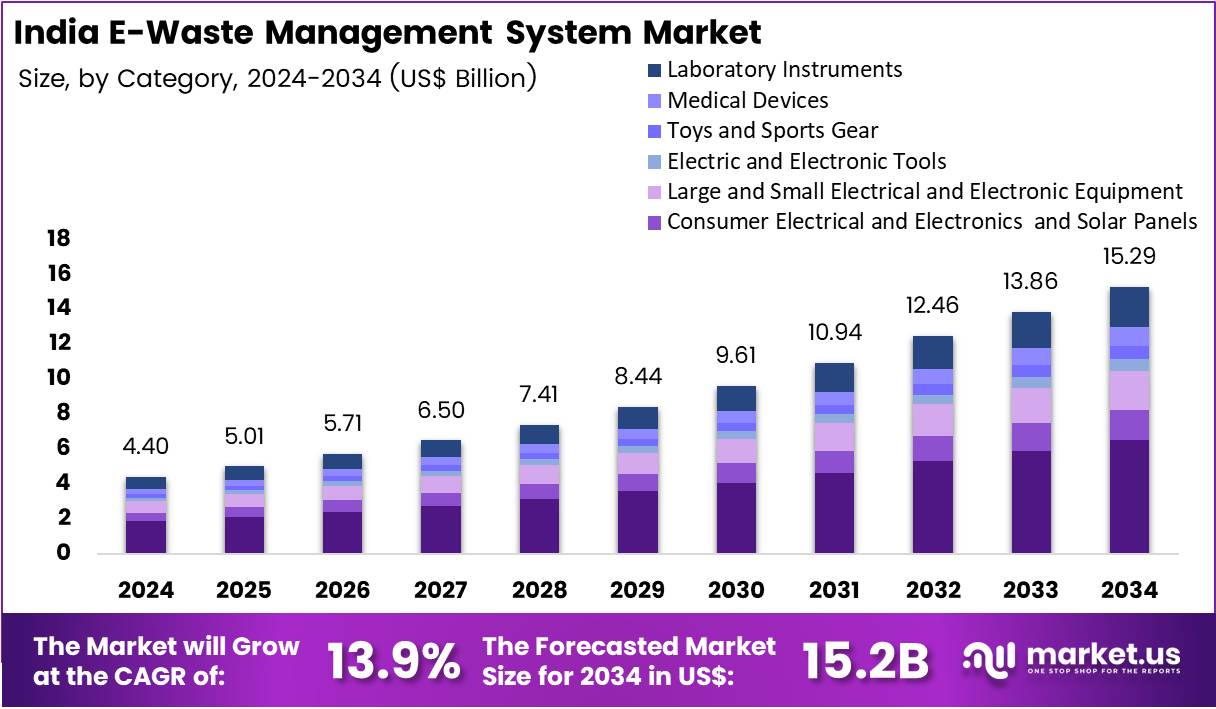
The India E-Waste Management System Market size is expected to be worth around US$ 15.29 billion by 2034 from US$ 4.40 billion in 2024, growing at a CAGR of 13.9% during the forecast period 2025 to 2034. The India E-Waste Management System Market is rapidly evolving due to increasing consumer electronics penetration, urbanization, and heightened regulatory awareness and actions regarding the proper disposal and recycling of e-waste.
Recognizing the growing problem of electronic waste, the Indian government has implemented strict regulations, such as the E-Waste (Management) Rules, 2016, which mandate producers to collect and channel e-waste to authorized recyclers. This has spurred the growth of formal recycling sectors within the country.
India E-Waste Management System Market, Analysis, 2020-2024 (US$ Billion)
| India | 2020 | 2021 | 2022 | 2023 | 2024 | CAGR |
|---|---|---|---|---|---|---|
| Revenue | 1.98 | 2.70 | 3.39 | 3.86 | 4.40 | 13.9% |
Several companies and initiatives stand out in the Indian market. Attero Recycling, India’s largest electronic asset management company, is an excellent instance of a business that not only recycles e-waste but also extracts precious metals like gold and silver, thus contributing to resource conservation and reduced environmental impact. Another example is E-Parisaraa Pvt. Ltd., India’s first government-authorized e-waste recycler, which is engaged in dismantling and recycling various types of e-waste efficiently and safely.
Furthermore, there is a significant drive towards increasing consumer awareness regarding the hazards of improper e-waste disposal and the benefits of recycling. Various NGOs and government initiatives focus on outreach and education to encourage the public to participate actively in e-waste management programs.
This educational approach helps in reducing the environmental footprint of electronic waste by diverting it from landfills to recycling facilities, thus fostering a more sustainable approach to electronics consumption and waste management in India. These efforts collectively aim to transform India’s e-waste sector into a more efficient, environmentally responsible, and economically viable part of the global recycling industry.
Currently, much of the e-waste recycling occurs in the non-formal sector, utilizing primitive and hazardous methods. Addressing this issue requires adequate legislative measures and the adoption of cost-effective, environmentally friendly technological solutions. This article aims to provide fundamental information on electronic waste management in India.
In India, Mumbai leads as the top e-waste generator among the top ten cities, followed by Delhi, Bangalore, Chennai, Kolkata, Ahmedabad, Hyderabad, Pune, Surat, and Nagpur. These 65 cities collectively contribute over 60% of the total e-waste generated in the country. Additionally, 10 states account for 70% of the total e-waste generated.
In May 2025, Casio India Co. Pvt. Ltd., a leading and trusted name in consumer electronics, highlighted the success of its ambitious two-week CSR initiative, “Recycle Responsibly,” launched in March 2025. The campaign, aimed at addressing the rapidly growing challenge of electronic waste, spanned the entire Delhi-NCR region. It resulted in the collection of an impressive 5,488 kilograms of e-waste from more than 450 touchpoints, including residential societies, corporate campuses, and major market areas.
Key Takeaways
- The India E-Waste Management System market was valued at US$ 4.40 billion in 2024 and is anticipated to register substantial growth of US$ 15.29 billion by 2034, with 13.9% CAGR.
- Based on Category, the market is bifurcated into IT and Telecom Devices, Consumer Electrical and Electronics, and Solar Panels, Large and Small Electrical and Electronic Equipment, Electric and Electronic Tools (excluding Large Industrial Tools), Toys and Sports Gear, Medical Devices (excluding implanted and infected products), and Laboratory Instruments with IT and Telecom Devices taking the lead in 2024 with 42.6% market share.
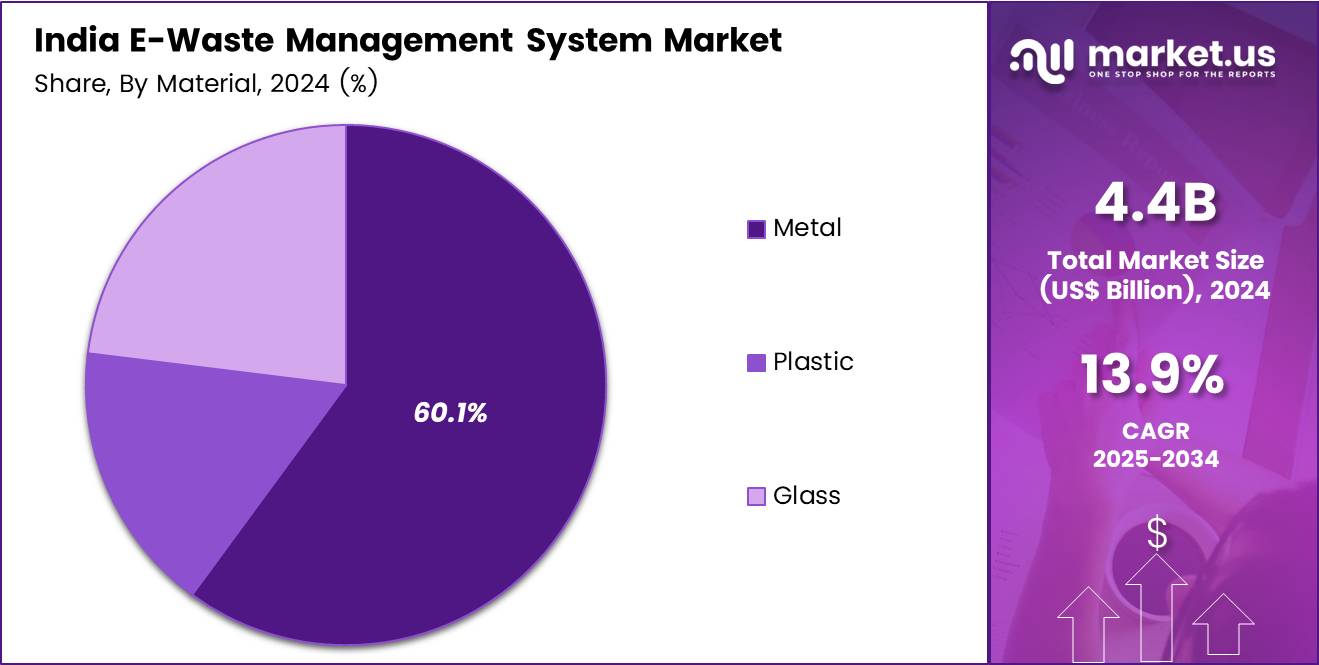
- By Material, the market is divided into Metal, Plastic, Glass, and, with Metal taking the lead market share in 2024 with 60.1%.
- By Application, the market is divided into Disposals, and Recycled, with Disposals taking the lead market share in 2024 with 92.5%.
- By Sector, the market is divided into Formal and Informal with Informal taking the lead in 2024 with 90.1% market share.
- Considering State, the market is classified into Maharashtra, Karnataka, Tamil Nadu, Haryana, Gujarat, Telangana, Uttar Pradesh, and Others, with Haryana accounting for major market share of 46.3%.
By Category
The IT and Telecom Devices segment dominated with 42.6% market share is a major contributor to e-waste in India, driven by the swift technological advancements and the increasing dependence on digital solutions. This category includes a broad array of devices such as computers, mobile phones, servers, and routers, which often have short life cycles due to rapid innovation and consumer demand for the latest technology. As these devices become obsolete at an accelerating rate, they generate a significant amount of e-waste, highlighting the urgent need for effective recycling solutions.
Efficient recycling systems are crucial for handling this type of e-waste because they contain valuable materials like copper, gold, and rare earth elements. These materials are not only economically valuable but also critical to reducing the environmental impact of mining for new resources. Recycling helps in the conservation of these materials and ensures they are reused in the manufacturing of new products.
In November 2025, Blue Planet Environmental Solutions Pte Ltd, a Singapore-based global leader in sustainable waste management and circular economy technologies, advanced its vision for resource recovery in India through a strategic move. The company completed the acquisition and integration of its subsidiaries—Pegasus Waste Management Pvt Ltd, located in Haryana (New Delhi) and Karnataka (Bengaluru). Following this consolidation, the entity has been rebranded and will now operate as Blue Planet E-waste Solutions Pvt Ltd.
India E-Waste Management System Market, Type, 2020-2024 (US$ Million)
| Type | 2020 | 2021 | 2022 | 2023 | 2024 | CAGR |
|---|---|---|---|---|---|---|
| IT and Telecom Devices | 830.9 | 1,135.7 | 1,434.8 | 1,640.1 | 1,874.9 | 14.3% |
| Consumer Electrical and Electronics and Solar Panels | 225.0 | 306.5 | 386.0 | 439.9 | 501.4 | 14.0% |
| Large and Small Electrical and Electronic Equipment | 295.3 | 400.4 | 502.0 | 569.4 | 645.9 | 13.4% |
| Electric and Electronic Tools (excluding Large Industrial Tools) | 90.7 | 122.4 | 152.6 | 172.1 | 194.0 | 12.7% |
| Toys and Sports Gear | 101.0 | 136.1 | 169.6 | 191.0 | 215.0 | 12.6% |
| Medical Devices (excluding implanted and infected products) | 137.9 | 188.3 | 237.4 | 271.3 | 309.8 | 14.2% |
| Laboratory Instruments | 298.4 | 405.7 | 509.4 | 579.5 | 659.4 | 13.7% |
| TOTAL | 1,979.2 | 2,695.0 | 3,391.8 | 3,863.3 | 4,400.3 | 13.9% |
By Material
In India’s E-Waste Management System Market, the metal segment dominated the market with 60.1% market share as it is essential due to the recyclability and economic value of metals extracted from electronic waste. This segment encompasses both precious and non-precious metals, each offering specific benefits and challenges in recycling.
Precious metals such as gold, silver, palladium, and platinum are found in small quantities in electronic devices like mobile phones and computers. Their recovery is economically significant because of their high market value. Specialized recycling techniques, including chemical leaching and electrolysis, are used to extract these metals efficiently from discarded electronics, providing a substantial return on investment. These processes not only recover valuable resources but also reduce the environmental impact compared to primary mining operations.
Both categories of metals are integral to India’s recycling efforts, supporting the country’s transition towards sustainable material management by minimizing waste and maximizing resource recovery. This holistic approach not only helps conserve the environment but also bolsters economic development through the recycling industry.
According to the Material Recycling Association of India, E-waste presents both a growing problem and a lucrative business opportunity due to its substantial volume and the presence of toxic and valuable materials. Metals such as iron, copper, aluminum, gold, and others constitute over 60% of e-waste, while pollutants make up 2.7% of its composition.
India E-Waste Management System Market, Material, 2020-2024 (US$ Million)
| Material | 2020 | 2021 | 2022 | 2023 | 2024 | CAGR |
|---|---|---|---|---|---|---|
| Metal | 1,197.8 | 1,628.0 | 2,045.3 | 2,325.3 | 2,643.6 | 13.7% |
| Precious Metal | 907.3 | 1,236.2 | 1,556.9 | 1,774.4 | 2,022.4 | 14.0% |
| Non-precious Metal | 1,071.9 | 1,458.8 | 1,835.0 | 2,088.9 | 2,377.9 | 13.8% |
| Plastic | 338.8 | 459.7 | 576.6 | 654.4 | 742.7 | 13.5% |
| Glass | 442.6 | 607.3 | 769.9 | 883.6 | 1,014.0 | 14.7% |
| TOTAL | 1,979.2 | 2,695.0 | 3,391.8 | 3,863.3 | 4,400.3 | 13.9% |
By Application
The Disposal segment is estimated to account for 92.5% revenue share in the India E-Waste Management System market in the year 2024 during the forecast period. The disposal segment is further segmented into incineration, landfill, and reuse. Incineration involves the combustion of waste materials in controlled environments to reduce their volume and sometimes harness energy from the process.
However, incinerating e-waste must be approached with caution due to the potential release of toxic chemicals, such as dioxins and furans, which can occur if the waste contains plastics and other hazardous substances. Modern incineration plants are equipped with advanced emission control technologies to capture these harmful by-products, ensuring they do not escape into the atmosphere. In India, incineration is generally reserved for specific types of waste that are not suitable for recycling, under stringent environmental regulations.
In October 2025, “Pan-India E-Waste Recycling Drive under Special Campaign 5.0” announced a drive by the Ministry of Mines from 2-31 October 2025 to collect and recycle unserviceable computers, laptops, printers, LED displays, mobile phones and other obsolete EEE across government offices.
India E-Waste Management System Market, Application, 2020-2024 (US$ Million)
| Application | 2020 | 2021 | 2022 | 2023 | 2024 | CAGR |
|---|---|---|---|---|---|---|
| Disposable | 1,835.1 | 2,497.2 | 3,140.8 | 3,575.1 | 4,069.4 | 13.8% |
| Incineration | 686.9 | 933.6 | 1,172.8 | 1,333.4 | 1,516.0 | 13.7% |
| Landfill | 933.1 | 1,266.3 | 1,588.4 | 1,803.1 | 2,046.7 | 13.5% |
| Reuse | 232.1 | 320.9 | 409.9 | 474.0 | 547.9 | 15.5% |
| Recycled | 144.1 | 197.8 | 251.0 | 288.2 | 330.9 | 14.8% |
| TOTAL | 1,979.2 | 2,695.0 | 3,391.8 | 3,863.3 | 4,400.3 | 13.9% |
By Sector
The Informal segment acquired the prominent revenue share of 90.1% in the overall market in 2024. The Informal sector includes those entities that are not officially sanctioned and typically do not adhere to regulated safety or environmental standards. This sector is often comprised of small workshops or individual collectors and recyclers who utilize primitive methods for extracting valuable components from e-waste. These methods often pose significant health risks to workers and can lead to environmental degradation.
For example, informal recyclers might burn cables to extract copper, releasing toxic fumes into the air, or use acid baths to recover gold from circuit boards, leading to severe chemical pollution. Despite these challenges, the informal sector handles a substantial portion of India’s e-waste due to the lack of adequate formal recycling facilities and the economic opportunities it presents to low-income populations. Efforts are being made to integrate the informal sector into the formal system by providing training and resources to informal workers, thus improving safety standards and environmental compliance.
According to ScienceDirect, each year, more than 3.23 million tonnes of e-waste are generated in India, with over 90% of this total being managed by the informal waste management sector.
India E-Waste Management System Market, Sector, 2020-2024 (US$ Million)
| Name & Designation | Opinion |
|---|---|
| Arjun Mehta, Head of Operations at Green IT Recycling Center Pvt Ltd | “In India’s e-waste ecosystem, formalising reverse logistics is expected to unlock value streams from discarded IT assets. We anticipate growth which is driven by regulatory clarity and corporate data-security priorities, positioning our company to capture mainstream volumes from the informal sector.” |
| Priya Singh, Director of Client Services at Ecowise Waste Management Pvt Ltd | “The transition of e-waste management towards circular-economy models is projected to accelerate in India as enterprises seek compliant solutions. Our nationwide service network gives us an edge to manage bulk collections and asset remarketing efficiently, enhancing both sustainability and brand reputation.” |
| Nitin Gupta, Co-Founder of Attero Recycling Pvt Ltd | “With India generating increasing volumes of electronic devices, we are expected to integrate advanced recovery technologies into our operations and expand capacity. This shift will enable us to recover critical minerals domestically, reduce reliance on imports and support the national strategy for raw-material security.” |
Recent Developments
- In July 2025, Eco Recycling Ltd announced further expansion with overall e-waste processing capacity now stands at 31,200 MTPA (including Li-ion battery recycling) with commissioning of a 40,000 sq ft plant at Vasai near Mumbai.
- In March 2024, RecycleKaro announced the launch of India’s first Plasma Furnace Technology unit for e-waste, targeting an increase in recycling capacity to 75,000 MT per annum, using advanced technology to extract precious/rare metals from e-waste and industrial residue.
- In December 2023, Attero Recycling Pvt Ltd entered into collaboration with Mahindra Last Mile Mobility Ltd to process e-waste and Li-ion battery waste at its Roorkee plant (Uttarakhand) with advanced recycling capability.

- 蓝茶市场(2026—2031)
0评论2026-09-15

- 泡沫材料市场(2026—2031)
0评论2026-09-15

- 重铬酸钠市场(2026—2031)
0评论2026-09-15

- 家族性淀粉样多发性神经病(FAP)市场(2026—2031)
0评论2026-09-15

- 次氯酸钙市场(2026—2031)
0评论2026-09-15

- 海上储能市场(2026—2031)
0评论2026-09-12

- 混凝土市场(2026—2031)
0评论2026-09-12

- 矫形器械市场(2026—2031)
0评论2026-09-12

- 木质素基树脂市场(2026—2031)
0评论2026-09-12

- 聚碳酸酯二元醇市场(2026—2031)
0评论2026-09-12