


Report Overview
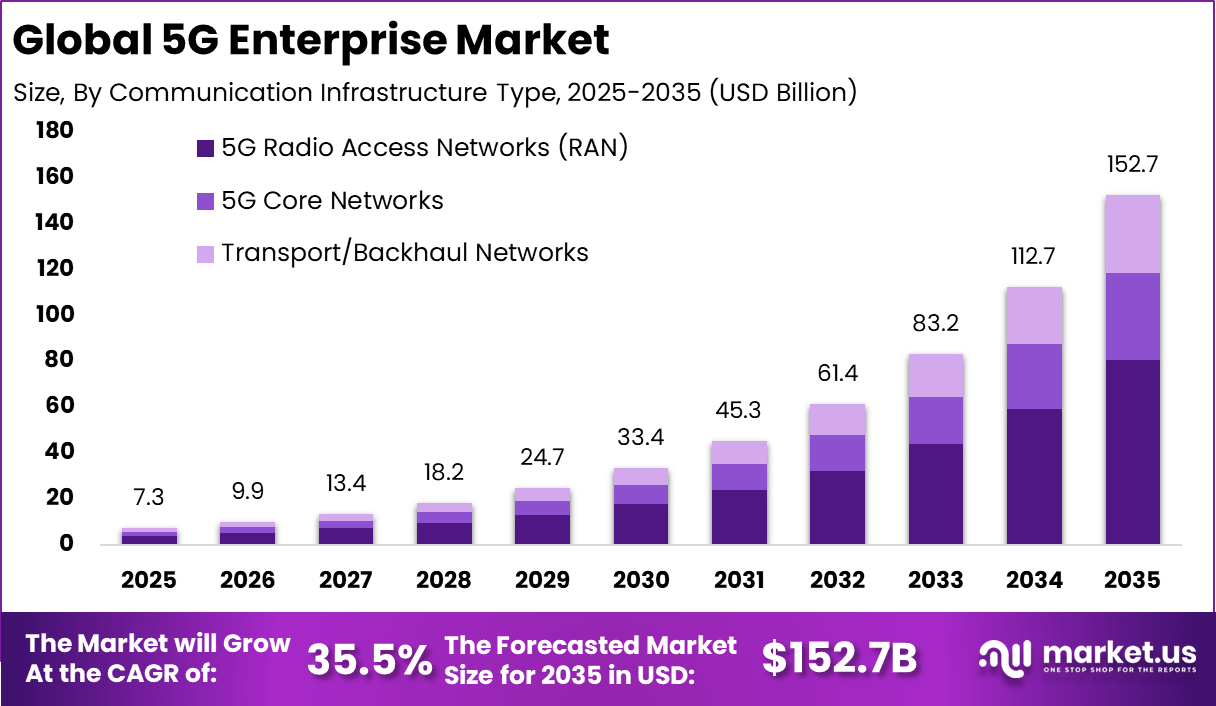
The Global 5G Enterprise Market size is expected to be worth around USD 152.7 Billion By 2035, from USD 7.3 billion in 2025, growing at a CAGR of 35.5% during the forecast period from 2026 to 2035. North America held a dominan Market position, capturing more than a 38.7% share, holding USD 2.8 Billion revenue.
The 5G enterprise market refers to the adoption of fifth generation mobile network technology by businesses and organizations to support digital operations. Enterprises use 5G for high-speed connectivity, low latency communication, and reliable network performance. Applications include smart manufacturing, logistics, healthcare systems, remote operations, and enterprise IoT. 5G enables private networks and advanced wireless infrastructure within enterprise environments.
Investor Type Impact Matrix
| Investor Type | Adoption Level | Contribution to Market Growth (%) | Key Motivation | Investment Behavior |
|---|---|---|---|---|
| IT and telecom enterprises | Very High | ~37.6% | Network modernization | Platform wide deployment |
| Large enterprises | High | ~31% | Mission critical connectivity | Phased rollout |
| Cloud service providers | High | ~18% | Edge and cloud integration | Capital intensive |
| Industrial enterprises | Moderate | ~9% | Automation and control | Selective adoption |
| SMEs | Low | ~5% | Cost sensitive connectivity | Limited usage |
Technology Enablement Analysis
| Technology Layer | Enablement Role | Impact on Market Growth (%) | Adoption Status |
|---|---|---|---|
| 5G RAN | High speed wireless access | ~8.4% | Growing |
| Network slicing | Customized enterprise networks | ~7.1% | Growing |
| Software defined networking | Centralized network control | ~6.0% | Mature |
| Edge computing | Ultra low latency processing | ~4.6% | Developing |
| Network security platforms | Enterprise grade protection | ~3.4% | Developing |
Emerging Trends
Emerging trends in the 5G enterprise landscape include the convergence of 5G with edge computing to enable real time data processing closer to the source, reducing latency and supporting autonomous systems. Another trend is network slicing that allows enterprises to partition a single physical network into multiple virtual networks tailored for specific performance, security, and reliability needs.
There is also increasing adoption of private 5G networks by large organisations seeking greater control over connectivity, performance optimisation, and customised service level agreements. Integration with artificial intelligence and analytics tools is being explored to optimise network performance, predict faults, and automate traffic management.
Growth Factors
Growth in the 5G enterprise market is supported by rising demand for digital transformation, real-time applications, and connected solutions that require reliable high-speed connectivity. The expansion of digital services, rise of mobile computing, and deployment of smart factory and logistics initiatives reinforce enterprise motivation to transition from legacy wireless technologies to 5G based networks.
Continued advancements in hardware, radio technologies, and network functions make 5G more accessible and scalable for enterprise contexts, while supportive regulatory frameworks and spectrum policies in several regions encourage investment in infrastructure and services that enable next generation connectivity.
Opportunities and Business Benefits
Investment opportunities in the 5G enterprise market exist in private network solutions. Enterprises seek customized network deployments. Private 5G platforms attract strong interest. Service providers and technology vendors benefit. This segment shows strong potential.
Another opportunity lies in industry-specific 5G applications. Manufacturing, healthcare, and logistics require tailored solutions. Vertical-focused deployments improve adoption. Specialized offerings create differentiation. Industry alignment supports expansion.
5G enterprise solutions improve business agility by enabling faster decision making. Real-time data access supports responsive operations. Improved connectivity reduces bottlenecks. Agility improves competitiveness. Organizations adapt more quickly.
These solutions also support cost optimization over time. Wireless infrastructure reduces reliance on complex wiring. Scalable networks reduce long-term maintenance costs. Operational savings improve financial performance. Cost efficiency strengthens business outcomes.
Regulatory Environment
The regulatory environment for the 5G enterprise market includes spectrum allocation and telecommunications rules. Enterprises must comply with national communication regulations. Licensing and usage policies affect deployment. Regulatory compliance ensures lawful operation. Alignment is essential.
Data security and privacy regulations also influence adoption. Enterprise networks handle sensitive operational data. Secure network design is required. Compliance with data protection laws builds trust. Regulatory adherence supports responsible deployment.
Opportunity Analysis
Emerging opportunities in the 5G enterprise market are linked to innovative use cases that leverage enhanced mobile broadband, massive machine type communications, and ultra-reliable low latency communication. Industries such as manufacturing, healthcare, logistics, and smart cities can benefit from mission-critical applications that require real time responsiveness and high reliability.
For example, 5G enables connected robotics, remote surgical assistance, digital twins for industrial optimisation, and autonomous guided vehicles in warehouses. Service providers that can deliver tailored 5G solutions for specific industry needs, combined with edge computing and analytics, are well positioned to capture expanding enterprise demand.
Challenge Analysis
A central challenge facing the 5G enterprise market relates to security, spectrum management, and interoperability. As enterprises adopt 5G connectivity across different environments, securing distributed network edges, devices, and data flows becomes increasingly complex.
Ensuring network resilience, protecting against cyber threats, and managing secure access control require advanced security frameworks and specialised expertise. Spectrum allocation and regulatory uncertainty in some regions further complicate enterprise 5G rollouts, while ensuring interoperability with existing communications systems demands strategic planning and often custom engineering.
Key Market Segments
By Communication Infrastructure Type
- 5G Radio Access Networks (RAN)
- 5G Core Networks
- Transport/Backhaul Networks
By Deployment Model
- Public 5G Networks
- Private 5G Networks
- Hybrid/Shared Networks
By Spectrum Licensing Type
- Licensed Spectrum
- Unlicensed/Shared (e.g., CBRS, LAA)
- Mixed Licensing
By Enterprise Vertical
- IT and Telecommunications
- BFSI
- Manufacturing – Discrete
- Manufacturing – Process
- Retail and E-commerce
- Healthcare
- Energy and Utilities
- Transportation and Logistics
- Other Verticals
Regional Analysis and Coverage
- North America
- US
- Canada
- Europe
- Germany
- France
- The UK
- Spain
- Italy
- Russia
- Netherlands
- Rest of Europe
- Asia Pacific
- China
- Japan
- South Korea
- India
- Australia
- Singapore
- Thailand
- Vietnam
- Rest of Latin America
- Latin America
- Brazil
- Mexico
- Rest of Latin America
- Middle East & Africa
- South Africa
- Saudi Arabia
- UAE
- Rest of MEA
Competitive Analysis
Key players such as Cisco Systems, Ericsson, Huawei Technologies, and Nokia lead the enterprise 5G infrastructure segment. These companies provide radio access networks, core networks, and private 5G solutions. Their focus remains on high reliability, low latency, and secure connectivity. Strong R&D capabilities support continuous technology upgrades. Adoption is driven by manufacturing, logistics, and critical enterprise applications.
Technology and chipset focused players such as Qualcomm and Intel Corporation support device and edge ecosystem development. Samsung Electronics, NEC Corporation, and ZTE Corporation strengthen end to end 5G offerings. Their solutions enable private networks and industrial automation. Integration with cloud and edge platforms improves enterprise deployment flexibility and performance.
Enterprise IT and service providers such as Hewlett Packard Enterprise, Dell Technologies, and Juniper Networks focus on campus and edge networking. Telecom operators including AT&T, Verizon Communications, and Deutsche Telekom AG drive managed private 5G services. Siemens AG and Fujitsu expand industrial use cases. Other players enhance regional reach and competition.
Top Key Players in the Market
- Cisco Systems
- Ericsson
- Huawei Technologies
- Nokia
- NEC Corporation
- Samsung Electronics
- ZTE Corporation
- Qualcomm
- Intel Corporation
- Hewlett Packard Enterprise (Aruba)
- Dell Technologies
- Juniper Networks
- Mavenir
- Rakuten Symphony
- CommScope
- AT&T
- Verizon Communications
- Deutsche Telekom AG
- Siemens AG
- Fujitsu
- Others
Recent Developments
- In January 2026, Quectel Wireless Solutions launched the RG600QA and RG660QB 5G modules to support a wide range of next generation 5G networks for homes and businesses. These modules are designed to enable reliable connectivity across diverse use cases. The launch supports growing demand for high speed and low latency wireless solutions.
- In August 2025, T Mobile US launched 5G network slicing for major enterprises such as Delta Air Lines and Axis Energy Services. Earlier, in April 2025, Cisco Systems partnered with Vodafone Idea in India to upgrade 4G and 5G backhaul using MPLS transport solutions. This upgrade reduced network latency by 30% and supported Vi’s 5G rollout in Delhi and Mumbai for high quality streaming and enterprise cloud applications.
- In February 2025, Ericsson partnered with Jaguar Land Rover to deploy a Private 5G network at the Solihull plant. The network replaced wired systems with wireless connectivity to support AI driven quality control, IoT sensors, and automated guided vehicles. This deployment reduced production line reconfiguration time from weeks to seconds, improving manufacturing flexibility and efficiency.









