


Report Overview
The Global AI Sports Analytics Market size is expected to be worth around USD 60.62 billion by 2035, from USD 751.05 billion in 2025, growing at a CAGR of 29.0% during the forecast period from 2025 to 2035. North America held a dominant market position, capturing more than a43.6% share, holding USD 2.07 billion in revenue.
The AI sports analytics market refers to software platforms that use artificial intelligence to analyze sports data for performance, strategy, and decision support. These solutions process data from matches, training sessions, wearables, and video feeds to generate actionable insights. AI sports analytics tools are used by professional teams, leagues, coaches, analysts, and sports organizations. They support player performance evaluation, tactical planning, and injury risk management. Adoption improves data-driven decision making in sports.
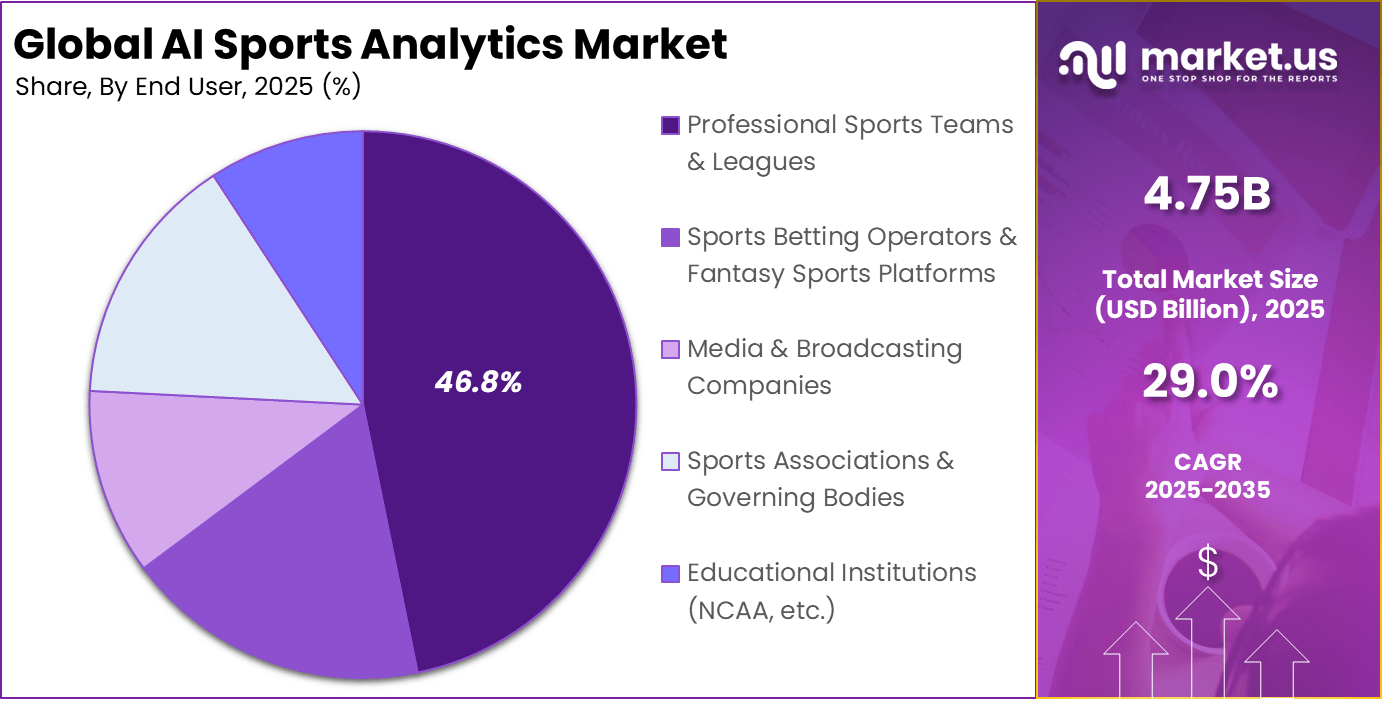
These solutions support visualization, reporting, and real-time analytics. Coaches and analysts use software dashboards to evaluate performance trends and tactical outcomes. The ability to customize analysis workflows strengthens adoption. As data intensity in sports continues to rise, demand for advanced analytics software remains strong. Continuous feature enhancements support evolving use cases. This sustains software as the leading component in the market. For Instance, in November 2025, Hudl acquires ADI to enhance its software with athlete tracking metrics. The platform merges GPS and video data into unified KPIs for load and injury risk, all software-driven. This powers performance analysis across sports, showing why software dominates as it handles multi-source data seamlessly for coaches daily. Performance and tactical analytics account for 37.2% of application demand, reflecting the importance of strategy optimization. These tools help teams analyze formations, player positioning, and match dynamics. AI enhances understanding of complex tactical interactions. Teams use tactical analytics to prepare for opponents and refine in-game strategies. Performance metrics support player evaluation and role optimization. This improves match readiness and competitive outcomes. As competition intensifies, reliance on tactical insights increases. AI-driven analytics provide faster and more accurate evaluations. This application segment remains a key growth driver. For instance, in January 2026, Teamworks buys Sportlogiq for AI hockey performance tracking. It adds automated video player insights to predict development and prep, blending with existing models. Performance analytics surges as such tech uncovers hidden patterns for better training and scouting in fast team sports. Football represents 30.5% of market adoption by sports type, making it the largest contributor. The sport generates extensive data from matches, training, and player tracking systems. AI analytics help process this data efficiently. Football clubs use analytics to assess player performance and tactical execution. Insights support transfer decisions and match preparation. The complexity of the sport benefits strongly from AI analysis. The global scale of football supports widespread adoption of analytics tools. Clubs seek competitive advantages through data-driven strategies. Football remains a leading sport type in the market. For Instance, in March 2025, Veo rolls out AI auto-follow cameras for soccer video analysis. It tracks the ball and players automatically for broadcast-quality footage, aiding play breakdowns and highlights. Soccer leads as this tech makes pro-level reviews easy for clubs worldwide, fueling tactical growth in the global game. Professional sports teams and leagues account for 46.8% of end-user demand. These organizations manage performance, competition scheduling, and talent development. AI analytics support strategic and operational decisions. Teams use analytics to monitor player workloads and optimize tactics. Leagues apply analytics to enhance competition quality and fan engagement. AI-driven insights support long-term planning. As professional sports become more data-centric, adoption continues to grow. Teams and leagues invest in analytics to maintain competitiveness. This segment remains dominant. For Instance, in September 2025, Genius Sports acquires Sports Innovation Lab for fan data in pro leagues. It bolsters media ops with game data and insights for teams like Premier League users. Pro end-users thrive as combined analytics enhance broadcasts, betting, and engagement for big leagues. AI models process vast volumes of match data, sensor inputs, and historical performance records to reveal actionable insights that support tactical planning, player selection, and training optimisation. As digital tracking technologies and wearable sensors become more prevalent, the need for sophisticated analytics that can interpret complex datasets continues to strengthen adoption of AI-enabled sports analytics solutions. A significant restraint in the AI sports analytics market relates to data availability, consistency, and standardisation across teams, leagues, and competition levels. High-quality analysis depends on comprehensive, accurate, and structured datasets, yet many organisations face challenges in aggregating performance, biometric, and event data due to varied capture technologies and proprietary formats. Smaller clubs or lower-tier leagues may lack access to advanced tracking infrastructure, which can limit the depth of AI insights and strengthen the gap between well-resourced and resource-limited teams. Addressing these disparities is essential to extend AI analytics benefits more uniformly across the sporting ecosystem. Emerging opportunities in the AI sports analytics market are linked to expanding applications that go beyond on-field performance into fan engagement, broadcast enhancement, and commercial optimisation. AI engines can generate predictive insights for fan behaviour, personalise content recommendations, and automate highlight generation for media distribution, creating new value in fan experience and monetisation. There is also opportunity in integrating AI analytics with training platforms, rehabilitation systems, and talent development pathways to support long-term athlete growth and injury prevention strategies. As sports organisations seek differentiated insights across competitive and commercial domains, AI analytics platforms that unify performance and engagement data can deliver strategic advantage. A central challenge confronting this market involves balancing the technical complexity of AI models with interpretability and operational adoption by coaching and support staff. While AI algorithms can produce sophisticated predictions and pattern recognition, stakeholders often require transparent, explainable insights to inform tactical decisions and justify strategic changes. Ensuring that AI outputs are interpretable, actionable, and aligned with sport-specific contexts demands close collaboration between data scientists, sport scientists, and practitioners. Without clear understanding of model reasoning, adoption may be limited to technical specialists, reducing practical impact on broader team operations. Emerging trends in the AI sports analytics landscape include the rise of real-time analytics that support live decision support during competitions, allowing coaches and analysts to adjust strategies on the fly based on evolving game conditions. There is also growing use of multi-modal data fusion that combines video feeds, sensor measurements, and contextual metadata to build richer performance profiles and situational insights. Predictive modelling for injury risk assessment, workload management, and player fatigue forecasting is gaining momentum, supporting proactive athlete care and training design. AI-powered fan experience features such as personalised highlights and interactive data visualisations further expand use cases beyond traditional performance analysis. Growth in the AI sports analytics market is supported by technological advances in data capture devices, cloud computing, and artificial intelligence frameworks that make complex analytics more accessible and scalable. Sports organisations are under increasing pressure to optimise performance outcomes, reduce injury occurrence, and engage fans in competitive digital environments, all of which drive investment in intelligent analytics solutions. Additionally, the rising commercialisation of sports through broadcasting, sponsorship, and digital platforms reinforces the strategic value of insights that can improve competitive performance and enhance audience retention. As adoption deepens across professional and emerging levels of sport, AI sports analytics continues to evolve as a foundational element of modern sport management and competition strategy. North America Europe Asia Pacific Latin America Middle East & Africa One of the leading players in November 2025, Hudl acquired Athletic Data Innovations (ADI), bringing advanced multidirectional athlete tracking to its video analytics platform. ADI’s AI algorithms unify GPS, LPS, and optical data to measure true workload and injury risk with metrics like gait analysis. This move tackles data fragmentation head-on, giving coaches deeper performance insights across football, rugby, and more.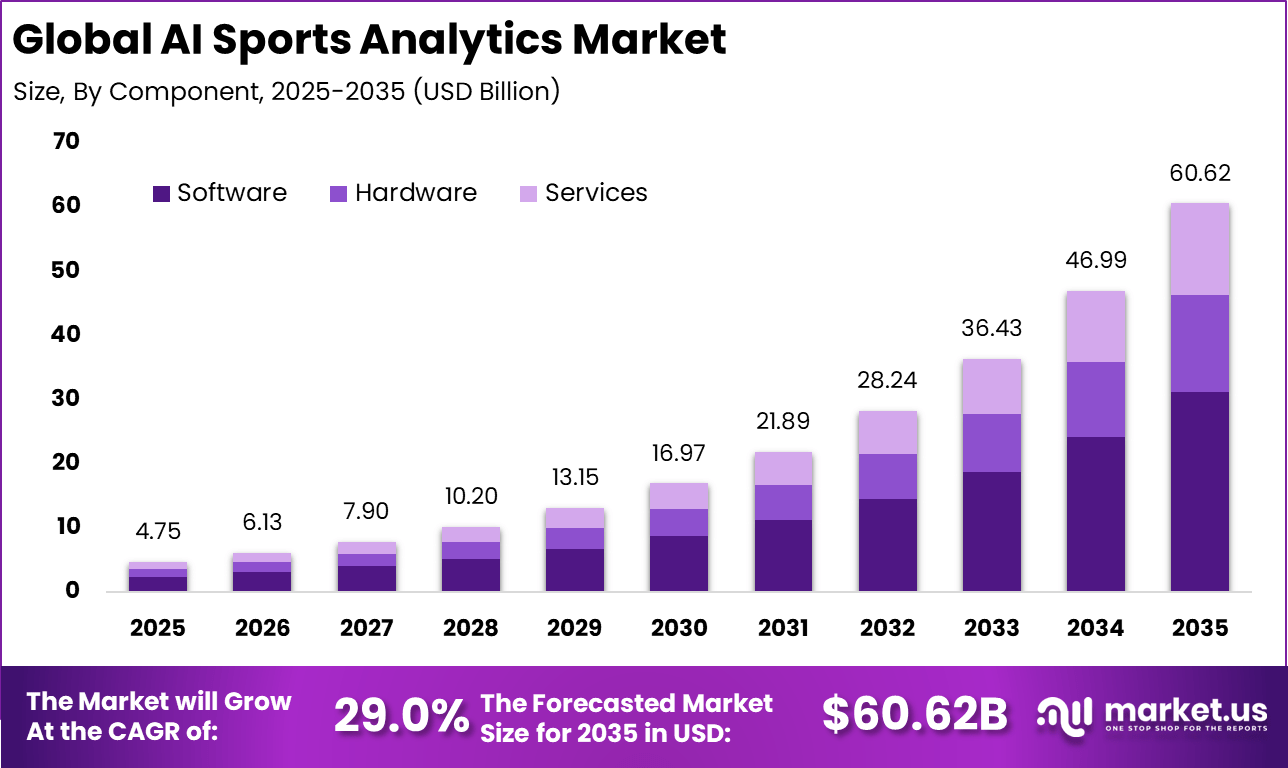
Application Analysis
Sports Type Analysis
End-User Analysis
Restraint Analysis
Opportunity Analysis
Challenge Analysis
Emerging Trends
Growth Factors
Investor Type Impact Matrix
Investor Type Adoption Level Contribution to Market Growth (%) Key Motivation Investment Pattern Professional sports teams and leagues Very High ~46.8% Competitive advantage Long term platform contracts Sports analytics vendors High ~22% Platform expansion R and D intensive Media and broadcasters Moderate ~14% Content and insights enrichment Selective adoption Sports federations Moderate ~11% Performance benchmarking Program based Amateur organizations Low ~6% Cost sensitive analytics Limited usage Technology Enablement Analysis
Technology Layer Enablement Role Impact on Growth (%) Adoption Status AI and machine learning Player and match performance modeling ~6.9% Growing Video analytics Movement and tactical analysis ~6.1% Mature Cloud analytics platforms Scalable data processing ~5.2% Mature Data visualization tools Coaching and management insights ~4.1% Growing API based data integration Multi source analytics ~3.3% Developing Key Market Segments
By Component
By Application
By Sports Type
By End-User
Key Regions and Countries
Key Players Analysis
Top Key Players in the Market
Recent Developments









