


Report Overview
The Global Crypto Making AI Market size is expected to be worth around USD 55.2 Billion By 2035, from USD 5.1 billion in 2025, growing at a CAGR of 26.8% during the forecast period from 2026 to 2035. North America held a dominan Market position, capturing more than a 42.6% share, holding USD 2.1 Billion revenue.
The crypto making AI market refers to the use of artificial intelligence technologies in the creation, management, and optimization of cryptocurrency assets and blockchain projects. AI is leveraged to design more efficient algorithms, improve mining processes, enhance security, and predict market trends. This includes the development of AI-powered mining hardware, AI-driven trading bots, and intelligent blockchain solutions. Adoption spans cryptocurrency miners, traders, financial institutions, and blockchain developers.
The crypto making AI market is being driven by the increasing integration of artificial intelligence into the creation, optimisation, and management of digital assets and blockchain protocols. AI technologies enhance efficiency in generating new cryptocurrencies, automating smart contract development, and optimising tokenomics through predictive modelling and adaptive algorithms. Blockchain developers and organisations seek AI‑enabled tools to reduce manual coding effort, improve security posture, and support rapid deployment of crypto assets that align with network performance and community dynamics. As interest in decentralised finance, tokenisation, and Web3 ecosystems grows, demand for intelligent platforms that streamline crypto creation and governance continues to strengthen. A significant restraint in the crypto making AI market relates to regulatory uncertainty and the potential for misuse of automated crypto creation tools. Authorities in many jurisdictions are still refining legal frameworks for digital asset issuance, token classifications, and compliance obligations, which can lead to hesitancy among developers and enterprises to adopt AI‑powered crypto generation solutions. Additionally, the complexity of aligning AI‑generated crypto logic with evolving security standards and best practices introduces technical risk, as flaws in automated smart contract creation can expose networks to vulnerabilities or economic exploits. These concerns can slow market uptake until clearer governance and compliance models emerge. Emerging opportunities in the crypto making AI market are linked to the expansion of tools that support personalised, purpose‑built token ecosystems and adaptive governance models. AI platforms that enable predictive analysis of token performance, demand forecasting, and community behaviour can help developers design crypto assets that better align with use case objectives and market dynamics. There is also potential for integration with decentralised autonomous organisation infrastructures, where AI contributions assist in proposal evaluation, consensus formulation, and incentive optimisation. As decentralised applications proliferate across gaming, finance, supply chain, and identity domains, intelligent crypto creation tools that lower technical barriers and improve design quality can attract broader participation. A central challenge confronting this market involves balancing automated AI outputs with human oversight, interpretability, and ethical design principles. While AI can generate code structures, token frameworks, and economic models at scale, human experts must validate that outputs align with strategic goals, ethical constraints, and practical usability criteria. Ensuring transparency of AI decision‑making, preventing biased or unsafe code generation, and embedding robust risk controls into automated workflows require rigorous testing and governance oversight. In the absence of clear explainability, stakeholders may be reluctant to trust AI‑driven crypto creation for high‑stake or financial‑critical deployments. Emerging trends in the crypto making AI landscape include the use of generative models to assist in smart contract drafting, automated security testing, and dynamic tokenomics simulation. Developers are exploring hybrid AI workflows that combine automated generation with contextual prompts, allowing tailored asset design that reflects project vision and community needs. There is also growing interest in AI‑assisted auditing tools that analyse contracts post‑generation for vulnerabilities, compliance gaps, and optimisation opportunities. Integration with visual design interfaces and low‑code/no‑code crypto builders is expanding accessibility for creators with limited programming expertise. Growth in the crypto making AI market is supported by the expanding adoption of decentralised finance and blockchain solutions that require scalable, secure, and adaptable digital asset frameworks. Advances in AI, natural language understanding, and pattern recognition enhance the capability to produce high‑quality crypto code and predictive insights that inform design decisions. Increasing participation from developers, entrepreneurs, and enterprises seeking to tokenise assets or launch decentralised applications reinforces demand for intelligent tooling that accelerates creation cycles and reduces technical friction. As tooling matures and ecosystem education improves, AI‑powered approaches to crypto generation are expected to play a central role in driving innovation and lowering entry barriers within the broader decentralised economy. Leading platforms such as Coinbase Global, Inc., 3Commas, and Cryptohopper focus on AI-driven automated trading and portfolio management. Their solutions support strategy automation, risk controls, and real-time market signals. Integration with major crypto exchanges strengthens usability. These players benefit from strong brand recognition and large user bases. Demand is driven by retail traders seeking efficiency and reduced manual trading complexity. Mid-tier and strategy-focused providers such as Bitsgap, TradeSanta, and Pionex emphasize grid trading, arbitrage, and AI-assisted strategies. Trality and Hummingbot support advanced users and developers. These platforms attract users seeking customizable strategies and transparent performance logic. Adoption is supported by rising volatility and continuous crypto market activity. Emerging and community-driven players such as Mudrex, Stacked, and Shrimpy focus on simplified AI-driven investing. Zignaly, HaasOnline, and Gunbot expand feature depth for active traders. Other vendors increase competition and innovation. This ecosystem supports steady growth and broader adoption of AI-powered crypto trading solutions.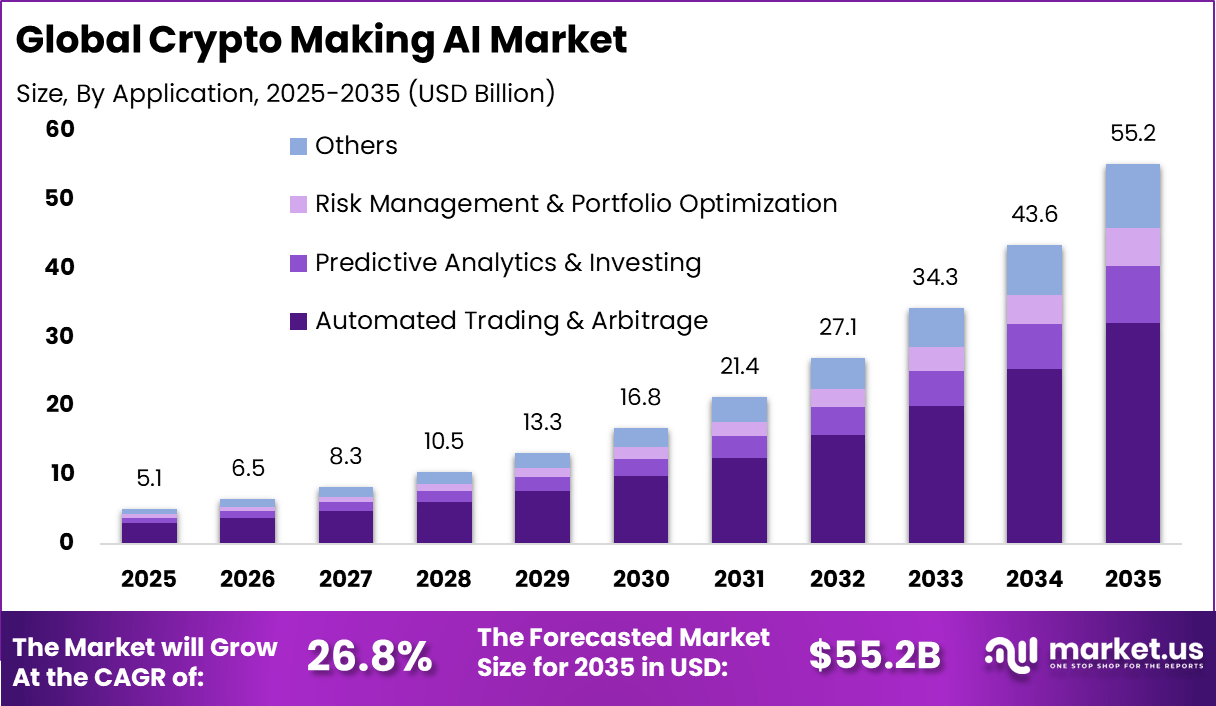
Investor Type Impact Matrix
Investor Type Adoption Level Contribution to Market Growth (%) Key Motivation Investment Behavior Retail investors and traders Very High ~62.7% Profit from trading and arbitrage Frequent platform usage Cryptocurrency exchanges High ~17.8% Integration of AI for trading efficiency Platform based adoption Hedge funds and institutional investors High ~11.0% High frequency trading algorithms Strategic deployment Financial technology providers Moderate ~6.5% Enhancing trading tools and platforms Partnership with exchanges Government and regulators Low ~2.0% Regulatory oversight of crypto trading Policy formulation Driver Analysis
Restraint Analysis
Opportunity Analysis
Challenge Analysis
Emerging Trends
Growth Factors
Key Market Segments
By Component
By Deployment Mode
By Application
By End-User
Regional Analysis and Coverage
Competitive Analysis
Top Key Players in the Market
Recent Developments









