


Report Overview
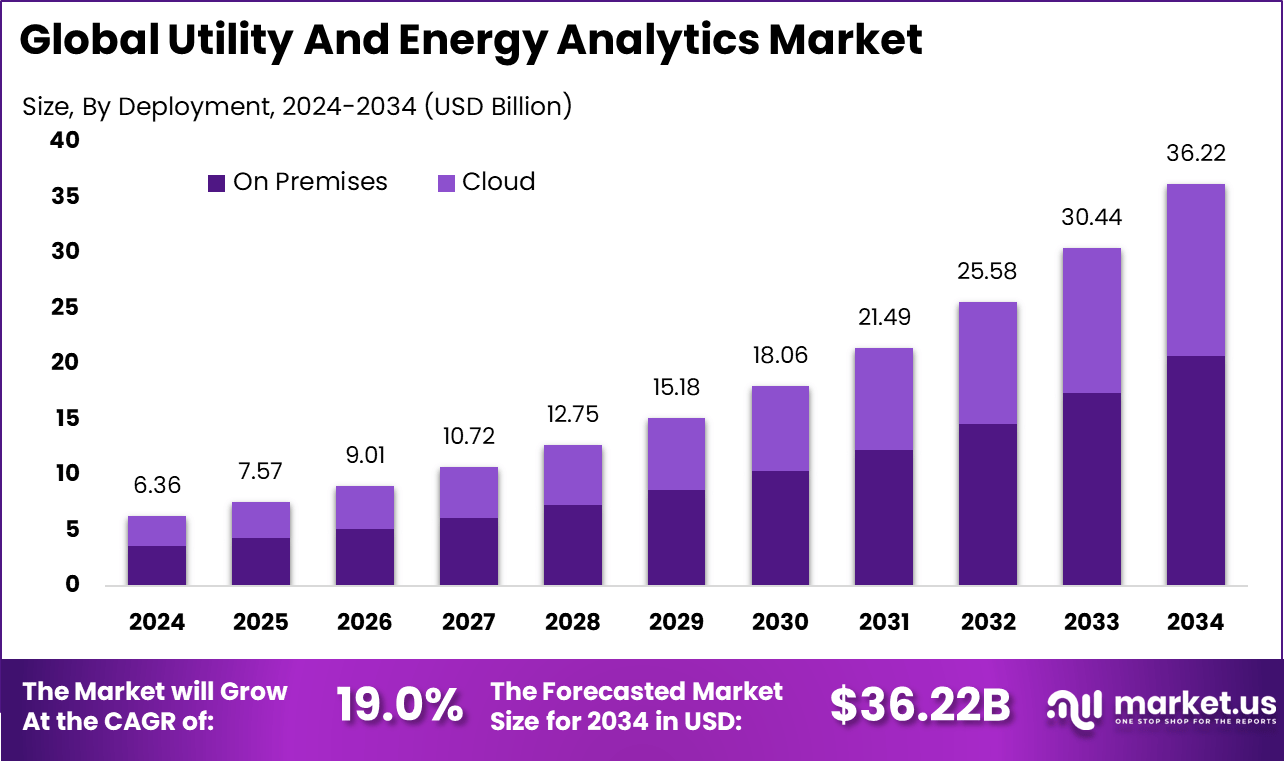
The Global Utility And Energy Analytics Market size is expected to be worth around USD 36.22 billion by 2034, from USD 6.36 billion in 2024, growing at a CAGR of 19.0% during the forecast period from 2025 to 2034. North America held a dominant market position, capturing more than a35.7% share, holding USD 2.27 billion in revenue.
The utility and energy analytics market refers to the use of data analytics tools to monitor, optimize, and manage energy production, distribution, and consumption. These solutions help utilities and energy companies process large volumes of operational and consumer data to make informed decisions. They support energy efficiency, grid reliability, predictive maintenance, and regulatory compliance.
Analytics tools provide actionable insights for both renewable and non-renewable energy sources, helping companies to reduce costs and improve sustainability. Adoption spans electricity, water, gas utilities, and energy service providers. Market development has been driven by the increasing complexity of energy systems and the need for smarter, data-driven solutions.
Investor Type Impact Matrix
| Investor Type | Adoption Level | Contribution to Market Growth (%) | Key Motivation | Investment Behavior |
|---|---|---|---|---|
| Energy providers and utilities | Very High | ~58.7% | Efficiency, compliance, and optimization | Long term strategic investments |
| Solution providers | High | ~26.2% | Market penetration and technology deployment | R and D and product expansion |
| Government bodies | Moderate | ~9.4% | Regulatory compliance and sustainability | Policy development and support |
| Technology vendors | Moderate | ~5.6% | Innovation and analytics platforms | Technology adoption and integration |
| Retail and commercial consumers | Low | ~4.0% | Reduced energy consumption costs | Program based investments |
Technology Enablement Analysis
| Technology Layer | Enablement Role | Impact on Market Growth (%) | Adoption Status |
|---|---|---|---|
| IoT enabled smart meters | Real time data collection for analytics | ~7.3% | Growing |
| Machine learning algorithms | Predictive analysis and pattern recognition | ~6.5% | Growing |
| AI driven optimization platforms | Automated decision making and optimization | ~5.8% | Mature |
| Cloud computing platforms | Scalable data storage and analysis | ~4.4% | Mature |
| Blockchain for energy tracking | Ensuring transparency and data security | ~3.7% | Developing |
Driver Analysis
The utility and energy analytics market is being driven by the increasing demand for improved operational efficiency, cost optimisation, and sustainability in energy production and consumption. Utilities and energy providers are leveraging advanced analytics to process large volumes of data from smart meters, grid sensors, and asset monitoring systems to gain actionable insights into consumption patterns, system performance, and demand forecasting.
The shift toward renewable energy sources, grid modernisation, and regulatory emphasis on efficiency and emission reduction further reinforce investment in analytics solutions that can optimise load balancing, reduce losses, and support proactive maintenance. Enhanced visibility into energy flows enables organisations to make data‑informed decisions that strengthen reliability and customer service.
Restraint Analysis
A key restraint in the utility and energy analytics market relates to the challenges of integrating disparate data sources and ensuring data quality across complex infrastructure environments. Energy systems often combine legacy equipment, diverse communication protocols, and varied sensor technologies, which can make harmonising data for analytics difficult.
Inconsistent or incomplete data can reduce the reliability of analytics outcomes and limit trust in insights. Organisations may also face technical and organisational barriers in aligning analytics platforms with existing operational and enterprise systems, which can increase implementation costs and extend deployment timelines.
Opportunity Analysis
Emerging opportunities in the utility and energy analytics market are linked to the expanding adoption of predictive analytics, real‑time optimisation, and digital twin models that simulate energy systems under varying conditions. Predictive models support proactive maintenance and asset life extension by identifying potential failures before they occur, reducing downtime and repair costs.
There is also opportunity in advanced demand‑side analytics that enable dynamic pricing, load shifting, and tailored energy efficiency programmes for consumers and industrial users. Platforms that combine advanced analytics with visualisation and decision support can help stakeholders across operations, planning, and customer engagement derive more strategic value from energy data.
Challenge Analysis
A central challenge confronting this market involves balancing analytical depth with interpretability and operational relevance. Advanced models such as machine learning algorithms can identify complex patterns and forecast outcomes, but stakeholders often require clear explanations of how insights are generated to trust and act upon them.
Ensuring analytics outputs align with business objectives and regulatory frameworks, while remaining understandable to planners and operators, demands careful design of user interfaces, explanation mechanisms, and contextual reporting. Achieving this balance is essential to drive adoption and integrate analytics into core decision‑making processes.
Emerging Trends
Emerging trends within the utility and energy analytics landscape include the integration of artificial intelligence and machine learning to support real‑time anomaly detection, demand forecasting, and automated optimisation. Another trend is the use of cloud‑based analytics platforms that provide scalable processing, remote access, and collaborative environments for cross‑functional teams.
Utilities are also exploring edge analytics that perform data processing closer to the source, reducing latency and network load for time‑sensitive applications. The convergence of digital twin technologies with energy analytics enables deeper scenario testing, system resilience analysis, and planning for future grid expansions.
Growth Factors
Growth in the utility and energy analytics market is supported by the accelerating deployment of smart meters, IoT sensors, and advanced grid infrastructure that generate high volumes of operational data. Increasing focus on decarbonisation, regulatory compliance, and customer‑centric energy services reinforces the need for analytics that can translate data into actionable insights.
Advancements in data integration, machine learning, and visualisation tools improve the accessibility and utility of analytics outcomes for organisations of varied sizes. As utilities seek to optimise performance, minimise costs, and support sustainable energy goals, analytics platforms remain integral to achieving these objectives and driving competitive advantage in evolving energy ecosystems.
Key Market Segments
By Deployment
- On-premise
- Cloud
By Component
- Software
- Services
- Hardware / Edge Devices
By Application
- Meter Operations and Data Management
- Load and Generation Forecasting
- Demand Response and Flexibility
- Distribution Planning and Optimisation
- Asset Performance Management
- Outage Management and Reliability
By Utility Type
- Electric
- Gas
- Water
- Multi-utility
By End-user
- Generation Utilities
- Transmission and Distribution Operators
- Retail Energy Suppliers
- Independent Power Producers
- Others
Key Regions and Countries
North America
- US
- Canada
Europe
- Germany
- France
- The UK
- Spain
- Italy
- Russia
- Netherlands
- Rest of Europe
Asia Pacific
- China
- Japan
- South Korea
- India
- Australia
- Singapore
- Thailand
- Vietnam
- Rest of APAC
Latin America
- Brazil
- Mexico
- Rest of Latin America
Middle East & Africa
- South Africa
- Saudi Arabia
- UAE
- Rest of MEA
Key Players Analysis
One of the leading players in March 2025, Siemens teamed up with TURN2X to weave biogas data into its analytics platform, sharpening its focus on renewables. This partnership lets utilities track and optimize green energy production in real time, cutting waste in the shift to sustainable sources. It’s the kind of targeted collab that keeps Siemens leading in energy transition analytics.
Top Key Players in the Market
- Oracle Corporation
- IBM Corporation
- Siemens AG
- Schneider Electric SE
- ABB Ltd
- General Electric Company
- SAS Institute Inc.
- SAP SE
- Capgemini SE
- Teradata Corporation
- Hitachi Energy Ltd.
- Landis+Gyr AG
- Itron Inc.
- AutoGrid Systems Inc.
- Wipro Ltd.
- Accenture plc
- Amazon Web Services (AWS) Utilities
- Microsoft Azure Energy
- Enel X
- Nexant Inc.
- OSIsoft (AVEVA)
- Uptake Technologies
- Bidgely Inc.
- Smarter Grid Solutions
- Others
Recent Developments
- In May 2025, Schneider Electric opened an Innovation Center in Houston focused on advanced analytics for grid reliability. This facility helps utilities predict outages and optimize energy flow using real-time data from smart meters. It’s a smart move as North American grids face growing demand from EVs and renewables, giving Schneider an edge in delivering practical tools that cut downtime and boost efficiency for power companies.
- In September 2025, Hitachi Energy took the top spot as the world’s leading grid automation supplier per ARC’s latest study. Their systems excel at integrating analytics for smarter power distribution, especially with rising renewables. This recognition cements their role in helping U.S. and Canadian grids handle more variable energy sources reliably.









