


Report Overview
The Global Edge Observability for RAN Market presents a compelling telecom and edge-computing investment opportunity, having generated USD 1.62 billion in 2025 and expected to scale to nearly USD 8.62 billion by 2035, expanding at a CAGR of 18.2%. North America’s dominant position, accounting for more than 42.1% market share and USD 0.68 billion in revenue, reinforces the region’s role as a primary growth engine for long-term capital deployment.
The edge observability for RAN market covers software and platforms that collect, standardize, and analyze telemetry from radio access networks near the network edge, so that faults, performance drops, and user experience issues can be detected faster. In practical terms, this includes monitoring data from disaggregated RAN functions such as CU, DU, and RU, plus edge cloud workloads that host virtualized RAN components.
The focus is on visibility across metrics, logs, traces, alarms, and performance measurements, presented in a way that operations teams can act on quickly. Adoption is being pushed by the shift toward Open RAN and cloud native RAN designs, where traditional appliance based monitoring is often not enough to explain issues across multiple software layers.
O RAN architecture also increases the number of interfaces and managed elements that must be supervised, which raises the importance of consistent, standards aligned data collection. As a result, observability is being treated as an operational requirement rather than an optional add on, especially for large scale multi vendor environments.
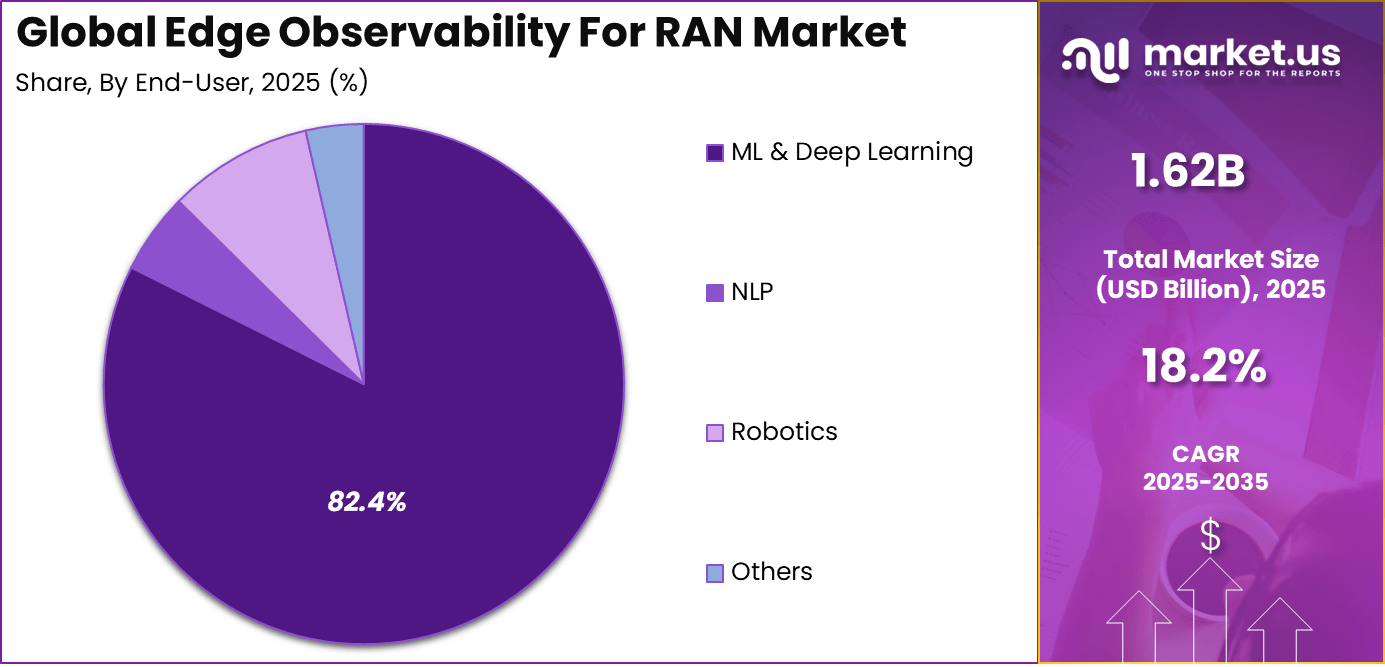
For Instance, in January 2026, NetScout upgraded 5G observability for network slicing, offering end-to-end RAN-to-core views for PM/A in standalone setups. It enables AIOps-driven SLA checks and root cause in minutes for gaming or remote surgery slices. CSPs verify performance to monetize premium services reliably. In 2025, The Mobile Network Operators (MNOs) segment held a dominant market position, capturing a 82.4% share of the Global Edge Observability For RAN Market. Mobile Network Operators lead adoption because they operate large and complex wireless networks. As traffic volumes and coverage areas expand, traditional monitoring methods become inefficient. Edge observability enables operators to monitor performance across regions and user groups in a more detailed and timely manner. This helps reduce outages, improve service quality, and maintain a consistent experience for millions of subscribers. Cost control and operational efficiency also play a major role in driving adoption. Operators face pressure to expand capacity while keeping expenses in check. Observability tools help pinpoint issues faster and optimize resource usage, reducing unnecessary maintenance efforts. By improving visibility and efficiency, these solutions directly support operator performance goals and continue to see strong demand. For Instance, in December 2025, Ericsson partnered with MasOrange on an Intelligent Automation Platform for MNOs, deploying rApps like Cell Anomaly Detector for RAN optimization. It automates energy savings and fault isolation, improving user experience in live networks. MNOs gain proactive issue spotting without extra tools. Investment opportunities are emerging in data model aware observability that can interpret RAN specific semantics rather than treating telemetry as generic infrastructure data. The O RAN community continues to expand specification titles and releases, including work linked to O1 and network resource models, which indicates ongoing evolution in how RAN elements are described and managed. Products that keep pace with these changes and translate them into practical dashboards, alarms, and automated runbooks can improve adoption in multi vendor deployments. Another opportunity is edge first analytics that reduces backhaul load and supports near real time actions. When monitoring is paired with edge analytics, high frequency signals can be processed locally and only summarized insights are sent to central systems, improving scalability. This approach also supports automation programs where RAN analytics and control frameworks are used to adjust parameters faster, especially when service quality must be maintained in dense or highly variable radio environments. A clear business benefit is improved service stability and fewer prolonged incidents, because telemetry correlation speeds up diagnosis across radio, compute, and software layers. When metrics, logs, and traces are captured in a consistent format, operations teams can reduce repetitive manual checks and shorten escalation loops between radio and IT teams. Over time, this can lower operational cost per site by reducing truck rolls and limiting the duration of widespread customer impact events. Another benefit is better readiness for multi vendor operations and faster rollout cycles, which becomes more important as networks shift toward disaggregated RAN and cloud native updates. O RAN management concepts such as O1 and SMO style orchestration increase the importance of clear monitoring, alarms, and configuration tracking across managed elements. In commercial terms, observability supports quicker acceptance testing, clearer accountability, and more reliable scale out of new sites and features, which can improve time to operational maturity after deployment. Edge observability for Radio Access Networks (RAN) is being shaped by the increasing complexity of distributed network environments and the need for real-time insight into system performance. Traditional monitoring methods are evolving into comprehensive observability frameworks that collect, correlate, and analyse telemetry from edge nodes to provide visibility into latency, throughput, and packet behaviour at the network edge. Another emerging trend is the integration of cybersecurity monitoring into edge observability systems for RAN. Edge observability solutions are being used to detect anomalies, identify potential threats, and support rapid security response across distributed radio access points. As cyber threats become more sophisticated, the value of real-time threat detection and proactive security controls at the edge is increasingly recognised by network operators. A significant opportunity lies in deploying edge observability solutions to support multi-access edge computing (MEC) and virtualised network functions, where performance must be continuously monitored across distributed computing resources. Observability can help operators understand interactions between network slices, edge applications, and user traffic, improving service reliability in real-time. This creates potential value for service providers prioritising quality of experience and network automation. Another opportunity is in enhancing security visibility at the network edge, where observability tools can provide actionable insights into unusual activity and potential vulnerabilities. As networks evolve to support more critical services, such as industrial IoT and autonomous applications, robust edge observability that includes security analytics can be a differentiator. This expands use cases beyond performance monitoring to broader network assurance. A primary challenge is managing the scale of telemetry data generated at the edge, where large volumes of performance metrics, logs, and event data must be collected, processed, and analysed without overwhelming network or compute resources. Efficiently handling this data requires careful design of observability pipelines and resource allocation strategies. If not managed effectively, high data volumes can negate the responsiveness that edge observability seeks to provide. Another challenge is securing the observability infrastructure itself, as distributing telemetry sources across many edge nodes increases the potential attack surface. Protecting observability data and ensuring secure communications between edge and central management systems is essential, yet adds complexity to system design and operations. This requires robust security frameworks that balance performance visibility with data protection. Leading telecom infrastructure vendors such as Ericsson, Nokia Corporation, Huawei Technologies Co., Ltd., and Samsung Electronics Co., Ltd. dominate the edge observability for RAN market. Their solutions are closely integrated with 4G and 5G radio access networks. AI-driven analytics support real-time performance monitoring, fault detection, and latency optimization at the network edge. These players benefit from direct relationships with mobile network operators. Demand is driven by the rollout of 5G standalone networks and edge computing use cases. Test, measurement, and assurance specialists such as Keysight Technologies, Inc., Viavi Solutions, Inc., and Spirent Communications plc play a critical role in validating RAN performance. EXFO, Inc. and Anritsu Corporation support edge observability through advanced probing and analytics tools. Their platforms help operators ensure service quality and compliance. Adoption is strong during network rollout, optimization, and troubleshooting phases. Software and network visibility providers such as RADCOM, Ltd., Netscout Systems, Inc., and Accedian Networks, Inc. focus on real-time traffic analysis and service assurance. Kentik, Inc., Empirix, Inc., and Cubro Network Visibility strengthen edge-level visibility. Other vendors expand regional reach and innovation. This competitive landscape supports reliable and scalable edge observability for next-generation RAN deployments.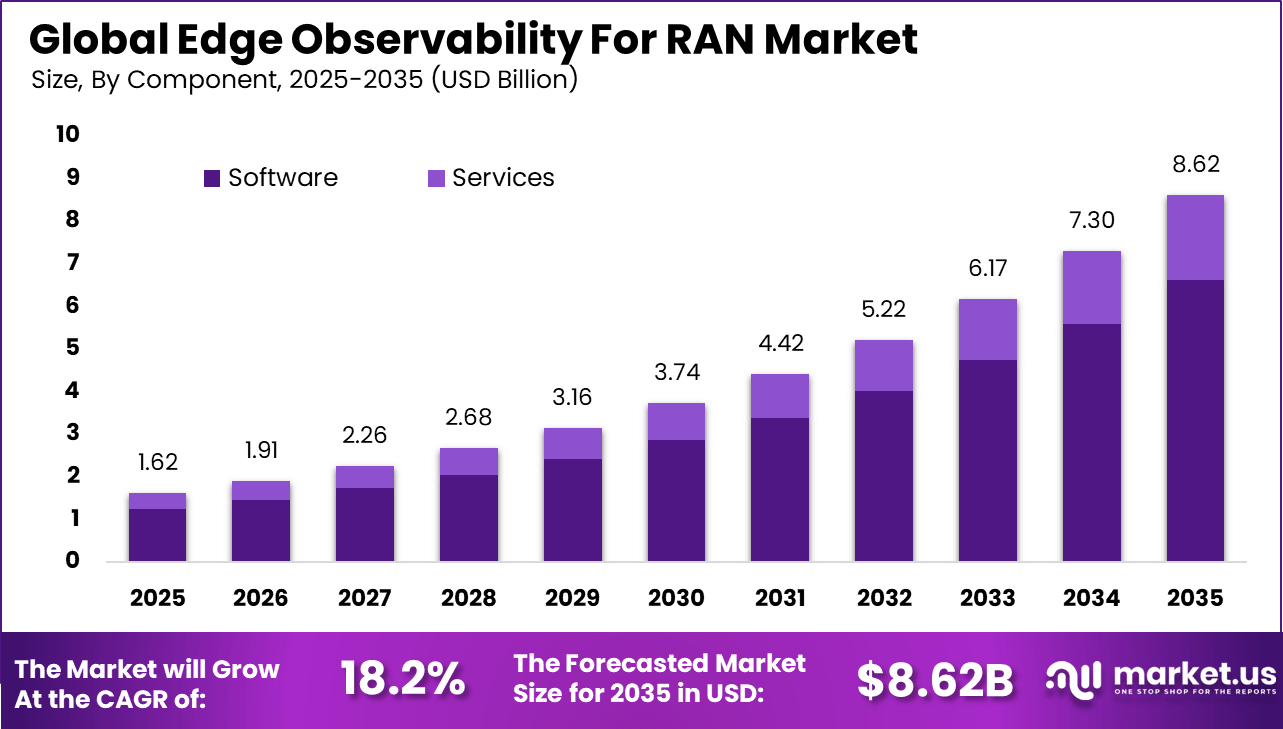
End-User Analysis
Investment Opportunities
Business Benefits
Investor Type Impact Matrix
Investor Type Strategic Objective Risk Tolerance Market Influence Telecom equipment vendors Differentiation through network intelligence Medium High Network analytics platform providers Expansion of edge observability capabilities Medium High Venture capital firms High growth telecom software platforms High Medium Private equity investors Long term returns from telecom digitalization Medium Medium Strategic telecom operators Network reliability and service quality leadership Low to Medium Medium Technology Enablement Analysis
Technology Enabler Functional Role Impact on Adoption Adoption Timeline Edge native observability platforms Real time visibility into RAN performance Very High Short term AI driven anomaly detection and root cause analysis Faster fault identification and resolution High Short to medium term Cloud native data collection and processing Scalable monitoring across distributed sites Very High Short term Integration with Open RAN architectures Multi vendor performance assurance High Medium term Advanced telemetry and streaming analytics Continuous monitoring of network KPIs Medium Medium to long term Emerging Trends Analysis
Opportunity Analysis
Challenge Analysis
Key Market Segments
By Component
By Deployment Mode
By Network Type
By Application
By End-User
Regional Analysis and Coverage
Key Players Analysis
Top Key Players in the Market
Recent Developments









