


Report Overview
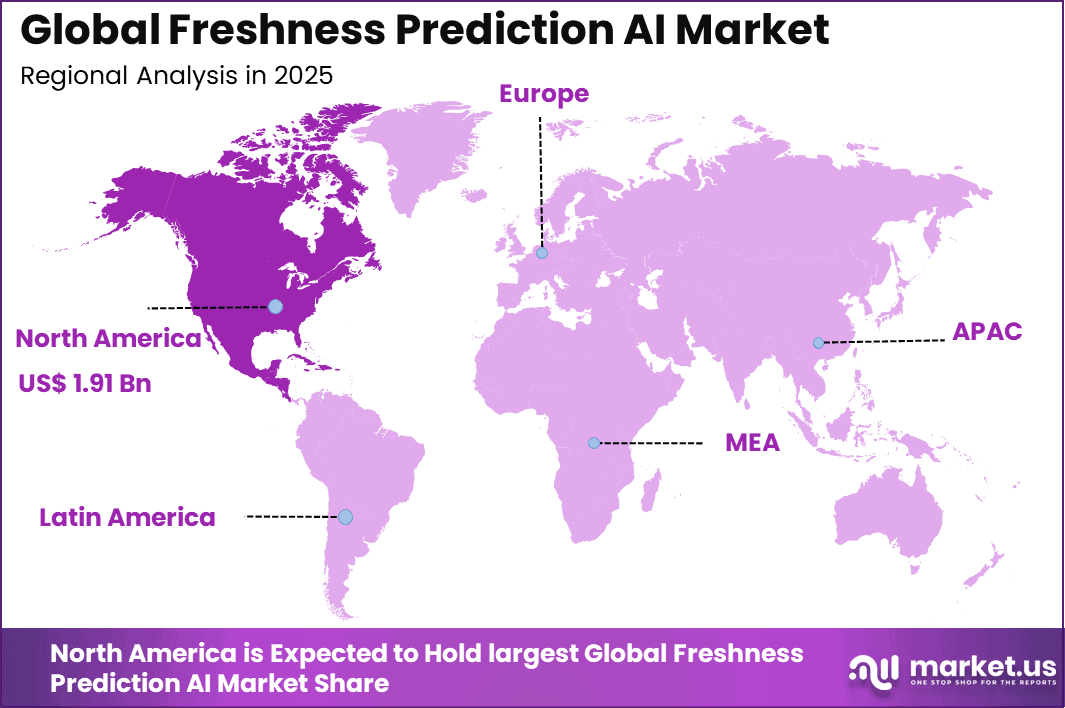
The Global Freshness Prediction AI Market size is expected to be worth around USD 25.07 billion by 2035, from USD 4.63 billion in 2025, growing at a CAGR of 18.4% during the forecast period from 2025 to 2035. North America held a dominant market position, capturing more than a41.26% share, holding USD 1.91 billion in revenue.
The freshness prediction artificial intelligence market refers to technology solutions that apply machine learning models, computer vision, and predictive analytics to assess the quality or spoilage status of perishable products. This market is influenced by the increasing need for accurate freshness assessment across the food supply chain, from harvesting and processing to retail and consumption.
AI-enabled systems analyse real time data from sensors, images, environmental conditions, and historical patterns to determine freshness levels and forecast spoilage. Adoption is driven by operational needs to reduce food waste, enhance food safety, and optimise inventory management within complex distribution networks. Technological innovation in this field supports more reliable quality assurance processes and contributes to sustainability goals in the food ecosystem.
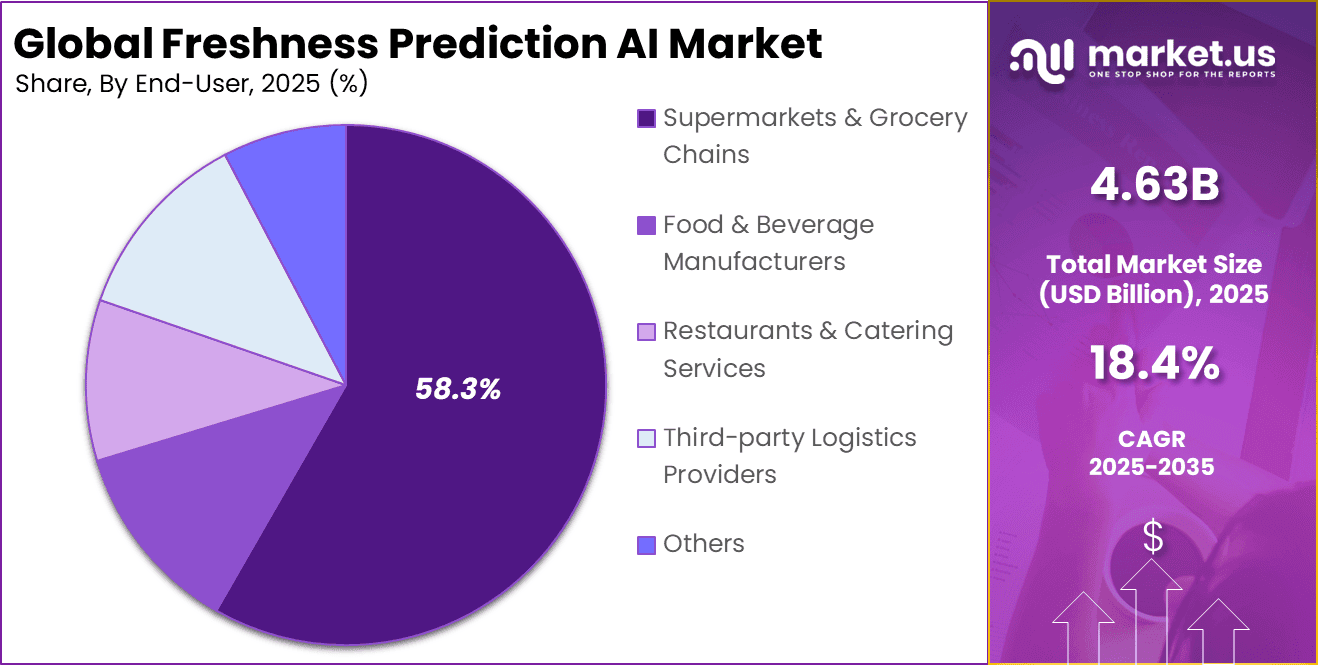
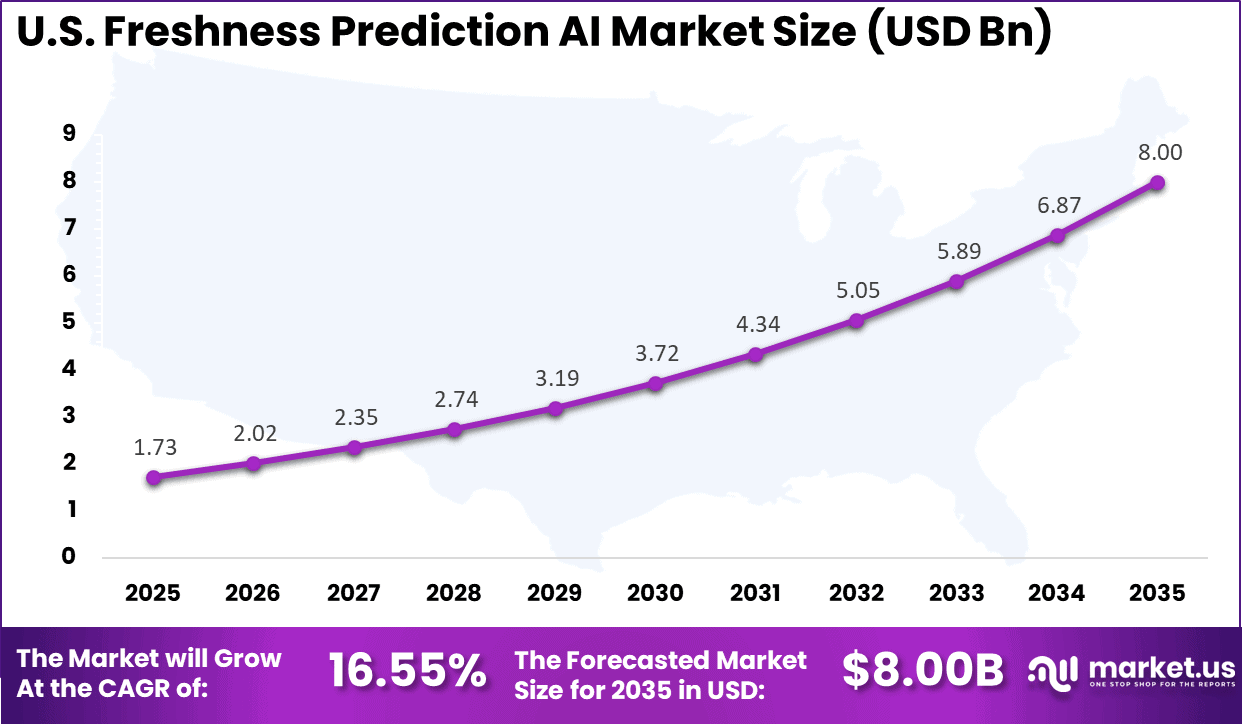
For Instance, in November 2025, Afresh Technologies launched its AI-powered Fresh Buying solution with Wakefern. This tool uses smart algorithms to forecast demand and pick vendors for produce and meat. It streamlines workflows to cut waste and ensure fresh stock reaches stores fast. Buyers get real-time insights, making daily decisions easier in the fast, fresh supply chain. In 2025, the Cloud-based/SaaS segment held a dominant market position, capturing a 68.7% share of the Global Freshness Prediction AI Market. Cloud based and SaaS platforms are expanding because they are easy to deploy and manage across multiple locations. Businesses can access freshness insights in real time without investing heavily in IT infrastructure. This flexibility is especially valuable for grocery chains and distributors with wide networks. Cloud platforms allow users to add new stores, sensors, or data sources quickly as operations expand. Regular software updates and remote access also help companies keep systems current and reliable, supporting long term adoption. For instance, in March 2025, Crisp acquired Shelf Engine’s AI demand planning tech. This boosts Crisp’s cloud platform for real-time inventory forecasts in fresh goods. Retailers now automate orders via SaaS to match demand and slash spoilage. The move expands data sharing across supply chains for better perishables handling. Easy integration drives wider use. In 2025, The Retail & Grocery segment held a dominant market position, capturing a 52.8% share of the Global Freshness Prediction AI Market. Retail and grocery applications are growing as stores face constant pressure to keep products fresh while reducing waste. Freshness prediction tools help retailers plan replenishment more accurately and avoid overstocking items with short shelf lives. This improves inventory efficiency and customer satisfaction. Shoppers increasingly demand fresh and safe food, especially for produce, meat, and dairy. Retailers use freshness insights to maintain quality standards and build trust, which drives continued investment in this application area. For Instance, in January 2026, OneThird rolled out AI-driven Visual Inspection in its Digital Quality Platform. The tool scans soft fruits like berries for defects and shelf life in stores. It speeds quality checks up to 10 times, helping grocers pick fresher stock and reduce waste at retail. Cloud reports aid smart stocking decisions. In 2025, The IoT Sensor Data segment held a dominant market position, capturing a 41.6% share of the Global Freshness Prediction AI Market. IoT sensor data is growing in importance because it provides continuous and accurate information on product conditions. Sensors track temperature, humidity, and handling across the supply chain, which improves freshness prediction accuracy compared to manual inspections. Growth is further supported by better connectivity and lower sensor costs. As sensors become easier to install and maintain, more businesses rely on real time data to monitor freshness. This makes IoT a core input for AI-driven freshness systems. For Instance, in June 2022, Strella Biotechnology raised $8M to scale its IoT biosensors for fruit ripeness. Sensors track maturity from harvest to shelf, streaming data for precise freshness predictions. This cuts produce waste by optimizing routes and inventory. Growers gain actionable insights to boost quality across the chain. In 2025, The Supermarkets & Grocery Chains segment held a dominant market position, capturing a 58.3% share of the Global Freshness Prediction AI Market. Supermarkets and grocery chains are driving growth due to their high exposure to spoilage losses. Managing large volumes of perishable goods across many stores creates a strong need for predictive tools that support timely decisions and reduce waste. These organizations also have the scale and digital readiness to adopt AI solutions. Centralized data systems and standardized processes make it easier to roll out freshness prediction across locations, supporting steady growth in this end-user segment. For Instance, in September 2025, Afresh introduced Fresh Store Suite for grocery inventory and production planning. AI handles end-of-period counts and fresh prep for chains. It unifies data to minimize overstock in supermarkets. Partners report less waste and smoother ops in high-volume stores. Scalable for big retail networks. The market for Freshness Prediction AI within the U.S. is growing tremendously and is currently valued at USD 1.73 billion, the market has a projected CAGR of 16.55%. The market is growing due to rising demand for food safety, waste reduction, and real time quality monitoring across retail, foodservice, and supply chain operations. Grocery chains and distributors increasingly adopt AI-driven analytics to predict spoilage, optimize inventory turnover, and extend shelf life. Growth in e-commerce grocery, stricter food safety regulations, and higher consumer expectations for fresh produce further accelerate adoption, making AI-based freshness solutions a strategic priority across the US food ecosystem. For instance, in November 2025, Afresh Technologies, Inc. launched the industry’s first AI-powered Fresh Buying solution with Wakefern Food Corp., enabling real-time visibility, coordination, and intelligent decision-making for fresh produce distribution centers. This innovation optimizes supply chains, reduces waste, and maximizes freshness and profits, reinforcing U.S. leadership in AI-driven freshness prediction. In 2025, North America held a dominant market position in the Global Freshness Prediction AI Market, capturing more than a 41.26% share, holding USD 1.91 billion in revenue. This dominance is due to early adoption of advanced AI technologies across food retail, logistics, and cold chain infrastructure. The region benefits from a strong presence of large grocery chains, advanced supply chain digitization, and high investment in AI driven analytics. Strict food safety regulations, rising focus on food waste reduction, and widespread use of smart sensors and IoT further support adoption, enabling consistent deployment of freshness prediction solutions at scale. For instance, in April 2025, Shelf Engine, Inc. was acquired by Crisp, enhancing AI demand forecasting and automated ordering for fresh goods. The integration bolsters food waste reduction and inventory optimization in grocery retail, showcasing North American dominance in predictive freshness technologies. A significant emerging trend within the Freshness Prediction AI market is the integration of real time sensor data and machine learning to dynamically assess product quality throughout the supply chain. AI models are being trained with environmental, visual, and biochemical data to predict how long perishable items will remain fresh and safe for consumption, which supports faster decision making for producers, retailers, and consumers. Recent research illustrates that devices using smartphone imaging and advanced algorithms can classify produce freshness directly from RGB images, enabling real time predictions even at retail or household levels. Another trend is the adoption of intelligent freshness indicators that adjust estimates based on actual storage conditions rather than static expiry dates. These AI frameworks combine temperature, humidity, and handling variables to refine spoilage projections and reduce waste. The shift from traditional static labeling toward predictive AI driven expiration estimations is gaining traction in efforts to improve food safety and supply chain transparency across food and beverage industries. An opportunity in the Freshness Prediction AI market exists in tailoring AI models for specific food categories and localized conditions. By training algorithms on diverse datasets that reflect different climates, storage methods, and product characteristics, solutions can offer more precise and location sensitive freshness estimates. This customisation enhances predictive relevance for producers and retailers operating in varied environments, expanding applicability across global markets. Expansion of mobile and edge computing applications also presents an opportunity. AI models deployed on smartphones or handheld scanners enable on the spot freshness assessments without the need for complex infrastructure. These portable solutions can empower smaller retailers, farmers, and even consumers to access predictive freshness insights, opening new channels for adoption and scaling. Specialized food retail and supply chain technology providers such as Afresh Technologies, Inc., Shelf Engine, Inc., and Crisp focus on AI-driven demand sensing and freshness prediction. Their platforms analyze sales patterns, inventory age, and supplier data to reduce spoilage. These solutions are widely adopted by grocery retailers and distributors. The value proposition centers on waste reduction and improved product availability. Post-harvest and produce-focused innovators such as Zest Labs, Inc., OneThird, and Strella Biotechnology, Inc. emphasize real-time quality assessment. ImpactVision and AgShift, Inc. apply computer vision and sensor data to predict remaining shelf life. These players support growers, packers, and retailers. Their tools improve pricing decisions and cold chain efficiency across fresh produce categories. Food preservation and enterprise platform providers such as Apeel Sciences, Hazel Technologies, Inc., and Wasteless, Ltd. complement AI prediction with shelf-life extension and pricing optimization. IBM Corporation and Microsoft Corporation support scalable deployment through cloud analytics and IoT integration. Other vendors expand niche use cases.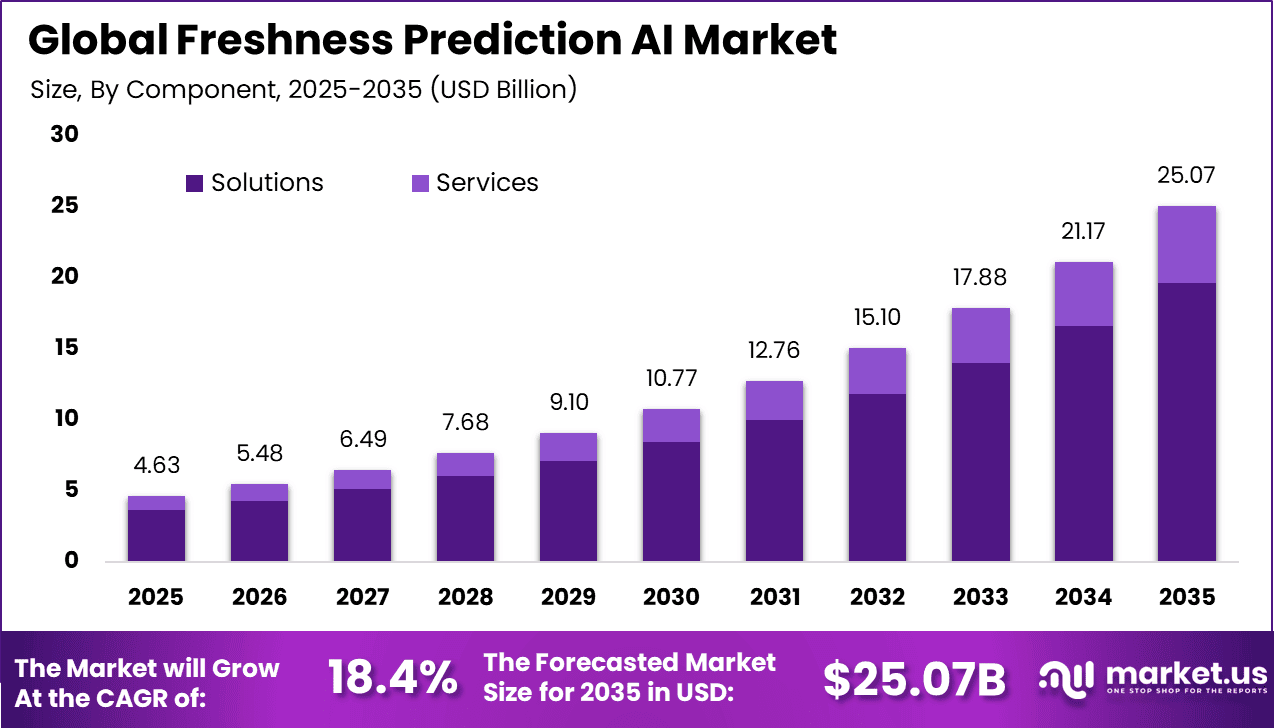
Deployment Mode Analysis
Application Analysis
Technology Input Analysis
End-User Analysis
Investor Type Impact Matrix
Investor Type Growth Sensitivity Risk Exposure Geographic Focus Investment Outlook Food technology companies Very High Medium North America, Europe Strong alignment with sustainability goals AI and analytics platform investors High Medium Global Scalable software-driven returns Logistics and cold chain operators Medium Low to Medium North America, Asia Pacific Efficiency-led strategic investments Private equity firms Medium Medium North America, Europe Platform expansion and consolidation Venture capital investors Very High High North America Early-stage innovation upside Technology Enablement Analysis
Technology Enabler Impact on CAGR Forecast (~)% Primary Function Geographic Relevance Adoption Timeline Machine learning-based freshness prediction models +5.0% Shelf-life estimation accuracy Global Short to medium term IoT sensors for temperature and humidity monitoring +4.3% Real-time data capture North America, Europe Medium term Computer vision for visual quality assessment +3.6% Non-invasive inspection Global Medium term Cloud-based analytics and dashboards +3.1% Scalability and remote access Global Medium to long term Edge AI for on-site freshness analysis +2.4% Low-latency decision making North America Long term U.S. Market Size
Emerging Trend Analysis
Opportunity Analysis
Key Market Segments
By Component
By Deployment Mode
By Application
By Technology Input
By End-User
By Region
Key Players Analysis
Top Key Players in the Market
Recent Developments









