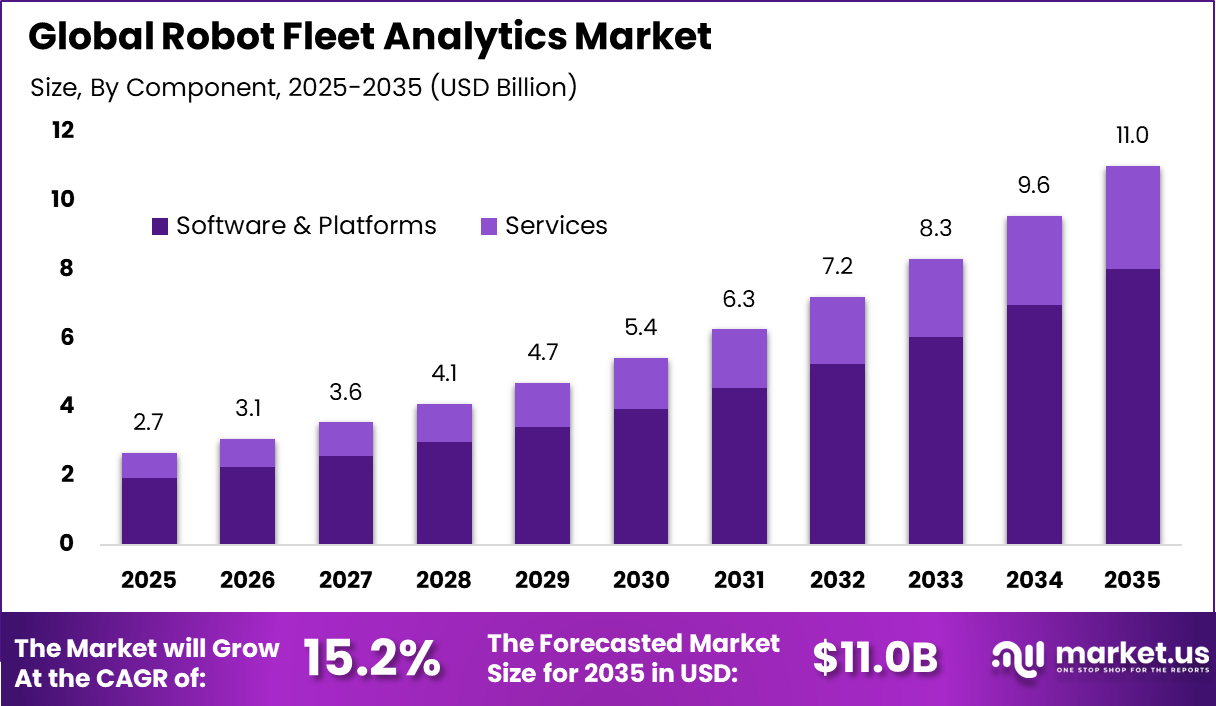
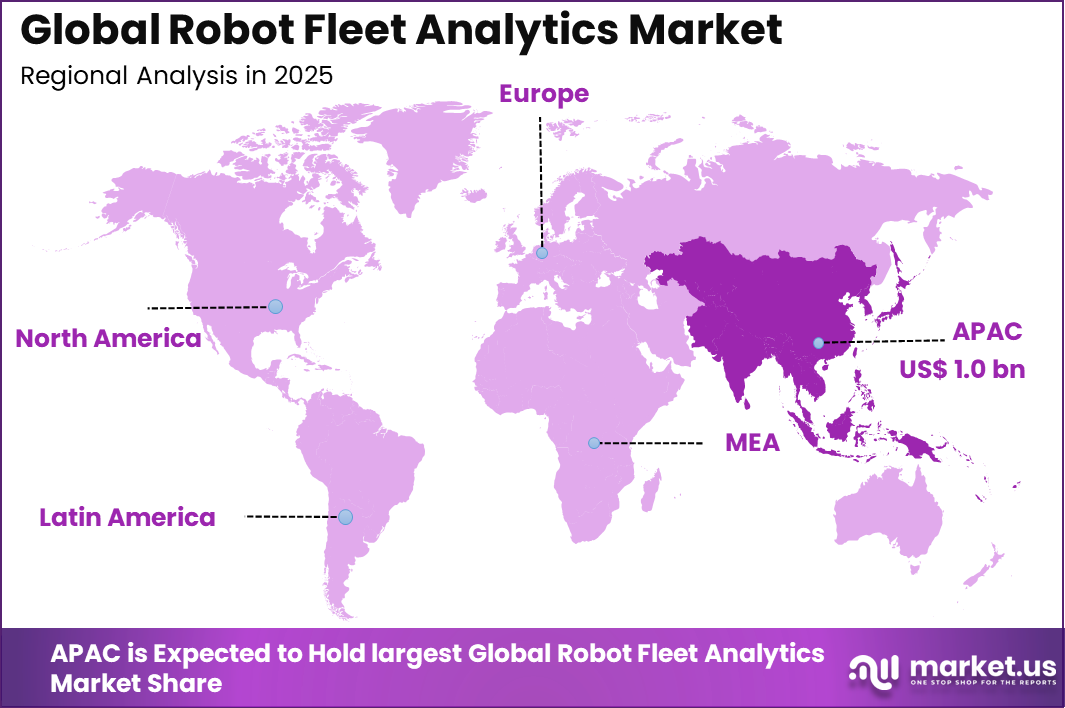
The Global Robot Fleet Analytics Market size is expected to be worth around USD 11 Billion By 2035, from USD 2.7 billion in 2025, growing at a CAGR of 15.2% during the forecast period from 2026 to 2035. Asia-Pacific held a dominant Market position, capturing more than a 40.2% share, holding USD 1.0 Billion revenue.
The Robot Fleet Analytics Market refers to software platforms and analytical systems that monitor, analyze, and optimize the performance of multiple robots operating simultaneously. These robots are deployed across warehouses, factories, hospitals, campuses, and outdoor operational environments. Fleet analytics focuses on collecting real time data related to robot location, task execution, battery status, utilization, errors, and downtime.
The market has gained strategic importance as organizations transition from isolated robot deployments to large scale autonomous fleets. Autonomous robotics usage has scaled rapidly across multiple sectors. By late 2024, Brain Corp’s autonomous robot fleet had surpassed 250 billion square feet of total coverage, reflecting large scale commercial deployment. Utilization of autonomous mobile robots increased sharply between 2022 and 2024, led by warehouse and industrial environments with a 340% rise.
+1.9%
Global
Medium to long term
Restraint Impact Analysis
Key Restraint
Impact on CAGR Forecast (~%)
Geographic Relevance
Impact Timeline
High initial cost of analytics platforms and integration
-2.8%
Emerging Markets
Short to medium term
Complexity of integrating analytics across multi-vendor robot fleets
-2.4%
Global
Medium term
Limited analytics expertise among small and mid-sized operators
-2.0%
Asia Pacific, Latin America
Medium term
Data standardization and interoperability challenges
-1.7%
Global
Medium term
Cybersecurity risks in connected robotic systems
-1.5%
North America, Europe
Medium to long term
By Component
Software and platforms account for 72.8% of overall adoption in the Robot Fleet Analytics Market. This dominance reflects strong demand for centralized tools that monitor, analyze, and optimize robot performance across large fleets. Software platforms provide visibility into utilization, downtime, and task efficiency.
The reliance on software is further driven by the need for data driven decision making. Analytics dashboards enable operators to identify bottlenecks and improve throughput. This capability reduces operational inefficiencies and supports continuous improvement.
Software platforms also support integration with enterprise systems. Connectivity with warehouse management and manufacturing execution systems enhances coordination. These factors sustain the leading position of software and platforms.
By Deployment Mode
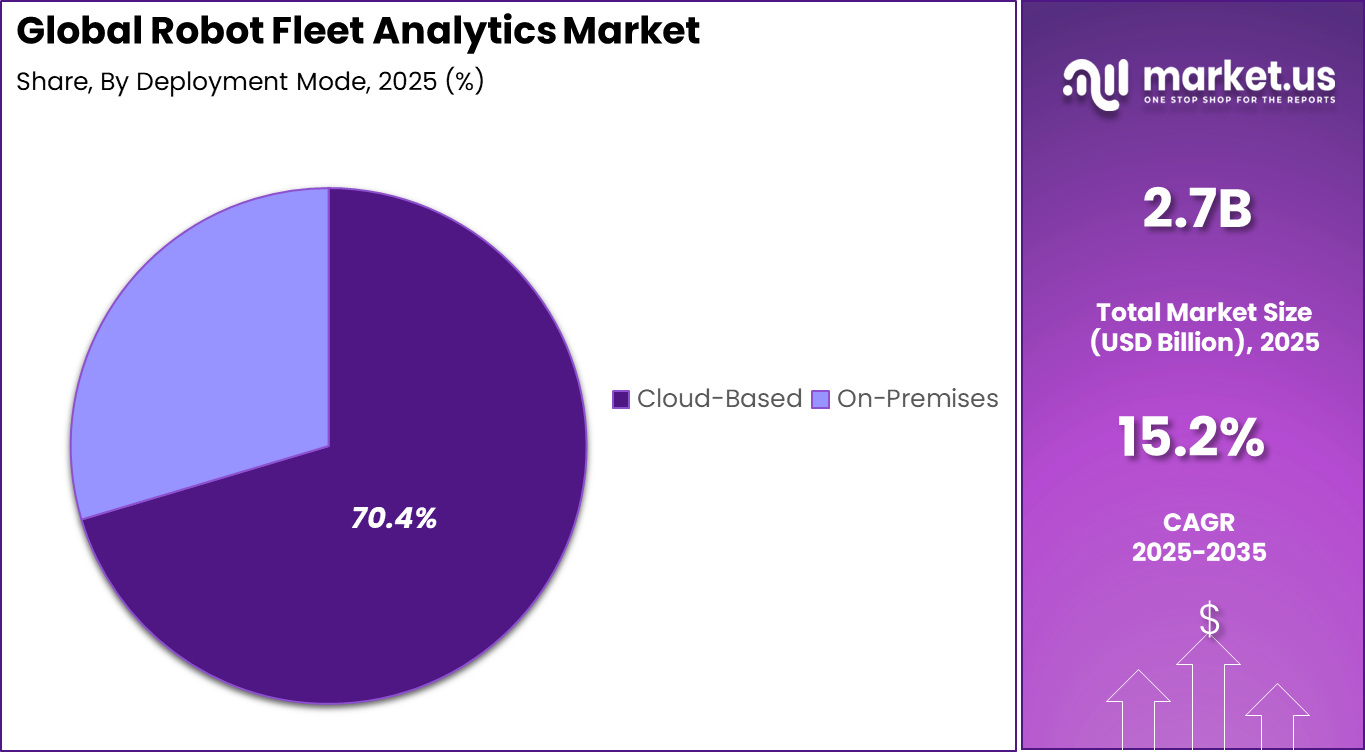
Cloud based deployment represents 70.4% of total adoption. Cloud environments enable scalable data processing and real time analytics across distributed robot fleets. Organizations benefit from centralized management without maintaining complex infrastructure. The preference for cloud deployment is also influenced by flexibility and speed.
Updates and feature enhancements can be deployed centrally. This allows rapid adaptation to changing operational needs. Cloud based models further support remote monitoring. Fleet managers can access insights from multiple locations. These advantages reinforce cloud deployment as the dominant mode.
By Robot Type
Industrial robots account for 41.6% of total robot type adoption. These robots are widely used in manufacturing and warehousing environments where precision and reliability are critical. Fleet analytics helps optimize task scheduling and maintenance. The dominance of industrial robots is also linked to high capital investment.
Organizations seek to maximize asset utilization and reduce downtime. Analytics provides actionable insights to achieve these goals. Industrial robots often operate in complex environments. Monitoring performance and health improves safety and productivity. This sustains strong adoption within this robot type segment.
By End User Industry
Logistics and e commerce represent 32.1% of end user demand. These industries rely heavily on automated material handling and order fulfillment systems. Fleet analytics supports efficiency in high volume operations. The growth of online retail increases pressure on logistics performance. Analytics enables real time tracking and optimization of robot workflows.
This improves order accuracy and delivery speed. E commerce operations also face seasonal demand fluctuations. Fleet analytics supports dynamic resource allocation. These needs maintain strong demand from logistics and e commerce users.
Regional Perspective
Asia Pacific holds a leading position in the Robot Fleet Analytics Market, accounting for 40.2% of total activity. The region benefits from rapid automation adoption and strong manufacturing growth. Investment in robotics continues to rise across industries. Government initiatives supporting smart manufacturing further drive regional demand. Analytics tools are increasingly used to optimize robotic investments. These factors reinforce Asia Pacific’s leadership.
China Market Overview
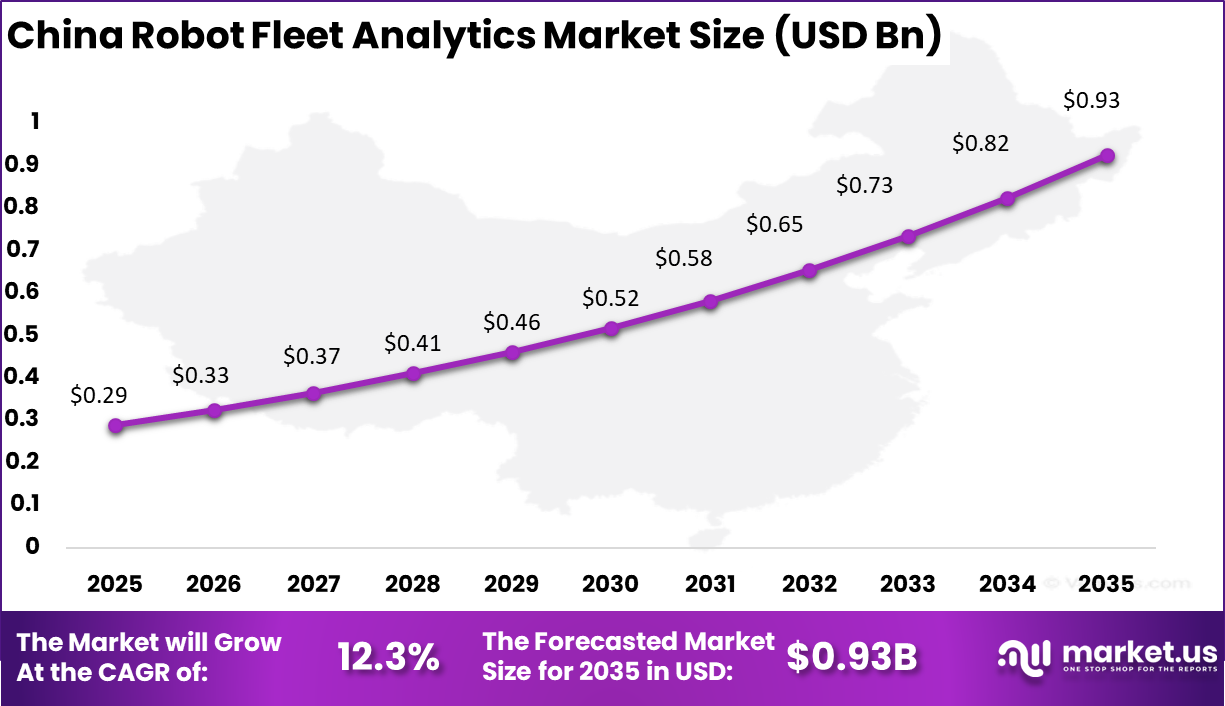
China represents a major contributor within the Asia Pacific region, with a market value of USD 0.29 Billion and a growth rate of 12.3% CAGR. Expansion is supported by large scale deployment of industrial robots and advanced logistics systems. Fleet analytics plays a key role in operational optimization.
Adoption in China is influenced by efficiency goals and labor cost considerations. Organizations focus on maximizing robot productivity. These dynamics collectively support steady growth in the China market segment.
Trends and Disruptions Impacting Customers
Customers are increasingly embracing robot fleet analytics as operations scale and become more complex. In warehousing and logistics, analytics help track inventory movement, reduce idle time, and improve order fulfilment performance.
The value of these insights is notable, as automated environments require coordination among many autonomous mobile robots and other equipment. At the same time, manufacturing and healthcare applications are relying on analytics to enhance safety, monitor task completion rates, and anticipate maintenance needs before breakdowns occur.
Disruptions and challenges in this market are connected to data integration, interoperability, and the need for advanced software platforms. Organisations often face difficulty in unifying data from robots made by different vendors, which can slow analytics deployment and reduce visibility into fleet performance.
Additionally, cybersecurity and data privacy concerns influence customer choices, especially as analytics systems are connected to enterprise networks. Despite these challenges, the increasing volume of robotics deployment encourages investment in analytics tools that can bring long term operational clarity and cost savings.
Investor Type Impact Matrix
Investor Type
Growth Sensitivity
Risk Exposure
Geographic Focus
Investment Outlook
Robotics software and analytics providers
Very High
Medium
North America, Europe
Strong recurring SaaS revenue
Industrial automation and robotics manufacturers
High
Medium
Global
Value-added analytics expansion
Logistics and warehouse automation operators
Medium
Low to Medium
Global
Productivity-driven investment
Private equity firms
Medium
Medium
North America, Europe
Platform scaling and consolidation
Venture capital investors
High
High
North America
Innovation-led analytics platforms
Technology Enablement Analysis
Technology Enabler
Impact on CAGR Forecast (~%)
Primary Function
Geographic Relevance
Adoption Timeline
Cloud-based robot fleet management and analytics platforms
+4.2%
Centralized monitoring
Global
Short to medium term
AI and machine learning for performance optimization
+3.6%
Predictive insights
Global
Medium term
Real-time telemetry and sensor data analytics
+3.1%
Operational visibility
Global
Medium term
Predictive maintenance and failure forecasting tools
+2.5%
Reduced downtime
North America, Europe
Medium to long term
Integration with warehouse, MES, and ERP systems
+1.8%
End-to-end optimization
Global
Long term
Increasing Adoption Technologies
Cloud based data aggregation technologies are widely adopted within robot fleet analytics platforms. These systems collect real time data from distributed robots and centralize analysis. Cloud architectures support scalability and remote access. This technology enables fleet level visibility across locations.
Machine learning based performance analysis is also gaining adoption. These models identify patterns in robot behavior and predict failures before they occur. Automated anomaly detection reduces reliance on manual supervision. Technology adoption improves both responsiveness and decision accuracy.
Organizations adopt advanced analytics technologies to manage operational complexity. As fleets grow, manual tracking becomes unreliable. Automated analytics ensures consistent performance monitoring across all robots. This reduces operational risk and management overhead.
Another reason is optimization of resource usage. Analytics helps balance workloads, optimize charging cycles, and reduce idle time. These improvements lower energy consumption and extend hardware lifespan. The resulting cost savings strengthen the adoption case.
Investment and Business Benefits
Investment opportunities in this market exist in platforms that support heterogeneous robot fleets. Many organizations operate robots from different vendors. Analytics solutions that integrate across systems offer higher value. This interoperability focus attracts strong enterprise interest.
There are also opportunities in analytics solutions tailored for industry specific use cases. Warehousing, manufacturing, and healthcare each have distinct performance metrics. Specialized analytics improve relevance and adoption. Investors favor solutions that demonstrate clear operational impact.
For businesses, robot fleet analytics delivers improved productivity and reliability. Real time insights allow faster response to issues and better planning. This leads to smoother operations and higher throughput. Analytics transforms robotic fleets into predictable assets.
From a financial perspective, analytics reduces maintenance costs and extends robot service life. Early fault detection lowers repair expenses. Improved utilization increases return on automation investments. These benefits compound as fleet size increases.
Emerging Trends Analysis
An emerging trend in the robot fleet analytics market is the use of artificial intelligence for autonomous optimization. Machine learning models are increasingly applied to predict congestion, recommend task reassignment, and optimize fleet behavior over time. This shifts analytics from passive monitoring to active decision support. Intelligent automation is becoming a defining feature.
Another trend is integration with enterprise systems such as warehouse management, manufacturing execution, and facility management platforms. Linking robot analytics with broader operational data improves coordination and planning. This integration supports end to end visibility across automated and human driven processes.
Growth Factors Analysis
One of the key growth factors for the robot fleet analytics market is the continued expansion of warehouse and logistics automation. E commerce growth and labor constraints are driving large scale robot adoption. Managing these fleets efficiently requires analytics driven oversight. This structural demand supports sustained market growth.
Another growth factor is rising emphasis on performance accountability in automation investments. Organizations expect measurable productivity gains and cost savings from robots. Fleet analytics provides the metrics and insights needed to justify and optimize these investments. As automation budgets increase, demand for analytics grows in parallel.
Opportunity Analysis
A significant opportunity in the robot fleet analytics market lies in optimization driven automation. Analytics can be used not only to monitor performance but also to dynamically adjust task allocation, routing, and workload balancing across robots. This level of optimization improves throughput and reduces energy consumption. Organizations seeking higher automation efficiency increasingly value these capabilities.
Another opportunity is expansion into service and healthcare robotics. Hospitals, hotels, and public facilities are deploying fleets of service robots for delivery, cleaning, and assistance. These environments require high reliability and compliance with operational standards. Fleet analytics supports oversight, reporting, and performance assurance, creating new demand outside traditional industrial settings.
Challenge Analysis
A major challenge for the robot fleet analytics market is ensuring reliable real time data connectivity. Fleet analytics depends on continuous data streams from robots operating across large facilities or multiple locations. Network interruptions or latency can affect visibility and decision making. Ensuring resilient connectivity remains critical.
Another challenge is translating technical metrics into actionable business insights. Raw robot telemetry may not be meaningful to operations managers. Analytics platforms must present insights in an intuitive and decision oriented manner. Bridging the gap between technical data and operational outcomes is essential for adoption.
Competitive Analysis
Industrial automation and robotics leaders such as ABB Ltd., Siemens AG, and Rockwell Automation play a central role in the robot fleet analytics market. Their platforms integrate analytics with factory automation, warehouse management, and industrial IoT systems. Fleet-level data is used to monitor utilization, downtime, and predictive maintenance. Strong enterprise integration and global customer bases support adoption. Demand is driven by the need to improve operational efficiency and reduce unplanned robot downtime.
Warehouse and mobile robotics specialists such as Amazon Robotics, Locus Robotics, and GreyOrange focus on analytics for large robot fleets. Geekplus Technology, Mobile Industrial Robots, and Fetch Robotics emphasize real-time visibility, task optimization, and fleet orchestration. These players benefit from rapid growth in eCommerce fulfillment and logistics automation. Analytics helps customers scale robot deployments with predictable performance.
Advanced robotics and navigation-focused providers such as Boston Dynamics, Clearpath Robotics, and KUKA AG offer analytics tied to motion control and autonomous navigation. Omron Corporation, Honeywell International Inc., and BlueBotics support fleet monitoring through software intelligence. Seegrid Corporation and Vecna Robotics address material handling use cases. Other vendors expand competition and innovation, supporting scalable robot fleet analytics across industries.
Top Key Players in the Market
Amazon Robotics
ABB Ltd.
Boston Dynamics
Clearpath Robotics
KUKA AG
Omron Corporation
Siemens AG
Rockwell Automation
Honeywell International Inc.
Locus Robotics
GreyOrange
Geekplus Technology
Mobile Industrial Robots (MiR)
Seegrid Corporation
BlueBotics
Vecna Robotics
Others
Recent Developments
April, 2025 – Locus Robotics surpassed 5 billion picks globally with LocusONE platform providing real-time orchestration, predictive analytics, and labor guidance across 350+ sites, enabling dynamic scaling from 87 daily bots to 104 peak bots.
February, 2025 – Boston Dynamics launched Orbit fleet management platform for Spot robots, unifying multi-site visibility, mission scheduling, predictive alerts, and cloud connectivity across 1,500+ Spots worldwide.