


Report Overview
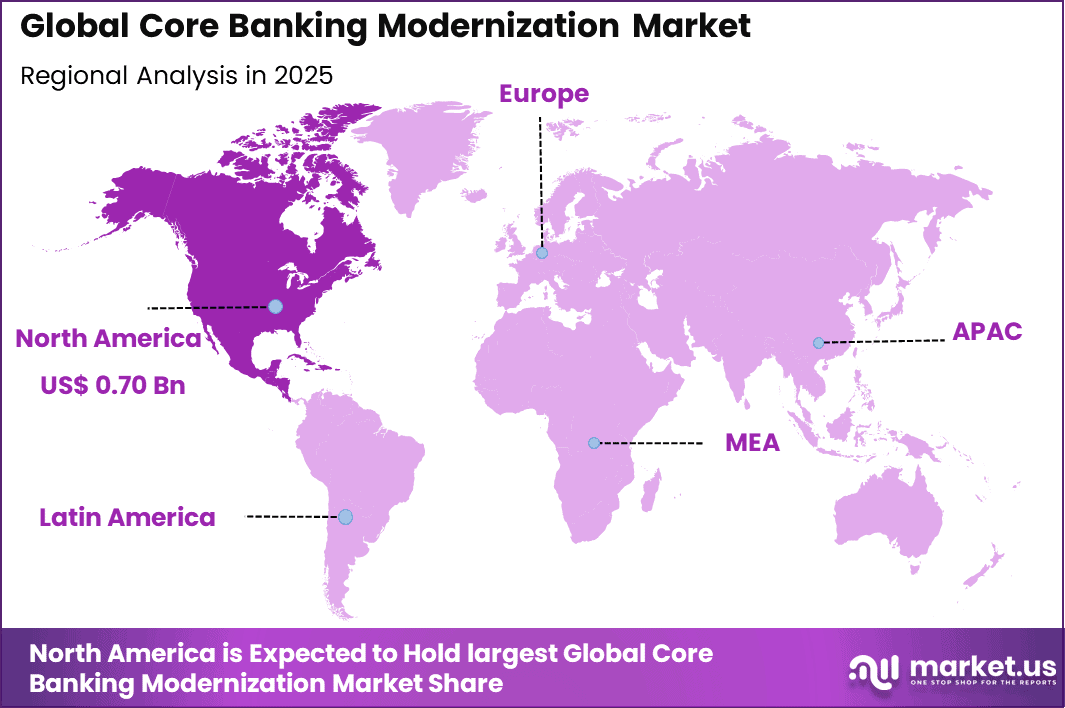
The Global Core Banking Modernization Market generated USD 1.9 billion in 2025 and is predicted to register growth from USD 2.4 billion in 2026 to about USD 16.8 billion by 2035, recording a CAGR of 24.40% throughout the forecast span. In 2025, North America held a dominant market position, capturing more than a 37.5% share, holding USD 0.70 Billion revenue.
The Core Banking Modernization Market refers to the transformation of legacy banking systems into modern, flexible, and digitally enabled core platforms. These initiatives focus on replacing or upgrading monolithic systems that manage deposits, loans, payments, and customer accounts. Modern core banking platforms support real time processing, open integration, and scalable operations. Modernization is increasingly treated as a strategic necessity rather than a technology refresh.
Banks rely on core systems as the foundation of all financial products and customer interactions. Legacy cores often limit speed, product innovation, and integration with digital channels. Industry observations indicate that more than 60% of banks operate on systems that are over two decades old. This aging infrastructure has become a critical constraint on competitiveness and operational efficiency.
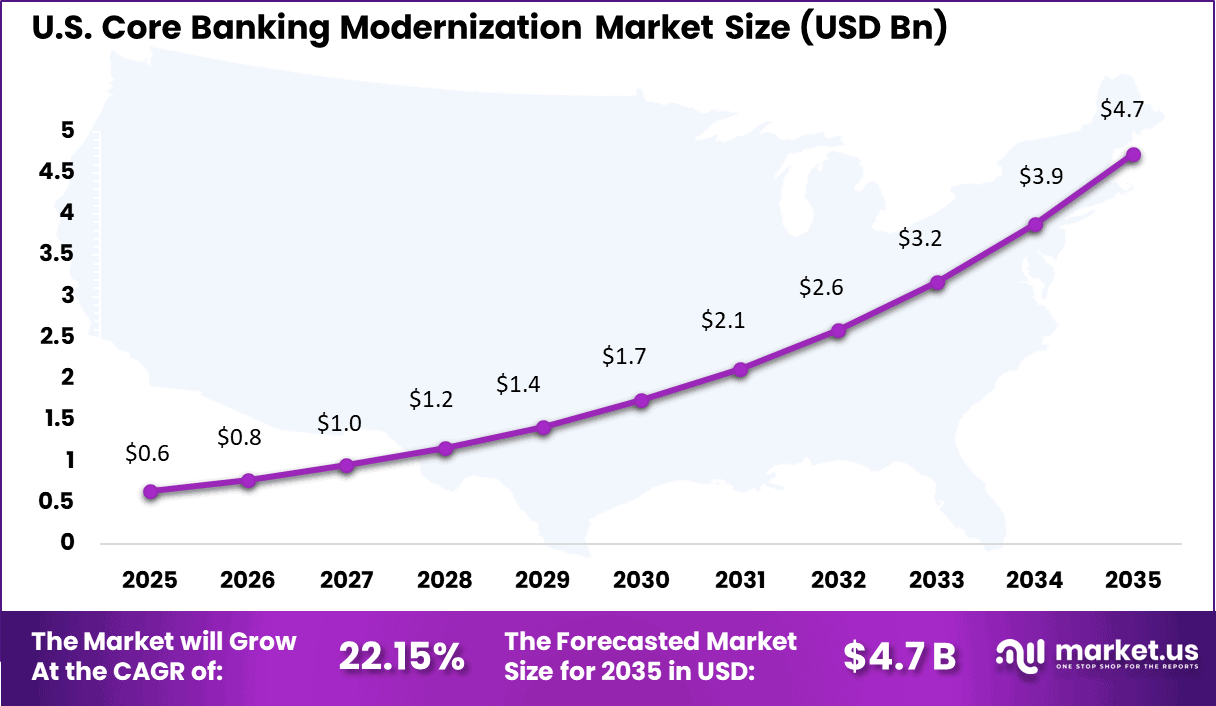
North America accounts for 37.5% of the core banking modernization market, supported by the region’s early transition toward digital-first banking models. Financial institutions are modernizing legacy core systems to improve transaction speed, system resilience, and regulatory reporting efficiency. Demand is also influenced by the need to support real-time payments, open banking frameworks, and seamless integration with digital channels. The United States market is valued at USD 0.64 Bn and is growing at a CAGR of 22.15%, reflecting strong investment in replacing aging core platforms. Adoption is driven by rising customer expectations for always-on banking services and the operational limits of legacy infrastructure. Growth is further supported by increased focus on cloud migration, modular architectures, and scalable systems that enable faster product launches and long-term cost efficiency. Large banking technology and enterprise software providers such as FIS, Fiserv, Inc., and Oracle Corporation lead the core banking modernization market through end-to-end transformation programs. Their solutions support legacy replacement, modular upgrades, and regulatory compliance. Strong integration with payments, risk, and digital channels improves operational continuity. SAP SE and Temenos AG strengthen adoption with scalable architectures. IT services and platform-led modernization specialists such as Tata Consultancy Services, Ltd., Infosys, Ltd., and EdgeVerve Systems, Ltd. focus on phased modernization and migration strategies. Finastra and NCR Corporation support banks with integration, managed services, and omnichannel capabilities. These players are widely adopted by regional and tier-two banks. Cloud-native and next-generation core providers such as Mambu GmbH, Thought Machine Group, Ltd., and Avaloq enable API-driven and real-time banking models. Backbase B.V. and Jack Henry & Associates, Inc. address digital-first and mid-market institutions. Other vendors expand innovation and regional reach, supporting steady growth in core banking modernization globally. The future outlook for the Core Banking Modernization Market is strong as banks and financial institutions continue to update legacy systems to stay competitive. Demand for modern, flexible core banking platforms is expected to rise because these systems support digital services, real-time processing, and improved customer experience. Adoption of cloud technology, APIs, and automation will accelerate transformation and reduce operational costs. Growth can be attributed to rising customer expectations, pressure to comply with evolving regulations, and the need for scalable, efficient banking operations. Overall, market expansion is expected as institutions prioritize innovation and resilience.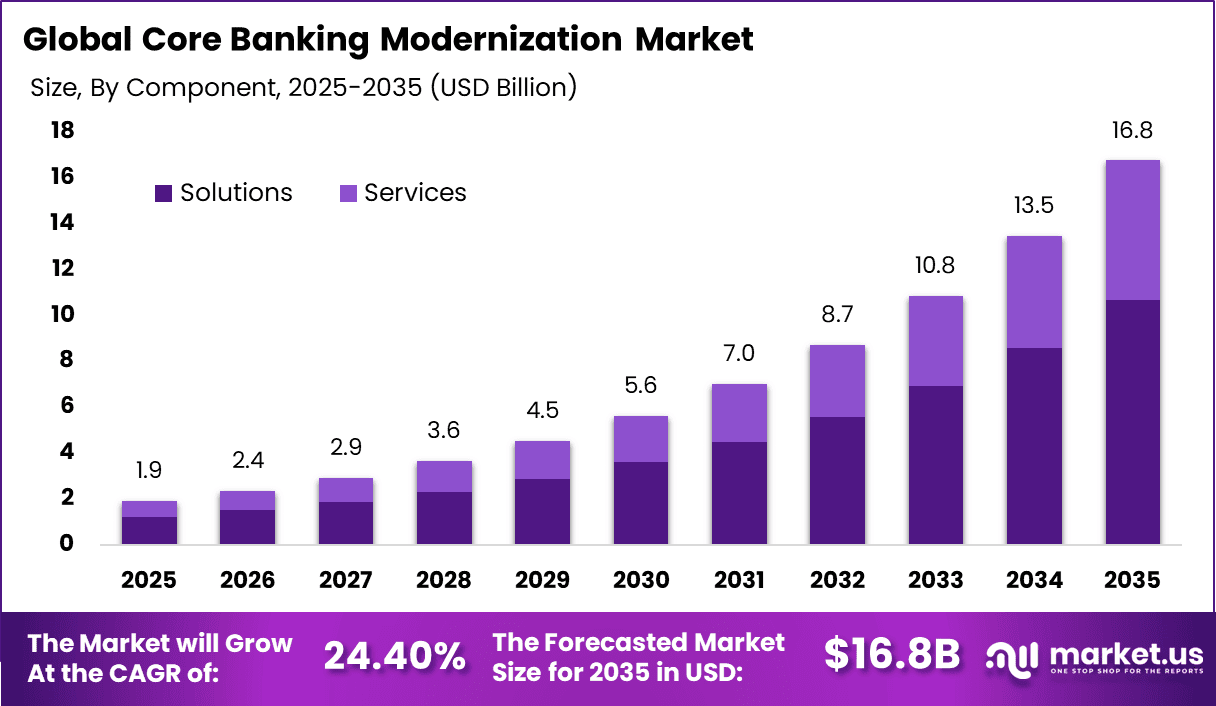
Technology Enabler Impact on CAGR Forecast (~%) Primary Function Geographic Relevance Adoption Timeline Cloud-native and SaaS core banking platforms +6.6% Scalability and cost efficiency Global Short term Microservices and API-first architecture +5.8% Faster product innovation Global Medium term Real-time processing and event-driven systems +5.1% Instant transaction handling Global Medium term AI-driven automation for operations and compliance +4.4% Reduced operating cost North America, Europe Medium to long term Integration with open banking and payment ecosystems +3.7% Ecosystem expansion Europe, Asia Pacific Long term Key Market Segments
By Component
By Deployment Mode
By Organization Size
By Modernization Type
By End-User
Regional Analysis
Key Regions and Countries
Competitive Analysis
Top Key Players in the Market
Future Outlook
Recent Developments









