


Report Overview
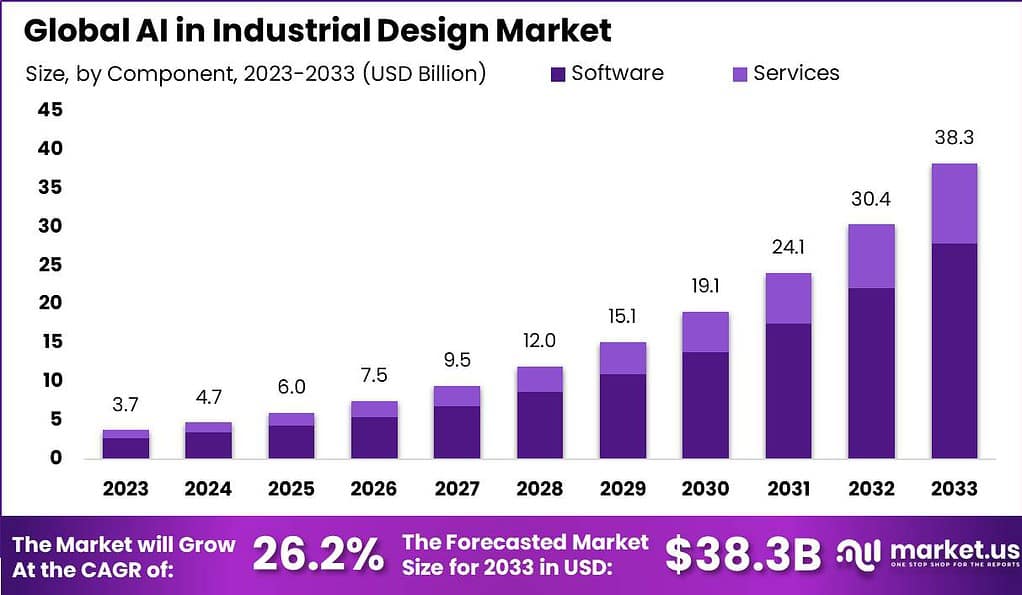
The Global AI in Industrial Design Market size is expected to be worth around USD 38.3 Billion By 2033, from USD 3.7 Billion in 2023, growing at a CAGR of 26.2% during the forecast period from 2024 to 2033.
AI in Industrial Design is transforming how products are created, shifting from traditional manual processes to smart, data-driven methods. It integrates automation, generative design, and optimization algorithms to speed up development, enhance creativity, and improve product performance. This market grows as industries seek faster innovation cycles, more complex designs, and customized products that meet evolving user needs in a competitive environment.
Top driving factors include the push to accelerate innovation and reduce product development time, the increasing complexity of products, and customer demand for personalization. AI’s integration with technologies like IoT, 5G, augmented reality, and virtual reality further drives efficiency and smart automation in the design process. These factors encourage companies to adapt AI-powered tools to stay competitive and meet stringent quality and sustainability standards.
Another significant aspect of the AI in industrial design market is the integration of generative design algorithms. These algorithms explore countless design variations based on specified parameters and constraints, enabling designers to identify optimal solutions that meet functional requirements while optimizing factors such as weight, material usage, and manufacturing costs. This approach not only improves product performance and efficiency but also reduces waste and production time.
The Global Artificial Intelligence Market is projected to experience substantial growth, expanding from USD 177 billion in 2023 to an estimated USD 2,745 billion by 2032. This represents a robust compound annual growth rate (CAGR) of 36.8% from 2024 to 2033. Such significant growth can be attributed to increasing investments in AI technologies and the widespread adoption across various industries seeking to enhance operational efficiencies and decision-making processes.
Similarly, the Industrial Design Market is set to grow from USD 48.72 billion in 2023 to USD 77.86 billion by 2033, at a CAGR of 4.8% during the same forecast period. This growth is driven by the rising demand for innovative and efficient design across products and systems, integrating functionality with aesthetics to meet consumer expectations.
Furthermore, over 40% of executives are focusing on employing AI to improve speed, efficiency, and to reduce product failures in engineering and design sectors. This strategic focus highlights the critical role of AI in transforming business operations and enhancing product development processes.
Key Takeaways
- The AI in Industrial Design market is estimated to reach USD 38.3 Billion by 2033, with a strong CAGR of 26.2% throughout the forecast period.
- In 2023, the Software segment held a dominant position in the AI in Industrial Design market, capturing more than 72.7% of the market share.
- In 2023, the Cloud-Based segment held a dominant market position in the AI in Industrial Design market, capturing more than a 67.6% share.
- In 2023, the Automotive segment held a dominant market position in the AI in Industrial Design market, capturing more than a 33.7% share.
- Asia-Pacific led the market in 2023 with a substantial share of over 34.7%, attributed to factors such as the concentration of major technology firms and significant investments in research and development.
Analysts’ Viewpoint
Investment opportunities lie in expanding AI solutions tailored for specific design needs, including cloud-based platforms, AI-powered simulation tools, and integration with IoT for data-driven design optimization. Companies investing in AI capabilities for industrial design stand to benefit from growing demand for faster and more customizable product development, as well as from supporting sustainable design trends that regulatory bodies increasingly emphasize.
The business benefits of AI in industrial design are significant: reduced time to market, increased design accuracy, enhanced creativity, and more efficient use of materials. AI tools can identify potential design flaws early, optimize resource allocation, and offer better cost estimates, ultimately leading to higher product success rates and customer satisfaction. This results in stronger market positioning and lowered operational costs.
The regulatory environment is evolving as governments introduce AI-specific rules to ensure safety, ethical use, and transparency. Frameworks like the EU AI Act and national rules in the US, China, and other regions impose requirements on explainability, data privacy, and bias mitigation in AI systems. Compliance with these regulations is crucial for companies to ensure responsible AI use and maintain public trust, particularly in high-risk industrial applications.
Component Analysis
In 2023, the Software segment held a dominant position in the AI in Industrial Design market, capturing more than 72.7% of the market share. This substantial dominance can be attributed to the critical role that software plays in the operational deployment of AI technologies in industrial design.
Software solutions are integral for the implementation of AI functions such as machine learning, neural networks, and computer-aided design systems. These tools are essential for conducting complex simulations, creating detailed designs, and automating design processes, which significantly enhance productivity and innovation.
The leadership of the Software segment is further reinforced by the continuous advancements in AI software capabilities that allow for more accurate and faster design outcomes. The development of specialized software that integrates seamlessly with existing industrial design frameworks has facilitated widespread adoption. Moreover, the push towards digitalization across manufacturing industries has propelled the demand for AI-driven software solutions that can optimize design accuracy and reduce time-to-market for new products.
The reliance on AI software in industrial design is expected to grow as companies continue to seek solutions that offer competitive advantages through technological innovation. This trend is supported by investments in R&D by major tech companies aiming to expand their portfolio of design solutions tailored to specific industry needs.
As the technology matures and becomes more accessible, the software segment is likely to maintain its leading position in the market, driven by a combination of innovation, integration capabilities, and the increasing necessity for efficient and agile design methodologies in industrial settings.
Deployment Mode Analysis
In 2023, the Cloud-Based segment held a dominant market position in the AI in Industrial Design market, capturing more than a 67.6% share. This segment’s prominence is largely driven by the scalable and flexible nature of cloud computing platforms, which are ideally suited to the demands of modern industrial design.
Cloud-based solutions allow for the management and analysis of vast amounts of data with greater efficiency and reduced operational costs. They enable designers and engineers to access powerful AI tools and resources on demand, without the need for significant upfront investment in physical infrastructure. The leadership of the Cloud-Based segment is also supported by the global shift towards remote work environments, which has accelerated the adoption of cloud technologies.
These platforms facilitate collaboration among geographically dispersed teams, allowing for continuous integration and real-time updates to design projects. Furthermore, cloud-based AI solutions offer enhanced security features, regular updates, and maintenance, ensuring that the latest technological advancements are readily available to users.
As industries continue to focus on innovation and agility, the demand for cloud-based AI solutions in industrial design is expected to grow. This trend is bolstered by ongoing improvements in cloud infrastructure and the increasing reliability of internet services, making cloud solutions more accessible than ever before.
The flexibility and cost-effectiveness of cloud-based deployments are set to keep this segment at the forefront of the market, as companies seek to leverage these technologies to maintain a competitive edge in the fast-evolving industrial landscape.

Industry Vertical Analysis
In 2023, the Automotive segment held a dominant market position in the AI in Industrial Design market, capturing more than a 33.7% share. This significant market share can be attributed to the intensive integration of AI technologies in automotive design and manufacturing processes. AI applications in the automotive industry have revolutionized how vehicles are conceptualized, designed, and built. These technologies enable more efficient design simulations, predictive maintenance, and automation of routine tasks, leading to reduced costs and enhanced product quality.
The dominance of the Automotive segment is further driven by the automotive industry’s push towards electric vehicles (EVs) and autonomous driving technologies, where AI plays a crucial role. AI algorithms are used to improve battery efficiency and performance, optimize drivetrain systems, and enhance the safety features of autonomous vehicles. Moreover, AI-driven tools help in customizing car designs according to specific consumer preferences and rapidly changing market trends.
As environmental regulations become stricter and consumer expectations for smarter, safer vehicles continue to grow, the demand for AI in automotive design is expected to increase. The industry’s commitment to innovation and sustainability is likely to keep the Automotive segment in the lead. Ongoing advancements in AI and its growing application in areas such as virtual reality for vehicle design and testing will further cement the Automotive industry’s position as a key user of AI in industrial design.
Key Market Segments
By Component
- Software
- Services
By Deployment Mode
- Cloud-Based
- On-Premise
By Industry Vertical
- Automotive
- Consumer Electronics
- Aerospace & Defense
- Healthcare
- Other Industry Verticals
Driver
Integration with Emerging Technologies
The integration of AI with emerging technologies such as the Internet of Things (IoT), 5G, and advanced robotics serves as a significant driver in the AI in Industrial Design market. This synergy enhances the capabilities of industrial design tools, enabling real-time data collection, analysis, and the automation of complex design processes. For instance, AI-driven systems can now leverage IoT data to optimize product designs based on actual usage patterns, improving product functionality and user experience.
The adoption of 5G further accelerates data transfer rates, enabling more complex simulations and testing scenarios to be conducted virtually, thereby reducing development cycles and increasing market responsiveness. Such integrations are pivotal in transforming traditional industrial design methodologies, driving efficiency, innovation, and productivity across sectors.
Restraint
High Implementation Costs
A major restraint for the AI in Industrial Design market is the high cost associated with implementing AI solutions. Initial investments in AI technology can be substantial, encompassing expenses for acquiring cutting-edge hardware, software licenses, and the infrastructure needed to support AI systems.
Additionally, organizations often face significant operational costs related to the training and development of personnel to effectively utilize these advanced AI tools. Smaller enterprises and startups, in particular, may find these costs prohibitive, limiting the adoption of AI in their design processes. This financial barrier not only restricts market growth but also widens the technological divide between large corporations and smaller entities, affecting competitive dynamics within various industries.
Opportunity
Advancements in Machine Learning and AI Algorithms
The ongoing advancements in machine learning and AI algorithms present significant opportunities for the AI in Industrial Design market. As these technologies become more sophisticated, they offer enhanced capabilities in predictive analytics, image recognition, and automated decision-making. For industrial designers, these improvements mean more accurate simulations, enhanced customization options, and smarter integration of design elements.
Moreover, the evolution of AI can unlock new possibilities in materials science and eco-friendly designs, catering to the growing demand for sustainability. By harnessing these technological advancements, companies can not only streamline their design processes but also innovate new products that meet the evolving demands of modern consumers, opening up vast new markets and applications.
Challenge
Ethical and Privacy Concerns
A significant challenge facing the AI in Industrial Design market is addressing the ethical and privacy concerns associated with AI deployment. As AI systems handle massive amounts of data, including potentially sensitive information, concerns about data privacy and security are paramount.
Additionally, the use of AI in designing products that interact closely with humans (such as in healthcare or consumer electronics) raises ethical questions about bias, decision transparency, and the extent of human oversight required.
Ensuring AI systems are unbiased and operate transparently is crucial to maintaining public trust and compliance with international regulatory standards. Overcoming these ethical challenges requires continuous efforts towards developing robust, secure, and fair AI systems that are acceptable to all stakeholders.
Growth Factors
- Rapid Digital Transformation: Businesses across industries are undergoing digital transformations, integrating AI into their design processes to enhance efficiency and innovation. This trend is particularly strong in sectors like automotive and aerospace, where AI can significantly shorten design cycles and improve product performance.
- Demand for Customization: The increasing consumer demand for personalized products is driving the use of AI in industrial design, allowing companies to offer customized options more efficiently. AI algorithms can analyze consumer data and preferences to help design products that better meet individual needs.
- Advancements in AI and Machine Learning: Continuous improvements in AI algorithms and machine learning models enable more sophisticated design capabilities, such as predictive design and real-time problem-solving, further fueling market growth.
- Environmental and Sustainability Pressures: There is a growing emphasis on sustainability in product design, driven by both regulatory requirements and consumer preferences. AI helps in creating more sustainable designs by optimizing materials usage and reducing waste during the design phase.
- Integration with AR and VR: The integration of AI with augmented reality (AR) and virtual reality (VR) technologies is transforming the design process by allowing designers to create and test complex product designs in virtual environments. This integration reduces the time and cost associated with physical prototyping and testing.
Emerging Trends
- Generative Design: AI-driven generative design is becoming increasingly popular, where AI systems generate numerous possible iterations of a design, providing designers with multiple options to optimize for performance, cost, and materials.
- AI in Robotic Process Automation (RPA): The use of AI in RPA for automating repetitive tasks in the industrial design process not only saves time but also increases precision, reducing human error and enhancing overall productivity.
- Cloud-based AI Design Tools: The shift towards cloud-based AI design tools offers designers scalable, flexible, and cost-effective solutions. These tools facilitate collaboration among global teams, enabling more dynamic and responsive design processes.
- Focus on User Experience (UX) Design: AI is increasingly used to enhance UX design, analyzing user interaction data to predict trends and preferences, which informs more user-centered product designs.
- AI for Material Innovation: AI is being used to explore new materials and composites, predicting their properties and performance, which can lead to breakthroughs in various industries, such as lightweight materials for aerospace or biodegradable plastics for consumer goods.
Regional Analysis
In 2023, the Asia-Pacific (APAC) region held a dominant position in the AI in Industrial Design market, capturing more than a 34.7% share with revenue amounting to approximately USD 1.2 billion. This prominent market stance can be attributed to several key factors. Primarily, the region boasts a robust manufacturing sector, driven by countries like China, Japan, and South Korea, which are heavily investing in digital transformation initiatives. These investments are aimed at integrating AI technologies to enhance design precision, reduce product development cycles, and achieve cost efficiency.
Moreover, the increasing governmental support across the region for adopting advanced technologies in industrial processes further bolsters the market growth. Initiatives such as Made in China 2025 and India’s Make in India campaign encourage the incorporation of AI solutions in industrial design to improve product quality and manufacturing processes. Additionally, the presence of a vast number of small and medium-sized enterprises (SMEs) in APAC that are rapidly adopting cloud-based AI solutions contributes significantly to the region’s market expansion.
The growth in APAC is also fueled by the rising demand for customized and consumer-specific products which require sophisticated design technologies to ensure rapid delivery and high-quality standards. This demand leads to greater reliance on AI-driven tools that offer efficient solutions for complex design challenges in industrial applications, further driving the market’s growth in the region. With a continued focus on innovation and technological adoption, APAC is expected to maintain its leadership in the AI in Industrial Design market.

Key Regions and Countries
- North America
- US
- Canada
- Europe
- Germany
- France
- The UK
- Spain
- Italy
- Russia
- Netherlands
- Rest of Europe
- Asia Pacific
- China
- Japan
- South Korea
- India
- Australia
- Singapore
- Thailand
- Vietnam
- Rest of APAC
- Latin America
- Brazil
- Mexico
- Rest of Latin America
- Middle East & Africa
- South Africa
- Saudi Arabia
- UAE
- Rest of MEA
Key Players Analysis
In the rapidly evolving landscape of the Industrial Design market, the integration of Artificial Intelligence (AI) has emerged as a transformative force. AI technologies are revolutionizing the way industrial designers create, optimize, and refine products, leading to enhanced efficiency, cost savings, and improved customer experiences. Several key players are leading the way in harnessing the power of AI in this sector.
One prominent player in the AI-driven Industrial Design market is Autodesk, a well-established software company that develops cutting-edge design and engineering solutions. Autodesk’s Fusion 360 platform incorporates AI algorithms to assist designers in generating optimized designs, analyzing performance, and simulating real-world scenarios. The integration of AI enables designers to explore a wide range of possibilities and make informed decisions, resulting in more efficient and innovative products.
Top Key Players in the Market
- Autodesk Inc.
- Dassault Systèmes SE
- Siemens AG
- NVIDIA Corporation
- PTC Inc.
- Ansys Inc.
- Hexagon AB
- Altair Engineering Inc.
- Bentley Systems Incorporated
- MathWorks
- Other Key Players
Recent Developments
- In 2023, Autodesk released AutoCAD 2024, which introduced new features such as Smart Blocks and enhanced Markup Import and Markup Assist, leveraging machine learning to improve productivity in design processes. This version also brought significant performance enhancements in 2D graphics and streamlined installations.
- In July 2023, Dassault Systèmes introduced CATIA Visual Scripting, a new feature aimed at boosting design flexibility and efficiency by enabling users to generate complex 3D geometries through algorithmic design without manual interactions.
- NVIDIA Corporation: NVIDIA announced the availability of Omniverse Cloud APIs, which will be first available on Microsoft Azure. These APIs are aimed at enhancing the creation of industrial digital twins by enabling seamless integration with various simulation tools and applications. This development marks a step towards the next era of industrial digitalization.
- Ansys Inc.: Ansys has announced a significant merger with Synopsys, scheduled for completion in January 2024. This merger aims to create a leader in silicon to systems design solutions, reflecting Ansys’s strategy to bridge the gap between design and operational reality through advanced simulation technologies









