


Report Overview
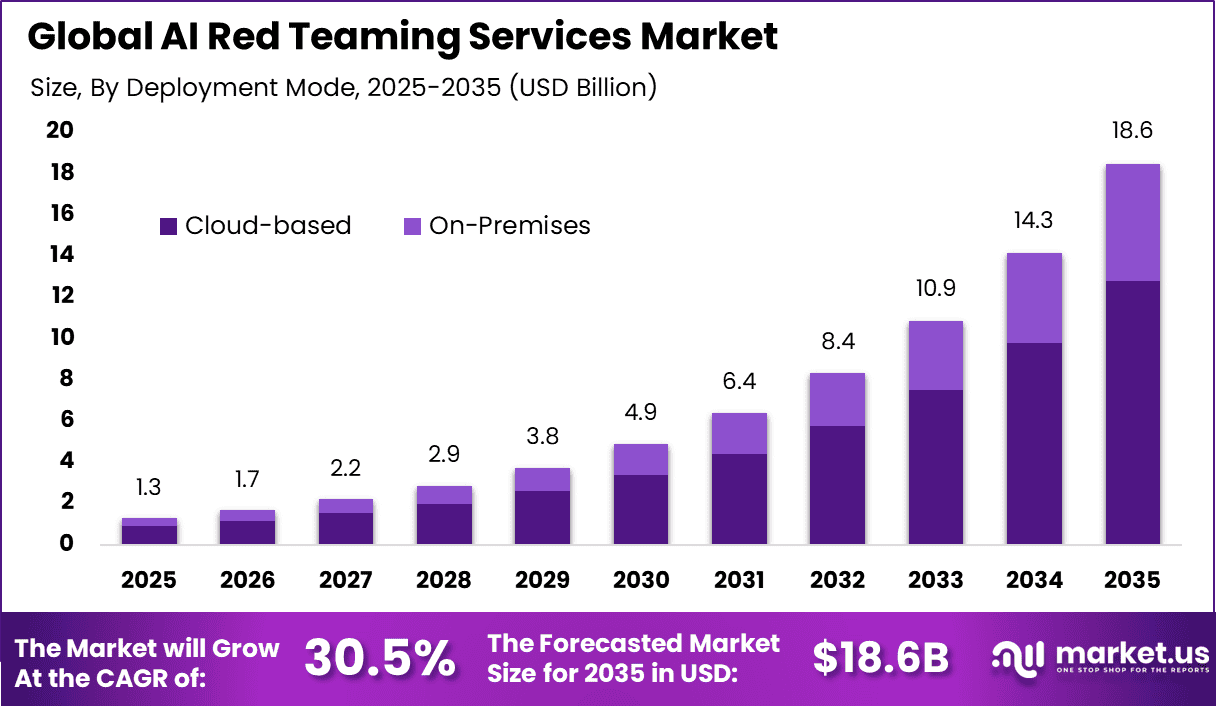
The Global AI Red Teaming Services Market size is expected to be worth around USD 18.6 Billion By 2035, from USD 1.3 billion in 2025, growing at a CAGR of 30.5% during the forecast period from 2026 to 2035. North America held a dominant Market position, capturing more than a 42.4% share, holding USD 0.5 Billion revenue.
The AI red teaming services market focuses on structured testing designed to identify weaknesses, misuse risks, and security gaps in artificial intelligence systems. These services simulate real world attacks, misuse scenarios, and failure conditions to assess how AI models behave under stress. As AI systems are increasingly deployed in critical business functions, the consequences of model failure have become more severe. Red teaming has therefore emerged as a proactive risk control practice.
One of the main driving factors is the rapid deployment of AI systems in high impact environments. AI is increasingly used in finance, healthcare, hiring, security, and customer interaction. Errors or manipulation in these systems can lead to serious consequences. Red teaming helps organizations identify risks before systems are exposed to real world threats. Another key driver is growing concern around AI misuse and adversarial attacks.
Adoption of generative AI is expanding rapidly, but failure rates remain high. Between 70% and 85% of GenAI deployment efforts are either failing or struggling to progress beyond pilot stages, largely due to trust, governance, and security concerns. Despite strong interest, many organizations face challenges in scaling GenAI safely across production environments. Risk exposure is increasing as AI adoption accelerates.
About 71% of organizations report severe impact from AI powered cyberthreats, while 60% remain unprepared to defend against such attacks. In addition, 85% of security leaders believe traditional security tools are insufficient to counter AI based threats. With over 80% of Fortune 500 companies deploying active AI agents, the attack surface continues to expand, reinforcing the need for advanced security and governance frameworks.
Demand for AI red teaming services is strongest among enterprises deploying generative AI and automated decision systems. These organizations face heightened exposure due to direct interaction between AI and users. Internal risk assessments show that AI related incidents often emerge after deployment rather than during development. This gap drives demand for independent adversarial testing.
Top Market Takeaways
- By service type, adversarial attack simulation led the AI Red Teaming Services Market with a 32.4% share, reflecting strong demand for controlled stress testing of AI models.
- By deployment mode, cloud based services accounted for 68.7% of total adoption, supported by scalable testing environments and faster deployment cycles.
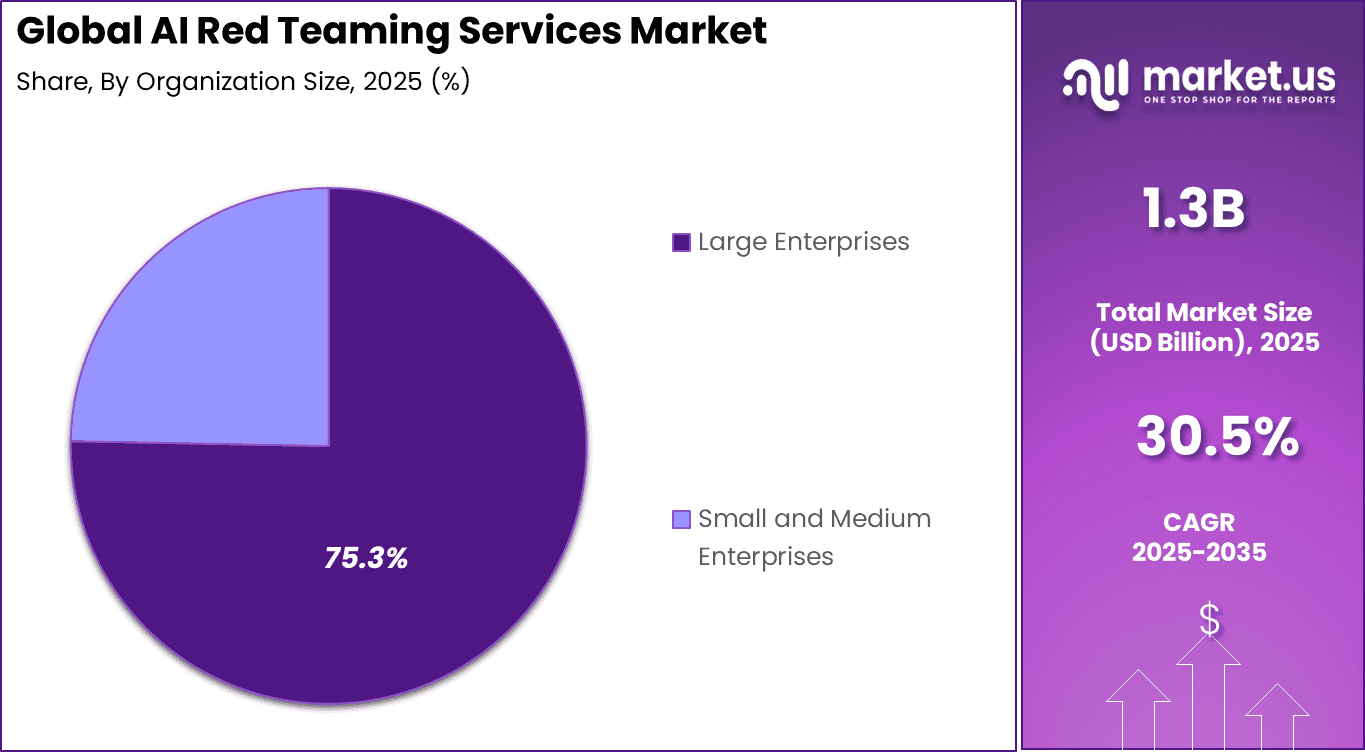
- By organization size, large enterprises represented 75.3% of market demand, driven by higher regulatory exposure and complex AI systems.
- By application, Banking, Financial Services, and Insurance accounted for 27.5% of total usage, supported by strict compliance and risk control requirements.
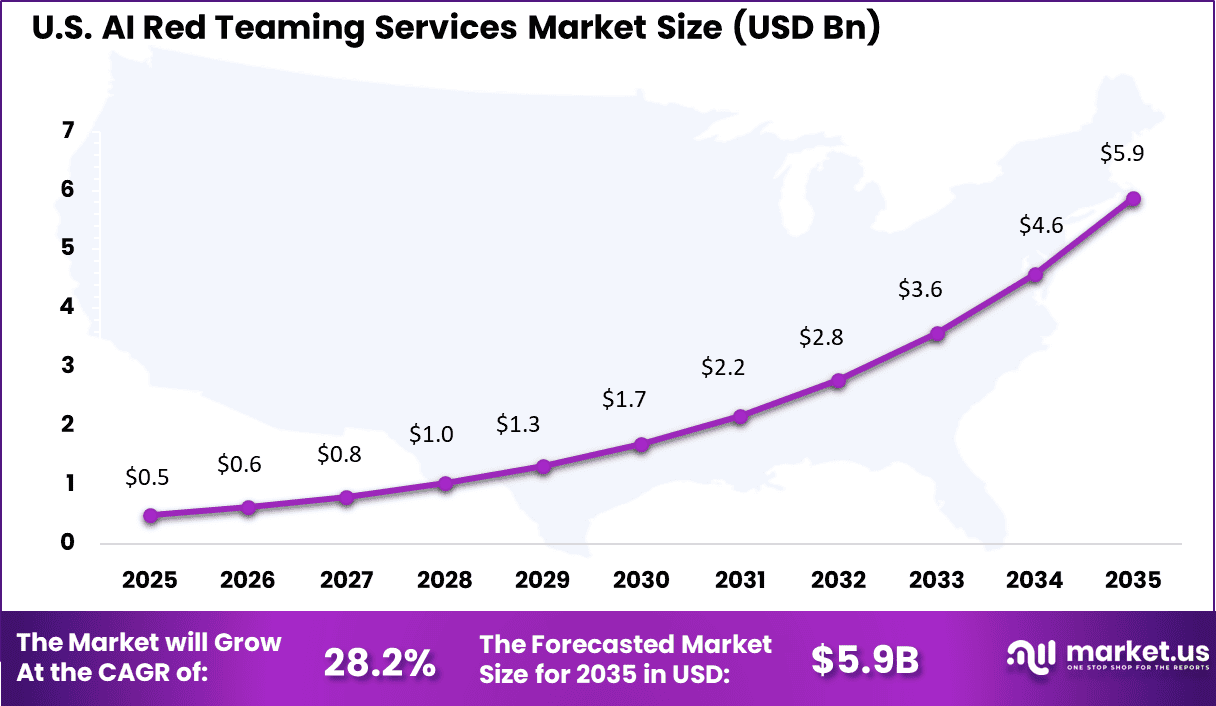
- Regionally, North America held a 42.4% share of the market, with the US valued at USD 0.49 billion and recording a CAGR of 28.2%, reflecting rapid expansion of AI governance initiatives.
Drivers Impact Analysis
| Key Driver | Impact on CAGR Forecast (~%) | Geographic Relevance | Impact Timeline |
|---|---|---|---|
| Rapid enterprise adoption of generative AI and foundation models | +8.2% | North America, Europe | Short to medium term |
| Increasing regulatory focus on AI safety, governance, and accountability | +6.9% | Europe, North America | Medium term |
| Rising concerns over model bias, hallucinations, and adversarial attacks | +5.8% | Global | Short term |
| Expansion of AI deployment in critical sectors such as finance and healthcare | +4.9% | North America, Asia Pacific | Medium term |
| Growth of third-party AI risk assessment and audit requirements | +4.7% | Global | Medium to long term |
Restraint Impact Analysis
| Key Restraint | Impact on CAGR Forecast (~%) | Geographic Relevance | Impact Timeline |
|---|---|---|---|
| Limited availability of specialized AI security expertise | -4.6% | Global | Short to medium term |
| High cost of comprehensive red teaming engagements | -3.9% | Emerging Markets | Medium term |
| Rapid evolution of AI models requiring frequent reassessment | -3.4% | Global | Medium term |
| Lack of standardized AI testing frameworks | -2.8% | Global | Medium term |
| Organizational reluctance to expose internal AI systems to testing | -2.3% | Global | Medium to long term |
Investor Type Impact Matrix
| Investor Type | Growth Sensitivity | Risk Exposure | Geographic Focus | Investment Outlook |
|---|---|---|---|---|
| AI security and governance service providers | Very High | Medium | North America, Europe | Strong consulting and managed services growth |
| Cybersecurity firms expanding into AI testing | High | Medium | Global | Strategic service diversification |
| Large enterprises deploying AI at scale | High | Low to Medium | Global | Mandatory risk mitigation investment |
| Private equity firms | Medium | Medium | North America, Europe | Consolidation of AI security vendors |
| Venture capital investors | Very High | High | North America | Innovation in automated AI testing tools |
Technology Enablement Analysis
| Technology Enabler | Impact on CAGR Forecast (~%) | Primary Function | Geographic Relevance | Adoption Timeline |
|---|---|---|---|---|
| Automated adversarial testing frameworks | +7.4% | Model vulnerability identification | Global | Short to medium term |
| Red teaming toolkits for large language models | +6.2% | Prompt and response risk analysis | North America, Europe | Medium term |
| AI risk scoring and model evaluation platforms | +5.1% | Quantified risk assessment | Global | Medium term |
| Continuous AI monitoring and post-deployment testing | +4.3% | Ongoing risk management | Global | Medium to long term |
| Integration with enterprise AI governance systems | +3.6% | Compliance alignment | Europe, North America | Long term |
By Service Type
Adversarial attack simulation accounted for 32.4% of service demand, reflecting its importance in identifying AI vulnerabilities. These simulations mimic malicious inputs designed to confuse or manipulate models. The goal is to observe failure points and unintended behaviors. This approach provides practical insight into real world risk exposure.
Organizations value adversarial testing because it reveals issues not visible in standard validation. Bias amplification, hallucination, and data leakage can be triggered under controlled conditions. Early detection reduces downstream risk. This has made adversarial simulation a core red teaming activity.
As AI threats evolve, simulation techniques are becoming more sophisticated. Testing now includes prompt manipulation and model evasion scenarios. Continuous simulation supports ongoing model improvement. This sustains demand for this service type.
By Deployment Mode
Cloud based delivery represented 68.7% of adoption, driven by scalability and speed. Cloud environments allow rapid testing across multiple models and datasets. Organizations can run simulations without deploying local infrastructure. This reduces cost and complexity.
Cloud platforms also support collaborative testing workflows. Security teams and developers can access results in real time. Updates to test scenarios are deployed instantly. This improves response effectiveness.
Security controls in cloud environments have matured. Encryption and access management protect sensitive model data. As a result, cloud based red teaming has become the preferred deployment mode.
By Organization Size
Large enterprises accounted for 75.3% of adoption due to their extensive AI usage and risk exposure. These organizations deploy AI across customer, operational, and financial systems. Failures can have significant reputational and regulatory impact. Formal red teaming is therefore essential. Large enterprises also operate across multiple jurisdictions.
AI behavior must be consistent and compliant in different regions. Red teaming helps validate this consistency. It also supports internal governance frameworks. Higher investment capacity supports advanced testing. Large organizations integrate red teaming into development lifecycles. This reinforces their dominant role in the market.
By Application
Banking, financial services, and insurance represented 27.5% of usage, reflecting the sector’s sensitivity to AI risk. Financial institutions use AI for fraud detection, credit assessment, and customer interaction. Errors or misuse can lead to financial loss and compliance issues. Red teaming helps mitigate these risks. Regulatory scrutiny in BFSI is strict.
Institutions must demonstrate AI reliability and fairness. Red teaming provides documented evidence of proactive testing. This supports audit and compliance needs. As financial services increase AI automation, testing intensity has increased. Red teaming helps ensure model stability under adversarial conditions. This has made BFSI a leading application area.
Regional Analysis
North America accounted for 42.4% of market adoption, supported by early AI deployment and strong security practices. Organizations in the region prioritize proactive risk management. Regulatory discussion around AI safety has further encouraged adoption.
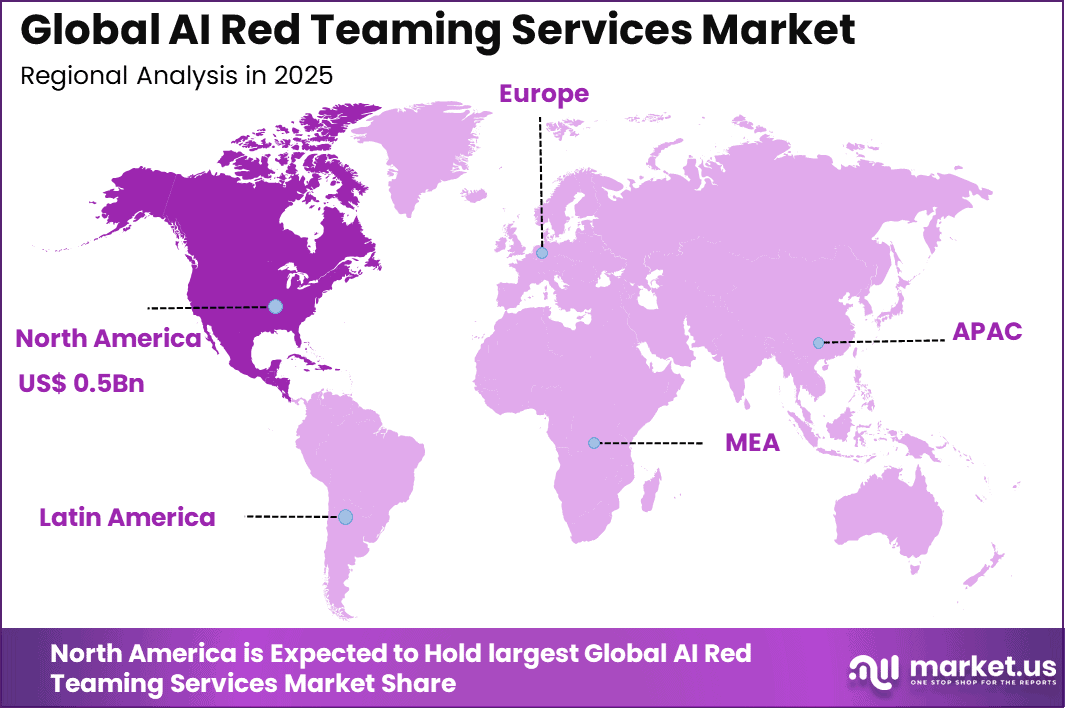
The United States leads the region with market value of USD 0.49 Bn and a CAGR of 28.2%. High AI investment across finance, technology, and healthcare drives demand. Enterprises increasingly include red teaming as a standard control.
Innovation continues to reinforce regional leadership. Integration with AI governance and security platforms has improved service effectiveness. As AI adoption accelerates, AI red teaming services remain critical in North America.
Top AI Red Teaming Providers & Platforms
| Provider / Platform | Type | Key Features |
|---|---|---|
| HackerOne | Managed Service | Human-led testing by 750+ vetted researchers; results mapped to OWASP LLM Top 10 and NIST AI RMF. |
| CrowdStrike | Professional Service | Emulates real-world adversaries; offers Red/Blue team exercises with Charlotte AI enhancements. |
| Mend.io | Automated Platform | Continuous behavioral analysis; integrates into CI/CD to scan AI-generated code and configs. |
| Protect AI (Recon) | Automated Platform | Extensive library of 450+ known attacks; uses trained LLMs as detectors for high accuracy. |
| Mindgard | Automated Platform | DAST-AI platform for continuous testing across modalities (text, image, audio). |
| Microsoft Foundry | Tooling / Agent | AI Red Teaming Agent (preview) automates adversarial probing using the open-source PyRIT framework. |
Investment Opportunities
Investment opportunities in this market exist in firms that combine AI expertise with security and risk management. Multidisciplinary service providers deliver higher value than siloed offerings. Investors favor teams that can address technical, ethical, and operational risks together. This integrated approach supports premium positioning.
There are also opportunities in tooling platforms that support continuous AI red teaming. As models evolve through updates and retraining, testing must be ongoing. Platforms that enable recurring assessments attract strong interest. Continuous validation aligns with long term AI usage patterns.
Another investment area is sector specific red teaming services. Industries such as finance, defense, and healthcare have unique AI risk profiles. Tailored methodologies improve relevance and outcomes. Specialization creates defensible market niches.
Business Benefits
For organizations, AI red teaming reduces the likelihood of costly AI failures. Early identification of vulnerabilities prevents public incidents and misuse. This protection supports brand trust and operational stability. Proactive testing shifts risk management left in the development cycle.
From an operational perspective, red teaming improves model quality and resilience. Findings guide improvements in training data, controls, and deployment safeguards. This leads to more robust AI systems. Quality improvements compound over time.
Financially, AI red teaming reduces downstream remediation and legal costs. Fixing issues before deployment is significantly cheaper than post incident response. Over time, this preventive approach delivers strong return on investment. The business case strengthens as AI exposure increases.
Key Market Segments
By Service Type
- Penetration Testing
- Network Penetration Testing
- Web Application Penetration Testing
- Mobile Application Penetration Testing
- Cloud Penetration Testing
- Social Engineering Testing
- Vulnerability Assessment
- Network Vulnerability Assessment
- Web Application Vulnerability Assessment
- Mobile Application Vulnerability Assessment
- Cloud Vulnerability Assessment
- Database Vulnerability Assessment
- Adversarial Attack Simulation
- Phishing Simulation
- Malware Simulation
- Ransomware Simulation
- Denial Of Service Simulation
- Insider Threat Simulation
- Security Auditing
- Compliance Auditing
- Risk Assessment Auditing
- Policy and Procedure Auditing
- Network Security Auditing
- Application Security Auditing
- Other Service Types
- Threat Intelligence Services
- Incident Response Services
- Security Consulting Services
- Red Team As A Service
- Cybersecurity Training Services
By Deployment Mode
- On-Premises
- Cloud-based
By Organization Size
- Small and Medium Enterprises
- Large Enterprises
By Application
- Banking, Financial Services, and Insurance(BFSI)
- Healthcare
- Government
- Retail
- Manufacturing
- Other Applications
Regional Analysis and Coverage
- North America
- US
- Canada
- Europe
- Germany
- France
- The UK
- Spain
- Italy
- Russia
- Netherlands
- Rest of Europe
- Asia Pacific
- China
- Japan
- South Korea
- India
- Australia
- Singapore
- Thailand
- Vietnam
- Rest of Latin America
- Latin America
- Brazil
- Mexico
- Rest of Latin America
- Middle East & Africa
- South Africa
- Saudi Arabia
- UAE
- Rest of MEA
Emerging Trends Analysis
An emerging trend in the AI red teaming services market is integration with automated risk orchestration and response tooling. AI red team insights are increasingly being operationalised through automated alerts, remediation workflows, and model-centric monitoring dashboards. This trend enables faster translation of findings into action and supports continuous assurance practices.
Another trend is cross functional collaboration between AI teams, security units, and governance bodies. Red teaming is becoming a multidisciplinary activity that involves data scientists, security analysts, compliance officers, and business owners. This collaborative approach improves coverage of risk vectors and strengthens organisational readiness.
Growth Factors Analysis
One of the key growth factors for the AI red teaming services market is heightened concern about AI model bias and unfair outcomes. As AI systems influence lending decisions, hiring practices, and critical infrastructure operations, organisations require validation that models behave equitably across demographic groups. Red teaming supports identification of bias risks and mitigation planning.
Another growth factor is adoption of AI in regulated sectors such as finance, healthcare, and autonomous systems. Regulatory scrutiny in these industries emphasises risk management, transparency, and consequence assessment. Red teaming helps organisations demonstrate compliance and prepare for external evaluation, reinforcing its relevance as AI governance matures.
Opportunity Analysis
A significant opportunity in the AI red teaming services market lies in standardisation of assessment frameworks. As industry best practices and regulatory guidelines evolve, there is growing demand for structured methodologies that can be applied consistently across sectors. Providers that offer repeatable frameworks, benchmarking metrics, and certification pathways can differentiate their services and support broader adoption.
Another opportunity is expansion of AI red teaming into model lifecycle management. Beyond pre-deployment testing, organisations increasingly require continuous red teaming to address model drift, emerging threats, and evolving data environments. Services that align with ongoing monitoring and refresh cycles strengthen value propositions for long term partnerships.
Challenge Analysis
A major challenge for the AI red teaming services market is ensuring the realism and relevance of adversarial scenarios. Red team exercises must reflect plausible threat models and operational contexts. If scenarios are overly synthetic or disconnected from real usage patterns, insights may lack practical value. Balancing theoretical depth with real world relevance is essential for meaningful outcomes.
Another challenge is quantifying impact and ROI. Translating red team findings into business impact, prioritised mitigation plans, and measurable improvements can be difficult. Clients require clear metrics that connect red teaming insights with risk reduction and operational performance. Articulating this value is key to market growth.
Competitive Analysis
Major technology and cloud providers such as Google, Microsoft, IBM, and Amazon Web Services are central to the AI red teaming services market. These firms integrate adversarial testing into their AI development and deployment frameworks. Their services focus on model robustness, bias detection, and vulnerability assessment. Strong research ecosystems and global enterprise reach support adoption. Demand is driven by rapid deployment of generative AI and increasing regulatory focus on AI safety.
Global consulting and advisory firms such as Deloitte, Accenture, PwC, EY, and KPMG provide structured AI governance and validation programs. Capgemini and Cognizant embed red teaming within enterprise AI risk management strategies. These firms emphasize compliance documentation and ethical AI assessments. Adoption is strong among financial services, healthcare, and public sector organizations.
Cybersecurity and defense specialists such as BAE Systems, Booz Allen Hamilton, CrowdStrike, Trellix, Rapid7, Synack, Mitre Corporation, Palantir Technologies, and Mindgard focus on adversarial simulation and threat modeling for AI systems. These players strengthen resilience testing against real-world attack scenarios. Other vendors expand innovation and specialized AI red teaming capabilities globally.
Top Key Players in the Market
- Microsoft
- Deloitte
- Accenture
- IBM
- PwC
- EY (Ernst And Young)
- KPMG
- BAE Systems
- Capgemini
- Cognizant
- Amazon Web Services (AWS)
- Booz Allen Hamilton
- CrowdStrike
- Mitre Corporation
- Palantir Technologies
- FireEye (Trellix)
- Rapid7
- Synack
- Mindgard
- Others
Recent Developments
- In February 2025, Google’s Responsible AI Progress Report highlighted 150+ CART‑style exercises across products, using AI‑assisted red‑teaming agents to simulate attacks such as indirect prompt injection.
- In 2024, Microsoft’s AI Red Team conducted 67 red‑teaming operations on flagship models (e.g., Phi series, Copilot), focusing on prompt‑injection attacks, misuse, and alignment violations.









