


Report Overview
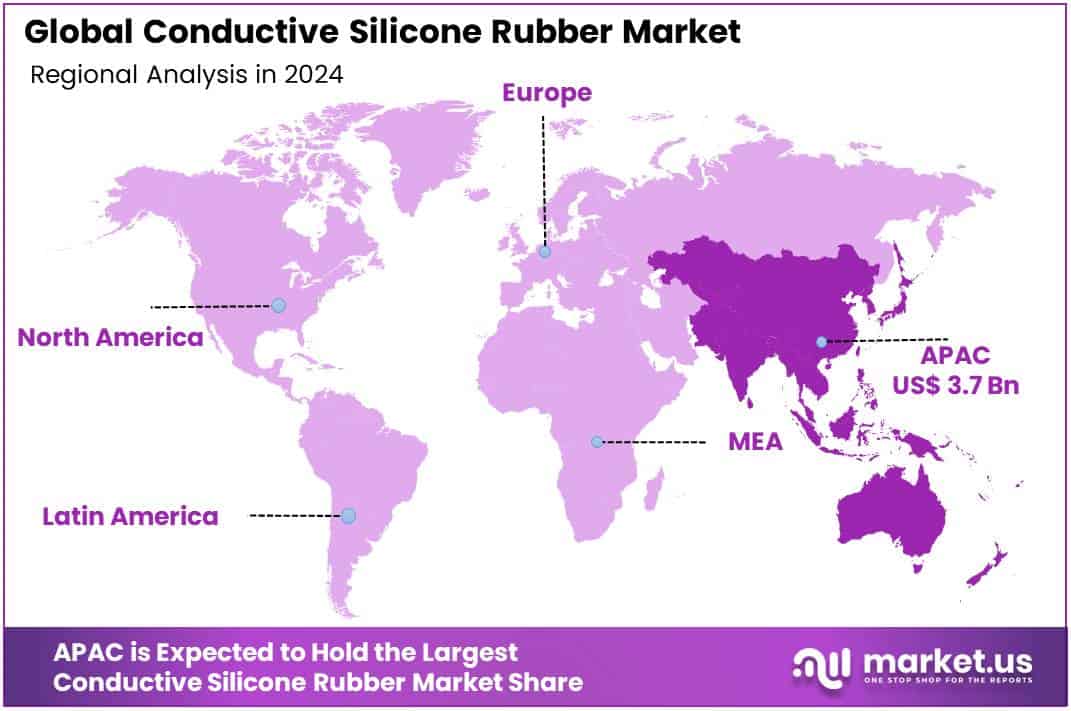
The Global Conductive Silicone Rubber Market is expected to be worth around USD 19.7 Billion by 2034, up from USD 8.7 Billion in 2024, and is projected to grow at a CAGR of 8.5% from 2025 to 2034. The Asia Pacific segment maintained 43.5%, supporting a Psychedelic Mushrooms value of USD 3.7 Bn.
Conductive silicone rubber is a modified silicone elastomer filled with conductive media to deliver controlled electrical conductivity while retaining silicone’s heat stability, flexibility, and weather resistance. In industrial systems, it is selected where electrical continuity and sealing must coexist—for example, EMI shielding gaskets for enclosures, conductive keypads and connectors, static-dissipative seals around sensitive electronics, and thermal/electrical interface pads used to manage both heat and grounding. Market tracking also reflects this broad adoption, with one widely cited estimate placing the conductive silicone rubber market at USD 8.84 billion in 2024.
The scale of leading food organizations shows why this opportunity is durable rather than a short-term spike. Nestlé reported CHF 91.4 billion in sales in 2024, reflecting a huge global production base where even incremental automation upgrades translate into thousands of retrofits and new line builds. PepsiCo states it generated nearly $92 billion in net revenue in 2024, and its products are enjoyed more than one billion times a day in 200+ countries and territories—a simple way to understand how many factories and packaging sites are under constant pressure to run faster, safer, and with fewer stoppages. Regulatory and customer requirements make the modernization wave more predictable, which is why it looks like an opportunity. In the U.S., FDA states it intends not to enforce the Food Traceability Rule prior to July 20, 2028, following congressional direction. That date matters because it effectively creates a runway for companies to phase in hardware and software upgrades—labeling, scanning points, data capture at critical steps, and more connected devices at the line level. Government manufacturing initiatives also support the opportunity indirectly by expanding the availability of electronics used in industrial equipment. India’s Union Budget FY 2026–27 increased the outlay for the Electronics Components Manufacturing Scheme to ₹40,000 crore, signaling a strong push to scale electronics component capacity. More local electronics output generally means more competitive pricing and faster supply of sensors, control hardware, and enclosures—exactly the equipment base where conductive silicone rubber is specified for conductive gaskets, keypad mats, and grounded seals. Asia Pacific dominates at 43.5% share ($3.7 Bn), powered by electronics manufacturing depth and fast EV scale-up Asia Pacific remains the dominating region in the Conductive Silicone Rubber market, accounting for 43.5% share and reaching $3.7 Bn, supported by the region’s unmatched concentration of electronics assembly, component ecosystems, and high-volume industrial production. The demand base is strengthened by the fact that Asia Pacific is widely recognized as the largest regional semiconductor market, keeping downstream requirements strong for EMI shielding, grounding, and ESD-safe sealing used in devices, connectors, enclosures, and automation hardware. In 2024–2025, the region’s momentum is closely tied to the growth of electrification and power electronics, where conductive elastomers are used in gaskets and seals around sensitive control systems. The International Energy Agency notes electric-car sales growth into 2025, with more than 4 million electric cars sold globally in Q1 2025 and about 60% of those sold in China—illustrating how concentrated EV-related electronics demand is within Asia Pacific. Saint-Gobain participates through engineered materials and industrial solutions where elastomers and performance components are specified for protection, durability, and compliance. In 2024, the group reported €46.6 billion in sales and employed more than 161,000 people. It also delivered €5.30 billion operating income and €2.05 billion in capital expenditure, reflecting continued investment in manufacturing and process capability—important for customers seeking consistent quality and high-throughput supply for sealing and shielding applications. WACKER is a major silicone producer, and its silicones portfolio is closely aligned with conductive silicone rubber value chains (base polymers, specialty silicone materials, and industrial-grade formulations). In 2024, WACKER posted €5.7 billion in total sales and €763 million EBITDA, with 16,637 employees. The Silicones division generated €2,805 million in sales in 2024 (up from €2.74 billion in 2023), showing resilience in specialty mix. Western Rubbers (India) serves industrial sealing and rubber component demand where conductive elastomers can be used for antistatic interfaces and grounded sealing in equipment. Financial tracking sources report revenue of ₹17.3 crore for the financial year ending March 31, 2024. Company datasets also list an estimated 125 employees and $7.8 million revenue (profile-based), which signals a mid-sized operation supporting customized rubber part supply. In 2024, Dow delivered approximately $43 billion in sales globally and continues to invest in materials that combine mechanical reliability with electrical performance for advanced manufacturing environments. WACKER reported €5.72 billion in total sales in 2024, and its Silicones segment alone delivered €2.81 billion in 2024 sales (up from €2.74 billion in 2023), helped by a better specialty mix—important because specialty silicone materials are where conductive and performance-driven elastomer formulations typically sit.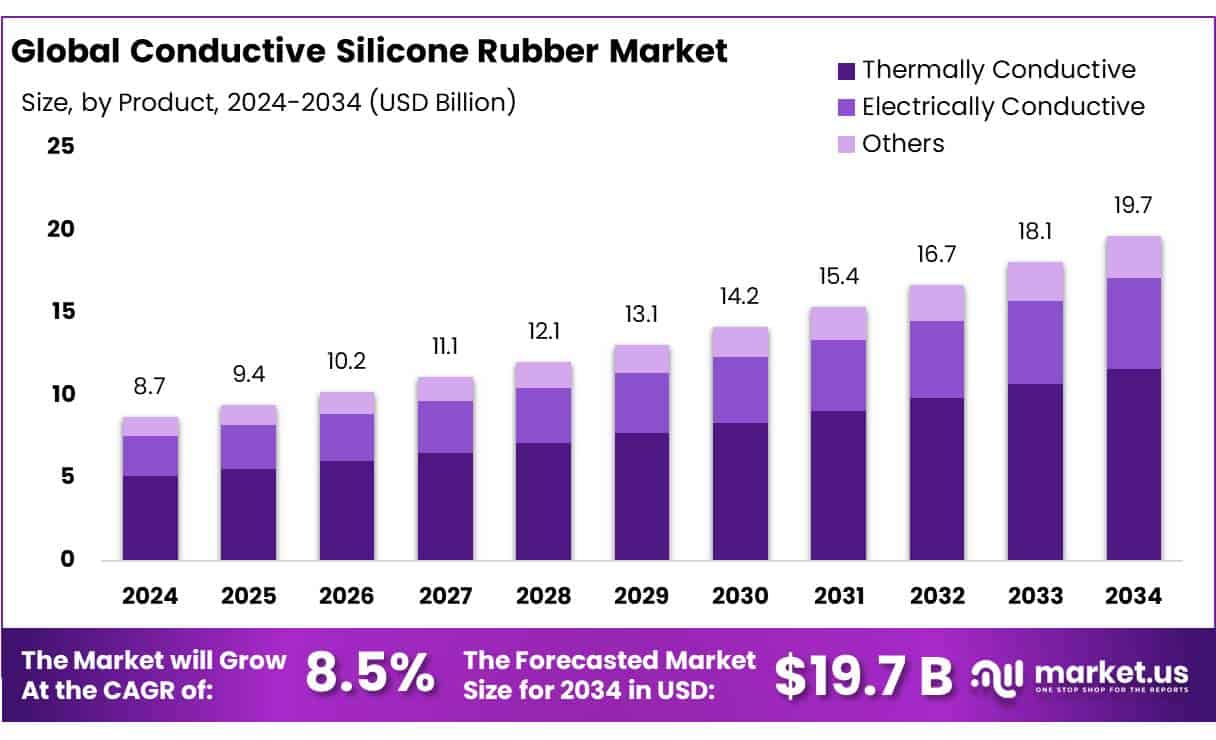
Regional Insights
Key Regions and Countries Insights
Key Players Analysis
Top Key Players Outlook
Recent Industry Developments









