


Report Overview
Global Car Sharing Market size is expected to be worth around USD 39.7 Billion by 2035 from USD 11.6 Billion in 2025, growing at a CAGR of 13.1% during the forecast period 2026 to 2035.
Car sharing connects urban residents, business travelers, and occasional drivers to vehicles on demand — without the financial burden of ownership. The model operates across free-float, stationary, and peer-to-peer formats, each serving a distinct urban mobility need. This flexibility positions car sharing as a practical alternative to private vehicle ownership in congested city environments.
The structural case for car sharing strengthens as cities grow denser and private vehicle costs climb. Fuel, insurance, and maintenance now represent a substantial financial burden for most households. Car sharing platforms allow users to pay only for the time and distance they actually use, making urban mobility more efficient and affordable. This cost logic drives consistent adoption across both individual and business user segments.
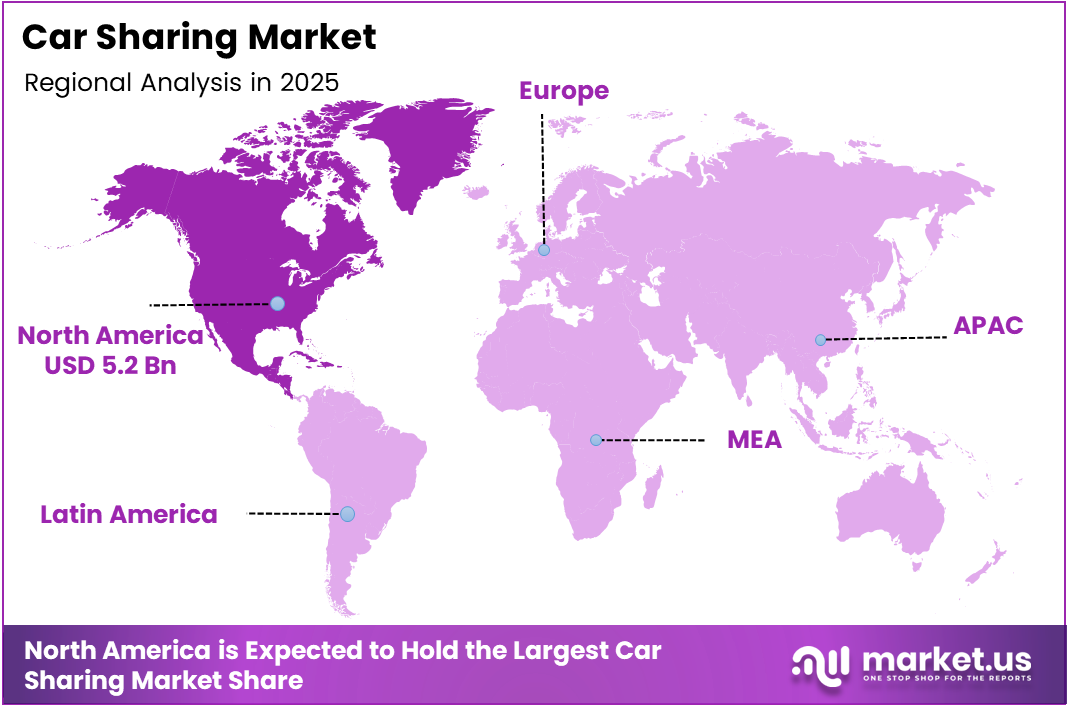
North America holds 45.20% of the global car sharing market, valued at USD 5.2 Billion in 2025. Mature digital payment infrastructure, high smartphone penetration, and early regulatory support for shared mobility ecosystems established this region’s lead. Dense urban centers in the U.S. and Canada generate consistent fleet utilization rates that sustain operator profitability at scale. Europe represents the second-largest region, driven by aggressive urban decarbonization mandates and congestion charging policies that directly penalize private vehicle use. Cities including London, Paris, Berlin, and Amsterdam have established low-emission zones that structurally advantage shared EV fleets over privately owned combustion vehicles. These regulatory conditions reduce operator acquisition risk and accelerate fleet electrification timelines. Asia Pacific holds substantial long-term expansion potential, anchored by China’s massive urban population, rising disposable incomes, and government-backed smart city initiatives. India and Southeast Asian markets are entering early-stage adoption as middle-class commuter populations in Tier-1 cities outgrow private vehicle budgets. Platform operators with mobile-first infrastructure are best positioned to capture this demand at scale. Latin America’s car sharing market develops unevenly, with Brazil and Mexico leading adoption in megacity corridors where traffic congestion makes private vehicle ownership increasingly impractical. Affordability constraints limit penetration to urban professionals with smartphone access and bank account infrastructure for digital payments. However, the addressable commuter population in São Paulo and Mexico City alone represents a commercially significant user base for early movers. The Middle East and Africa region remains at an early commercial stage, with deployment concentrated in Gulf Cooperation Council cities including Dubai and Riyadh. Government smart city agendas in the UAE and Saudi Arabia actively support mobility-as-a-service infrastructure development, creating a policy-backed entry opportunity. Africa’s longer-term potential depends on urban infrastructure maturity and smartphone and banking penetration growth timelines. North America Europe Asia Pacific Latin America Middle East & Africa Cambio Mobilitäts Service operates a station-based car sharing model across Germany and Belgium, targeting urban residents and businesses that need predictable vehicle access rather than free-float flexibility. Its station-based approach reduces vehicle repositioning costs and supports corporate account management more efficiently than free-float competitors. This operational discipline gives Cambio a margin advantage in markets where parking cost management is critical. Communauto holds the distinction of being North America’s longest-running car sharing operator, giving it a loyalty depth and brand recognition that new entrants cannot replicate quickly. Its hybrid model — combining station-based and one-way options — allows it to serve a broader urban user profile than single-model competitors. Consequently, Communauto captures both habitual commuter users and occasional trip users within the same platform infrastructure. Free2Move benefits from Stellantis’s manufacturing scale and multi-brand vehicle portfolio, giving it fleet acquisition advantages unavailable to independent operators. Its successful consolidation of Share Now into a single platform with access to over 10,000 shared vehicles across Europe and the U.S. demonstrates platform integration capability at enterprise scale. However, reported evaluations of a potential sale in October 2025 introduce strategic uncertainty that competitors may attempt to exploit. Getaround differentiates through its peer-to-peer model, which allows private car owners to monetize idle vehicles without operator-owned fleet investment. This asset-light approach enables geographic expansion at lower capital cost than traditional operator-owned models. Getaround’s competitive positioning depends on building a dense supply of listed vehicles in target markets — a network effect dynamic where supply density directly determines user booking success rates and platform retention.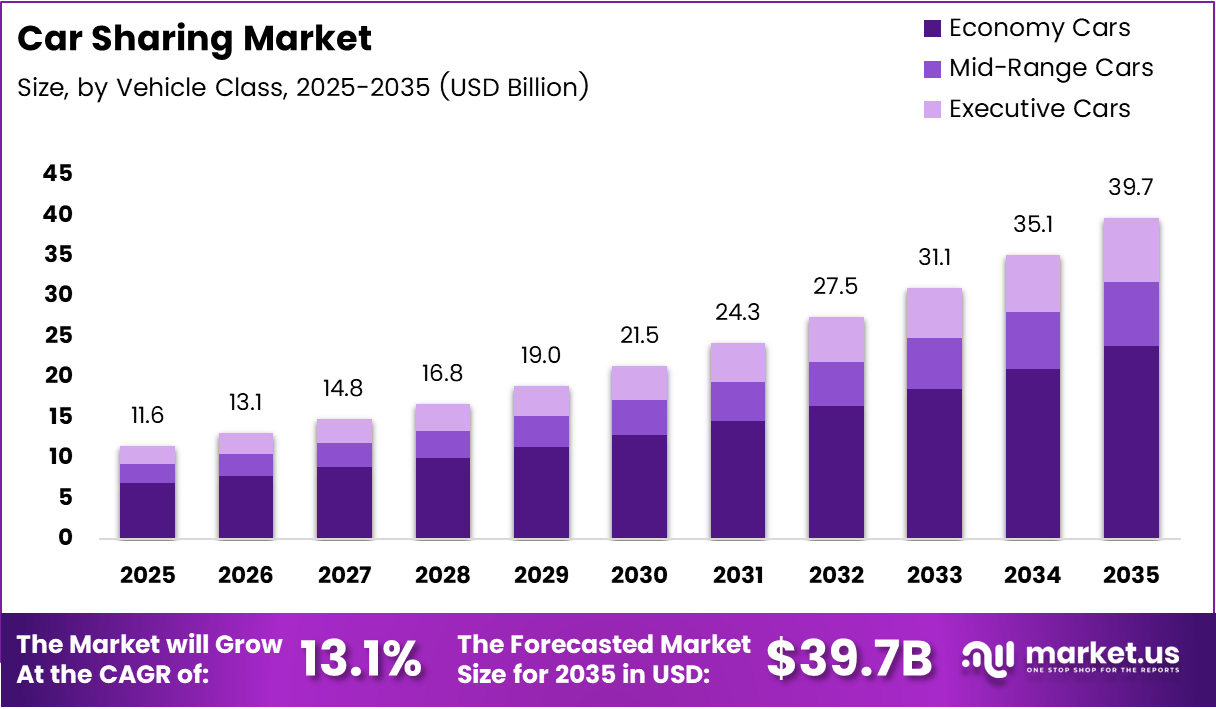
Regional Analysis
North America Dominates the Car Sharing Market with a Market Share of 45.20%, Valued at USD 5.2 Billion
Europe Car Sharing Market Trends
Asia Pacific Car Sharing Market Trends
Latin America Car Sharing Market Trends
Middle East and Africa Car Sharing Market Trends
Key Regions and Countries
Key Company Insights
Key Players
Recent Developments









