


Report Overview
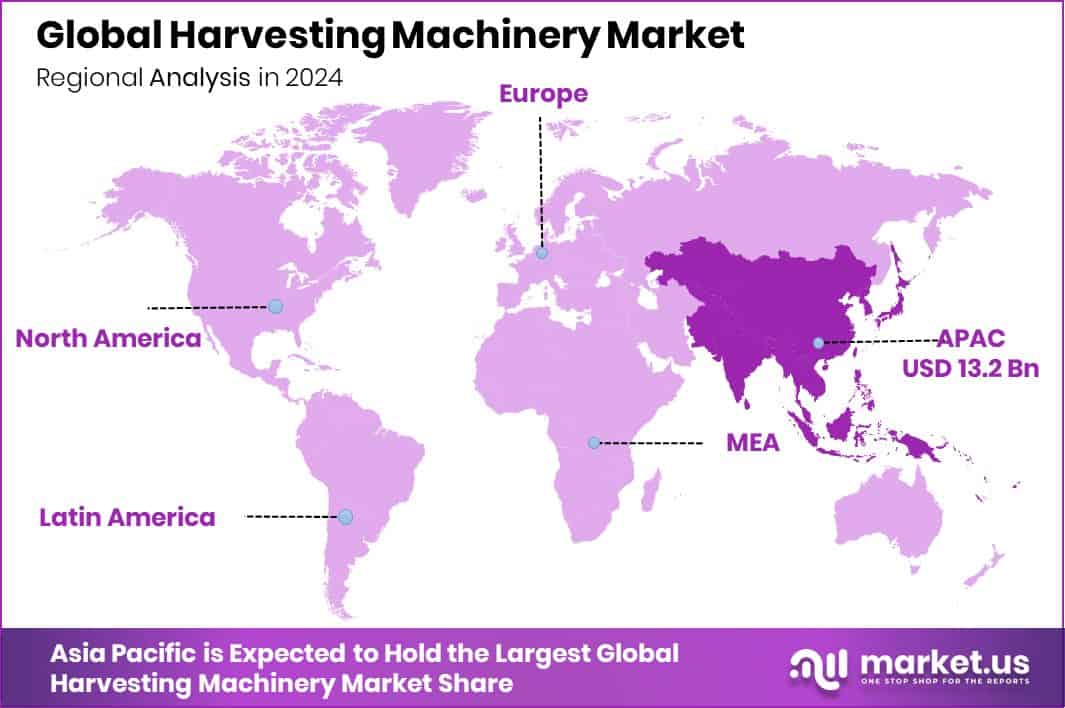
The Global Harvesting Machinery Market is expected to be worth around USD 58.5 billion by 2034, up from USD 38.4 billion in 2024, and is projected to grow at a CAGR of 4.3% from 2025 to 2034. With 34.6% share, the Asia Pacific accounts for a USD 13.2 Bn market.
Harvesting machinery refers to farm equipment used to gather mature crops from fields efficiently and at the right time. These machines reduce manual labor and help farmers protect crop quality during harvest. Depending on crop type and farm size, equipment may include combine harvesters, cotton pickers, forage harvesters, grain headers, and various header attachments. Power sources range from diesel to hybrid and electric systems, while technologies such as auger, cylinder, belt, reel, and pick-up headers support smooth crop handling.
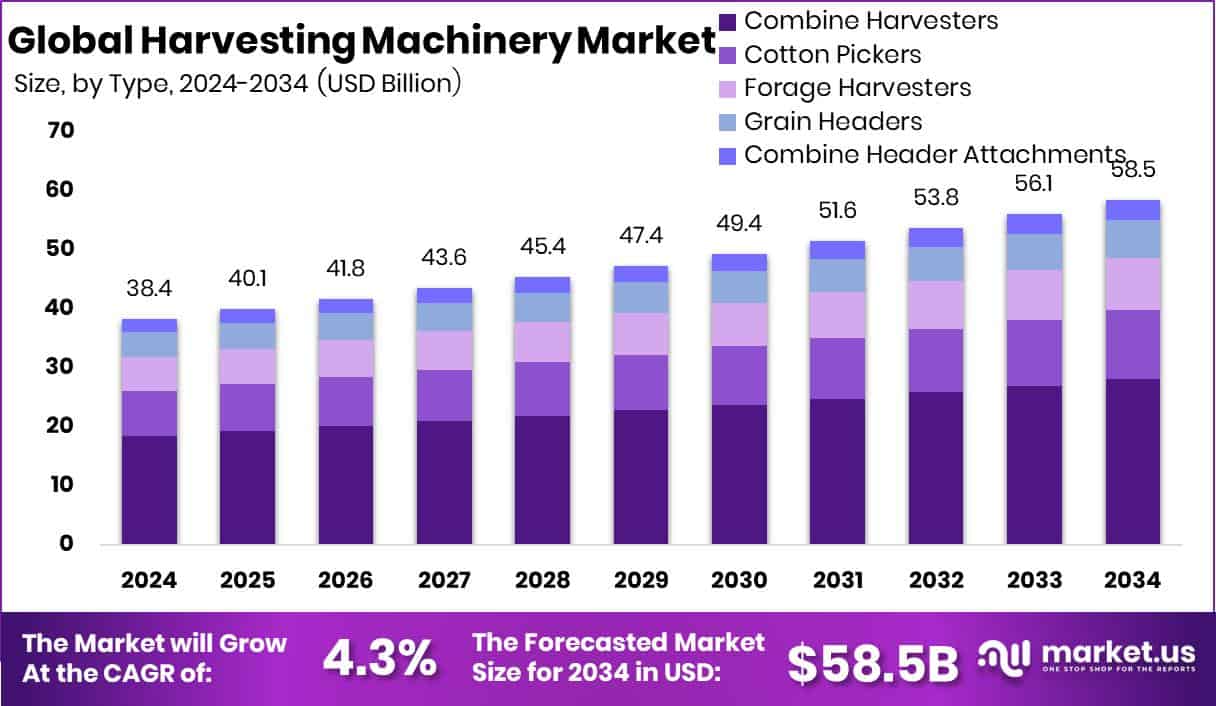
The Harvesting Machinery Market represents the commercial ecosystem involved in manufacturing, distributing, and servicing these machines. It covers different crop segments, including grains and cereals, forage crops, horticultural crops, specialty crops, and others. Growth in this market reflects the broader shift toward farm mechanization and higher productivity standards across global agriculture.
One major growth factor is the steady push toward automation in farming. Agtonomy recently secured $18m to expand AI-driven agricultural equipment, showing strong investor confidence. At the same time, USDA Equipment Grants offering up to $500,000 for agricultural machinery in 2025 are encouraging farmers to modernize fleets.
Demand is rising as farms seek efficiency and labor savings. AgTech startup Brilliant Harvest securing $4 million in seed funding highlights innovation in harvest operations. The Week in AgriFoodTech also reported Kubota acquiring Bloomfield Robotics, signaling continued investment in smart harvesting solutions. Together, these developments create new opportunities for advanced, efficient harvesting systems.
Key Takeaways
- The Global Harvesting Machinery Market is expected to be worth around USD 58.5 billion by 2034, up from USD 38.4 billion in 2024, and is projected to grow at a CAGR of 4.3% from 2025 to 2034.
- Combine Harvesters dominate Harvesting Machinery Market with 48.1% share across global farming operations.
- Diesel-powered equipment leads the Harvesting Machinery Market, holding 87.2% due to reliability advantages.
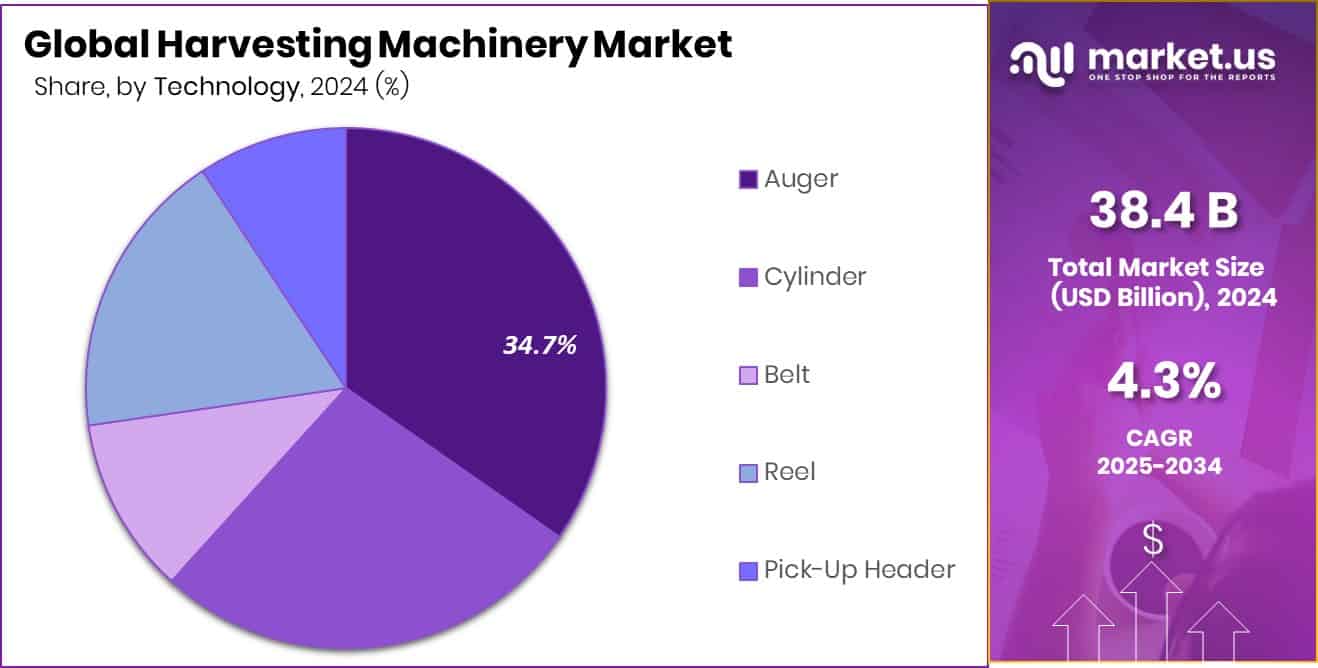
- Auger technology captures 34.7% share in the Harvesting Machinery Market for efficiency.
- Grains and Cereals segment commands 53.4% of the Harvesting Machinery Market demand.
- Harvesting Machinery Market in Asia Pacific reached USD 13.2 Bn, holding 34.6%.
By Type Analysis
Harvesting Machinery Market by Type sees Combine Harvesters dominating at 48.1%.
In 2024, Combine Harvesters held a leading 48.1% share of the Harvesting Machinery Market, reflecting their strong presence across large-scale farming regions. Farmers continue to rely on combine harvesters because they perform reaping, threshing, and winnowing in a single operation, saving both time and labor during peak harvest seasons. The demand has been particularly strong in grain-producing countries where labor shortages and rising wage costs are pushing farm owners toward mechanization.
Larger farm holdings are also investing in modern combine models equipped with improved grain handling systems and better fuel efficiency. As agricultural productivity becomes a priority to meet growing food demand, combine harvesters remain the preferred equipment choice, especially for commercial farms seeking operational efficiency and reduced crop losses.
By Power Source Analysis
Harvesting Machinery Market by Power Source shows Diesel leading at 87.2%.
In 2024, Diesel-powered machines dominated the market with an 87.2% share, highlighting the continued reliance on conventional fuel systems in agricultural operations. Diesel engines remain popular due to their higher torque output, durability, and ability to handle long working hours in tough field conditions. In many rural areas, diesel infrastructure is well established, making refueling more practical compared to alternative energy options.
Farmers prefer diesel harvesting machinery for its reliability during peak harvest windows, when equipment downtime can lead to significant crop losses. Although interest in cleaner power sources is gradually increasing, diesel continues to be the backbone of harvesting operations due to cost efficiency, strong engine performance, and easy maintenance, particularly in developing agricultural economies.
By Technology Analysis
Harvesting Machinery Market by Technology highlights Auger systems capturing 34.7%.
In 2024, Auger-based technology accounted for 34.7% of the Harvesting Machinery Market, driven by its effective grain handling and transfer capabilities. Auger systems are widely used in combines and other harvesting equipment for moving harvested grains efficiently from the cutting platform to storage tanks. Farmers value auger technology for its simple design, dependable operation, and ability to reduce grain spillage during transfer.
The system’s mechanical reliability and ease of repair make it suitable for both small and large farms. With ongoing improvements in auger design to enhance throughput and minimize blockages, this technology continues to maintain a solid presence in the market. Its practical functionality keeps it relevant, particularly in grain-focused agricultural regions.
By Crop Type Analysis
Harvesting Machinery Market by Crop Type favors Grains and Cereals at 53.4%.
In 2024, Grains and Cereals emerged as the largest crop segment with a 53.4% share in the Harvesting Machinery Market. The dominance of this segment is closely linked to the global importance of staple crops such as wheat, rice, corn, and barley. Large cultivation areas dedicated to these crops require efficient harvesting solutions to manage seasonal harvest cycles. Mechanized harvesting ensures timely collection, reduces post-harvest losses, and supports large-scale food supply chains.
Many governments are also encouraging cereal production to strengthen food security, further supporting machinery demand in this segment. As consumption of staple foods remains consistently high worldwide, harvesting machinery tailored for grains and cereals continues to experience steady adoption across both developed and emerging farming economies.
Key Market Segments
By Type
- Combine Harvesters
- Cotton Pickers
- Forage Harvesters
- Grain Headers
- Combine Header Attachments
By Power Source
- Diesel
- Hybrid/Electric
By Technology
- Auger
- Cylinder
- Belt
- Reel
- Pick-Up Header
By Crop Type
- Grains and Cereals
- Forage Crops
- Horticultural Crops
- Speciality Crops
- Others
Driving Factors
Rising global farm mechanization demand
Rising global farm mechanization demand continues to support steady expansion in the Harvesting Machinery Market as farmers look for faster and more reliable crop collection methods. Larger farm sizes and seasonal labor shortages are pushing growers toward advanced harvesting systems that improve field efficiency and reduce post-harvest losses. Public investment is also reinforcing this shift.
Manitoba recently boosted its stake in a cereals research centre to $23.5 million, signaling strong institutional backing for grain production and innovation. Such funding strengthens the broader cereal value chain, indirectly encouraging farmers to upgrade harvesting fleets. As grain cultivation expands and productivity expectations rise, the need for dependable harvesting machinery becomes even more central to agricultural performance and long-term food supply planning.
Restraining Factors
High initial equipment investment costs
High initial equipment investment costs remain a major challenge for many farmers, particularly small and mid-sized operations. Modern harvesting machinery requires significant upfront capital, along with ongoing maintenance and fuel expenses. Even though technology improves efficiency, the purchase decision can be delayed when margins are tight.
Government funding initiatives help strengthen agriculture overall, such as the Manitoba Government’s $13-Million investment in the Downtown Agriculture Exchange, yet these programs do not always directly offset machinery acquisition costs. Farmers must carefully evaluate return on investment before committing to large equipment upgrades. As a result, high capital requirements can slow replacement cycles and limit adoption in price-sensitive regions, keeping some producers dependent on older or rented harvesting systems.
Growth Opportunity
Expansion in emerging agricultural economies
Expansion in emerging agricultural economies presents strong growth opportunities for harvesting machinery providers. As developing regions modernize farming practices and scale cereal production, demand for efficient harvest systems continues to rise. Consumer-facing cereal brands also reflect the sector’s dynamism. Magic Spoon raised $85M to expand its better-for-you cereal retail presence, while a Minneapolis-based sustainable cereal brand secured $6M to grow operations. These investments show confidence in cereal demand, which ultimately supports upstream agricultural activity.
As cereal production increases to meet evolving consumer preferences, farmers in emerging economies are likely to invest more in mechanized harvesting. This creates space for manufacturers to introduce adaptable, cost-effective machinery tailored to expanding grain-producing regions.
Latest Trends
Integration of precision farming systems
Integration of precision farming systems is shaping the current direction of the Harvesting Machinery Market. Farmers increasingly seek equipment that connects with digital farm management platforms, enabling real-time monitoring of yield, moisture, and machine performance. Funding activity in the cereal segment mirrors this innovation wave.
Magic Spoon secured $5.5M in seed funding earlier to reinvent the cereal category, reflecting broader momentum across grain-related industries. Meanwhile, questions surrounding a proposed $100M grain facility in Winnipeg highlight how infrastructure investments influence supply chain strategies. As grain markets evolve, harvesting machinery is gradually incorporating smarter controls, data integration, and performance tracking tools. These trends point toward more connected, technology-driven harvesting operations across global agriculture.
Regional Analysis
Asia Pacific leads the Harvesting Machinery Market with 34.6% share valued USD 13.2 Bn.
The Harvesting Machinery Market shows varied performance across North America, Europe, Asia Pacific, the Middle East & Africa, and Latin America, reflecting differences in farm size, mechanization levels, and crop patterns. Among these regions, Asia Pacific stands as the dominating region, accounting for 34.6% of the global market, with a valuation of USD 13.2 Bn. This leadership is closely tied to the region’s vast agricultural land, high cereal production, and strong demand for mechanized harvesting solutions to support food supply chains. Countries across the Asia Pacific continue to adopt advanced harvesting equipment to improve operational efficiency and manage seasonal labor gaps.
North America and Europe remain mature markets, characterized by established farm mechanization and replacement demand for modern machinery. Meanwhile, Latin America and the Middle East & Africa are gradually expanding, supported by improving agricultural practices and growing awareness of productivity-focused equipment. Overall, regional demand patterns continue to shape the competitive landscape of the global harvesting machinery industry.
Key Regions and Countries
- North America
- US
- Canada
- Europe
- Germany
- France
- The UK
- Spain
- Italy
- Rest of Europe
- Asia Pacific
- China
- Japan
- South Korea
- India
- Australia
- Rest of APAC
- Latin America
- Brazil
- Mexico
- Rest of Latin America
- Middle East & Africa
- GCC
- South Africa
- Rest of MEA
Key Players Analysis
In 2024, Deere & Company continued to demonstrate strong leadership in the global harvesting machinery space through its focus on advanced combine platforms and precision agriculture integration. The company’s harvesting portfolio reflects consistent engineering upgrades aimed at improving grain quality, fuel efficiency, and operator comfort. Its emphasis on digital connectivity, including machine data monitoring and automation features, positions it well among large commercial farming operations seeking higher productivity. From an analyst’s perspective, Deere’s brand strength, global dealer network, and continuous product refinement provide it with a stable competitive advantage in both mature and emerging agricultural markets.
CNH Industrial N.V. maintained a solid footprint in harvesting machinery through its diversified agricultural equipment offerings. The company leverages its established brands and wide geographic presence to serve varied farm sizes, from mid-scale operations to large enterprises. Analysts observe that its strategy centers on balancing cost efficiency with technological enhancement, particularly in combine harvesters and grain handling systems. Its ability to adapt machinery designs to regional crop requirements supports steady demand across multiple agricultural economies.
In 2024, AGCO Corporation strengthened its competitive stance by focusing on farmer-centric innovation and smart harvesting solutions. The company’s harvesting equipment portfolio emphasizes performance reliability and adaptable configurations for different crop conditions. Analysts note that AGCO’s investment in precision farming technologies enhances machine efficiency while supporting sustainable agricultural practices. Its global distribution strategy and emphasis on tailored solutions contribute to a resilient market position within the harvesting machinery segment.
Top Key Players in the Market
- Deere & Company
- CNH Industrial N.V.
- AGCO Corporation
- CLAAS KGaA mbH
- Kubota Corporation
- Mahindra & Mahindra Ltd.
- Yanmar Co., Ltd.
- SDF Group
- Tractors & Farm Equipment Ltd.
Recent Developments
- In January 2025, CNH’s agricultural brands Case IH and New Holland won ten AE50 2025 awards for innovative agricultural technology. Among the winners were updates to the Axial-Flow (AF) 260 series combines, which offer improved grain handling, efficient horsepower, and easier maintenance to support better harvesting performance.
- In February 2024, Deere announced one of the largest equipment launches in its history, including updates to its S7 Series combines with more fuel-efficient engines, improved automation, and better grain-handling performance for harvesting operations. The launch highlighted new harvesting machinery technology aimed at increasing productivity.









